
Ace of Pentacles as a Yes or No Answer

- Arcana
- Minor Arcana, Suit of Pentacles
- Element
- Earth
- Yes or no
- Yes
opportunityprosperitynew job
setbackspoor planningfinancial worry
The Ace of Pentacles is a yes in a yes or no reading. Upright, it is one of the clearest practical yeses in the deck: a real opportunity is being offered, and the conditions support moving forward. Reversed, it softens to not yet or maybe, because the opportunity is there but the plan, timing or follow-through is not.
The Ace is not a vague, hopeful yes. It is a yes you can hold in your hand, like a job offer, a deposit, a signed lease or a first workable step. That is why it answers best when the question is about something you can build, earn or start. This guide covers how to read it upright and reversed, how the answer shifts in love, work, money and health, and what to do with the yes once you have it. For the full card, see the Ace of Pentacles meaning.
Why the Ace of Pentacles leans yes
Every Ace in tarot is a seed: the pure beginning of its suit. The suit of Pentacles belongs to Earth, which covers the body, money, work, home and the physical world. So the Ace of Pentacles is the moment a material possibility becomes available. Nothing in the card is blocked, delayed or in conflict, and that is what a yes looks like in a spread.
Yes or no readings depend on the direction of energy in a card. The Ace’s energy moves forward and outward: something is arriving, growing or being offered. Compare that to cards that show waiting, loss or retreat, which tend to lean no. The Ace has no such weight. It is also numbered one, the number of starts, so it points to the beginning of an answer, not its end.
The yes has a particular flavour, though. It is a practical yes. If you ask “Is this a sound plan?” or “Can I make this work?”, the Ace answers confidently. If you ask “Does he love me?” or “Is this the universe’s sign?”, the card is a less natural fit, and I come back to this below.
Upright Ace of Pentacles: a yes with conditions
Upright, treat the Ace as a green light with one condition: you have to act on it. The hand in the image offers the coin, but it does not place it in your pocket. A yes from this card means the door is open and the resources are available, not that things will happen on their own.
In practice, a strong upright yes looks like this: the answer is yes if you take the offer, make the call, put down the deposit or start the plan. The card rewards steady, realistic effort, which is what Earth energy is about. It does not reward leaps of faith with nothing underneath them. If your question is built on wishful thinking, the Ace will still say yes to the opportunity, but it will quietly ask whether you have done the groundwork.
Think of it as a yes to the start, not a yes to the finish. It tells you that beginning is wise. It does not promise how big the result will be or how long it will take, and it works best when you read it as permission to take the first step.
Try this: Write your yes or no question as one sentence about something you can start. Draw one card. If it is the Ace upright, write down the smallest action you could take in the next 48 hours, and do it before you think about the outcome.
Ace of Pentacles reversed: not yet, not never
Reversed, the Ace of Pentacles is usually a maybe or a not yet, rather than a flat no. The coin is still being offered, but something is wrong with how you are receiving it. Common causes are poor timing, a plan with holes in it, money tied up elsewhere, or an opportunity you keep ignoring until it fades.
In a yes or no reading, this means the answer depends on what you do next. If you can name the missing piece, such as savings, a qualification, a clearer agreement or a calmer head, the answer can turn to yes once you supply it. If you cannot name it, the reversed Ace is warning you to slow down before committing money, time or trust.
A few readers treat the reversed Ace as a firm no, and in a rushed, greedy or unrealistic situation it can read that way. For most questions, though, “not yet” is truer to the card. The full picture is in the Ace of Pentacles reversed guide, and the broader approach to upside-down cards is covered in how to read reversed tarot cards.
Read Ace of Pentacles for your question
Upright: A grounded yes to a relationship with real, practical promise, such as a first date that turns into plans or a commitment that becomes concrete.
Reversed: A not yet: the feeling may be there, but the stability, timing or effort to build on it is missing for now.
Upright: They feel steady, sincere and ready to show care through actions rather than words.
Reversed: They feel unsure or distracted, and the interest has not yet turned into anything you can rely on.
Upright: A yes to the job offer, the new role, the pitch or the fresh start, as long as you do the groundwork.
Reversed: A not yet: the opening is real but badly timed, poorly planned or slipping away because no one is acting on it.
Upright: A yes to a new income source, a gift, a saving plan or a sound investment you have properly researched.
Reversed: A pause: hold off on the purchase or gamble, and fix the budget or the plan before committing funds.
Upright: Say yes, then take the first small concrete step this week.
Reversed: Do not abandon the idea, but prepare it better before you commit.
Upright: A yes to a fresh start with your body, such as a new routine, a good treatment plan or a recovery that gets real support.
Reversed: A not yet: the plan is too vague or too extreme, so simplify it and build one habit at a time.
Ace of Pentacles yes or no in love
In love, the Ace of Pentacles leans yes toward something real and steady. A new relationship with practical promise, a partner who shows up and follows through, a decision to move in together or commit more seriously: these are all things the Ace supports. It is a quieter yes than the cards of passion, but it is one that tends to last.
It works best for questions such as “Is this relationship worth investing in?” or “Can we build something stable together?” The card is less about fireworks and more about whether care shows up in plans, time and action. If someone’s interest is easy to see in what they do, the Ace confirms it.
Reversed in love, the answer becomes not yet. There may be attraction, but one person is not ready to commit, circumstances are unstable, or effort is uneven. It is not a verdict on the person. It asks you to look at whether the foundation is there before you give more.
Reconciliation, marriage and commitment questions
For “Will we get back together?”, the Ace of Pentacles says yes to a fresh start, not to a replay. It shows a new beginning with a more solid base, so read it as a yes only if something real has changed, such as time, honesty, habits or circumstances. If nothing has changed, the card is more likely a reminder that you cannot plant a new seed in exhausted soil.
For “Will they propose?” or “Will we marry?”, the Ace leans yes because it speaks about concrete steps. It often appears when a relationship is ready to become practical: shared finances, a shared home, formal commitment. It does not give a date, so pair it with a timing question if you need one.
For “Is this person serious about me?”, the Ace is a quiet yes if their care shows up in actions. If they say the right things but nothing in their behaviour backs it up, the card’s grounded nature suggests you hold out for evidence. It is a good card to draw if you tend to be swept up by words and need a reminder to watch what people do.
Career and job questions
Career is where the Ace of Pentacles is at its strongest. For questions such as “Will I get the job?”, “Should I accept the offer?” or “Is this the right time to start my business?”, the answer is a confident yes. The card often shows up as a real offer, a promotion, a new contract or a first client.
The yes depends on being prepared. Earth energy rewards the person who has done the work: the portfolio is ready, the numbers have been checked, the skills are in place. If you are not ready, the card still says the opportunity is real, but it asks you to close the gaps. For the next stage after the start, the Eight of Pentacles shows the steady skill-building that follows a good beginning.
Reversed in work questions, read it as a delay or a flawed offer: a role that looks good but has unclear terms, a plan that is underfunded, or a chance that is closing because you have not acted. Ask what is missing, fix it, and ask again.
Money, investing and purchases
For money questions, the Ace of Pentacles is a yes to new income, a windfall, a bonus, a sound plan for saving or a purchase that genuinely adds value. It is one of the best cards to draw when asking “Will money improve?” because it shows a fresh supply arriving, not a slow drain.
It is also a yes to sensible risk, not reckless risk. If you are asking whether to put your savings into something you do not understand, the card’s grounded nature should make you pause. A good use of the Ace is to ask yes or no about a specific, well-researched step: opening a savings account, applying for a grant, pricing your work higher.
Reversed, the Ace warns against spending what you do not have or chasing a quick payoff. It does not mean money will never arrive. It says the plan needs tightening first. If you want to explore your finances in more depth, a dedicated money tarot spread gives more detail than a single card can.
Health and wellbeing
In health questions, the Ace of Pentacles is a yes to starting something that supports the body: a new routine, a good practitioner, a treatment plan, a more nourishing way of eating or sleeping. It represents the first small, physical step and the sense that your body can respond to care.
It is not a medical prediction. Tarot cannot tell you a diagnosis or whether a treatment will work, so use the card to think about habits and support, and take medical questions to a qualified professional. Used this way, the Ace is encouraging: start small, be consistent, and let the body build on it.
Reversed, it suggests an approach that is too vague, too extreme or too hard to keep up. A plan that needs a total life overhaul by Monday is not an Ace of Pentacles plan. Shrink it to one habit you can actually repeat.
Ace of Pentacles card symbols
Choose a symbol to read what it means on the card.
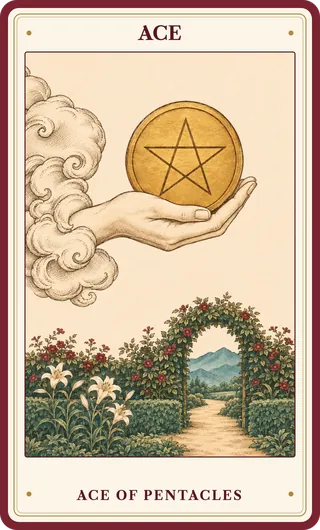
Hand from the cloud
A single hand reaches out of a cloud and offers the coin. It shows that the opportunity arrives as a gift or a chance, and that you still have to reach out and take it.
The gold pentacle
The coin is the whole point of the card: a tangible, usable resource such as money, a job, a home or a skill. It is an offer you can hold, not a promise of something vague.
The tended garden
The garden below is orderly and in bloom, so the seed lands on prepared ground. This is why the card says yes most firmly when you have done some groundwork.
White lilies
Lilies grow among the flowering hedge and stand for sincerity and clear intentions. They suggest the yes is honest and not a trick or a temptation.
The archway in the hedge
A gap in the hedge opens onto a path out of the garden. It marks a threshold: the opportunity is a doorway, and you decide whether to walk through.
Distant mountains
Mountains rise beyond the arch, showing the long-term goal this start could lead to. They remind you that a good beginning still needs steady, patient climbing.
When the Ace is a poor fit for the question
The Ace of Pentacles speaks the language of the material world. Some yes or no questions sit outside that language, and a yes from the Ace may mislead you if you read it too literally. Questions where it is weaker include:
- What someone secretly thinks or feels about you
- Whether a spiritual or emotional breakthrough is coming
- Whether a conflict will be resolved by a certain date
- Questions that are really about fear, such as “Will I ever stop worrying?”
For these, draw a second clarifying card or choose a different spread. A card such as the Ace of Swords suits questions about truth and decisions, while the Ace of Pentacles belongs with questions about building and earning. Matching the card to the question makes the yes more trustworthy.
How timing works with this card
The Ace of Pentacles points to a beginning, so it usually suggests the opportunity is near or already present. It does not carry a built-in date. Earth is also the slowest, steadiest element, so the Ace often shows an opening that develops over weeks or months rather than overnight.
If timing matters, ask a separate question, such as “When will this offer become clear?”, and read the next card as the answer. The tarot timing guide explains common ways to read time in a spread, including suits, numbers and seasons. Pentacles are often linked with autumn in some traditions, but treat that as a light hint, not a rule.
In a yes or no reading, the Ace most often tells you that the question is already moving. If you have been waiting for a sign to begin, this is it. If the reversed Ace appears, it suggests the timing is not right yet, and the better question is what you need to prepare.
Asking a question the Ace can answer well
The quality of the answer depends on the question. Yes or no tarot works best when you ask something specific, time-bound and honest. “Will I be rich?” is too vague for any card. “Should I accept the job offer I received this week?” gives the Ace something to work with.
Avoid questions that hide two decisions in one, such as “Should I quit my job and move cities?” Split them and draw for each. Avoid questions you have already decided emotionally, because you will read the card to fit your wish. If you want ideas for better wording, the list of questions for a tarot reading shows how to phrase questions so they can be answered.
Try this: Before you draw, write the question and then your own gut answer on a separate line. Draw the card and compare. If the Ace says yes and you wrote no, ask yourself what you are afraid of, since the card may be pointing at a hesitation rather than a fact.
Reading the Ace with other cards
One card gives a quick answer, but its neighbours can strengthen, soften or change it. The Ace of Pentacles supports yes cards and adds firm ground to uncertain ones. Beside cards of delay or loss, it points to the opportunity still being there once the obstacle passes.
- With the Two of Pentacles, the yes becomes conditional: the opportunity is real, but you are juggling too much to commit fully.
- With the Ten of Pentacles, the yes extends to long-term security and a settled outcome.
- With the Five of Pentacles, the opportunity is present but you may feel too anxious or deprived to see it.
- With the Ace of Wands, the yes carries extra drive and creative energy, so act quickly.
- With the Tower, expect the start to come after a sudden change, so stay flexible.
If you draw several cards, count them loosely: a spread with mostly upright, forward-moving cards and the Ace is a clear yes. A mix with delays and reversals suggests yes with conditions. A dedicated tool such as the yes or no tarot reading page can help you practise reading this balance.
What the image tells you about the answer
The Rider-Waite-Smith Ace of Pentacles shows a hand reaching from a cloud, holding a large gold coin above a garden of flowers and lilies. An archway cut into a hedge opens onto a path toward distant mountains. Each part of this picture explains the card’s answer.
The hand and the cloud show that the offer comes from outside your own effort: a chance, a gift, luck or timing. The garden shows that the ground is ready. The archway shows that you have to walk through. And the mountains show that the first step leads toward a far goal. Together, the picture says: here is a real chance, in good soil, with a clear way forward.
It also explains the reversed meaning. When the card turns, the coin is held upside down and the garden path is hard to read. The offer is still on the table, but something about the ground or the route needs attention before it will hold.
What to do after you draw a yes
A yes means little unless it changes what you do. The Ace is a card of action, and the best response is a small, concrete one. Try this order:
- Name the opportunity in one clear sentence.
- Check the practical details: cost, terms, time, who else is involved.
- Take one step within 48 hours, such as making a call, sending an application or setting up a savings transfer.
- Review after a week and decide on the next step.
This keeps the yes grounded, which is exactly what the card asks. If the details do not hold up, treat that as useful information, not a failure of the reading. The Ace says the possibility is real, and your checks tell you whether this particular version is the right one.
Try this: Draw one card a day for three days on the same practical question, using the random tarot card generator if you have no deck to hand. Note whether the Ace or other earthy cards keep appearing, and let the pattern guide your decision rather than any single draw.
When you keep drawing the Ace
If the Ace of Pentacles shows up again and again, the message is rarely “yes, yes, yes”. It usually means the opportunity is real and you have not yet started. Repeated Aces are the deck’s way of asking what you are waiting for.
Do not keep re-drawing the same question hoping for a different card. If you ask three times, you have your answer, and a fourth draw will only reflect your doubt. The cleaner approach is to move on to a new question: what is stopping you, what support you need, or what the first step should be. A short three card tarot spread works well for this: situation, obstacle, next step.
The Ace is also a good reminder that a yes does not have to be big. A small beginning counts, and it is how most solid things start. Take the coin, plant it, and let the garden do what it is built to do.
Questions readers ask
Is the Ace of Pentacles a yes or no card?
Upright, the Ace of Pentacles is a yes, especially for practical questions about work, money, health and building something real. Reversed, it usually means not yet or maybe, because the opportunity exists but needs better preparation or timing.
What does the Ace of Pentacles mean for a yes or no question about love?
It leans yes when the question is about a stable, sincere connection that can grow into something lasting. It is less reliable for questions about passion or what someone is thinking, because it speaks about practical foundations.
Is the reversed Ace of Pentacles a no?
Not usually. It more often means the answer is not yet, or yes with conditions, because the opportunity is still there but is delayed, badly planned or being ignored. Treat it as a request to prepare, not a closed door.
Does the Ace of Pentacles mean I will get the job?
It is one of the most encouraging cards you can draw for a job question, since it points to a real offer or new start. It does not guarantee the outcome, so keep applying and preparing while you wait.
Can the Ace of Pentacles mean yes to getting back with an ex?
It can, if the question is whether a fresh, more stable start is possible. It points to rebuilding on solid ground rather than repeating the old pattern, so look at what has actually changed.
How should I read the Ace of Pentacles if the question is not about money?
Treat it as a yes about anything you can build in practice, such as a habit, a home, a project or a routine. For emotional or purely spiritual questions, draw a clarifying card because the Ace speaks mainly about the material side of life.