
Two of Pentacles as a Yes or No Answer

- Arcana
- Minor Arcana, Suit of Pentacles
- Element
- Earth
- Yes or no
- Maybe
balancejugglingadaptability
setbackspoor planningfinancial worry
The Two of Pentacles is a qualified yes in a yes or no reading. Upright, it says the thing you are asking about is possible and likely to work, as long as you stay flexible and do not take on more than you can manage. Reversed, it becomes a not yet: the answer is closer to no until you reduce the load or get organised.
That “yes, but” is what makes this card different from a clean Ace or a flat Eight of Swords. It is a card of motion, not outcomes, so it answers questions about whether you can keep things going. Below you will find how to read it upright and reversed, how the answer shifts for love, work, money and health, and when to treat it as a no.
The short answer: a qualified yes
If you draw the Two of Pentacles upright for a yes or no question, read it as yes, with conditions. The card shows a figure keeping two coins moving, and the message is that you can handle what is in front of you if you stay light on your feet. It is a green light for something that needs ongoing attention, not for something you can set and forget.
Reversed, read it as not yet or a soft no. The juggling has tipped into dropping things, so the sensible answer is to wait, simplify or fix the underlying overload before moving ahead.
If you want a single line to remember: the upright card says yes if you can keep the balance, and the reversed card says no because the balance is already lost.
Why this card leans yes
Every Two in tarot is about a pair: two options, two forces, two sides of a choice. In the suit of Pentacles, which covers money, work, health and the practical world, the Two is about handling two material demands at once. The card does not show someone struggling or in despair. He is dancing, and that detail is why the answer leans positive.
Compare it with the Two of Swords, another card about two things in tension. The Two of Swords freezes, blindfolded and unable to decide. The Two of Pentacles moves. Movement is a sign of an answer that is already in progress, which is why this card sits on the yes side of the line while still asking for effort.
You can see more of the card’s general meaning, including its place in the suit and its numerology, on the Two of Pentacles meaning page. For yes or no purposes, the key point is simple: the card agrees with your plan but wants you to keep working at it.
What the image says about the answer
The Rider-Waite-Smith illustration holds most of the answer. A young man in a tall hat balances two coins joined by an infinity-shaped ribbon. Behind him, two ships ride large waves. The sea is rough, yet he is not worried by it, and neither are the ships.
That tells you how to read the verdict. The waves mean conditions around you are not stable, so a yes does not guarantee smooth sailing. The ribbon means the two coins are connected, so your choice affects more than one area of life. His dance step means you answer with adjustment, not with rigidity. The infinity loop and tall hat also echo The Magician, a hint of skill and capability, though here it is practical and improvised rather than commanding.
Try this: Look at the card for one minute and ask yourself which of your two “coins” matters most right now. Write it down. If you cannot name two, your question may not be a Two of Pentacles question at all.
Read Two of Pentacles for your question
Upright: A yes, if both of you keep making room for each other's schedules and needs, because the bond is real but busy.
Reversed: A not yet, because stretched time, mixed signals or uneven effort are leaving the relationship half-attended.
Upright: They care and are trying to fit you in alongside everything else, but their attention is divided.
Reversed: They feel swamped and torn, and their feelings may be hard to read until the pressure drops.
Upright: A cautious yes to taking on a second task, role or project, as long as you can manage your time.
Reversed: A no for now, because adding more would tip you into missed deadlines and burnout.
Upright: A yes to managing two accounts, bills or income streams, provided you track the flow carefully.
Reversed: A no to new spending or commitments until the budget stops wobbling.
Upright: Stay flexible, prioritise honestly and keep both hands moving rather than waiting for a perfect moment.
Reversed: Put something down, simplify your list and stop saying yes to everything.
Upright: A yes to routines that balance rest, work and movement, as long as you keep adjusting them.
Reversed: A no to overloading your schedule, because stress and poor sleep are asking to be addressed first.
Upright Two of Pentacles as a yes or no answer
Upright, the card says yes to anything that depends on flexibility, time management or keeping more than one thing going. It favours choices that add variety or a second stream of effort, such as a side project, a second income or a schedule that fits both work and relationships.
The condition is capacity. The yes holds if you are not already juggling too much. If you can honestly say you have room, take the card at its word. If your calendar is already full, the card is less a green light than a reminder to look at what you are carrying.
The tone is practical rather than glowing. It rarely signals a big, dramatic yes the way the Ace of Pentacles does, with its clear opening and fresh start. Think of the Two as a yes that comes with a to-do list.
Two of Pentacles reversed as a yes or no answer
Reversed, the card describes the moment the juggling goes wrong: overwhelm, disorganisation, dropped coins and late bills. As a yes or no answer it leans no, but in a specific way. It is a no to adding anything else right now, not a verdict that the whole idea is doomed.
Some readers also see the reversed card as a signal that the balance is about to restore itself, or that you are close to a decision. In yes or no terms, treat it as a pause. Reduce what is on your plate, then ask again. The Two of Pentacles reversed page covers the longer meaning, and our guide to reading reversed cards explains how to decide whether you use reversals in a yes or no system at all.
If you do not read reversals, a simple alternative is to treat the upright card as a yes and rely on a clarifying draw when the situation feels stretched.
Love: is it a yes?
In a love question, the Two of Pentacles is a yes when both people are willing to adapt. It often describes a relationship that is real but busy: two people with jobs, family and responsibilities who are making it work. It rarely shows a fairy-tale answer, but it shows a partnership that can last if both keep adjusting.
For a new connection, read it as a yes with realistic timing. The match is possible, but the two of you may have to coordinate schedules and expectations. For an existing relationship, it says the bond is fine and the strain is about logistics, not love.
For questions like “Will they come back?” or “Does this person like me?”, the card is less clear. It can point to someone who is interested but distracted, or caught between two options. Reversed in love, it suggests one person is overstretched or the effort is uneven. The honest reading is not yet, until time and energy are rebalanced.
Career: a cautious yes
For work questions, the Two of Pentacles is a cautious yes. It supports taking on a second project, covering two roles, or managing a transition between jobs. Employers and clients may be asking for flexibility, and the card says you have the skill to give it.
The risk is overcommitment. If the question is “Should I accept this extra responsibility?”, the card says yes only if you honestly assess your hours. If you are asking about a full change of direction that requires you to drop everything else, the answer is less certain, because the card describes managing several things, not choosing one.
Reversed, it becomes a no to extra work for now, particularly when burnout, missed deadlines or divided attention are already showing. If you are choosing between two clear paths, the Eight of Pentacles may be a better fit for questions about steady, focused progress.
Money: yes, with a budget
In money readings, the card is a yes to managing two accounts, two income streams or two financial priorities. It is the card of the person who juggles rent and savings, or a main job and a side income. The answer is yes as long as you track the flow of cash with care.
It is not a card for big, risky leaps. If you are asking “Should I invest everything?” or “Can I quit my job and live off one new project?”, the Two of Pentacles points to a measured approach, keeping both coins in play. It suggests spreading effort rather than betting on one outcome.
Reversed, the card points to unstable budgets, debt juggling or paying one bill by neglecting another. Here the answer is no to new spending until you have a clear overview. The cure the card offers is a written budget, not wishful thinking.
Try this: Before asking a money yes or no question, write down your monthly income and your three biggest outgoings. Then draw the card. You will read it far more accurately with real numbers in front of you.
Two of Pentacles card symbols
Choose a symbol to read what it means on the card.
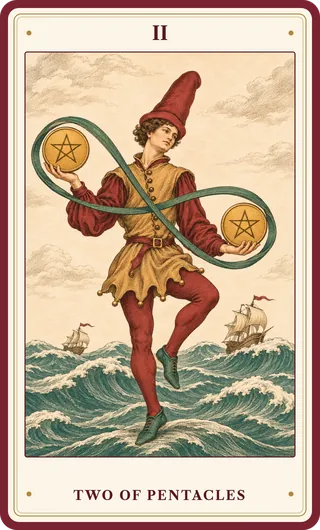
The juggling figure
A young man in bright clothes keeps two coins moving at once. He shows that the situation can be handled, but only with attention.
The infinity ribbon
A looping ribbon in the shape of a lemniscate joins the two pentacles. It stands for a constant flow between two demands, so nothing here is final or fixed.
The two pentacles
Each coin is a separate responsibility, resource or option. Neither one is set down, which is why the answer depends on how well you keep both in play.
The tall hat
His hat echoes the lemniscate above the Magician's head. It hints at skill and practised control, though the mood is lighter and more improvised.
The dancing stance
His body is mid-step, weight shifting from one foot to the other. Movement is the point: the answer is yes to something that keeps changing.
The two ships on the waves
Two ships ride large swells behind him. They show how much is changing around you, and that others are managing rough conditions too.
The rolling sea
The waves rise and fall in a steady rhythm. They remind you the situation has ups and downs, so a yes now may need adjusting later.
Health and daily life
For health questions, upright is a yes to routines that balance rest, movement and work. The card likes habits that bend: a schedule you can adjust when life changes. It is a reasonable yes to starting a modest new routine alongside your existing one.
Reversed, it warns of overload. Poor sleep, constant rushing and an overpacked week may be the real issue, so the answer is no to taking on more until your basics are in place. Tarot cannot diagnose or replace medical advice, so use the card as a prompt to look at your pace, and see a professional for symptoms.
For general life questions, such as moving house, changing routines or starting something new, the card gives a gentle yes. It encourages you to trust your ability to adapt, while making clear that nothing will run on autopilot.
When the Two of Pentacles is a no
Even upright, the card can read as a no in some situations. The most common is when your question demands a single, all-in commitment. “Should I put everything into this one thing?” does not match a card that is about keeping two things going.
It also tips toward no when you are already stretched. If you are asking whether to add another responsibility and you feel overwhelmed as you ask, the card is likely describing your current state rather than endorsing the plan. In that case the honest answer is to put something down first.
A third case is a question that looks for certainty. The card shows waves and a moving figure, so it will not give you a guaranteed outcome. If you need a firm, unchanging promise, look at how it differs from cards of resolution, such as the Four of Pentacles, which is about holding and securing.
How surrounding cards change the answer
In a spread, the cards around the Two of Pentacles tell you what the yes depends on. A few patterns come up often:
- With strong, forward cards like the Ace of Wands or the Six of Wands, the yes becomes more confident and the juggling more productive.
- With cards of delay, secrecy or doubt, the yes remains, but you need to name the obstacle first.
- With cards of exhaustion or collapse, the card reads as a warning that you are carrying too much.
- With another Two, the question is likely about a choice between two clear options.
Read the neighbours as conditions, not contradictions. A Two of Pentacles beside a heavy card does not turn into a no automatically. It means the yes has a price, and the other card tells you what it is.
Timing: how soon is the yes?
The Two of Pentacles does not give a single date, but it does give a feel for timing. The yes is ongoing rather than sudden. Things are in motion now, and the outcome unfolds as you keep adapting, usually over weeks rather than days.
Reversed, timing stretches. The card says to wait until the load eases, which may be a matter of weeks, or whenever you finish clearing your schedule. In both cases, the speed depends more on your habits than on outside events.
If you want a more detailed sense of when something will happen, our guide to tarot timing explains how to use suits, numbers and spreads for time questions.
How to ask a yes or no question for this card
Cards behave better when the question is clear. Closed questions work best: “Will this schedule work for me?” or “Should I take the second job?” are better than “What will happen with work?” Open or vague questions give you a description rather than a verdict.
Because the Two of Pentacles is about balance, it responds well to questions about capacity, compatibility and practical fit. It responds less well to “Will I get what I want?” or questions that ask for a guaranteed ending. If you need help forming your question, our list of questions for tarot reading has examples you can adapt.
Decide your rules before you draw. Will you use reversals? Does a clarifying card count? Setting this in advance stops you from bending the answer after the fact. The yes or no tarot reading tool follows a simple, consistent method if you want to compare your own draw.
Getting a clearer answer with a second card
Because the Two of Pentacles is a conditional yes, it often helps to draw one more card. Ask: “What does this yes depend on?” The clarifying card shows the condition, whether that is time, money, energy or another person’s cooperation.
A three-card draw can also work well. Use the first card for the situation, the second for the condition, and the third for the likely result. You can follow our 3 card tarot layouts for a clean structure. If the clarifying card is positive, the yes is solid. If it is heavy or blocked, treat the answer as not yet.
Avoid drawing again and again until you get the answer you want. One card, one clarifier, and then act on what you have.
What to do after you draw it
The Two of Pentacles is practical, so the best response is practical too. Take a few minutes to list your current commitments and decide what comes first. If the card was upright, set a small review point, such as one week, to check whether the balance still works.
If you drew it reversed, pick one thing to put down, delay or delegate. Then return to the question. Often the answer changes simply because you have made space.
Try this: Draw the card, then write two columns: what I can keep and what I can drop. Choose one item from the second column and remove it this week. Notice how the question feels afterwards.
The card’s real message is that you do not need a perfect plan to say yes. You need rhythm, honesty about your limits and a willingness to adjust as the waves change.
Questions readers ask
Is the Two of Pentacles a yes or no card?
It leans yes, but with a condition attached. The yes holds if you can stay organised and flexible, and it weakens if you are already stretched thin.
Is the Two of Pentacles reversed a no?
Usually it means no for now rather than never. Reversed, the card points to overload, disorganisation or too many commitments, so the answer improves once you simplify.
Is the 2 of Pentacles a yes for love questions?
It is a gentle yes when both people are willing to adapt and make time. If one person is overstretched or the effort is lopsided, treat it as a not yet.
Does the Two of Pentacles mean yes to a job offer or new project?
It is a cautious yes, especially if the role adds to what you already do. Check your capacity honestly before accepting, since the card warns against taking on more than you can juggle.
When is the Two of Pentacles a no?
It can read as a no when your question is about a single, all-in commitment, or when you are already overwhelmed. The card is about balancing several things, so it does not favour one-track decisions.
Can I trust one Two of Pentacles in a yes or no reading?
Treat it as a strong lean rather than a final verdict. Draw a clarifying card, or read the surrounding cards, to see which condition the yes depends on.