
Two of Swords as a Yes or No Answer

- Arcana
- Minor Arcana, Suit of Swords
- Element
- Air
- Yes or no
- Maybe
stalematedifficult choiceavoidance
confusionrecoveryrelease of mental strain
The Two of Swords is a maybe in a yes or no reading. Upright, it means not yet: the decision has not been made, so the answer cannot go either way. Reversed, it leans yes, because the stalemate is breaking and a choice is on its way. If you have to commit to one word upright, “wait” is more accurate than “no”.
This is a card about a blocked answer, not a bad one. The blindfolded woman has chosen not to look, and while she keeps her eyes covered, the question stays open. Below you will find how to read the card in different situations, how to firm up the answer, and when to draw again.
The short answer
Think of three outcomes. Upright with an open question: maybe, and specifically not yet. Reversed: leans yes, as long as the choice is made with open eyes. Upright when you must answer today: treat it as a soft no, meaning do not proceed until something changes.
Many readers want a flat yes or no, and some decks and sites give the Two of Swords a firm answer. Both a firm yes and a firm no can be found online, which tells you something: the card does not carry a verdict. It describes a state of mind, and the verdict depends on what the person asking does next.
For the full picture of the card beyond yes or no, see the Two of Swords meaning page.
Why the Two of Swords is a maybe
Twos in tarot are about duality and choice. Swords belong to the mind and to the element of air, so the Two of Swords is the mind caught between two options and unwilling to pick. The card is traditionally linked to the Moon in Libra, which adds the themes of balance, weighing and fairness. Libra will hold a scale level for a very long time if you let it.
The image makes the answer plain. Two swords are held in perfect balance, and balance means no movement in either direction. A yes needs motion forward and a no needs a decisive step back. She is doing neither.
There is also a protective side. Her folded arms and blindfold keep her safe from a painful truth. Sometimes the right reading is that you are not ready to know yet, and that is allowed. The trouble comes when “not ready” quietly turns into “never deciding”.
Two of Swords upright as a yes or no answer
Upright, treat the card as an answer about readiness. It says the question as you have framed it cannot be answered, because something is missing: information, honesty, courage or time. Pushing for a yes or no right now would be forcing a result the situation does not hold.
In practice that means two things. First, the outcome is genuinely undecided, not secretly decided against you. Second, you are probably part of the reason. Look for the thing you have not looked at: a number you have not checked, a conversation you have not had, a feeling you have been covering up.
A useful comparison is the Eight of Swords as a yes or no answer. That card shows someone who feels trapped by circumstances. The Two of Swords is different because she is in control of her position, and that is why her answer is “not yet” and not “no way out”.
Try this: Write your question at the top of a page, then draw a line down the middle. On one side list what you know for certain about each option, and on the other list what you are avoiding finding out. The second column is your real answer.
Read Two of Swords for your question
Upright: Both people are holding back, so the answer is not yet until someone says what they actually feel.
Reversed: The silence breaks and a choice gets made, which can feel like relief or like a hard truth arriving at once.
Upright: They feel torn, guarded and unwilling to show their hand, even to themselves.
Reversed: Their feelings are coming into the open, and they are tired of pretending they have none.
Upright: You are weighing two offers or paths and need more facts before you commit to either.
Reversed: The deadline arrives or new information lands, and a decision at work is no longer optional.
Upright: Hold off on big commitments until you have compared the numbers properly and are not choosing out of fear.
Reversed: Avoiding your budget has run its course, so face the figures and pick a plan, even an imperfect one.
Upright: Pause, gather what you are missing, and set a date by which you will choose.
Reversed: Take the blindfold off and put one sword down on purpose before exhaustion or events decide for you.
Upright: Stress and mental tension are holding you in place, so rest and get a second opinion before deciding on treatment.
Reversed: Stop postponing the appointment or the decision, because the worry is costing you more than the answer would.
Two of Swords reversed as a yes or no answer
Reversed, the blindfold slips. The card leans yes because motion returns: the stalemate ends and a decision gets made. That does not guarantee the outcome you want. It says the question is about to be answered, and that answering it is better than holding the swords up any longer.
How the blindfold comes off matters. Sometimes you take it off yourself, after gathering the facts or reaching your limit. Sometimes events do it for you, through a deadline, an ultimatum or a piece of news. The yes is stronger in the first case and shakier in the second, because a choice made under pressure can be rushed or reactive.
A few readers see the reversed card as confusion getting worse, with anxiety and overwhelm taking over and still no answer. That version exists, particularly if the surrounding cards are heavy. When that is the case, read it as a no for now, because a mind in that state cannot give a clean yes. For more on how upside down cards behave in a spread, see how to read reversed tarot cards, and for the full meaning see Two of Swords reversed.
How to turn the maybe into a usable answer
A maybe is only unhelpful if you stop there. The card is pointing at a specific job: find out why the answer is stuck, then unstick it. These steps work for most questions.
- Name the two options in plain words. If you cannot, the question itself is muddled.
- Write down the one fact that would change your mind if you knew it.
- Decide who or what could supply that fact, and when.
- Set a decision date and put it in your calendar.
- Redraw with a better question once you have done the above.
The fifth step is where most people go wrong. Drawing the same question again and again until the card says yes is a way of keeping the blindfold on. If you are unsure how to frame a sharper question, the list of questions for tarot reading gives plenty of open-ended alternatives to a bare yes or no.
Two of Swords yes or no in love
In love, the Two of Swords is a maybe because someone is holding their feelings back. It might be you, it might be them, or it might be both of you in a careful neutral, avoiding the one conversation that would settle things. The relationship is not dead, but it is not moving either.
Asked about a new person, “will they ask me out” or “do they like me”, the card says they are undecided or guarded. They may like you and be afraid of the cost, or they may be weighing you against another option. Either way the answer today is not yet.
If you are the blindfolded one, the card asks a simple question: what are you not letting yourself feel? Reversed in love, the answer tends to move forward. The silence ends, someone speaks up, and you get clarity, even if it is not the clarity you were hoping for.
Getting back together, marriage and commitment
For reconciliation questions, the upright Two of Swords says the ending is not final but the reunion is not agreed either. Both people are guarded. Nothing will move until one of you is honest about what you want, and the card suggests that honesty has to come before any promise.
For marriage or long-term commitment, the card shows hesitation. It does not mean the relationship is wrong. It means one or both of you have unanswered questions, usually about trust or about giving up other possibilities. A yes here depends on talking about them directly. Reversed, a decision is near, and it often arrives as a conversation that can no longer be postponed.
When you need a card that actually pushes a relationship forward, look at the neighbours instead. The Two of Cups or The Lovers would lift the answer toward yes, while the Ten of Swords would close the door.
Two of Swords yes or no for career and money
At work, the Two of Swords appears when you hold two job offers, two projects or two directions and are keeping both at arm’s length so neither loss has to be felt. The answer is not yet: gather more information, ask the question you have been avoiding, and then choose. It leans toward yes once you have done the homework, particularly for choices that reward careful comparison.
Reversed at work, the decision becomes unavoidable. A deadline falls, an offer expires, or a manager asks for your answer. Treat that as a yes to deciding, not necessarily a yes to the opportunity. Check your reasons before you sign anything.
For money, the card warns against both freezing and rushing. If you are asking whether to invest, buy or lend, wait until you have compared actual numbers. A tarot card is not financial advice, and the Two of Swords in particular is telling you to look at the figures yourself. For a card that speaks more directly to a new financial opportunity, the Ace of Swords as a yes or no answer is a good contrast.
Two of Swords card symbols
Choose a symbol to read what it means on the card.
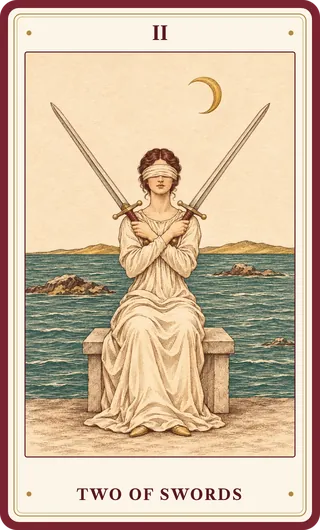
The blindfold
She chooses not to look, which shows a decision avoided on purpose. It also means the answer cannot come from outside information alone, because she is shutting it out.
Two crossed swords
Each blade stands for one option, and held in an X they cancel each other out. The balance is the point: neither side is winning yet.
The seated woman
She sits upright and still, with her arms folded across her chest. She is guarding herself, and she holds this position because she can, not because she is trapped.
The calm sea
Water behind her stands for emotion she is not facing. Her back is turned to it, so feelings are being kept out of a choice they belong in.
The rocks in the water
Jagged shapes rise from the sea and hint at hidden risks beneath the surface. They suggest the choice carries real consequences once she looks.
The crescent moon
The moon points to intuition, cycles and timing. It says the answer will ripen, and that waiting has a limit.
The pale, open sky
The sky is quiet, neutral and slightly cold. It shows a mind at rest between two thoughts, which is peaceful but not permanent.
Health and wellbeing questions
Tarot cannot diagnose anything or replace medical advice, and a yes or no card should never settle a health decision. What the Two of Swords can show is the mental side: stress, overthinking and the tension of weighing a difficult choice. Upright, it can mean pausing for a second opinion before committing to a course of action.
Reversed, it often points to putting off an appointment or a decision because the worry feels safer than the answer. The card leans yes toward facing it, in the sense of making the call, booking the test or asking the question. The worry is usually costing more than the result would.
Some readers also link the card to the neck and shoulders, because the woman holds the blades up with her arms across her chest. If you are carrying decision stress in your body, rest and a trusted person to talk to matter more than any card.
Timing: when will the answer come?
The Two of Swords does not give a date, because it is a card about a decision that has not happened yet. Timing depends on you. As a guide, the Moon in the sky links it to lunar cycles, so a few weeks is a reasonable first estimate, long enough to collect information and short enough to avoid drifting.
Upright, assume the wait continues until you act. Waiting for the situation to resolve by itself is the same as holding the swords up. Reversed, the timing shortens sharply and the decision tends to come soon, often within days or as soon as a deadline hits.
If timing is your main question, rephrase it. Ask “what do I need to do to be ready to decide” or “when will I have the information I need”. For a full method, read the page on tarot timing.
Try this: Set a decision date for the question you pulled this card for, ideally two to four weeks away. Write it on a sticky note and put it where you will see it daily. When the date arrives, decide, even if the answer is only a first step.
Cards that tip the answer
Because the Two of Swords is so neutral, the cards around it change the answer a lot. These pairings give a rough guide.
- Ace of Swords: clarity breaks through, so the answer moves toward yes.
- Two of Cups or The Lovers: a relationship question tilts toward yes, with mutual honesty.
- Four of Swords: more rest is needed, so the answer is wait.
- Ten of Swords or Death: a firm ending, so the answer is no.
- The Moon: you do not yet have the full picture, so the maybe deepens.
These are guides, not rules. A single draw also reads differently from a spread, so give the surrounding story weight. If you work with three cards, the 3 card tarot spread lets you see what leads to the stalemate, what it is now, and what comes next.
Reading it in a yes or no spread
In a one card draw, the Two of Swords is best read as a pause. Say so plainly: the answer is not yet, and here is what is missing. This is more honest than forcing it into a yes or no box.
In a three card yes or no spread, where each card is meant to read yes, no or maybe, a Two of Swords in the middle or final position tends to leave the overall answer unresolved. Count it as a maybe and look at the other two cards for the direction of travel. If both are yes, the Two of Swords means the answer is yes after some deliberation. If both are no, it suggests you are stalling over something you already know.
You can also use the dedicated yes or no tarot reading tool if you want a quick draw, and then come back here to interpret a Two of Swords when it appears.
Common mistakes with this card
The biggest mistake is reading a maybe as a no and giving up. The card says wait and look, not stop. Another is reading it as a yes because the woman looks calm and in control. Calm is not consent, and balance is not progress.
A third mistake is drawing repeatedly to escape the maybe. If you pull the Two of Swords three times in a row, the deck is telling you something: you are circling the same decision without acting on it. Stop drawing and do the work in the list above.
Finally, avoid treating the blindfold as shameful. Sometimes pausing is wise, especially after a shock or while you are exhausted. The card only turns into a problem when the pause has no end date and no purpose.
Quick reference
Here is the card at a glance for a quick check mid-reading.
- Upright: maybe, or not yet. Soft no if you need an answer today.
- Reversed: leans yes, as the stalemate breaks. Check the choice is considered.
- Love: guarded feelings and an avoided conversation.
- Career and money: compare the facts, then decide.
- Timing: a few weeks upright, soon if reversed.
- Best next step: name what you are avoiding and set a decision date.
If you want to explore other cards for decision questions, the full list of tarot card meanings is a good place to start, and the Two of Swords sits alongside the rest of the suit of Swords.
Questions readers ask
Is the Two of Swords a yes or a no?
Upright, it is a maybe, or more precisely not yet. The decision has not been made, so the answer cannot land either way. Reversed, it leans yes because the stalemate is finally breaking.
Is the Two of Swords reversed a yes or no?
It leans yes, with conditions. The blindfold is coming off and a choice is being made, but it may be forced by events or taken in a hurry, so check that the yes is a considered one.
Does the Two of Swords mean yes in love?
Not outright. In love it shows two people, or one conflicted person, avoiding a conversation. The answer stays open until someone is honest, and then it can go either way.
Can the Two of Swords ever mean no?
Sometimes it reads as a soft no if you need an answer today, because nothing is ready to move forward. It is better described as not yet than as never.
How long does the Two of Swords say it will take?
It points to the time it takes you to gather information and decide, often a few weeks and tied to a lunar cycle. Reversed, it suggests the wait is nearly over.
What should I do if I pull the Two of Swords for a yes or no question?
Find out what you are avoiding, list the missing facts, and set a deadline. Then draw again with a sharper question, such as what happens if I choose each option.