
3 of Swords Tarot Card Meaning: Heartbreak, Grief and Healing

- Arcana
- Minor Arcana, Suit of Swords
- Element
- Air
- Yes or no
- No
heartbreakgriefpainful truth
confusionrecoveryrelease of mental strain
The 3 of Swords is the tarot card of heartbreak. It shows a red heart pierced by three swords under a stormy sky, and it stands for grief, sorrow, betrayal and the pain of a hard truth. Upright, it says you are hurting or about to be hurt. Reversed, it usually says the wound is beginning to heal.
It is one of the most recognisable cards in any deck, and it is easy to dread. But it is also one of the most honest. It does not pretend the pain is small, and it does not ask you to be fine. This guide covers the card’s imagery, upright and reversed meanings, love, work, money and health readings, yes or no answers, timing, astrology and how to read it beside other cards.
3 of Swords Tarot Card Meaning at a Glance
The Three of Swords belongs to the suit of Swords, the suit of the mind, thought, language and truth. The third card in the suit, it is sometimes written III of Swords in older or Roman numeral decks. Its core message is that something has cut deeply, and the feeling is real.
Key ideas for the card:
- Upright: heartbreak, grief, sorrow, betrayal, rejection, painful words, hard news, separation
- Reversed: healing, forgiveness, release, recovery, or grief that is being held in
- Element: Air (Swords)
- Astrology: Saturn in Libra
- Yes or no: no upright, a slow yes reversed
The Golden Dawn tradition named this card Sorrow, and A.E. Waite listed removal, absence, delay, division and rupture as its meanings. Modern readers keep that sense of a clean break, but they stress that the card also marks the point where honest healing can start.
What Is on the Three of Swords Card
In the Rider-Waite-Smith deck, illustrated by Pamela Colman Smith in 1909, a large red heart floats in the middle of the card. Three swords go through it: one from each side and one from below. Behind it the sky is grey and heavy with cloud, and rain falls across the whole scene. There are no people at all.
That absence matters. Most pain cards in the suit show a figure: a blindfolded woman, a person lying under ten blades, someone sitting up in bed in the dark. The Three of Swords strips everything back to the wound itself. It tells you that this is not about who did what, but about what a heart feels like when truth hits it.
The rain is not only gloom. Water is the element of emotion in tarot, and it falls here into a card of Air. That mix of feeling and thought is the whole card: a mental blow (words, news, a realisation) that lands in the heart and has to be cried out. Waite and Smith left the storm with no sun in it, which is why the card feels so honest. The pain is shown as it is.
Three of Swords Upright Meaning
Upright, the Three of Swords means heartbreak and emotional pain. It often shows up after a breakup, a betrayal, a death, a harsh criticism, or news you did not want to hear. The hurt is usually specific and recent, and it has a source you could name.
Because Swords are about the mind, the card also points to pain that is made of thoughts. A memory replayed on a loop, a cruel remark you cannot stop hearing, or a story you keep telling yourself about being unwanted can all be swords in the heart. In these cases the card is asking you to notice what you keep repeating.
The card carries one more gift. It is the moment where the truth comes out, and truth that has been avoided can finally be dealt with. Grief that is felt tends to move. Grief that is denied tends to stay. Upright, the 3 of Swords is a call to stop minimising the hurt and let it be what it is.
Read Three of Swords for your question
Upright: A breakup, a betrayal or a painful truth has hurt the heart, and the pain needs to be acknowledged before anything can mend.
Reversed: Healing is underway and forgiveness or reconciliation is possible, though an old wound may still be sore if you keep pressing on it.
Upright: They are hurt, sad or grieving, and the sorrow is real even if it is not being spoken aloud.
Reversed: They are recovering and letting go of the hurt, or they are burying it so deeply that it cannot ease.
Upright: A rejection, harsh feedback, a layoff or a falling-out with colleagues has caused real disappointment.
Reversed: You are bouncing back from a professional setback and learning from it, or you are letting an old blow shape your choices.
Upright: A financial loss, a broken agreement or bad news about money brings stress and sadness.
Reversed: Recovery from a financial setback begins as you face the facts and stop avoiding the numbers.
Upright: Let yourself grieve, say what hurts plainly, and do not rush to put on a brave face.
Reversed: Take the swords out slowly: forgive where you can, release what you cannot change, and ask for support.
Upright: Emotional pain is affecting your body and sleep, and the heart (literally and figuratively) needs gentle care.
Reversed: Recovery is under way, though stress or grief that has been suppressed may still need proper attention.
Three of Swords Reversed Meaning
Reversed, the Three of Swords usually means the swords are coming out. Healing, forgiveness and release become possible, and the worst of the storm has passed. This is the more hopeful reading, and it is the most common one when the card follows a clear loss in the story of the question. For a deeper look, see our full guide to the Three of Swords reversed.
There is a second, quieter reading that is worth knowing. Reversed can also mean the pain has been pushed down rather than processed. You may be telling everyone you are over it, while the wound stays open underneath. In this version, the card is not a sign of recovery but a nudge to stop avoiding the feeling. Context tells you which meaning fits: look at the cards around it and at how you feel when you read the question.
Waite’s reversed meanings lean towards confusion, distraction and disorder, and some readers still use that. If you want a framework for deciding when a reversed card is a different message and when it is a softened one, our guide to reversed tarot cards walks through it.
Three of Swords in Love and Relationships
In a love reading, the 3 of Swords is the broken heart. It can mean a breakup, a betrayal, a divorce, a painful argument, a loss of trust, or one person finding out something that changes how they see the relationship. It can also appear for the grief of an unrequited love or a love that never began.
The card does not say who caused the hurt, and it does not prove cheating. Third parties sometimes appear in this card’s traditional meaning, but that is one possibility, not a rule. If you are worried about fidelity, use conversation and evidence. A tarot card is not evidence.
For singles, the card often points to a heart that is still carrying a previous wound. It can warn against jumping into a rebound before the old grief has been felt. Reversed, it describes a heart that is ready to be open again, or a couple that is rebuilding after a hard truth was spoken. Reconciliation is possible, but only if both people let the facts stand rather than covering them over.
Try this: Write down the one sentence you most need someone to say to you about the hurt, then write what you would say back. You do not have to send it. Naming the wound plainly is the first step in drawing a sword out.
Three of Swords as Feelings
When the Three of Swords describes what another person feels, it shows someone who is hurt, sad or grieving. If you asked about a partner, ex or crush, it suggests that they are in pain, and it may be over you or the relationship. They may also be in pain about something else and bringing it into the connection.
The card describes feeling, not action. A person with the Three of Swords as their feeling may be very sad but silent, withdrawn or defensive. It does not mean they want you back, and it does not mean they are indifferent. It means that the hurt is real and probably unresolved.
If the card describes your own feelings, treat it as permission. You are allowed to be sad about this. You are allowed to feel the loss properly. Reading it reversed as your own feelings often shows that you are tired of carrying the pain and are looking for a way to put it down.
Three of Swords in Career and Work
At work, the Three of Swords marks a real professional disappointment. It might be a rejection, a failed interview, harsh feedback, a layoff, a project that collapsed, a falling-out with a colleague or boss, or the realisation that a job is not what you hoped it would be. The pain tends to be personal rather than abstract.
The card also covers painful communication. Think of the conversation where you were told, bluntly, that your role was ending, or the email that hurt more than it should. It asks you to acknowledge that this has stung before you try to turn it into a lesson. Rushing to reframe a loss often leaves it unprocessed.
Reversed, it shows recovery from a professional setback. You may be learning from the experience, mending a working relationship, or applying again with clearer eyes. It can also warn that you are letting an old rejection quietly steer your choices. If every opportunity is being filtered through one past wound, the card is asking you to look at that.
Three of Swords in Money and Finances
In money readings, the 3 of Swords points to a financial loss, a broken agreement, bad news about debt or income, or sorrow connected to money (such as a family dispute over an inheritance). It rarely describes a neutral financial event. It describes the emotional weight that comes with one.
The practical advice is to face the numbers. This card does not want you to avoid the statement, the letter or the conversation. Swords are about truth, and financial healing starts when the full picture is on the table, however unpleasant.
Reversed, it shows recovery. You may be working out a repayment plan, forgiving yourself for a bad decision, or finally letting go of money that is not coming back. If you want a card that describes steady rebuilding, look next to the Four of Swords, which comes after this one in the suit and shows rest after the blow.
Three of Swords and Health
For health, the Three of Swords connects emotional pain to the body, and the heart is the obvious symbol. It can describe grief or stress that is affecting sleep, appetite, energy or concentration, and traditional readers sometimes link it to heart trouble or surgery. Treat that as symbolism, not a diagnosis.
If you draw it while asking about your health, the card is mainly asking you to take emotional wellbeing seriously. Grief is a physical experience, and gentle routines (rest, food, movement, time outdoors, someone to talk to) are not optional extras during it. If the pain is heavy or lasting, a doctor or counsellor is the right place to go, and the card does not replace one.
Reversed, it suggests recovery, a gradual lifting of low mood or the relief that follows when a long-held feeling is finally acknowledged. It can also show that grief is being carried silently in the body and needs a safe outlet.
Is the Three of Swords a Yes or No?
Upright, the Three of Swords is a no. It shows pain, loss and disappointment, so it rarely supports a question that hopes for a smooth, happy answer. For love questions it tells you that a hurt has to be faced first, and for career questions it often means not yet. Our page on the Three of Swords as a yes or no answer goes through this by question type.
Reversed, it becomes a slow, cautious yes. It supports questions about healing, forgiving, forgetting, trying again with clearer eyes or making a fresh start after a loss. It does not promise that the old situation will return exactly as it was.
If you want a quick answer to a specific question, you can draw one on our yes or no tarot reading page. Remember that a no from this card is often an honest no to a rushed outcome, not a no to your whole future.
Three of Swords card symbols
Choose a symbol to read what it means on the card.
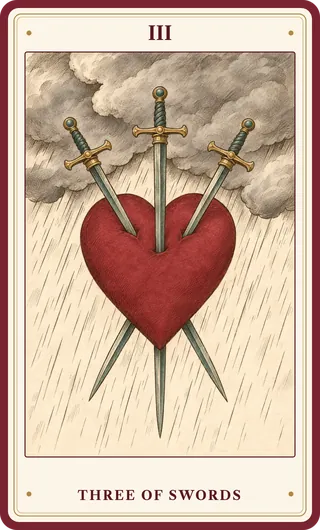
The pierced heart
A large red heart sits at the centre of the card, stabbed straight through. It shows that the wound is emotional and unavoidable to look at.
Three swords
Each blade passes through the heart, standing for hurtful words, hard news and painful thoughts. Swords belong to the mind, so the pain is often tied to what was said, thought or realised.
Grey storm clouds
Heavy clouds fill the whole background and set a mood of gloom and heaviness. They suggest a period of sorrow that has to pass in its own time.
Falling rain
Rain streams down on either side of the heart. It stands for tears and for emotional release, and it also hints at cleansing.
The empty landscape
No figures appear on the card, only the heart and the weather. Grief here is something you go through on your own terms, and nobody else can feel it for you.
The pointing blades
Two swords cross from the sides and one rises from below, all meeting in the heart. The shape shows pain converging on a single point, and the swords can be drawn out one at a time.
Three of Swords as Advice
As advice, the 3 of Swords tells you to stop pretending. Feel what you feel, say what is true and give the hurt the time it needs. It is a card against forced positivity, and it suggests that the quickest route out is usually the honest one.
It also advises care with words. Swords cut, and this card knows what a careless sentence can do. If you are about to deliver bad news or confront someone, slow down and choose your words with the same care you would want to receive.
Finally, it advises asking for support. Grief that is carried alone is heavier. Reversed as advice, it recommends forgiveness: of others, where it is safe, and of yourself, always.
Try this: Take a sheet of paper and draw a heart. Write the thoughts that hurt most around it, one per line, then cross out the ones that are only stories you tell yourself. What is left is the real wound, and it is usually smaller and clearer than the whole storm.
Three of Swords in Past, Present and Future Positions
In a three-card spread, the position changes the story. A single card can mean very different things depending on where it lands.
- Past: a heartbreak or loss that still shapes how you feel and act today
- Present: you are in the middle of pain, or the truth has just landed
- Future: a difficult event, conversation or realisation is coming, and you can prepare for it
- Reversed in the past: you have healed more than you give yourself credit for
- Reversed in the future: relief is coming, or you will be tempted to avoid a feeling you need to face
If you use this card in a larger layout, such as a Celtic Cross, pay attention to whether it lands in the position of the hidden influences or the recent past. In those spots it often shows a hurt that explains the question but has not been named.
Three of Swords Combinations
Cards beside the Three of Swords change its tone. The strongest pairings are the ones that show what comes after the pain, or what has caused it.
With The Star, the pairing is one of the most comforting in the deck: healing after heartbreak, gentle hope arriving once the storm clears. See the Star tarot card for more on that quiet recovery. With the Ace of Cups, a new emotional opening follows the loss. With The Tower, the pain comes from a sudden shock, and the road to recovery is likely longer.
Next to the Nine of Swords, the card points to grief that has turned into sleepless worry. Next to the Eight of Cups, it can show a painful but necessary walking away. For the broader pattern of the suit and how the swords build through pain and recovery, see the suit of Swords.
Three of Swords Compared with Similar Cards
Several cards can look like the Three of Swords at first glance. The difference is in what each one is about.
The Five of Cups is also sad, but it is about grieving over what is spilled while ignoring what remains. The Five of Cups is a card of regret and perspective. The Three of Swords is the sharper pain itself, with no figure turning away. The Ten of Swords is the final collapse, a painful ending that is already over. The Three of Swords is a wound being felt, usually before the bottom has been reached.
The Nine of Swords is anxiety and sleeplessness, the mind attacking itself in the night. The Three of Swords is cleaner: one clear hurt, with a clear cause. If the card in front of you feels more like dread than sorrow, it is probably a different card.
Astrology, Numerology and Symbolism
Traditionally, the Three of Swords is linked to Saturn in Libra. Libra is the sign of relationships, balance and fairness, and Saturn is the planet of limits, loss and hard lessons. Together they describe a relationship rupture that teaches something lasting. The element is Air, which is why the pain here is bound up with words, thought and truth.
In numerology, the number three is the number of growth that follows a first pairing. In the other suits, three is a celebration or a creative step. In Swords, three is what happens when two minds meet and the result is not harmony but a cut. If you like to work with this layer of the cards, our page on tarot numerology explains how the numbers carry across the suits.
The colours add to it. A red heart is life, love and courage, and it is the only warm colour on the card. The grey around it is detachment and mental heaviness. The card holds both, which is why the image feels like grief rather than hatred.
How to Work with the Three of Swords
When the Three of Swords appears, the best response is gentleness. You do not need to solve the pain, but you can make room for it. Sit with the card for a few minutes and ask what it is naming, and whether you have already been honest about it.
Journaling works well with this card. Write about what has hurt, what you have told yourself about it, and what you would say to a friend in the same position. A few days of this often shows the difference between a wound and the story wrapped around it.
If you are new to reading, this is a good card to practise with, because its image is so clear. Draw one from our random tarot card generator and see how it speaks to your day. The card is not a sentence. It is a mirror for a feeling, and recognising the feeling is where recovery starts.
Try this: Pull the Three of Swords from your deck and place it where you will see it for a day. Each time you notice it, take one slow breath and name one feeling you have been avoiding. At the end of the day, write down which one came up most.
The Three of Swords in Different Decks
Because the Rider-Waite-Smith image is so famous, many modern decks copy it closely: a heart, three swords, rain. Some versions soften the scene with a rainbow at the edge or a fallen heart on the ground, but the meaning stays the same.
In older decks such as the Tarot de Marseille, the Three of Swords is a pip card, showing three swords arranged in a pattern with no scene at all. Readers of those decks lean on numerology and suit instead of the picture. That is why meanings like division, separation and rupture appear in older sources: three blades cutting across each other suggest a break.
Whichever deck you use, the best reading is the one that fits the question in front of you. The images in the Rider-Waite-Smith tradition are a helpful starting point, but your own response to the card in your hands matters too.
Frequently Overlooked Points
A few things are worth remembering when reading this card. It is not a prediction of divorce or death, even though older books list those. It is not a punishment. And it is not permanent: the sky on the card is clouded, but clouds move.
It is also worth noticing what the card asks of the person asking. The Three of Swords will often show up when someone is trying to skip the sorrow and get to the answer. The card says: not yet. Feel it first.
If you want to continue learning how each card fits together, the tarot card meanings list is a good place to explore the rest of the deck, and the Two of Swords and Four of Swords on either side of this card show the build-up and the rest that follows it.
Questions readers ask
What does the 3 of Swords mean in tarot?
The 3 of Swords means heartbreak, grief and painful truth. It shows a heart pierced by three swords under a stormy sky, and it asks you to acknowledge hurt honestly so that healing can begin.
Is the 3 of Swords a bad card?
It is one of the most painful cards in the deck, but it is not a curse or a prediction of doom. It names a hurt that already exists or is arriving, and it points to honest grieving as the way through.
Does the 3 of Swords mean cheating?
It can sit alongside betrayal, but it does not prove infidelity. The card describes the pain of a hurt, not who caused it, so look at the surrounding cards and the real situation before drawing conclusions.
Is the 3 of Swords a yes or no card?
Upright, it leans towards no, especially for questions about quick happiness or smooth outcomes. Reversed, it softens to a slow, cautious yes, particularly for questions about healing, forgiving or moving on.
What does the 3 of Swords reversed mean?
Reversed, the 3 of Swords usually shows healing, forgiveness and release after heartbreak. It can also warn that grief has been suppressed and the wound cannot close until you feel it.
What does the 3 of Swords mean as someone's feelings?
It shows someone who is hurt, sad or grieving, possibly because of you or the relationship. They may be struggling to say it, so the card describes the pain more than any plan to act on it.