
Three of Swords as a Yes or No Answer

- Arcana
- Minor Arcana, Suit of Swords
- Element
- Air
- Yes or no
- No
heartbreakgriefpainful truth
confusionrecoveryrelease of mental strain
The Three of Swords is a no in a yes or no reading. Upright, it points to heartbreak, disappointment and a truth that hurts, so the answer to a hopeful question is that things will not go as you want, at least not yet. Reversed, it softens into a slow, conditional yes, because healing and forgiveness are possible.
That verdict sounds blunt, but the card is not cruel. It is the most honest card in the Swords suit about pain, and it often shows up when the real question is not “will this happen?” but “am I ready to feel what is already here?” Below you will find how to read the no, when it bends, and how to apply it to love, work, money, health and timing.
Why the Three of Swords says no
Yes or no readings usually follow the energy of a card. Cards of growth, momentum and joy lean yes. Cards of loss, delay and strain lean no. The Three of Swords sits firmly in the second group because its central themes are heartbreak, grief, separation and painful words. When you ask for a green light and a pierced heart appears, the card is telling you the situation carries hurt.
The suit matters too. Swords belong to air, the element of thought, speech and truth, and the Three is the first place in the suit where that truth lands emotionally. The Ace of Swords cuts through to a clear idea, but by the Three, an idea has become a wound. Numerologically, three often means growth and expression, so here the sorrow has to be expressed before anything can move on.
Quick summary of the verdict:
- Upright: no, or not without pain
- Reversed: a slow, conditional yes
- With supportive cards around it: a no that leads to relief
- With heavy cards around it: a firm no
For the full symbolism, see the Three of Swords card meaning.
What the card shows, and why it points to no
The Rider-Waite-Smith image is simple. A bright red heart floats in front of a grey, rainy sky, and three swords pass straight through it. There are no people, no landscape and no hint of comfort. That emptiness is deliberate: the card strips the situation down to the wound itself.
This is useful for yes or no reading. Other cards of difficulty, like the Ten of Swords, show a final collapse, and others, like the Eight of Swords, show feeling trapped. The Three of Swords shows something different: a clean, sharp injury that is felt fully. It tells you the answer involves emotional cost, and that the cost is real, not imagined.
Notice, though, that the heart is still whole. It is pierced, but it is not destroyed. Many readers take this as the card’s quiet promise: the pain is serious, but it does not end the story. That detail is why the reversed card can turn toward yes.
Three of Swords reversed as a yes or no answer
Reversed, the swords are being withdrawn. The card moves from fresh injury toward recovery, and in yes or no terms it shifts from no to a slow yes, or a yes with conditions. If you asked whether you will heal, forgive, move on or feel lighter, the reversed Three of Swords answers yes.
It does not, however, mean “yes, everything you hoped for will arrive.” If you asked whether an ex will return or a deal will go through, the reversed card says the hurt around it is loosening, not that the outcome flips. Read it as yes to healing and caution about grudges. The detailed meaning is on the Three of Swords reversed page.
Reversed can also mean the pain is being held in rather than released. If the rest of your spread feels stuck, a reversed Three can describe someone suppressing grief, refusing to forgive or pretending nothing hurts. In that case the answer is still a no for now, until the feeling is allowed to surface. If you are unsure how to treat upside-down cards at all, reversed tarot cards explains the options.
Try this: Pull the Three of Swords, then write the question on paper twice: once as you asked it, and once rephrased as “What do I need to feel or say before this can change?” Read the card against the second version and see which one fits better.
Read Three of Swords for your question
Upright: A no to easy reconciliation or a smooth start: someone is hurting, and the pain has to be faced before anything new can grow.
Reversed: A slow yes: forgiveness and healing are underway, so reconnecting or opening your heart again becomes possible, but only without grudges.
Upright: Sadness, grief or a wounded heart, either yours or theirs, and not the joyful feeling you were hoping to hear about.
Reversed: Hurt is easing and old resentment is being released, though some tenderness remains.
Upright: A no to the plan as it stands: expect disappointment, a painful conversation, a rejection or a team that is wounded.
Reversed: A cautious yes once the setback has been processed, and you are ready to stop replaying what went wrong.
Upright: A no to the purchase, loan or risk, because loss or a sour surprise is more likely than gain.
Reversed: A yes to recovering after a financial blow, as long as you stop punishing yourself over past mistakes.
Upright: Do not push for the answer you want: feel the hurt, tell the truth and let the wound be named before you decide.
Reversed: Draw the swords out slowly: forgive where you can, keep the lesson and do not hold on to the injury.
Upright: A no to rushing back to normal: emotional strain, grief or heart-related stress needs real attention and rest.
Reversed: A yes to recovery, with improvement coming as you process the grief and accept support.
Is it a hard no or a soft no?
Most readers treat the Three of Swords as a firm no, but strength varies with the question. If you asked something about a relationship, a rejection or a loss, the no is heavy and literal. If you asked about a project or plan, the no is more like “not this version, not without a difficult conversation.”
Look at three things to judge the weight. First, the cards beside it: supportive cards like the Sun or the Star soften the verdict, while the Tower or Ten of Swords harden it. Second, the question itself: closed questions about outcomes get a harder no than questions about decisions. Third, your own reaction. If the card makes you feel a quiet recognition, it is likely describing something already true.
A soft no is still a no. The card is rarely saying “try harder.” It is saying the current route costs more than it seems, and you should adjust before proceeding.
Three of Swords yes or no in love
In love readings, the answer is usually no to anything hopeful and immediate. Will we get back together? Is this person the one? Will they say sorry? The upright Three of Swords answers that hurt is still in the way, and that words or actions are likely to wound before they heal.
For a couple, the card can describe an argument, a betrayal, a third party or a conversation that finally says what was avoided. It may be a no to staying exactly as things are, rather than a no to the relationship. Sometimes the honest talk the card demands is the thing that gives the relationship any chance at all.
For singles, the no often applies to a quick start. Asking “will I meet someone soon?” with this card suggests you are still carrying hurt from a past connection. Reversed, it becomes a yes to being open again, as long as you stop measuring everyone against the last person. If you want a deeper reading of someone’s emotions, the Three of Cups offers a very different, brighter answer for comparison.
Does he or she love me? The card as feelings
When your question is about someone’s feelings, the Three of Swords describes sadness, regret or a wound. It does not say there is no love. It says the person is hurting, and the hurt is shaping everything they do. They may be grieving the relationship, ashamed of a mistake or feeling betrayed.
As a yes or no answer to “do they still care?”, the card is closer to a painful yes than a no: the emotion is real, but it is sorrow, not warmth. Do not read it as hidden affection waiting to be rescued. Read it as pain that needs time and honesty.
If the card refers to you, it can be a sign that you are feeling more than you admit. Many people pull it right when they are trying to convince themselves they are fine.
Career and work questions
At work, the Three of Swords is a no to the plan in its current form. Typical examples are a job application that is rejected, a project that collapses, a harsh review, a layoff or a team that has been damaged by conflict. It is rarely a mild “maybe.”
It can also be a no to staying silent. If you ask “should I tell my manager what is really going on?” the card is ambiguous, because truth is its theme even when it hurts. Here the answer depends on what else shows up. A card of clarity, such as the Queen of Swords, would lean toward speaking up with care.
Reversed, it is a yes to recovery: a yes to applying again, rebuilding trust or leaving a bad situation behind once you have processed what happened.
Money and finance questions
Money questions have little emotion in them, so the Three of Swords tends to be less specific here. Still, the answer is generally no to risky moves. It can describe a loss, a debt that causes real distress or a financial decision that breaks a relationship, such as a falling out over money.
If you ask “should I lend this money?” or “should I invest in this?”, the card warns that regret is likely. If you ask “will I recover financially?”, the upright card says the hurt is still in progress, and the reversed card says yes, the repair is under way.
Try this: For a money question, draw a second card and ask it, “What am I afraid of losing here?” If the second card is calm, the Three of Swords may only be describing your worry, not the outcome.
Three of Swords card symbols
Choose a symbol to read what it means on the card.
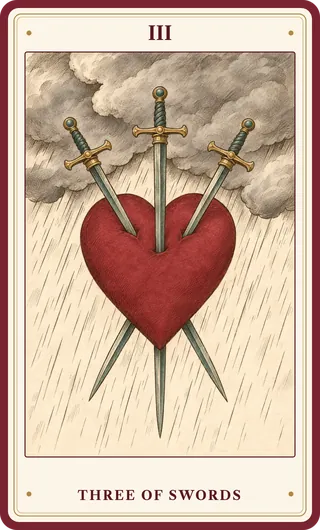
The pierced red heart
The heart is the centre of the card and stands for love, attachment and emotional vulnerability. Three blades through it show a wound that cannot be ignored.
The three swords
Swords belong to the element of air, so they stand for thoughts, words and truth. Together they show how a painful realisation or hurtful words can cut deeper than any physical blow.
The storm clouds
Grey clouds fill the whole background, which tells you the sadness has weather of its own and is not a passing mood. Storms also pass, which hints that this grief will not last forever.
The falling rain
Rain is the tears the heart cannot hold back. It also waters the ground, so it hints at cleansing and eventual renewal.
The empty sky
No figure appears anywhere on the card, so the pain stands alone without a villain or a rescuer. It reminds you that the wound itself is the message.
The heart floating in air
The heart hangs unsupported between sky and storm, which suggests a feeling suspended before it settles into grief or healing. It asks you to look at it rather than look away.
Health and wellbeing
Do not use tarot for medical decisions, but you can use the card to reflect on emotional wellbeing. Upright, the Three of Swords is a no to pushing through. It points to grief, stress and emotional pain that needs rest, support and, often, professional help.
Reversed, it is a yes to getting better. It suggests that processing the hurt is easing the strain, and that you are moving out of the worst part. Recovery with this card is rarely quick or linear, so patience matters.
If the card hits close to home because of a real loss, please talk to a doctor, therapist or someone you trust. A tarot card can name a feeling, but it cannot carry it for you.
When the Three of Swords can lean yes
There are questions where this card gives a surprising yes. The key is that the card values truth and release. If your question is “Should I end this?” or “Should I be honest about how I feel?” the Three of Swords may support you, because the hurt is already present and the choice to face it is healthy.
It also leans yes for questions about grief, closure and forgiveness. “Will I finally get closure?” can get a yes, provided you accept that closure here means feeling the pain, not avoiding it. The same goes for “Is it okay to cry about this?” or “Is it time to let this go?”
Think of the card as a yes to honesty and a no to illusion. When your question is about protecting an illusion, it says no. When your question is about telling the truth or leaving a painful situation, it can say yes.
How to word your question
The Three of Swords works best with questions that are specific, time-bound and emotionally honest. “Will this relationship work out?” is too broad. “Should I tell them how I feel this month?” gives the card something to answer. If you want help phrasing, questions for tarot reading has examples that work well for yes or no draws.
Avoid asking the same question repeatedly until you get a better card. That turns tarot into reassurance-seeking, and the Three of Swords is one of the least reassuring cards in the deck. If you want a clean method, the yes or no tarot reading tool gives you a structure to follow.
You can also split a big question into smaller ones. Instead of “Does he love me?” try “What do I need to know about this hurt?” and then ask the yes or no question separately.
Cards that change the answer
A single card is the cleanest way to ask, but if you draw several, the neighbours matter. They can soften, confirm or redirect the Three of Swords.
- Beside the Ace of Swords or Justice: a clear, truthful no that frees you up
- Beside the Ten of Swords: a very strong no, since this is the end of a painful chapter (see the Ten of Swords yes or no)
- Beside the Six of Swords: a no now, but a move toward calmer water (see the Six of Swords yes or no)
- Beside the Sun, Star or Ten of Cups: the pain is real but temporary, and recovery follows
If you want a structure for several cards, a simple 3 card tarot layout of past, present and future works well. The Three of Swords in the past position often means the hurt has already happened. In the future position, it warns that pain is likely if nothing changes.
Timing: how long does the no last?
The Three of Swords is a no for now, not always a no forever. Because it is a card of grief, its timing is slow and emotional, not scheduled. Grief has its own pace, so the answer to “when will this be better?” is “when you have actually felt it.”
Some readers connect the card to spring and Libra, thanks to its air element, which can suggest a period of weeks to months for change. Treat that loosely. A better guide is whether the hurt has been spoken or acknowledged yet. If it has, the reversed card is close. If it has not, the upright card is still in play.
Draw again after a few weeks if the situation changes. Do not draw again the same day, since you will mostly get the same energy re-expressed in a different form.
Common mistakes when reading this card
The first mistake is reading it as a curse. The Three of Swords does not cause heartbreak, and drawing it does not mean it is guaranteed. It names something that is likely already present, and gives you the chance to deal with it.
The second is ignoring reversals. Many readers say no every time, but a reversed Three of Swords describes healing and sometimes gives a real yes. The third is treating it as a replacement for a decision. A yes or no card can inform a choice, but you remain the person who has to make it.
The last mistake is softening the card too much. If you ask whether to go back to someone who has hurt you and the Three of Swords appears, it is fair to take the no seriously.
What to do after drawing the Three of Swords
Treat the card as a prompt, not a punishment. These steps help turn a no into something useful:
- Name what hurts, in one honest sentence.
- Ask whether the pain is old or new.
- Decide if there is a conversation you need to have, or one you need to stop having.
- Wait before making a big decision, especially in love or money.
- Pull a clarifying card and ask what healing would look like.
If you do not have a deck handy, you can draw a card with the random tarot card generator and apply the same approach. The goal is not to dodge the no, but to understand it well enough to decide what to do next.
Try this: Spend ten minutes writing a letter you will never send to the person or situation the card brings to mind. Say what hurt, plainly. Then draw one more card and ask, “What is the next gentle step?”
The Three of Swords says no, but it says it with honesty. If you let it name the hurt, it often leaves you with a clearer yes about what you need next.
Questions readers ask
Is the Three of Swords a yes or no card?
Upright, the Three of Swords is a no. It points to heartbreak, disappointment and painful truth, so the answer to a hopeful question is usually that it will not go smoothly or not now.
Is the Three of Swords reversed a yes?
Reversed, it leans toward a slow or conditional yes. The swords are being drawn out, so healing and forgiveness are possible, but the answer is yes to recovery rather than yes to everything.
Does the Three of Swords always mean heartbreak is coming?
No. It often describes pain that already exists, such as old hurt, a hard truth or a loss you are still carrying. Treat it as a description of what is happening emotionally, not a prediction of disaster.
Can the Three of Swords be a yes if I want to end something?
Yes, sometimes. If your question is whether you should leave, speak honestly or let go of something that hurts you, the card can support that choice, since it values truth over comfort.
What does the Three of Swords mean for 'Will he come back?'
Upright, it is usually a no or not yet, because the hurt between you is still raw. Reversed, it suggests forgiveness is possible, but only if both sides stop reopening the wound.
How accurate is the Three of Swords for yes or no questions?
It is most reliable when the question is specific and emotionally honest. A vague question gives a vague answer, so pair the card with its neighbours and the full spread meaning.