
Six of Swords as a Yes or No Answer

- Arcana
- Minor Arcana, Suit of Swords
- Element
- Air
- Yes or no
- Yes
transitionmoving oncalmer waters
confusionrecoveryrelease of mental strain
The Six of Swords is a yes. Drawn upright, it answers yes to questions about moving on, leaving a difficult situation, recovering and heading toward calmer ground. It is a quiet yes with some sadness in it, not an excited one, and the card’s real message is that the move is worth making even though it costs something. Reversed, it leans to no, or more precisely not yet.
Most yes or no pages stop there, but the answer depends on what you asked. The card is about departure, so it is strongest when your question is about leaving, healing or changing direction. This page covers when the yes is solid, when it weakens, how reversed changes things, and how to phrase a question so the card can answer it. For the full card meaning, see the Six of Swords tarot card meaning.
Why the Six of Swords reads as a yes
A yes or no answer comes from the card’s direction of travel. In the Rider-Waite-Smith image, a ferryman poles a boat from rough water toward calm water, carrying a woman, a child and six swords. The movement is forward and the water ahead is smoother than the water behind. A card that shows progress away from trouble reads as yes.
The yes is also practical. The boat is already loaded and already moving, which means the decision has been made in some form. The card does not ask whether you should consider leaving. It shows the crossing in progress. That is why it tends to confirm a plan rather than start one.
The yes carries weight, though. The passengers are bowed and the swords are heavy. The card says yes to the move and also admits that moving on hurts. If your question assumes the answer will feel purely joyful, the Six of Swords gives a more honest reply: yes, and you will feel the loss on the way.
What kind of yes it is
Think of it as a steady yes. It is not the burst of energy you get from the Ace of Wands or the celebration of a win. It is closer to the relief of finally getting on the train after a long, hard period. The answer is that things will get calmer, and you will get there by continuing, not by doing something dramatic.
It is also a yes with conditions attached. The swords in the boat show that you take your thoughts and memories with you. So the yes holds if you let the lessons travel and leave the damage behind. If you keep cutting yourself on those blades, the calm water will not feel calm.
Because the Six of Swords belongs to the suit of air, it often answers questions through clear thinking. The yes tends to come when the head has already decided. If you are still arguing with yourself, treat the card as encouragement to finish that argument instead of as a push to act today.
Six of Swords reversed: no, or not yet
Reversed, the boat stalls. The answer shifts to no for now, usually because something is keeping you in the rough water: baggage you have not looked at, a plan with holes in it, or a part of you that is not ready to leave. It is rarely a permanent no. It more often means the timing or readiness is off.
There are two common readings of the reversed card. In the first, you want to leave but cannot, because of fear, practical limits or divided feelings. In the second, you are leaving but carrying everything unresolved with you, so the move will not bring the relief you expect. Both give the same verdict: not yet, and look at what is holding the boat.
For a fuller look at how the card changes when flipped, read the Six of Swords reversed meaning. If you are new to flipped cards in general, how to read reversed tarot cards explains the logic, and it is also fine to skip reversals entirely and read every card as upright.
Try this: Draw the Six of Swords and write one sentence describing what you would leave behind and one describing what you would carry. If the second sentence is longer than the first, the yes is strong. If you cannot write the first, treat the card as not yet.
Read Six of Swords for your question
Upright: Yes to leaving a painful dynamic, healing after heartbreak and a calmer chapter, but not a promise that a past partner returns.
Reversed: No for now: old hurt or unresolved feelings keep you stuck, or you are going back and forth about leaving.
Upright: Relief mixed with sadness, a person who is detaching gently and heading toward peace.
Reversed: Emotional baggage, reluctance to let go, and feelings that have not been faced or spoken.
Upright: Yes to a planned exit, a transfer, a career change or a move away from a stressful workplace.
Reversed: No for now: the exit is stalled, the plan is half formed, or the problems will follow you to the next role.
Upright: Yes to a steady recovery, moving out of financial stress and settling into a calmer position.
Reversed: No for now: debt, old habits or unresolved obligations are slowing the recovery.
Upright: Go ahead and leave, accept help with the crossing, and carry only the lessons.
Reversed: Do not force the move yet: face what you are carrying before you set out again.
Upright: Yes to gradual recovery, rest and a gentler phase, especially for stress and emotional health.
Reversed: No for now: recovery is slow, rest is being skipped, or old stress is still being carried.
Questions the Six of Swords answers yes to
The card works best when the question is about movement away from something. Good examples:
- Should I leave this job, team or workplace?
- Is it time to move house, city or country?
- Will I get through this difficult period?
- Should I step back from a draining friendship or family conflict?
- Am I healing from this loss?
In each of these, the upright card says yes. It also says yes to travel, especially travel that is a relief or a reset rather than a holiday. In older readings, the card often stood for a journey over water, and that sense still shows up when people ask about trips or relocations.
It is a gentler yes for questions about peace of mind. If you ask whether a stressful phase will ease, the Six of Swords says yes, and it suggests the easing comes through distance, rest and clear thinking, not through confrontation.
Questions where the yes does not fit
Because the card is about departure and slow recovery, some yes or no questions fit it poorly. If you ask whether you should stay in a situation, the card does not reward staying. If you ask whether someone will return, the card does not describe a return. It describes your own passage away from pain, and a yes to the question may simply be a yes to your healing.
Be careful with fast questions too. “Will I hear back by Friday?” is not a Six of Swords question, because the boat moves at a measured pace. Likewise, “Will this be easy?” gets a mixed reply. The card promises progress, not an effortless one.
If you are weighing whether to leave or stay and the card feels unclear, compare it with the Eight of Cups yes or no. Both cards are about leaving, but the Eight of Cups is a walk away driven by dissatisfaction, while the Six of Swords is a crossing driven by a need for peace, often with help.
Six of Swords yes or no in love
In love, the upright card says yes to moving on from heartbreak, yes to leaving a relationship that has been wearing you down, and yes to starting again once you have healed. It also says yes to a calmer phase in a relationship that has been through conflict, since the water ahead of the boat is smooth. The common thread is relief after strain.
It does not guarantee a reunion. If you ask whether an ex will come back, the card points to your own movement, and that is closer to no than yes. If a reconciliation does happen, it will usually come after both of you have stepped away and let things settle, not as a quick return. For singles, the card can say yes to a new connection, especially if you have recently come through something painful and are open again.
Reversed, the love answer is no for now. You may be replaying an old relationship, holding feelings you have not named, or trying to move on without actually grieving. The card asks for honesty about what you are still carrying before you begin again.
Six of Swords yes or no for career and money
At work, the Six of Swords is one of the clearer yes cards for exits and pivots. It says yes to resigning from a stressful job, moving to a different team, changing industry or relocating for work. It suits people who have already done the thinking and want confirmation. It does not say yes to a sudden windfall or a quick promotion.
For money, the answer is yes to recovery rather than to growth. It points to leaving financial stress behind and moving into a more stable position, which makes it a good sign for paying down debt, restructuring or moving to a cheaper place. If your question is about whether an investment will multiply, the card has little to say. For that kind of question the Ace of Pentacles is closer to what you want.
Reversed, the career answer is no for now. The plan may be unfinished, or the real problem may follow you to the next role. Fix the part you are carrying first, then move.
Health, travel and everyday questions
For health questions, the upright card says yes to gradual recovery, especially from stress, burnout or grief. It describes a slow, steady improvement and a calmer phase, not a sudden cure. Treat it as encouraging, not as a medical statement, and keep professional advice in front of any tarot answer about your body.
For travel, the card says yes to journeys that bring relief or change, and to moving house, particularly across water or a significant distance. It often shows up for people who want a fresh start somewhere else. If you ask whether a trip will happen, the answer leans yes, with the pace being unhurried.
For small everyday questions, such as “Should I leave this event early?” or “Should I step away from this argument?”, the upright card says yes. The Six of Swords is the card of stepping away calmly. That is often wise advice, and the answer holds when the situation is draining and the exit is clean.
Six of Swords card symbols
Choose a symbol to read what it means on the card.
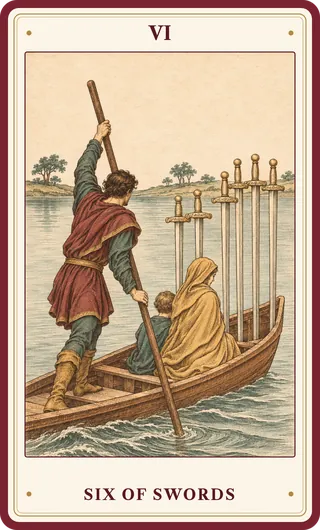
The boat
The boat is the vehicle of change, carrying the passengers from one state to another. Its steady course shows the move is already underway.
The ferryman
The figure with the pole guides the boat with effort and care. He stands for the discipline and practical effort needed to get through a transition.
The hooded woman and child
The huddled passengers show grief, vulnerability and the need to be protected while moving on. The child also points to innocence and the hope of a fresh start.
Six upright swords
The swords stand in the boat, standing for the thoughts, memories and lessons you take with you. They are carried, not thrown away, and they do not harm the boat.
Rough water on the left
The choppy water behind the boat is the trouble being left. It shows where the emotional turbulence was.
Calm water on the right
The smoother water ahead signals relief and a gentler phase. The change from rough to calm is the heart of the card's yes.
The distant shore
The faint land ahead is the destination, not yet fully visible. It tells you the future is real but still arriving.
Timing: how soon is the yes?
The Six of Swords moves at the speed of a boat, which is slow and steady. You can expect change over weeks or months, not days. The card does not suggest a sudden break. It suggests a process that has begun and is going to continue, with the shore visible but not yet reached.
If you want a more specific timeframe, the card is better combined with other cards or with a method such as the one in tarot timing. On its own, it tells you the direction and the pace, not a date. A reasonable reading is that the relief arrives gradually and that you will notice it in small ways before you notice it in big ones.
Try this: Ask your question, draw one card, and then write down one small step you could take in the next seven days toward the shore. The Six of Swords is a card about steady effort, so a modest step fits it better than a grand gesture.
How neighbouring cards change the answer
In a spread, the Six of Swords adjusts to the cards around it. Next to cards of hope, such as The Star or the Ten of Cups, the yes becomes warmer and more certain. Next to cards of success, it confirms that the move leads somewhere good.
Beside heavy Swords, the yes gets harder. With the Ten of Swords or the Nine of Swords, the card says you will leave, but you may be exhausted first, so the yes is a yes to relief after strain. Beside the Five of Swords, the departure may follow a conflict or a loss.
Next to cards of delay or stagnation, such as the Four of Pentacles or reversed cards, the yes becomes slower or conditional. Read the Six of Swords as the direction of the story and the cards around it as the weather on the water.
How to ask the question so the card can answer
A good yes or no question has one clear subject and one clear action. “Should I accept the transfer to Leeds?” is better than “Will my life get better?” The Six of Swords answers questions about moving, leaving and healing most clearly, so frame yours around a specific departure or change.
Avoid questions that contain two ideas, such as “Should I leave my job and start a business?” The card cannot split its answer. Ask one question at a time. Also avoid questions that ask the cards to promise a result you cannot influence, such as what another person will decide.
If you want a quick draw first, the yes or no tarot card reading tool gives you a single card to work with. For more complex decisions, many readers prefer a short spread, because one card can say yes while the situation around it is more mixed.
Using a three card spread for a fuller answer
A single yes can hide a lot. A simple 3 card tarot layout adds the context: the first card shows what you are leaving, the second shows the move itself, and the third shows what you arrive at. If the Six of Swords lands in the middle, the answer is yes with confidence, because the middle card is the crossing.
If the Six of Swords lands in the first position, it suggests you have already been through a transition and you are asking about what comes after. If it lands in the third, the answer is that calm waters are where the situation ends up. Either way, the other two cards tell you what the yes will cost and what it will give.
When the three cards disagree, trust the pattern. Two supportive cards and one cautionary card is a yes with a warning. Two cautionary cards and the Six of Swords is a yes that needs a plan.
What to do after a yes
A yes from this card is permission to act, but it asks for tidy preparation. Decide what you are taking and what you are leaving. The swords in the boat are your lessons and memories, and the card suggests that you keep the useful ones and set the rest down.
Accept help. The ferryman is doing the work of getting the boat across, which is a reminder that you do not have to manage a transition alone. Friends, advisers, a counsellor or a practical plan can all play that role.
Then go at a steady pace. The card does not ask you to rush or to burn bridges. It asks you to cross calmly. If you notice yourself hesitating after a yes, return to the reversed meaning and ask which piece of baggage is making you stall.
Common mistakes with this card
The first mistake is reading the yes as a guarantee of an outcome you want. The Six of Swords says yes to the movement, not to a particular result at the other end. The second is reading it as a reconciliation card in every case. It can include one, but it usually means you step away first.
The third mistake is ignoring the sadness. The passengers are not celebrating. If you want a pure win, a card like The Sun will give it. The Six of Swords gives a more grown-up answer: yes, you can move on, and it will feel like both a loss and a relief.
The fourth mistake is asking the same question repeatedly until a different card appears. If the Six of Swords gave a yes, sit with it for a few days, then act or reflect on why you do not want to. For more on how this card fits among the others in the suit, see the Suit of Swords.
Questions readers ask
Is the Six of Swords a yes or no card?
The Six of Swords is a yes card when it appears upright. It is a quiet, steady yes that points to moving on, healing and calmer days, rather than a loud green light.
What does the Six of Swords reversed mean as a yes or no answer?
Reversed, it leans toward no, or more exactly not yet. The boat is stalling because of baggage, indecision or unfinished emotional business.
Does the Six of Swords mean an ex is coming back?
Not by itself. The card is about leaving and moving toward peace, so it answers yes to healing and moving on. If you ask whether someone will return, the answer is usually no, or at least not the point of the card.
Is the Six of Swords a yes for a job change or a move?
Yes, this is one of the best questions for it. The card supports a planned exit, relocation or career change, especially if you have already weighed the practical side.
How fast does the Six of Swords say things will happen?
Gradually. The boat moves slowly and steadily, so expect weeks or months of change rather than a sudden event, and a calm arrival rather than a dramatic one.
Can the Six of Swords be a no?
Yes, in a few cases. It can be a no when the question is about staying, about someone returning, or about getting a fast result, because the card is about departure and slow progress.