
Six of Swords Reversed (Meaning in Love, Work & Life)

- Arcana
- Minor Arcana, Suit of Swords
- Element
- Air
- Yes or no
- Yes
transitionmoving oncalmer waters
confusionrecoveryrelease of mental strain
The Six of Swords reversed means that a transition you need to make is stalled, resisted or only half completed. You may be unable to leave a painful situation, pulled back toward something you already outgrew, or leaving physically while carrying all the hurt with you. Upright, this card is a calm crossing toward better days. Reversed, the boat is stuck in the shallows, drifting in circles or heading back to the shore it left.
That is rarely a disaster. The card is pointing at one specific problem: unfinished business. Once you know what is holding the boat in place, whether it is fear, grief, pride or a plan that was never thought through, you can start to move again. The rest of this guide covers what the reversed Six of Swords means in love, work, money, health and as advice, so you can read it in your own situation.
What the Six of Swords reversed means
At its core, the reversed Six of Swords describes change that is not flowing. In the upright position, a person leaves rough water for calmer water with help from a ferryman. Reversed, something interrupts that process. You might know that a move is needed and still feel unable to make it, or the move may have been forced on you and you are digging in your heels.
There are a few common versions of this. You may be resisting change because the unknown feels worse than a familiar problem. You may be leaving without closure, so the new place starts to feel like the old one. Or you may be going back to a person, job or habit you already left. All three share the same cause: the emotional work has not caught up with the practical decision.
The card also carries a quieter meaning. Sometimes the reversed Six of Swords shows a private, internal transition that no one else can see. You are shifting beliefs or letting go of old patterns without any outward sign, so it looks like nothing is happening. Context and the cards around it tell you which version applies.
What turning the card upside down changes
In the Rider-Waite-Smith image, a ferryman poles a small boat across the water. A hooded woman and a child sit in front of him, and six swords stand upright in the boat. The water on the left is choppy, while the water on the right is smooth. The swords do not leave the boat, which tells you that the hurt travels with you even when you move on.
Reversed, every part of that picture takes on a different tone. The boat can feel stuck or leaky, the ferryman may be absent or refused, and the swords feel heavier. The calm water seems far away. If you read reversals as an inversion of the upright meaning, the card says “no crossing yet.” If you read them as an internalised or blocked version of the upright energy, it says “the crossing is happening inside you, and you are not ready to share it.” Both are valid, and the reading should decide which fits. For more on how to choose, see our guide to reading reversed tarot cards.
If you want the full upright picture first, start with the Six of Swords upright meaning, then come back to compare the two.
Six of Swords reversed in love
In love, this card usually points to unresolved emotional business. If you are single, you may still be attached to an ex, replaying what went wrong, or comparing every new person to someone from the past. You may also be tempted to return to a relationship that ended for good reasons, because it feels familiar and the unknown feels lonely.
In a relationship, the reversed Six of Swords suggests a rough patch that you have not truly worked through. You may keep returning to the same old argument, or one of you may want change while the other resists it. It can also show a couple who need a change of circumstances, such as a move or a new routine, but keep postponing it. The warning is that putting up with the problem does not make it go away.
Sometimes the card shows someone leaving a relationship without any reflection. They get out fast, then repeat the same pattern with the next person. If that sounds familiar, the card asks you to look at what you carry with you, not just where you are going.
Try this: Write down three things about a past relationship that you still have not said out loud or on paper. Choose one and finish it, whether that means a letter you will not send or a conversation you have been avoiding.
Read Six of Swords for your question
Upright: Upright, you are leaving a painful relationship pattern behind and moving toward calmer ground.
Reversed: Reversed, you are stuck on an ex, circling old arguments, or heading back to something that already ended.
Upright: Upright, they feel relief and a quiet wish to heal and move forward.
Reversed: Reversed, they feel stuck, torn or unable to let go, and may be hiding it behind silence.
Upright: Upright, you are leaving a stressful job or project for steadier work.
Reversed: Reversed, you stay in the wrong role out of fear, or you change jobs and bring the same problems along.
Upright: Upright, finances slowly stabilise as you leave a shaky situation behind.
Reversed: Reversed, you avoid looking at debt or a money problem, so recovery is delayed.
Upright: Upright, accept help, leave what hurts and trust the slow crossing.
Reversed: Reversed, finish what is unresolved, ask for help and stop waiting for the perfect moment to leave.
Upright: Upright, recovery is under way and it will be gradual.
Reversed: Reversed, healing is slower than you hoped and unprocessed stress may be getting in the way.
Six of Swords reversed as feelings
When this card describes what someone feels about you, it points to emotional stuckness. They may care about you but be tangled up in their own past, unable to commit or move forward. They might feel torn between leaving and staying, and that indecision comes across as distance or mixed signals.
It can also describe your own feelings. You may feel exhausted, anxious about change, or ashamed that you have not “moved on” yet. The card is not criticising you for that. It is describing a heavy load and suggesting you stop pretending it weighs nothing.
If you are asking about a specific person, remember that this card describes their inner state, not a final decision. A reversed Six of Swords means they are struggling to cross, not that they have already chosen to leave. Pair it with a clarifying card, such as the Eight of Cups reversed, if you want to know whether they are close to walking away or trying to stay.
Six of Swords reversed in career
At work, the reversed Six of Swords often shows someone who knows a change is needed and stays put anyway. Fear, money worries, loyalty or simple exhaustion can all keep you in a job that no longer fits. The card does not tell you to quit tomorrow. It tells you that waiting without a plan is costing you something.
It can also show a transition that is delayed or going badly. A transfer falls through, a relocation is postponed, a project is stuck in review, or a job change brings the same problems with it. If you left a role because of a difficult boss and the new workplace has similar tension, the card suggests the pattern is partly yours to look at.
On the practical side, it can indicate cancelled or disrupted work travel, or a hesitation about moving abroad. Treat it as a prompt to check your paperwork, your timeline and your motives before you commit.
Six of Swords reversed in money
In money readings, the reversed Six of Swords suggests you may be avoiding a financial problem rather than fixing it. That might be unopened statements, a debt you would rather not think about, or a big decision about housing or work that keeps being pushed back. The boat is stuck partly because you will not look at the water.
It can also warn against a rushed escape. Moving cities, quitting a job or selling something at a loss just to get away from stress may feel like relief, but it can land you in rougher water. Slow and planned is better than fast and panicked.
Ask what one clear step would reduce the weight: a budget, a call to a lender, or a conversation with someone who understands the numbers. The card rewards small, honest actions more than dramatic moves. If you want to dig into a broader money question, a money tarot spread can add detail.
Health and spiritual meaning
For health, the reversed Six of Swords usually points to slow recovery. You may be healing, but more gradually than you hoped, or you may be rushing back to normal life too soon. Mental and emotional strain can slow physical healing, so the card is a gentle nudge to rest, accept support and avoid pushing for a quick fix. It is not a medical diagnosis, and any health concern needs a professional opinion.
Emotionally, it can describe grief or anxiety that has not been processed. Talking to a trusted friend, a counsellor or a support group is exactly the kind of “ferryman” this card suggests you accept.
Spiritually, it can show a period of feeling stuck on your path. Old beliefs may have stopped working, but new ones have not yet formed. That in-between stage is uncomfortable, and the card asks you to be patient with it rather than force a breakthrough.
Six of Swords reversed as a person
As a person, the reversed Six of Swords is someone who struggles to let go. They may keep returning to old relationships, old jobs or old stories about what went wrong. They are often thoughtful and wounded, rather than careless. They may refuse help because they believe they should manage alone, which makes everything slower.
It can also describe someone who flees problems instead of facing them. They move, change jobs or end relationships quickly, then find the same issues turning up again. They are running from the pain, but the pain is in the boat with them.
If this person is you, the card is kind about it. You are not stuck because you are weak. You are stuck because something real has not been dealt with yet.
Six of Swords card symbols
Choose a symbol to read what it means on the card.
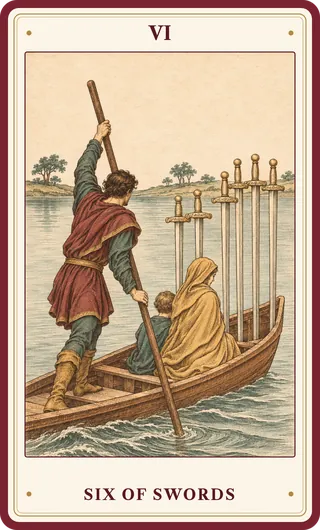
The boat
The boat is the vehicle of change, carrying the passengers from one state to another. Reversed, it suggests the vessel is stuck, drifting or turning back.
The ferryman and his pole
The ferryman does the steady work of moving the boat, standing for guidance and practical help. Reversed, it can mean you refuse help or have no one steering.
The hooded woman and child
They are the vulnerable part of you that is leaving something painful behind. Reversed, they show grief and fear that have not yet been processed.
The six swords
The swords stand upright in the boat, representing worries, memories and mental burdens you take with you. Reversed, they weigh more heavily and keep you from travelling light.
Rough water on the left
The choppy water on the near side is the turbulence you are leaving. Reversed, it suggests you are still in it or keep being pulled back.
Calm water on the right
The smoother water ahead points to relief and a gentler future. Reversed, it feels distant or hard to believe in.
The far shore
The distant land is the destination, a place of rest and a fresh start. Reversed, it is delayed, unclear or not yet chosen.
Is the Six of Swords reversed a yes or no?
Mostly it is a no, or at least a not yet. If you ask whether a move, a reconciliation or a fresh start will happen, the reversed Six of Swords says the way is not clear. Something needs to be resolved first, or the timing is wrong. It can mean the answer changes once you make a practical or emotional adjustment.
Context matters. If the question is “Will I get stuck here forever?” the card is more hopeful than it looks, because it highlights a specific block you can address. If the question is “Should I leave right now?” it advises caution rather than a rushed exit.
For a deeper look at how this card behaves in binary questions, see the Six of Swords yes or no guide.
Four ways the card tends to show up
Most readings of the reversed Six of Swords fall into one of these patterns:
- Stuck in place: you know you need to leave a situation but cannot act.
- Turning back: you return to someone or something you already left.
- Leaving without closure: you go, but the hurt travels with you.
- Refusing help: you insist on crossing alone and make the trip harder than necessary.
Spotting which one fits is usually the quickest way to make the card useful. You can often tell by the question you asked and the cards beside it. If you are unsure, ask which of the four makes you feel a small jolt of recognition.
Six of Swords reversed as advice
As advice, this card says to finish what is unfinished before you cross. That might mean saying something you have been holding back, forgiving yourself for a decision, or writing down what you are afraid will happen if you move. You do not need to feel perfectly ready. You do need to be honest about what is in the boat with you.
It also suggests accepting help. The ferryman is there for a reason. A friend, a mentor, a therapist or even a practical checklist can do the poling while you steady yourself. Insisting on managing everything alone often makes the trip longer and lonelier.
Finally, it advises against rushing. If you are tempted to leave a situation dramatically to escape the discomfort, pause and ask what you are really trying to leave. A planned, deliberate move beats an impulsive one almost every time.
Try this: Draw a line down a page. On the left, list what you want to leave behind. On the right, list what you will take with you, such as lessons, skills and people. Circle one item on the left that you can let go of this week.
Six of Swords reversed in a spread
Where the card lands changes its tone. In the past position, it suggests a previous move that was incomplete, which is still shaping the present. In the present position, it names the current block. In the future position, it warns that a transition ahead may be delayed or complicated unless you prepare for it.
In a three-card layout, it works well as the middle card, showing the obstacle between where you are and where you want to be. A 3 card tarot spread with past, present and future positions gives you a simple way to see how that block formed and where it leads.
In a larger layout, look at the cards around it for context. A card showing fear or isolation suggests an emotional cause, while a card of action or planning suggests a practical one.
Cards that pair well with it
Some combinations sharpen the meaning. With the Ten of Swords reversed, you are slowly recovering from a painful ending and the Six of Swords reversed shows the recovery stalling. With the Two of Swords, you are avoiding a decision. With the Eight of Cups, the urge to walk away is strong, but the Six reversed shows that you may not be ready to go.
With strengthening cards such as the Star, the block is likely to lift with time and care. With the Tower, a sudden event may force the change you have been resisting. In all cases, read the Six of Swords reversed as the question of readiness, and let its neighbours describe what is waiting on either shore.
Swords cards in general deal with thought, communication and conflict, so a cluster of them suggests the block is mostly mental. You can see how the suit fits together in the suit of Swords overview.
Common mistakes when reading it
The first mistake is reading it as “never leave.” The card does not forbid change. It says the conditions for change are not yet right, and it shows you what is missing.
The second is assuming it always means an ex returns. It can, but it can equally describe a job, a home or a belief you are clinging to. Check the question before you decide who or what the card is about.
The third is treating it as purely negative. A stalled crossing gives you time to prepare. If you use that time well, with honest reflection and practical steps, the boat can set off in much better shape than it would have done at the first attempt.
Upright versus reversed: the key differences
Upright, the Six of Swords is movement. A passage has begun, help is available, and calmer water is ahead. The emotional tone is quiet relief mixed with sadness. The advice is to keep going and trust the process.
Reversed, it is movement that is blocked or compromised. The tone is frustration, grief or unease. The advice is to deal with what is holding you back before you try again. Neither version is better or worse. They are two stages of the same experience, and many people see the reversed card first, then the upright one once they have done the work.
Questions readers ask
What does the Six of Swords reversed mean?
It means a transition you need to make is blocked, resisted or only half done. You may be unable to leave a situation, tempted to go back to it, or leaving without dealing with what hurt you.
Is the Six of Swords reversed a yes or no?
Usually it leans to a no, or a not yet. Progress is possible, but it is delayed by unfinished business, fear or a plan that has not been thought through.
What does the Six of Swords reversed mean in love?
It often points to being stuck on a past relationship, repeating old arguments, or going back to an ex out of habit. In a couple, it suggests a rough patch that has not been properly talked through.
Does the Six of Swords reversed mean someone is coming back?
It can, but it describes a return to old ground rather than a fresh start. If it appears about an ex, ask whether anything has actually changed before you decide what to do.
What does the Six of Swords reversed mean as feelings?
It describes someone who feels emotionally stuck, uncertain or unable to let go of the past. They may want to move forward but have not yet worked out how.
Is the Six of Swords reversed a bad card?
No. It is a warning about delay and avoidance, not a verdict. It shows you exactly what is blocking the crossing, which makes it easier to fix.