
Six of Swords Tarot Card Meaning (Upright & Reversed)

- Arcana
- Minor Arcana, Suit of Swords
- Element
- Air
- Yes or no
- Yes
transitionmoving oncalmer waters
confusionrecoveryrelease of mental strain
The Six of Swords means transition: you are leaving a difficult situation behind and moving toward calmer, quieter circumstances. Upright, it points to healing, moving on, relocating or travelling, and a mind that is finally settling after a hard stretch. Reversed, it points to resisting a necessary change, feeling stuck, or carrying unfinished business that makes the crossing rough.
What sets this card apart is its honesty. It does not announce a happy ending. It shows a slow, sober passage between what hurt and what comes next, and it admits that the swords (your worries, memories and lessons) come along in the boat. Below you will find the card’s imagery, its meaning in love, work, money and health, how it behaves as a yes or no answer, and how to read it in a real spread.
Six of Swords at a glance
Here are the core facts you will want to keep in mind when the card appears.
- Suit and element: Swords, Air (thought, truth, communication, conflict)
- Number: Six, the point of balance after the crisis of the fifth card
- Astrology: Mercury in Aquarius in the Golden Dawn system
- Upright keywords: transition, moving on, healing, relief, travel, leaving baggage behind
- Reversed keywords: resistance to change, stuck, turning back, unresolved issues, turbulent passage
- Yes or no: leans yes for moving on and recovery, with patience
The Six of Swords belongs to the suit of Swords, which deals with the mind: how we think, what we believe, what hurts us and how we make sense of it. Most Swords cards describe the struggle. This one describes the first real relief from it.
What the Six of Swords means upright
Upright, the Six of Swords says you are in the middle of a passage. You have stopped fighting the situation and started leaving it. That might be a literal move, a breakup, a change of job, the end of a hard season in your family, or a quieter shift in how you think about something that used to consume you.
The feeling of the card is relief with weight in it. You may be sad to go, even though you know staying would cost more. The card respects both truths. It supports the decision to move while acknowledging that grief and calm can sit in the same boat.
In Arthur Edward Waite’s original description, the card speaks of a journey by water, a route or way, and an envoy or messenger. Modern readers have kept the travel sense (relocation, trips, a change of scene) and expanded the inner sense: a mental shift that carries you from agitation to clarity. When it turns up, ask what you are leaving and what you are taking with you. Both answers matter.
The Six of Swords image and its symbols
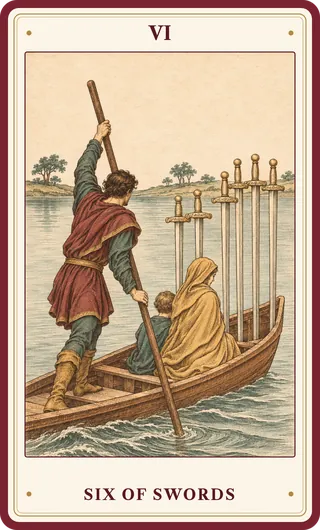
Pamela Colman Smith’s illustration is spare. A ferryman stands at the back of a small boat with a pole. In front of him a woman sits wrapped in a cloak, her head bowed, with a child leaning against her. Six swords stand upright in the bow. The water on one side of the boat is rippled and rough, and on the other it is smooth, and a low shore waits in the distance.
The figures have their backs to us and their faces hidden, which keeps the grief private and universal. The ferryman is the practical helper: a guide, a therapist, a friend with a car, or simply your own steady effort. The woman and child are the part of you that needs protection while it heals. And the swords are the key. They are not thrown overboard. The swords stay in the boat, which is the card’s quiet realism: you carry what happened, but you carry it across to somewhere safer.
The boat is also low and light. It is not a ship loaded with luggage, and that detail suggests the crossing is manageable. Nothing in the picture is dramatic. The sky is grey, the colours are muted, and the mood is the hush of recovery.
Try this: Look at the card for two minutes and name your own “six swords”. Write down six thoughts, memories or worries you are carrying, one per line. Then mark which ones you actually need on the far shore and which you could leave in the boat when you land.
Read Six of Swords for your question
Upright: A relationship is moving out of a rough patch into calmer water, or you are quietly leaving a painful love behind and healing as you go.
Reversed: Old hurts keep resurfacing, you feel stuck between leaving and staying, or you are tempted to return to a partner or ex without resolving what went wrong.
Upright: They feel weary of conflict and want peace, and they are trying to move toward something steadier even if they are not fully there yet.
Reversed: They are emotionally stuck, unsure whether to stay or go, and may be holding on to the past or avoiding a conversation that needs to happen.
Upright: You are moving away from a draining job, team or project toward work that feels calmer, saner and more sustainable.
Reversed: A needed change at work is delayed or resisted, and you may be staying in a stressful role because the unknown feels harder than the strain.
Upright: Finances are slowly stabilising after a bad stretch, and a steady, practical plan is carrying you toward firmer ground.
Reversed: Recovery stalls because old habits return, or a money problem is being avoided instead of faced.
Upright: Accept that you are leaving something behind, keep moving at a steady pace, and carry the lessons without carrying the pain.
Reversed: Name what is anchoring you, finish what needs finishing, and stop turning the boat around.
Upright: Gradual recovery from illness, stress, burnout or emotional strain, with rest and good support helping you through.
Reversed: Slow or interrupted recovery, a setback, or old patterns that keep dragging you back into the same strain.
Six of Swords reversed
Reversed, the crossing goes wrong in one of two ways. Either you are refusing to leave, or you have left and keep rowing back. The first looks like staying in a job, home or relationship long after it stopped working, because the shore ahead feels unfamiliar. The second looks like returning to an ex, an old habit or an old argument, then wondering why nothing has changed.
The reversed card can also show a rough passage. You are leaving, but you are doing it with unresolved anger, guilt or fear, and the water feels choppy as a result. In that case the advice is not to stop, but to deal with the baggage rather than hoping distance alone will cure it. Sometimes it signals delays too: visas, moves, travel plans or a recovery that moves slower than you hoped.
Waite also noted reversed meanings of declaration or confession, a sense of something being brought into the open. Some readers still use that when the card turns up in questions about honesty or disclosure. For a full breakdown across love, work and life, see Six of Swords reversed, and for general guidance on reading flipped cards, see reversed tarot cards.
Six of Swords in love
In a relationship reading, the upright Six of Swords often appears after conflict, a breakup scare or a long period of strain. It shows two people moving toward steadier ground: more honest talks, less drama, a slow rebuilding of trust. It does not say the relationship is perfect, only that the worst of the storm is behind you and the water ahead is calmer.
It can also describe a quiet exit. If you are in a relationship that has run its course, the card may show you beginning the work of leaving, sometimes with deep sadness, often with a sense that it is right. The card honours that choice without cheering it on.
For singles, the Six of Swords is a healing card. It marks the stretch between a painful past love and whatever comes next, when you stop rehashing the old story and start feeling lighter. It rarely signals a new romance arriving. It more often says you are not ready yet, and that this is fine. Reversed in love, it shows old wounds travelling into new relationships, or going back to a partner without fixing what broke. Compare the energy of the Eight of Cups, which also walks away, but does so alone and on foot rather than being carried across water.
Six of Swords as feelings
When someone’s feelings are the question, the Six of Swords describes a person who is emotionally tired and craving peace. They may care about you, but they are focused on settling down internally. They are probably quieter than usual, less reactive, and more careful about what they say.
What the card does not tell you is whether they are moving toward you or away from you. It shows the direction of their healing, not the destination. If the surrounding cards are warm (the Two of Cups, the Ten of Cups, the Sun), the calm may include you. If they are cold or final (the Eight of Cups, Death, the Ten of Swords), it may be a gentle goodbye.
Reversed, the feelings are tangled. The person may be torn between leaving and staying, avoiding a hard conversation, or stuck in guilt about the past. If you are the one drawing the card for your own feelings, it often means you already know what you need to do and are letting the hesitation run the show.
Six of Swords in career
At work, the Six of Swords shows a transition away from strain. It might be a job change, a move to a new team, a shift into a calmer industry, a relocation for work, or just a decision to stop tolerating a draining situation. It tends to favour a sensible pivot over a dramatic resignation. The boat is small and the crossing is steady.
It can also describe the relief of a project finishing or a toxic period ending. If you have recently been through burnout, restructuring or conflict with a manager, this card says the worst is easing. The practical advice is to travel light: keep the skills and lessons, drop the resentments.
Reversed, it points to a change you know you need but keep postponing, or a transition that keeps getting undone (resigning then retracting, applying then withdrawing). It can also appear when a move happens too fast, before you have dealt with what drove you out. Before you act on any career card, check the facts: finances, contracts, notice periods and alternatives. The Six of Swords is about the mind finding calm, and calm works best when paired with a plan.
Try this: Write one sentence that begins “The thing I am ready to leave at work is…” and one that begins “The thing I will take with me is…”. Then list the very first practical step to leave, such as updating a CV or booking a conversation, and set a date for it.
Six of Swords in money
In money readings, the upright Six of Swords suggests finances are stabilising after a tough period. You may be paying down debt, recovering from a loss, or simply thinking about money more clearly after a stretch of panic. It is a card of slow, steady improvement rather than windfalls.
It can also point to money connected to travel or relocation: moving costs, a work trip, an overseas opportunity, or a change in income because you changed jobs. Think of it as passage money, the cost and effort of getting from a worse position to a safer one.
Reversed, it warns about repeating old patterns: returning to overspending, ignoring a bill, or avoiding a financial truth that needs to be faced. The recovery keeps getting interrupted because the cause has not been addressed. If you want a bolder signal of financial growth, look to the Ace of Pentacles. The Six of Swords is about steadiness, not abundance.
Six of Swords card symbols
Choose a symbol to read what it means on the card.
The ferryman
A hooded figure stands at the back of the boat and poles it across the water. He represents guidance, patience and the practical effort needed to get through a transition, and he never faces us.
The woman and child
A cloaked woman sits with a child pressed against her, heads lowered. They show vulnerability and grief, and also the part of you that is being protected and carried to safety.
Six swords in the boat
Six blades stand upright in the bow. They are the thoughts, memories, worries and wounds you take with you, present but no longer piercing anyone.
Rough water behind, smooth water ahead
The surface is choppy on one side of the boat and calm on the other. It shows the shift from turmoil to quiet, which is a change of conditions, not an instant cure.
The far shore
A low bank with land in the distance marks where the crossing leads. It is an arrival point that is visible but not yet reached, so the card is about the passage itself.
The low, light boat
The little punt rides steadily with its small load. It suggests this move is manageable and that you can bring only what you truly need.
The grey sky
The muted, overcast light keeps the mood sober and quiet. Relief is real here, but it is the calm of recovery, not the glow of celebration.
Six of Swords in health and spirituality
For health, the card signals gradual recovery. That might mean healing from an illness, easing out of burnout, coming through a difficult emotional period, or finding relief after anxiety has been high. The process is not instant, and the card rarely promises a total cure, but it shows movement in the right direction. As always, tarot can offer reflection, not diagnosis, so any health concern deserves a proper medical opinion.
Reversed, it can suggest a slow or interrupted recovery, a setback, or the pattern of slipping back into whatever caused the strain. It sometimes asks whether you are letting yourself rest or pushing too hard to feel better.
Spiritually, the Six of Swords is a rite of passage card. Ferries, crossings and thresholds are old symbols for moving between life stages, and readers often connect the image with mythic river crossings. It suits seasons of grief, therapy, grieving rituals, relocation, and any time you are consciously closing one chapter. It reminds you that you do not have to feel finished to be moving.
Is the Six of Swords a yes or no card?
Upright, the Six of Swords leans yes, with patience. It supports questions about moving on, relocating, travelling, leaving something harmful and recovering. The answer is yes to the direction, not necessarily to the speed.
It leans no when the question hopes for a fast fix, a total reversal back to how things were, or an outcome without any real change. If you ask “Will everything go back to normal?”, this card says you are crossing to somewhere new instead. Reversed, the answer is usually not yet, or yes with delays and resistance. For a fuller breakdown by question type, see Six of Swords as a yes or no answer.
One caution: yes or no draws work best on simple, specific questions. A card about a quiet, gradual passage is a poor fit for a question like “Will he text me tomorrow?” Ask something broader such as “Is leaving this job the right direction?” and the Six of Swords has more to say.
The Six of Swords as a person
As a person, the Six of Swords describes someone in transition. They might be recently moved, recently separated, recently recovered, or just quietly working through something. They tend to be reserved, thoughtful and a little guarded, and they often listen better than they talk.
It can also describe a helper: a counsellor, mentor, driver, guide or anyone who helps others cross a hard stretch without making a fuss about it. The ferryman is the model: calm, practical, unshowy and reliable.
Reversed, the person may be stuck in the past, avoidant, or unable to commit to a move. They might talk about leaving and never go, or leave and keep circling back. Notice how you feel around them and look at the neighbouring cards to see whether they are a guide or someone who needs one.
Astrology, element and numerology
Swords are the suit of Air, which governs thinking, language and perspective. That is why this card is so concerned with mental recovery: the crossing is as much about how you think about what happened as about where you physically go.
In the Golden Dawn system, the Six of Swords corresponds to Mercury in Aquarius, a pairing of the planet of the mind with the sign of detachment, perspective and fresh outlooks. The old title, Lord of Earned Success, hints at the idea that this calm is something you worked for. Other modern traditions associate it loosely with the air signs in general, so treat the astrology as a flavour, not a rule. If you enjoy this angle, the page on tarot and astrology covers the main correspondences.
Numerologically, six is the number of balance, harmony and mutual support. It comes after the conflict of the Five of Swords, where someone wins at a cost and others walk away defeated. The Six is the retreat afterward: the first moment of quiet. For more on how numbers shape the minor cards, see tarot numerology.
Six of Swords compared with similar cards
A few cards look close to the Six of Swords, so it helps to tell them apart.
- Eight of Cups: you walk away alone, by choice, in search of something deeper. In the Six of Swords you are carried, often with help, and you are escaping pain more than seeking meaning.
- Ten of Swords: this is the ending itself, the painful collapse. The Ten of Swords is rock bottom, and the Six of Swords is the first quiet movement away from it.
- Three of Swords: heartbreak in the moment. The Six shows the healing passage that can follow.
- Seven of Swords: sneaking away with stolen goods and a plan. The Six leaves openly and with honesty.
A useful rule: if the card is about the decision to leave, think Eight of Cups. If it is about the aftermath of pain, think Ten of Swords. If it is about the journey from pain to peace, you are in Six of Swords territory.
How the Six of Swords reads in a spread
Position changes the emphasis. In a past position, it says you already crossed something and may still be sorting through what you brought. In the present, you are mid-passage. In the future, a transition is coming, and the card invites you to prepare gently. As advice, it says to leave the situation or to keep going.
Pairings sharpen the story. Here are a few that come up often:
- With the Six of Cups: returning to a familiar place or revisiting the past, which can be healing or a trap depending on the rest of the spread.
- With the Eight of Wands: the move happens fast, often travel or news.
- With the Four of Swords: rest comes before or after the crossing, and recovery needs space.
- With the Star: hope and healing after a hard time, a strong sign of a good outcome.
For timing, remember that this card is about a passage, not a deadline. It usually points to weeks or months rather than days, but your question and the surrounding cards matter more than any fixed number. If you are drawing the card in a larger layout such as the Celtic Cross, look at where it sits relative to the card that represents your obstacles or outcome.
Working with the Six of Swords
When this card appears, the most useful response is to slow down and be practical. Ask what you are crossing away from, who or what is helping you across, and what you are carrying that you could set down. Then ask what a realistic first step toward the far shore looks like this week.
Here is a simple way to use it:
- Name the situation you are leaving, in one honest sentence.
- Choose one lesson you will keep from it.
- Choose one habit, thought or grudge you will not take with you.
- Take one concrete step this week that moves you forward.
If the reversed card shows up, change the first question: what is holding the boat to the shore? Answer that and the rest follows.
Try this: Pull the Six of Swords from your deck (or draw a card with the random tarot card generator to practise), and journal for ten minutes on one question: “What would calmer water look like for me in three months?” Describe it in plain, specific details, such as where you wake up, what you do first and who is around you.
The Six of Swords never asks you to pretend the hurt did not happen. It asks you to keep moving anyway, with help, at a steady pace, toward quieter water.
Questions readers ask
What does the Six of Swords mean in tarot?
The Six of Swords means transition: leaving a difficult situation and moving toward calmer, more peaceful circumstances. It often points to healing, moving on, relocating or travelling. The pain is not erased, but it stops steering.
Is the Six of Swords a good card?
Yes, mostly. It is a card of relief and forward motion after hardship, though it is a quiet, sober kind of good. It does not promise happiness on the far shore, only that you are heading the right way.
What does the Six of Swords reversed mean?
Reversed, it points to resisting a needed change, feeling stuck, turning back, or carrying unresolved baggage that makes the crossing rough. It asks what is anchoring you and whether it is worth keeping.
What does the Six of Swords mean as someone's feelings?
It describes someone who is tired of turmoil and wants peace. They may care about you but need distance, time or a calmer chapter, and the card does not say whether that chapter includes you.
Is the Six of Swords a yes or no card?
Upright it leans yes for questions about moving on, relocating, travelling and recovering. It leans no for quick fixes or for hoping a painful situation will simply stay as it is. Reversed, expect delays and mixed answers.
Does the Six of Swords mean someone is coming back?
Not by itself. The card describes leaving and healing more than returning. In reconciliation questions it can show two people moving toward calmer ground, but only if the underlying problems have actually been dealt with.