
Seven of Swords Tarot Card Meaning (Upright & Reversed)

- Arcana
- Minor Arcana, Suit of Swords
- Element
- Air
- Yes or no
- No
strategydeceptiongetting away with something
confusionrecoveryrelease of mental strain
The Seven of Swords means deception, strategy and acting alone. A figure creeps away from a camp with an armful of swords, hoping nobody looks round. Upright, the card points to secrets, shortcuts, hidden agendas and getting away with something. It can describe another person’s behavior or your own.
The card is less simple than its reputation. Sometimes it is a warning about theft, lies or office politics. Sometimes it describes quiet, clever planning, or avoiding a fight you cannot win. Below you will find what the picture shows, how the card reads in love, as feelings, in work, with money and in health, what reversed means, how to answer yes or no questions with it, and what to do next when it turns up.
Seven of Swords at a glance
The quickest way to hold the card in your mind is as a plan made in secret. The person in the picture has a goal, has taken action and is hoping to avoid consequences. Everything in the card comes from that mix of ambition, concealment and risk.
- Upright keywords: deception, stealth, strategy, secrecy, theft, cunning, acting alone, avoidance, getting away with it
- Reversed keywords: confession, exposure, a guilty conscience, returning what was taken, a plan that fails, self-doubt
- Suit and element: Swords, Air (thoughts, words, truth)
- Number: seven, the number of testing, assessment and doubt
- Astrology: the Moon in Aquarius in the Golden Dawn system
- Yes or no: leans no
What the Seven of Swords shows
In the Rider-Waite-Smith deck, drawn by Pamela Colman Smith, a man walks across open ground on his toes. He has five swords gathered in his arms. Two more stand upright in the ground behind him. In the distance, a camp of tents and a small group of soldiers sit around a fire, apparently unaware of him.
He is turned back toward the camp and smiling. That detail matters. He is not running in panic. He is pleased with himself and watching for trouble. His success so far is real, but the picture also shows that he could not take all seven swords, and he is in the open, one shout away from being caught.
Waite’s own notes on the card lean toward an attempt, a hope and a plan that may fail. Read with the picture, the card is about the moment between the action and the outcome: you have made your move, and you do not yet know whether it will hold.
Seven of Swords upright meaning
Upright, the card describes cleverness without full honesty. Someone is working around the rules, leaving out part of the story, or doing something behind closed doors. Because Swords belong to the mind, the deception is usually verbal or mental: spin, omission, a version of events that suits one person.
The same energy can be defensive. If you are in a situation where being open would cost you, such as a hostile workplace, a legal dispute or an unfair negotiation, the Seven of Swords can mean being discreet and careful about what you share. It describes a person who is protecting something, not only taking it.
The card also often points to avoidance. The figure is leaving the scene rather than facing it. When it shows up for a conflict you have been dodging, it asks whether you are quietly slipping away from something you should deal with directly.
Read Seven of Swords for your question
Upright: Something is being held back, whether it is a secret, a mixed signal or a partner who is not giving you the whole story.
Reversed: A confession or an honest conversation is close, and hidden things in the relationship are ready to come out.
Upright: They are guarded and managing what you see, keeping their real feelings or plans to themselves.
Reversed: Their guard is slipping, and guilt or genuine feeling is starting to show through the strategy.
Upright: Office politics, quiet maneuvering or someone taking credit are in play, so protect your work and think before you act.
Reversed: A shortcut or hidden plan is exposed, or you decide to stop playing games and work in the open.
Upright: Watch for hidden fees, unclear terms or risky shortcuts, and keep records of everything.
Reversed: A money secret comes out, or you correct a mistake or unfair advantage before it costs you more.
Upright: Be strategic and discreet, but check your motives and make sure cleverness has not replaced honesty.
Reversed: Come clean, return what is not yours and drop the plan that depends on nobody noticing.
Upright: You may be hiding symptoms, skipping advice or telling yourself it is fine, so get an honest assessment.
Reversed: You stop avoiding the truth about your health and finally ask for help or a second opinion.
When the Seven of Swords is not about stealing
Most readers go straight to theft and betrayal, and those meanings are real. But treating every Seven of Swords as a crime misses a large part of how it works in a reading. The card is better understood as a question about motive: what is being taken, from whom, and why in secret?
A spectrum helps. At one end is plain dishonesty: lying, cheating, stealing credit. In the middle is gray strategy: not volunteering information, playing your cards close, getting something done without a fight. At the other end is healthy self-protection, such as leaving a toxic situation quietly because you know confrontation will not work.
The question to ask the card is whether the plan could survive being seen. If you would be comfortable explaining it to everyone involved, you are probably on the strategic side. If you need nobody to find out, you are closer to the warning side.
Try this: Pull the Seven of Swords and write down the “five swords” you are carrying right now: five things you have not said, shared or admitted. Then circle the two you could set down today.
Seven of Swords reversed
Reversed, the Seven of Swords is most often about truth surfacing. The soldier turns around, the swords are found, or your conscience finally catches up with you. It can mean a confession, a lie unraveling, or the decision to stop hiding something and face the consequences.
It can also describe a plan that does not work. The cunning scheme falls apart, the shortcut costs more than the honest route would have, or you realize you have been playing a game nobody else wanted to play. In that sense the reversed card is often a useful correction rather than a disaster.
A third reading is inward: imposter syndrome and a sense that you do not deserve what you have, as though you are always about to be caught out. If the card is reversed and you feel like a fraud, the work is to look at the evidence of what you have actually earned. For more on the reversed position, including love and work readings, see Seven of Swords reversed. If you are new to how reversals behave in general, how to read reversed tarot cards is a good place to start.
Seven of Swords in love
In a love reading, the upright card usually points to something unsaid. That might be a partner who is vague about where they have been, a secret kept to avoid conflict, or a relationship where one person is quietly keeping their options open. It does not automatically mean cheating, but it does say that full honesty is missing.
If you are single, it can suggest someone who is not being straight with you, such as mixed signals, a person who is emotionally unavailable while acting interested, or someone who has not fully ended a previous relationship. It can also describe your own habit of saying less than you mean, or of leaving before things get difficult.
Cheating is the meaning people fear most, and it can apply when other cards support it. A Three of Swords, a Moon or a Five of Swords nearby makes a strong case. Without those, read the Seven of Swords as hidden information first and betrayal second, and judge by what is actually happening in the relationship, not by the card alone.
Seven of Swords as feelings
When the card describes what someone feels about you, it shows a guarded person. They may have real feelings, but they are managing how much you see. They might be unsure, protecting themselves from being hurt, or keeping a second option open.
This is a card of calculation rather than spontaneity. The person may be waiting, testing the situation or avoiding a direct conversation about where things stand. You might notice that their words and actions do not quite line up, or that they say little about what they want.
Reversed, the calculation is breaking down. Guilt, honesty or real feeling starts to show, and they may admit what they have been holding back. If the Seven of Swords describes your own feelings, it often means you are not yet ready to say what is true, even to yourself.
Seven of Swords in career
At work, the Seven of Swords is the card of office politics. It can mean someone is taking credit for your ideas, a colleague is working against you quietly, or decisions are being made without telling you. It also points to plagiarism, cutting corners and “creative” ways of hitting targets that would not hold up to scrutiny.
It can describe you as well. You may be tempted to bend the truth on a report, skip a process or keep information to yourself to gain an edge. The card does not forbid strategy. It asks you to check whether the advantage you want is worth the risk of being found out.
The practical response is to document your work, keep important communication in writing and be careful about whom you confide in. Reversed, the card suggests that dishonest behavior is coming to light, or that you are ready to work more openly, own a mistake or leave an environment built on games.
Try this: For the next week, send a short written summary after any meeting where credit or responsibility could become unclear. It takes two minutes and takes the ground out from under quiet manipulation.
Seven of Swords in money
With money, the card is a caution about what is not visible. Check the fine print, question promises that sound too good, and look for fees, clauses or details that have been left out of an agreement. It is a reasonable card to see when you are about to sign something or share financial information.
It can point to theft, scams or fraud, and it is a sensible nudge to secure accounts and passwords. It can also describe your own behavior, such as hiding a purchase from a partner, avoiding looking at a balance or taking a financial shortcut you would rather nobody asked about.
Reversed, a financial secret comes out, a debt or error is faced, or you give back something you should not have kept. If you are ready to build something steadier, the Ace of Pentacles shows what an honest financial start can look like.
Seven of Swords card symbols
Choose a symbol to read what it means on the card.
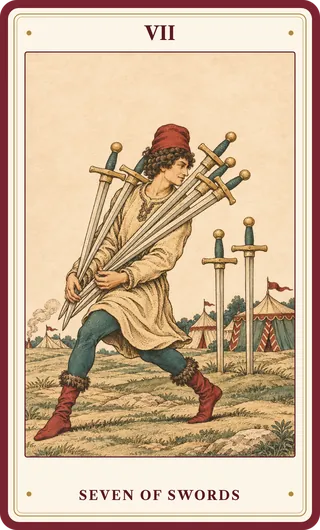
The tiptoeing figure
A man walks away on the tips of his toes, which shows stealth and a wish not to be heard. His movement is a mix of confidence and nerves.
Five swords in his arms
He carries away most of what he came for, which shows a plan that is mostly working. Swords stand for thoughts and information, so he is taking ideas, truth or advantage.
Two swords left in the ground
Two blades stay upright behind him, a sign that he could not carry everything. They suggest limits, loose ends and a plan with a gap in it.
The backward glance
He looks back over his shoulder with a half smile. It shows pride and vigilance together, since he is checking whether anyone has noticed.
The military camp
Tents and a campfire fill the background, which places the act inside a group or a rivalry. It points to competition, loyalty and the question of who is being taken from.
The soldiers in the distance
Small figures gather far behind him and have not noticed what is happening. They represent how close exposure is and how easily attention could turn.
The yellow sky
Yellow is the color of intellect in the Rider-Waite-Smith deck, and it fills the sky and ground. It reminds you that this card plays out in the mind, in calculation and justification.
Seven of Swords and health
Health readings are not a substitute for medical advice, but the card has a clear theme to reflect on: honesty with yourself about your body. The upright card can suggest brushing off symptoms, concealing a habit or not following advice you have been given. It asks whether you are managing the story rather than the problem.
It can also describe the mental side of wellbeing. The Swords suit governs thoughts, and the Seven often shows up when someone is running a quiet internal plan, such as promising themselves they will deal with something later. The cost of that avoidance builds up.
Reversed, you stop dodging. You might book the appointment, tell someone what is really going on or admit that you need support. That honesty is the healthiest outcome the card can offer.
What to do when the Seven of Swords appears
The card works best as a prompt for action. Start by identifying who the figure is. If it is another person, the card asks you to protect yourself and gather facts. If it is you, it asks you to look at what you are hiding and why.
- Name what is hidden. Be specific about the secret, shortcut or avoided conversation.
- Check the motive. Is it protection, fear, advantage or habit?
- Look at the swords left behind. What parts of the plan are still exposed?
- Decide on a more open option. Is there a way to get what you need without hiding it?
- Act on one honest step, such as a conversation, a correction or a boundary.
If the card describes someone else, resist the urge to accuse. Gather evidence first, keep your own records and ask direct questions. The card often shows suspicion before proof, so treat it as a reason to pay attention, not a verdict.
Is the Seven of Swords a yes or no card?
The Seven of Swords leans towards no. A yes needs trust, and this card tells you that something is hidden, risky or not fully reliable. For questions like “Is this person honest with me?” or “Is this deal safe?”, the answer is usually not as it appears, or not yet.
There are exceptions. If your question is “Can I get away with this?” or “Can I handle this quietly?”, the card can say yes, and the real question is whether you should. For a fuller breakdown by question type, see Seven of Swords as a yes or no answer.
Reversed, the answer is less fixed. It tends to mean the truth is about to come out, so wait before committing, and look again once the situation is clearer.
Astrology, numerology and element
The Seven of Swords belongs to Air, the element of thought, speech and strategy. Air is quick and intellectual, which is why this card is so often about plans, lies and information rather than physical action.
In the Golden Dawn system, which many modern readers follow, the card is linked with the Moon in Aquarius. Aquarius brings detachment and an independent streak, and the Moon adds changeability. Together they fit the picture of someone acting alone and moving in an unpredictable way. The Thoth deck names the card Futility, which captures the sense of effort that may not pay off.
In numerology, seven is a number of testing and inward reflection. After the conflict of the Five of Swords and the retreat of the Six of Swords, the Seven is where the mind starts to scheme and strategize. You can explore the pattern more in tarot numerology.
Seven of Swords in other positions
In a past position, the card can show a betrayal, a lie or a time you got away with something. It may also point to a pattern of avoiding difficult conversations that you are still living with. In a present position, it describes a situation with an unspoken layer, where the full picture is not yet visible. In a future position, it warns of a hidden factor to watch for, or a move you are considering that carries risk.
As an outcome card, the Seven of Swords is cautionary. It suggests that the path you are on leads to concealment, so you may want to change course. In a three-card reading, you can find a simple structure in 3 card tarot.
When the card represents a person, it is usually someone who is clever, evasive and difficult to pin down. It does not have a court card’s personality, so look to the cards around it to see whether the figure is a friend, a rival or yourself.
Seven of Swords with other cards
Neighbouring cards show whether the card is a warning, a strategy or a confession. A few common pairings are useful to know.
- With the Eight of Swords: secrecy has left you feeling trapped, and the way out is to speak up.
- With the Moon: illusions, half-truths and things that are hard to see clearly.
- With the Three of Swords: a hidden truth has already caused pain.
- With the Justice card: the truth will be weighed, and the consequences will be fair.
- With the Magician: skillful, resourceful influence, which can be a talent or a manipulation.
Within the suit, the Seven sits between the loneliness of the Six and the entrapment of the Eight, so it often marks the choice to hide a problem instead of dealing with it. The full range of the suit is laid out in the Suit of Swords meanings.
Try this: Draw the Seven of Swords with one more card from a shuffled deck and ask the second card, “What would honesty change here?” Compare the two images and write down what the second card suggests you could do openly.
How to read the Seven of Swords well
Read the card without assuming guilt. Begin with the picture: someone is leaving with something, and you do not yet know whether the swords are theirs. Ask who benefits from the secret, what the cost of exposure would be and whether the person involved has a real reason to hide.
Pay attention to your own reaction. If the card makes you defensive, you might be the figure. If it confirms a suspicion, test that suspicion against facts before acting. The Seven of Swords is a mirror for honesty as much as it is a detector for dishonesty.
Finally, remember the swords left behind. Every plan has gaps, and the card is a reminder that concealment is rarely complete. Whatever is hidden tends to be visible eventually, so choose the path you would be willing to have seen. For a wider view of how the cards connect, browse all tarot card meanings.
Questions readers ask
What does the Seven of Swords mean in tarot?
The Seven of Swords means deception, strategy and acting alone. A person is slipping away with something while others are not looking, so the card asks what is hidden and whether the plan is honest.
Is the Seven of Swords a bad card?
Not always. It carries a warning about lies, theft or avoidance, but it can also describe smart, discreet strategy when you are outnumbered or need to protect yourself. The surrounding cards and your question decide which side applies.
Does the Seven of Swords mean someone is cheating?
It can, especially in a relationship reading with cards like the Three of Swords or the Moon. More often it points to something unspoken, such as mixed signals, half-truths or a partner who is not fully committed.
What does the Seven of Swords mean as feelings?
As feelings, it describes someone who is guarded and managing what they show you. They may care, but they are keeping their plans, doubts or intentions to themselves.
What does the Seven of Swords reversed mean?
Reversed, the Seven of Swords usually means coming clean, being found out or a guilty conscience. It can also mean a plan that has failed and needs rethinking, or imposter syndrome and self-doubt.
Is the Seven of Swords a yes or no card?
It leans towards no. The card suggests that something is hidden or unreliable, so the honest answer is usually not yet, or not on these terms.