
Seven of Swords as a Yes or No Answer

- Arcana
- Minor Arcana, Suit of Swords
- Element
- Air
- Yes or no
- No
strategydeceptiongetting away with something
confusionrecoveryrelease of mental strain
The Seven of Swords is a soft no. Upright, it tells you that something in the situation is hidden, incomplete or not quite honest, so a plain yes would be premature. Reversed, it becomes a conditional answer: yes to honesty, confession and truth coming out, and no to any plan that still depends on secrecy.
That makes it one of the more useful cards to meet in a yes or no reading, because the no comes with a reason. The card shows a man stealing away from a camp with a bundle of swords, and the answer is built around that picture: find out what you have not been told before you commit. This page explains how to read it upright and reversed, how the answer shifts for love, work, money and health, and how to follow up with a better question.
Why the Seven of Swords leans toward no
Most readers class the Seven of Swords as a no, and the reasoning is consistent. Many read it as a soft no that signals incomplete information rather than a firm refusal. The card belongs to the suit of Swords, which governs thought, words and strategy, and its number seven sits in the stage of a suit where plans meet resistance. In this card, the plan is working through stealth rather than openness.
A yes needs a clear field. If someone is sneaking, avoiding, spinning or editing the story, you cannot say yes to what you cannot see. That is the logic behind the soft no: it is less “this will fail” and more “you do not have the full picture.”
Some sources give a flat no, and some give a “depends.” The most honest summary is that the answer is no to the situation as it currently stands, and open to change if the missing information appears. If you want the full card profile, with its meanings for love, work and spirituality, read the main Seven of Swords meaning page.
Upright Seven of Swords as a yes or no
Upright, the card reads as a soft no. The question you asked is tangled up with secrecy, a shortcut, a hidden motive or a plan that depends on nobody looking too closely. It does not always mean someone is lying. It may mean you are missing a fact, or that you already half know something is off and have been avoiding it.
The strength of the no depends on the question. If you ask “Will this go smoothly?”, expect complications. If you ask “Can I trust this person?”, it is a clear caution. If you ask “Should I take what is being offered?”, it asks what the catch is.
The card also leaves room for you to be the one acting in the shadows. If your question is about a plan you have not shared with the people it affects, the no is aimed at you. A good test is to ask whether your plan would survive being said out loud to everyone involved. If not, that is the no.
Reversed Seven of Swords as a yes or no
Reversed, the answer shifts from a soft no to a conditional one. The hiding stops working. A secret comes out, a conscience wins, or a clever plan collapses. Some readers label the reversed answer as conditional, and that fits: the result depends on how the truth lands and what you do with it.
A useful way to read it is by the question. If you ask whether the truth will come out, the reversed card leans yes. If you ask whether you should be more honest, it leans yes. If you ask whether you can keep something hidden or get away with it, it leans no. The reversed Seven of Swords page goes into the confession and exposure themes in more depth.
Reversed cards can also soften or delay an answer, and that applies here. If the upright card says “not yet,” the reversed one often says “not until the truth is out.” For a refresher on how reversals alter a reading in general, see how to read reversed tarot cards.
Try this: Write your question in one sentence, draw the card, and then add the words “and what is not being said?” to the end. If the answer to that second question comes to you quickly, it is probably the real reason for the no.
Read Seven of Swords for your question
Upright: No, or at least not yet: someone is holding something back, or you are, and the relationship cannot go forward on a half truth.
Reversed: Conditional: a secret is surfacing or a confession is coming, and a yes is possible only if both people choose full honesty.
Upright: Guarded and calculating: the person is keeping their real feelings out of sight and deciding how much to share.
Reversed: Guilt, relief or exposure: hidden feelings are leaking out, and they may be ready to come clean.
Upright: No to the plan as it stands: a colleague, a contract or your own shortcut is hiding a catch, so check the details first.
Reversed: A cautious yes to honest moves only: a workplace secret is surfacing, and transparency now protects you.
Upright: No to deals that feel too clever or too quiet: hidden fees, unclear terms or someone taking more than their share.
Reversed: Conditional: a financial mistake or dishonest arrangement comes to light, and fixing it openly turns the answer toward yes.
Upright: Slow down and find the missing piece of information before you commit to anything.
Reversed: Stop the workaround, tell the truth, and make the plan one you could defend in daylight.
Upright: Most likely no: you may be ignoring a symptom or hiding a habit, so get a straight answer from a professional.
Reversed: A gentler maybe: you are ready to admit what is going on and take proper care of it.
The questions where it can tilt toward yes
There is a narrow band of questions where the Seven of Swords is a legitimate yes. If you are asking whether a stealthy or private approach will succeed, such as a confidential job hunt or a quiet exit, the card can tilt yes. In those cases, discretion is the point, and the card says your cleverness will carry you.
Examples include keeping a surprise party secret, planning a private career move before announcing it, or protecting a negotiating position. None of these requires deceiving anyone harmfully. They need good judgment about what to share and when.
The test is whether the hiding harms anyone. A surprise or a confidential plan is strategy. Concealing something that others have a right to know is the shadow side. If your question sits closer to the second, take the no seriously.
What the card is really answering
The imagery explains why the verdict reads the way it does. A figure tiptoes away from a camp, carrying five swords and leaving two behind, and glances back to check whether anyone has seen him. Nothing in the picture is violent. It is about stealth, risk and the nerve it takes to act alone.
Because the swords are carried in his arms, the card also suggests a plan that is bigger than he can manage. Two blades stay in the ground, so even the thief does not get everything. That is why the answer to “will this work?” is usually “partly,” and why a clean yes rarely fits.
Pay attention to the observer in the story as well as the thief. The people in the camp are in the dark. If you feel like one of them, the card is a warning to look more carefully. If you feel like the thief, it is a question about what you are carrying and whether you can keep carrying it.
Seven of Swords yes or no for love
In love, the upright card is usually a no to the question as asked. Someone is holding back information, feelings or intentions, and the connection cannot deepen on that footing. If you ask “Is this person serious about me?”, the card says you are not getting the whole story. If you ask “Will we be together?”, it says not while the secrecy continues.
It does not always point at the other person. Sometimes the Seven of Swords is you: avoiding a hard conversation, editing your history, or pretending to feel something you do not. A no from this card can be an invitation to be more direct about what you want.
Reversed in love, the answer opens a little. A hidden truth surfaces, an apology arrives, or someone finally speaks plainly. That can be painful at first, but it often clears the way for something more honest. The Five of Swords yes or no card is a good comparison if the question involves an ongoing argument rather than a secret.
Does the Seven of Swords mean cheating?
This is one of the most common questions people bring to the card, and the honest answer is: not necessarily. The Seven of Swords points to concealment, not to one specific kind of secret. In a relationship reading it can mean infidelity, but it can equally mean a hidden debt, a private conversation with an ex, a lie about where someone was, or a plan someone has not yet shared.
Treat the card as a pointer, not proof. It says there is something you are not being told. It does not say what, and it does not say that the person is dishonest by nature. People hide things out of fear, shame and avoidance as often as malice.
If the question worries you, change it. Instead of asking “Is he cheating?”, ask “What do I need to know about the trust in this relationship?” A broader question usually gives the card more to work with, and the answer is easier to act on.
Seven of Swords for reconciliation and getting back together
For a question about getting back together, the Seven of Swords is usually a no for now. It suggests that the reason things ended has not been fully named, or that one of you is still holding back. Going back to a situation with the same unspoken problem tends to repeat the same pattern.
If the card appears reversed, the picture can improve. A reversed Seven can describe the moment someone owns up, apologises or finally says what they could not before. That makes a second chance possible, but only if both people respond with honesty rather than defensiveness.
A practical way to read the card here is as a checklist. Has the hidden issue been named? Has each person been honest about their part? If both answers are yes, you may be in reversed territory. If not, the soft no stands.
Seven of Swords yes or no for career and work
At work, the upright card says no to the plan as it stands. There may be office politics you cannot see, a contract with a catch, a colleague taking credit, or a shortcut of your own that you are hoping nobody notices. It is a good card to draw before signing anything, because it tells you to read the small print.
If you ask whether you will get a job or promotion, expect an incomplete answer. Something about the process is not transparent, or you do not yet know who else is involved. That does not rule out success, but it does mean you should gather more information first.
Reversed, the card often lines up with honesty at work: a mistake is admitted, a rumour is cleared up, or a hidden agenda is exposed. The answer can turn into a yes for any plan that is open and ethical. If you want a clearer, steadier answer on a work question, the Ace of Swords yes or no shows what it looks like when clarity arrives.
Try this: Before acting on a work decision, list three facts you do not know yet. Then draw the Seven of Swords again after you have found at least one of them, and notice whether the tone of the answer changes.
Seven of Swords card symbols
Choose a symbol to read what it means on the card.
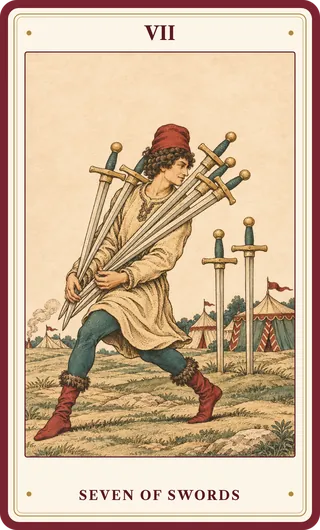
The tiptoeing figure
A man creeps away from a camp on his toes, which captures the whole card: movement made quietly, so nobody notices. He is acting alone and avoiding a direct confrontation.
Five swords carried in his arms
He has taken five blades and holds them awkwardly, close to his chest. It shows a gain made by stealth, and the effort of carrying something that is not openly his.
Two swords left in the ground
Two swords remain upright behind him. They suggest an incomplete plan: he could not carry everything, so the result is partial success and loose ends.
The glance over his shoulder
His head turns back toward the camp to check whether anyone has noticed. It points to nerves, a guilty conscience and the fear of being caught.
The military camp
Tents and a gathering of people sit in the background, unaware of what is happening. They stand for the group or situation being deceived, or the people whose trust is at stake.
The red cap and yellow boots
His bright clothing does not look like a disguise, which hints at cleverness that is more confident than careful. Yellow is the colour of Air, the element of thought and strategy.
The open, empty ground
He crosses flat, open land with no cover. The scene shows how exposed a secret plan really is, and why it can unravel the moment someone looks up.
Seven of Swords yes or no for money
With money, the upright card is a no to anything that feels too clever, too quiet or too good to be true. It warns about hidden fees, vague terms, an advisor who dodges questions, or a deal where you are being rushed past the details. It can also point to your own financial secrecy, such as a purchase or debt that you have not shared with a partner.
If you ask “Is this a good investment?”, the card does not say it will lose money. It says you do not have the full facts. Treat that as a reason to pause rather than a ban.
Reversed, a financial mistake or dishonest arrangement comes to light. That can be uncomfortable, but it is also a chance to put things right. The answer turns toward yes when you are willing to correct the problem openly and pay what is owed.
Seven of Swords yes or no for health
In a health question, the upright card is most likely a no, mainly as a signal to slow down and get proper information. It can point to symptoms you are avoiding, a habit you are keeping quiet, or a plan to push through something without telling anyone. A reading is not a diagnosis, and a card should never replace medical advice.
If you are asking whether a plan will work, such as a new routine or treatment, the card says to check the facts and be honest about what you are really doing. Telling your doctor everything, including the parts you would rather skip, is the most literal way to follow its advice.
Reversed, it softens. You may be ready to admit what is going on and take proper care of it. That readiness is the yes: it is a yes to honesty with yourself, which is where most useful health changes begin.
Is the thief you, or someone else?
A big part of reading the Seven of Swords well is working out who is carrying the swords. Sometimes the card describes someone else: a partner, a boss, a friend or a business who is acting without full openness. At other times it points at you, and the no is a reflection of what you are hiding or avoiding.
You can often tell by the feeling. If the card gives you a drop in your stomach, a sense of being misled, the thief is probably someone else. If it gives you a flush of recognition or discomfort, you may be the one with a secret.
Neither answer is a verdict on anyone’s character. The card describes a moment, not a personality. The useful question is always what would change if the hiding stopped.
Seven of Swords with other cards in a yes or no reading
The surrounding cards sharpen the answer. If the Seven of Swords falls next to a clearly positive card, such as the Sun or the Ten of Cups, treat the no as a caution about details rather than the whole situation. If it sits beside heavier cards, such as the Ten of Swords or the Tower, the no becomes firmer and the truth may arrive suddenly.
Some pairings are especially telling:
- With the Moon: confusion and illusion deepen the no, and you should wait for clarity. The Moon yes or no page explains why that card is so uncertain.
- With the Ace of Swords: the truth breaks through, and the answer can flip toward yes.
- With the Hanged Man: the truth emerges, but not yet, so patience is part of the answer.
- With the Justice card: facts and consequences are about to be weighed fairly.
If you want to explore the full set of options, a three card spread gives the Seven of Swords context in a way a single draw cannot: the situation, what is hidden, and what to do.
How to ask a better question
A card that says “something is missing” works best when you give it something specific to look at. Vague questions such as “Will things work out?” get vague answers. A sharper question gives the Seven of Swords a clear target.
Try wording that fits what the card is good at:
- “What am I not seeing about this offer?”
- “Will the truth about this come out soon?”
- “Should I tell the whole story or keep it private?”
- “Is this plan honest enough to go ahead with?”
If you want a quick yes or no draw to compare, the yes or no tarot reading tool lets you ask a question and pull a card, so you can see how the Seven of Swords sits alongside other answers.
When to trust the answer and what to do next
Trust the Seven of Swords most when your question was clear, you asked only once, and the answer matches a feeling you already had. Many people draw this card and feel a small click of recognition, as if it confirmed something they had been avoiding. That recognition is a good sign that the no is useful.
If you are unsure, do not redraw over and over. Repeated draws on the same question mostly produce noise. Instead, treat the card as an instruction: find the missing piece, ask the direct question, or have the honest conversation. Then come back with a new question, based on what you learned.
The no from this card is rarely final. It is a pause that says: not on these terms, not with this information. Once the information improves, the answer can too.
Try this: Take your last Seven of Swords answer and finish this sentence three times: “The thing I have not said out loud is…” Use the most honest ending as your next step, then redraw only after you have acted on it.
Quick reference: Seven of Swords yes or no
Here is a short summary you can use when you do not have time to read the whole page. Keep in mind that the surrounding cards and the exact wording of your question can change the weight of the answer.
- Upright, general question: soft no, because something is hidden or incomplete.
- Reversed, general question: conditional, leaning yes to honesty and truth, no to continued secrecy.
- Questions about discretion or privacy: can lean yes.
- Love and reconciliation: no for now, until the unspoken issue is named.
- Money, work and health: no until you have the full facts.
If you are new to reading single cards for quick answers, the tarot for beginners guide covers how to phrase questions and read the results.
Questions readers ask
Is the Seven of Swords a yes or no card?
Mostly no. Upright, it is a soft no that says something is hidden or incomplete. Reversed, the answer becomes conditional and depends on whether the truth comes out.
What does the Seven of Swords mean as a yes or no answer reversed?
Reversed, the Seven of Swords is a conditional answer, often a delayed yes or a not yet. It tends to say yes to honesty, confession and exposure, and no to any plan that still depends on secrecy.
Does the Seven of Swords mean someone is cheating?
Not by itself. It points to hiding, half truths or a withheld piece of information, which can be anything from a surprise to an affair. Look at the cards around it and ask a more specific follow up question before drawing a conclusion.
Is the Seven of Swords a yes for getting back together?
Usually no, or not until the truth is out. The card says that something unspoken stands between you. A reconciliation can only work once that issue is brought into the open.
Can the Seven of Swords ever mean yes?
Yes, in a narrow set of questions about discretion, such as whether a private job search or a quiet plan will stay under the radar. It can also lean yes when reversed if you ask whether the truth will come out.
What should I do after pulling the Seven of Swords for a yes or no question?
Treat the no as a prompt to look for what is missing. Gather the facts, ask the person or source directly, and then draw again with a sharper question.