
Ace of Swords as a Yes or No Answer

- Arcana
- Minor Arcana, Suit of Swords
- Element
- Air
- Yes or no
- Yes
claritybreakthroughtruth
confusionrecoveryrelease of mental strain
The Ace of Swords is a yes. When it lands upright in a yes or no reading, it says the answer is clear, the path is open and you have what you need to decide. Reversed, it becomes a gentle not yet: the facts are tangled, the timing is off or the words that need saying have not been thought through.
There is one thing worth knowing before you act on that yes. The Ace of Swords gives the yes of truth, not the yes of wishful thinking. It confirms what is real, and most of the time that supports your question. If your question depends on not looking too closely at something, this card may answer by pointing straight at it.
Why the Ace of Swords reads as a yes
Every Ace is a beginning, the seed of its suit before any complications arrive. Swords belong to air, which means thought, language, logic and decision. The Ace of Swords is the moment an idea becomes sharp enough to use. Nothing in the card is blocked, delayed or divided, and that lack of friction is what moves it into the yes column.
Compare it with the cards around it in the suit. The Two of Swords is a standoff, the Four of Swords is rest and the Ten of Swords is an ending. The Ace has none of that weight. It is a single blade held upright with a crown on top, and the image reads as a clean advance.
For the full picture of what the card means beyond a quick answer, including its symbolism and how it reads in different contexts, see the Ace of Swords tarot card meaning.
The yes of truth, not the yes of desire
This is the nuance that separates a useful reading from a disappointing one. Swords are the suit of honesty, and the Ace is honesty at its purest. When it says yes, it is saying: yes, this is clear, yes, this is real, yes, you can act on what you now see.
That means the card can feel unsatisfying if you were hoping for reassurance. Suppose you ask, “Is he telling me everything?” and draw the Ace of Swords. The card does not say “yes, relax.” It says the truth is available and you are about to see it. The answer is still a yes, but a yes to knowing, not to comfort.
A good habit is to ask yourself, as you read the card, what exactly the yes is attached to. Is it a yes to the plan, or a yes to seeing the plan clearly? Usually these are the same thing. When they are not, the second is the more accurate reading.
Ace of Swords reversed as a yes or no answer
Upside down, the sword points at the ground and the clarity goes with it. The reversed Ace of Swords is best read as not yet or maybe, rather than a flat no. The idea exists, but something is clouding it: bad information, too much overthinking, a rushed conclusion or words said too sharply.
In practice, a reversed Ace in a yes or no reading tells you not to trust the answer until you have done some groundwork. Gather the missing facts. Sleep on the message you are about to send. Check the figures again. Once the fog clears, the question is worth asking again.
The reversed card can also warn about the blade being used badly: bluntness without kindness, or a truth delivered to hurt rather than to help. If you want a closer look, the Ace of Swords reversed meaning covers love, work and life in detail.
Try this: Draw the Ace of Swords reversed? Write down three facts you are certain of and three you are only assuming. Ask your question again once the assumptions are checked.
Read Ace of Swords for your question
Upright: Yes, especially where honesty is the real question: a clear conversation, a plain confession or a relationship built on straight talk.
Reversed: Not yet: mixed signals, harsh words or a conversation that has not been thought through, so wait before expecting a clean answer.
Upright: Their feelings are clear to them, and you are likely to hear them said out loud without games.
Reversed: They are confused, holding back or unsure what they feel, so the answer is muddy for now.
Upright: Yes to the decision you have reasoned out: the pitch, the application, the new idea or the direct negotiation.
Reversed: Not yet: the plan has gaps, the facts are missing or a sharp reaction could cost you, so gather information first.
Upright: A qualified yes: go ahead if the numbers are checked and the terms are written down plainly.
Reversed: Hold off: unclear figures, small print or a rushed decision make the answer unreliable.
Upright: Say the true thing, make the decision and start. Clarity first, then action.
Reversed: Slow down, check your facts and soften the delivery before you speak or sign anything.
Upright: Yes to getting answers: a diagnosis, a second opinion or a plain explanation will bring relief and direction.
Reversed: Avoid self-diagnosing or spiralling on worst-case thinking, and ask a professional for clear information.
Ace of Swords yes or no in love
In love, the Ace of Swords leans yes wherever honesty is the heart of the question. Will we finally talk about this? Is it time to say how I feel? Can this relationship start on straight terms? The card backs a clear conversation and a fresh beginning that rests on mutual understanding rather than guesswork.
It is a strong yes for questions like “Should I tell them the truth?” and “Will we get clarity?” It is a more cautious yes for “Will this person fall for me?” because the card speaks to minds meeting before hearts, and to words before gestures. A new connection under this card often begins with conversation, a sharp exchange or a sudden realisation of how well you understand each other.
If you are asking about a relationship that already feels unclear, the card says the answer is coming and you will not have to guess for much longer. If the truth turns out to be unwelcome, the card is still doing its job. Clean information is what lets you decide what to do next.
Ace of Swords yes or no for career and work
At work, this is one of the most favourable cards you can draw. It supports applications, pitches, interviews, resignations and any decision that has been thought through. The Ace of Swords rewards preparation: a clear argument, a well-written proposal, a plain statement of what you want.
Read it as a yes for questions such as “Should I apply?”, “Will my proposal be accepted?” and “Should I speak up in this meeting?” It also suits roles that depend on analysis, writing, law, teaching, research and technical problem solving, where a sharp mind is the main asset.
It is less of a yes when the question is about luck or favours. The card does not promise that someone will hand you an opportunity. It says your own clarity is the lever. If you have not yet done the thinking, the yes is conditional on doing it.
Ace of Swords yes or no for money
Money questions get a qualified yes. The Ace of Swords backs financial decisions made with clear numbers and clear terms: signing a contract you have read, negotiating a rate directly, or setting up a budget that tells you plainly where you stand.
It is not a card of windfalls. For that, the Ace of Pentacles is the better sign, since it speaks of material seeds such as a new income source or a tangible offer. The Ace of Swords says your thinking about money is about to get sharper, and that this clarity is the real opportunity.
If your question is “Should I take this deal?”, read the yes as: yes, once you understand every line of it. If you cannot explain the terms in plain words, the card is asking you to do that first.
When the Ace of Swords gives an awkward yes
Some questions make a yes feel strange, and it helps to know what the card means in those cases. These are the common ones:
- “Will I find out the truth?” The answer is yes, and it may be sooner than you want.
- “Will this stay secret?” The card leans against secrecy, since it exposes what is hidden.
- “Should I keep the peace?” The Ace of Swords favours honest speech over silence, so this is often a no to avoidance.
- “Is it time to end this?” The card gives a yes to a clear decision, but whether that decision is to stay or go depends on what you see.
In each case, the yes is attached to clarity. If a question can be answered by learning the truth, the card says yes. If a question needs the truth to stay hidden, the card says something closer to no.
What the imagery says about the answer
The Rider-Waite-Smith image holds clues that help you read the strength of the yes. A hand comes out of a cloud and grips a sword crowned with a wreath. The olive branch and palm hang from the crown, and rocky peaks sit below. There is no person, no scenery and no story, only the tool and the moment of picking it up.
That simplicity is why the answer is firm. The crown shows victory, and the olive and palm show that the victory brings peace as well as success. The barren mountains show that the answer is unsentimental. It will not be softened to spare feelings. The falling drops suggest the idea arrives as inspiration, not as a long argument.
So when you draw it, look at what the hand is offering. It is not offering a guarantee. It is offering a sharp, ready instrument, and the yes depends on you being willing to use it.
Ace of Swords card symbols
Choose a symbol to read what it means on the card.
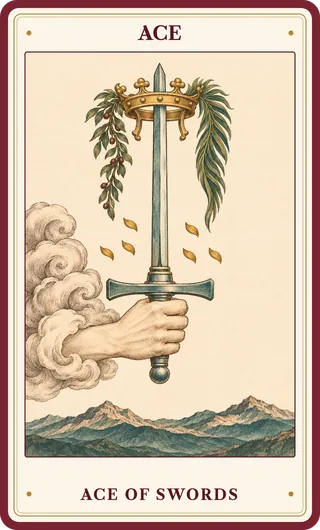
The hand from the cloud
A hand reaches down from the sky and offers the sword, as in every Ace. It shows that clarity arrives as a gift of insight, something that comes to you rather than something you force.
The upright sword
The blade points straight up, ready and untested. It stands for truth, logic and a decision that is clean enough to act on, which is why the card reads as a yes.
The crown
A golden crown sits on the tip of the sword. It signals victory of the mind and mastery over confusion, and it suggests the answer comes with authority.
The olive branch
The branch hangs from the crown on one side and stands for peace. It shows that a hard truth can still bring resolution.
The palm branch
The palm on the other side of the crown stands for triumph and success. Together with the olive, it says the yes carries both victory and responsibility.
The barren mountains
Rocky peaks rise below the cloud, a bare landscape with no softness in it. They show that the clear answer is sharp and unsentimental, and may be reached through effort.
The falling drops
Small flame-like drops fall from the cloud near the hand. They represent inspiration and grace, the moment the idea lands.
How strong is the yes?
The Ace of Swords is a firm yes on its own, but you can judge its strength by context. Three things matter: the question, the position in the spread and the cards nearby.
A firm yes comes when the question is about decisions, communication, ideas or truth. A softer yes appears when the question is about emotion, luck or things outside your control. In a single-card draw, trust the card at face value. In a longer spread, look at what sits beside it.
If the neighbours are cards of ending or heartbreak, such as the Three of Swords, the yes can arrive with pain attached. If they are cards of momentum or celebration, the yes is bright and quick. If they are cards of delay or doubt, the yes comes with a condition you should name before acting.
Ace of Swords compared with other Aces
Each Ace answers yes in its own way, and the differences help you choose the right card to read your situation by. The Ace of Swords is a yes to thinking and speaking clearly. The Ace of Wands is a yes to action and passion, as in the Ace of Wands yes or no reading. The Ace of Cups is a yes to emotional openness. The Ace of Pentacles is a yes to material growth.
If you draw the Ace of Swords in answer to a question about energy, desire or money, it may be telling you that the real issue is mental: you need a clearer view before the other areas can move. That is useful information. A yes from the Ace of Swords often means the thinking comes first and the doing follows.
How to word a question for the Ace of Swords
Because this card responds to clarity, vague questions get vague results. Ask questions that have a clear subject and a clear action, such as “Should I send the email this week?” or “Is it right to take the job offer?” Avoid questions like “Will things get better?” which give the card nothing to cut through.
Avoid asking about other people’s inner thoughts as if they were facts. The Ace of Swords is a card of your own clarity. It works best on questions about what you can say, decide or understand. For more ideas on phrasing, see these questions for tarot reading.
Try this: Before you draw, write your question as one plain sentence with a verb in it. If you cannot do that, the card is likely to tell you the question itself needs sharpening.
Using the Ace of Swords in a three card yes or no draw
A single card gives a quick answer, but three cards give you the reasoning. Draw one card for the situation, one for what is helping or blocking you and one for the likely outcome. If the Ace of Swords appears in the outcome position, the answer is a confident yes. If it is in the situation position, it says clarity is already available and the next two cards show what to do with it.
If you want a simple structure, the 3 card tarot layout works well for this. For a dedicated tool that assigns a yes, no or maybe to each draw, try the yes or no tarot reading page.
When the Ace of Swords falls in the middle position, it is often pointing at the thing that will make the difference. Read it as the key: the answer depends on seeing the situation clearly, and the card is telling you that you can.
Should you pull another card?
It is tempting to draw again when you get an answer you did not expect. With the Ace of Swords, resist that. This card is the energy of a clear, decisive moment, and redrawing is the opposite of what it asks for. If the yes feels uncomfortable, that is information about what you hoped to hear.
A better move is a follow-up question that digs into the truth the card has raised. Ask what you need to know, or what you are avoiding. That uses the card for what it is good at: cutting through, rather than going round.
If the reading feels unclear, you can wait. Tarot is not a machine that must produce answers on demand, and the reversed Ace itself recommends a pause before deciding.
Timing: when does the yes arrive?
Swords are quick. They belong to the world of thought and speech, which can change in an instant. A yes from the Ace of Swords often arrives as a sudden realisation, a message or a conversation rather than a slow build. It is a card of days and weeks more than months.
That said, tarot timing is not exact, and the card does not set a date. A practical reading is that the clarity could come as soon as you ask the right question or have the honest conversation. If you want to explore the question of when, the guide to tarot timing explains how to read cards for it.
Quick reference for the Ace of Swords yes or no
Here is the short version to keep in mind next time the card turns up:
- Upright: yes, especially for decisions, truth and new starts.
- Reversed: not yet or maybe, until facts are clear.
- In love: yes to honesty, cautious on pure romance questions.
- At work: yes to clear plans and direct speech.
- With money: qualified yes once terms are checked.
The Ace of Swords is a clean, sharp yes. Use it to decide, speak plainly and begin. When the answer comes with an edge, trust that the edge is what makes it useful.
Questions readers ask
Is the Ace of Swords a yes or no card?
The Ace of Swords is a yes card when it appears upright. It stands for clarity, truth and a clean start, which all support moving forward. Reversed, it softens to not yet or maybe.
What does the Ace of Swords mean for a yes or no question about love?
It leans yes where the question is about honesty, communication or a fresh and direct start. It is less certain when the yes you want depends on avoiding the truth, because this card brings facts rather than comfort.
Is the reversed Ace of Swords a no?
Not usually. Reversed, it points to confusion, mixed information or harsh timing, so the best reading is not yet or maybe. Gather facts, then ask again once the situation is clearer.
Can the Ace of Swords mean no?
It can, when the question is whether a painful truth will stay hidden, or when surrounding cards such as the Three of Swords or Ten of Swords show the answer arrives as a hard ending. The card itself is a yes to clarity, even when the clarity is unwelcome.
Is the Ace of Swords a yes for money and career questions?
Yes, as long as the decision has been reasoned through. It favours a clear plan, a direct negotiation or an idea with a solid argument behind it. It is a weaker yes if figures are unchecked or contracts are unclear.
What should I do if I draw the Ace of Swords for a yes or no reading?
Treat it as a yes and take the next clear step, such as writing down the facts or having the honest conversation. Use the card's energy to decide rather than to keep asking the same question again.