
Ace of Swords Reversed: Meaning in Love, Work & Life

- Arcana
- Minor Arcana, Suit of Swords
- Element
- Air
- Yes or no
- Yes
claritybreakthroughtruth
confusionrecoveryrelease of mental strain
The Ace of Swords reversed means that mental clarity is blocked, delayed or being misused. A breakthrough idea, a straight answer or an honest conversation is close, but something is in the way: missing information, tangled thoughts, fear of speaking up, or truth delivered like a blow. It is less a verdict than a pause, and it asks you to find out what is clouding the picture before you act.
The upright card is one of the clearest in the deck, so its reversal is quite specific. Sometimes the problem is in your own head. Sometimes it is in how someone else is communicating. Below you will find how to tell the difference, what the card says about love, work, money and health, and what to do next.
What the Ace of Swords reversed means at a glance
The Ace of Swords belongs to the suit of air, which rules thought, language, logic and truth. The upright Ace is the moment of insight when the fog lifts and you see what is true. Reversed, that moment is interrupted. The sword is still in the hand, but it points the wrong way, or the hand cannot quite hold it steady.
The keywords people usually attach to the card are confusion, mixed messages, clouded judgment, poor communication, a half-formed idea and truth used as a weapon. Those words can sound grim, but the card describes a problem of access and aim. The clarity exists. You have not reached it yet, or you are pointing it at the wrong target.
If you want the full picture of the card in its natural position, the upright Ace of Swords page covers it. It helps to hold the upright meaning in mind, because every reading of the reversed card is a variation on that theme.
Why a reversal changes the card
In many decks, a reversed card means the energy is blocked, turned inward, delayed or exaggerated. All four fit the Ace of Swords. Blocked clarity looks like brain fog. Inward clarity is a thought you have not said aloud. Delayed clarity is a decision that needs more time. Exaggerated clarity is brutal honesty with no kindness in it.
Not every reader uses reversals, and that is fine. If you do, the guide to reversed tarot cards explains the main approaches. For this card, the simplest rule works well: ask which part of the upright meaning is missing, and let that answer shape your reading.
Four ways the Ace of Swords reversed shows up
Most readings of this card fall into one of four patterns. Knowing them lets you match the card to your actual situation instead of settling for a vague “confusion” and stopping there.
- Foggy thinking: you are tired, overloaded or emotional, and you cannot think straight. The answer is not hidden, but you cannot reach it right now.
- Truth used as a weapon: someone (maybe you) is being “just honest” in a way that wounds. The facts may be correct, but the delivery is cruel or self-serving.
- An idea not ready yet: a good thought is forming but is not fully worked out, or you are not ready to share it. Pushing it out early could waste it.
- Missing or withheld information: a piece of the story has not reached you, or someone is keeping it back. You are deciding without all the facts.
Check your situation against this list. Usually one of the four stands out right away, and that is the one to work with.
Try this: Write the question you asked in one sentence. Underneath, list the three facts you are sure of and the three things you are only assuming. The gap between the two lists is where the reversed Ace is pointing.
Read Ace of Swords for your question
Upright: A frank conversation clears the air, and both people finally say what they mean.
Reversed: Words go unsaid or land too hard, so the same argument loops without a real answer.
Upright: They see you clearly and know exactly where they stand.
Reversed: Their feelings are muddled or unspoken, and what they say may not match what they think.
Upright: A sharp idea, a clear brief or a decisive meeting moves a project forward.
Reversed: A plan is half-formed, instructions are vague, or a good idea is shared too early or too bluntly.
Upright: You see your finances plainly and make a firm, well-informed decision.
Reversed: Hold off on signing or investing until you have read the details and have the full picture.
Upright: Say it, decide it, begin it.
Reversed: Slow down, gather the missing facts, and point your honesty at the problem instead of at people.
Upright: A diagnosis or a plan finally makes sense and you feel ready to act.
Reversed: Mental fog, overthinking or poor sleep cloud your judgment, and mixed information needs a second opinion.
Ace of Swords reversed in love
In a relationship, the reversed Ace of Swords usually points to a communication problem. You and your partner may be circling a topic that needs one honest conversation neither of you will start. Or one of you may speak plainly but without care, and the facts get lost in the hurt. Misunderstandings, snapping and “you never listen” arguments fit the card well.
It can also show that you are unclear about what you want. You might feel torn about commitment, unsure whether a doubt is a real signal or a passing mood, or reluctant to admit something you suspect. Before blaming your partner, ask whether you have said the thing aloud, even to yourself.
For single people, the card can mean mixed signals on dates, miscommunication in early messaging, or fuzzy thinking about what you are looking for. It is a good moment to define your own standards before you decide whether someone fits them. A calm, direct message often does more than a month of guessing.
Ace of Swords reversed as feelings
When the card describes what another person feels, it suggests their feelings are not clear, either to you or to them. They may be processing, overthinking or unable to find the words. It does not automatically mean they do not care. It means what they say and what they feel may not line up yet.
The card can also describe someone who defaults to criticism, sarcasm or cold logic when they are uncomfortable. You might hear sharp remarks while the real feeling sits underneath. Pay more attention to patterns over time than to one tense exchange.
If you are the person reading, notice whether you are trying to guess their mind instead of asking. This card tends to appear when assumptions are doing the work that a direct question should do. For a clearer sense of how another person sees you, pair the card with a spread that gives each person’s view their own position.
Ace of Swords reversed in career
At work, the reversed Ace of Swords describes ideas that are not fully formed, instructions that are vague, or a decision that keeps being made on thin information. A pitch may fall flat because the thinking behind it is not tight enough. A meeting may end with everyone nodding and no one agreeing on what was decided.
It can also warn about sharp communication at the office: an email written in anger, feedback that humiliates, or a colleague who treats bluntness as a virtue. If that is you, the card suggests keeping the point and softening the delivery. If it is someone else, document what is said and respond to the content rather than the tone.
For job seekers, the card can mean a rushed application, a muddled interview answer, or a role that is not clearly defined. Read the job description twice and ask direct questions before you accept. For creative or study work, it often marks a block, and the fix is usually to write out the messy version before editing it.
Ace of Swords reversed in money
Money questions call for caution with this card. It often advises you to read the fine print, check the numbers twice and not sign anything you do not fully understand. Contracts, loan terms, investment pitches and tax paperwork are all places where missing details can cost you.
The card can also describe financial decisions made in a fog: spending to avoid thinking about a problem, or avoiding your accounts because looking feels stressful. The reversed Ace suggests that facing the real figures, even uncomfortable ones, is the first step. A clear budget is a sword in the best sense.
If you are weighing a big purchase or move, wait for the missing piece. A day of research, a second opinion from someone qualified, or a written breakdown of costs can turn a murky choice into a clear one.
Ace of Swords reversed in health and wellbeing
Because swords rule the mind, the card often relates to mental load: overthinking, racing thoughts, poor concentration, insomnia or brain fog. It may show up when you are overwhelmed by information, especially online searching that leaves you more anxious than before. Tarot cannot diagnose anything, and persistent symptoms deserve a conversation with a doctor or therapist.
The reversed Ace can also point to confusion around medical information: conflicting advice, unclear test results or a plan that has not been explained well. Write down your questions, ask for plain language, and consider a second opinion if something does not add up.
On a day-to-day level, the card suggests simplifying. Fewer tabs open, a walk without your phone, a night of proper sleep and writing your thoughts on paper can all help clear the air. The card is nudging you toward rest and sorting, not toward forcing a decision.
Try this: Take ten minutes, set a timer, and write every thought swirling in your head without editing. Then circle the one that needs action today and put the rest aside.
Ace of Swords reversed as a yes or no
As a yes or no answer, the reversed Ace of Swords leans toward no for now, or more precisely not yet. The deciding facts are not in place, the conversation has not happened, or the idea needs more work. It is a pause rather than a permanent refusal.
That is useful, because it tells you what to do. If you can gather the missing information or have the honest talk, the answer may change. If you are being pushed to decide quickly, the card advises against it. For a deeper look at the card in both positions, see the Ace of Swords yes or no page.
The symbols turned upside down
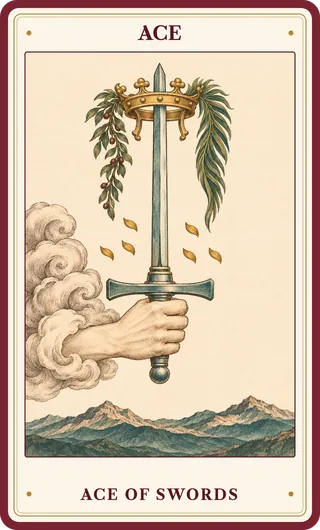
Look at the Rider-Waite-Smith image with the card inverted. The hand still emerges from the cloud, but now the blade points toward the ground, the crown sits at the bottom, and the six falling yods seem to rise instead of drop. The visual message is that the sword cannot do its work: the crown of victory is out of reach, and the direction of the energy has flipped.
The double-edged blade matters most here. A double edge means the truth can cut the speaker as readily as the listener. Reversed, the point faces down and the grip is awkward, which suggests unskilled or careless use. That fits both readings of the card: a mind that cannot find the point, and a voice that wounds without meaning to.
The palm and olive branches still hang from the crown. Even upside down, the picture includes success and peace, which is a reminder that the situation can still resolve well. The card shows a delay or a misuse, not a closed door.
Ace of Swords card symbols
Choose a symbol to read what it means on the card.
Hand from the cloud
A single hand reaches out of a cloud and grips the sword. It shows an idea or insight arriving from beyond ordinary effort, and reversed it can suggest the gift has not fully landed in your hands yet.
Double-edged sword
The blade cuts both ways, so truth can heal or wound. Reversed, with the point turned down, the question is whether the blade is aimed at the problem or at a person.
Crown with laurel wreath
The crown at the tip stands for earned victory and mental mastery. Reversed, it hints that the win is premature or that pride has crept in.
Palm and olive branches
A palm branch (success) and an olive branch (peace) hang from the crown. Reversed, they remind you that clear thinking should end in resolution, not in conflict for its own sake.
Falling yods
Six small flame-shaped drops fall from the cloud, a Hebrew letter often linked to divine energy and grace. Reversed, they read as inspiration scattering before it can be caught.
Barren mountains
Rough grey peaks sit below the cloud, a stark, cold view from above. Reversed, the view is harder to see, and the bare ground reflects how exposed and uncertain a new idea can feel.
Grey sky and cloud
The cloud holds the hand and keeps the origin of the idea a little mysterious. Reversed, it becomes the fog that hides the answer from you.
Is the Ace of Swords reversed a bad sign?
It is an uncomfortable card, but not a doom card. Compare it with the heavier cards in the same suit, such as the Three of Swords or the Ten of Swords, which describe real pain and endings. The reversed Ace is about clarity, and clarity can be recovered.
It is also a useful warning. Reversed, it can stop you from acting on a half-truth, sending a message you would regret, or making a major decision on a bad day. Readers often notice that the card appears just before a piece of information arrives, so the delay can carry its own value.
The risk lies in ignoring it. If the card shows up and you push ahead anyway, you may end up with the exact confusion it described. Treat it as a request to check your facts and your tone.
How to tell which meaning applies
Context decides. Look at the question, the position in the spread and the cards around it. If your question is about a decision, the card most likely means missing information or fog. If it is about a relationship conflict, it more likely means harsh or unclear communication. If it is about a project, think of an unfinished idea.
A few quick tests help. Ask yourself: Am I short of information, or short of nerve? Is someone being honest in a way that feels cruel? Have I been avoiding a conversation? Your honest answers usually line up with one of the four patterns above.
When you are still stuck, pull a clarifying card. A Page of Swords reversed next to it suggests scattered thoughts and gossip, while a reversed court card in the suit often names the person whose communication is the issue.
Cards that often appear with it
Neighbouring cards sharpen the picture. With the Two of Swords reversed, the fog may come from a decision you have been avoiding, and the reversed Ace of Swords shows what is lost by waiting. With the Seven of Swords, hidden information or deception may be at work. With the Five of Swords, truth used as a weapon becomes a full argument.
Paired with a gentler card such as the Two of Cups or the Queen of Cups, the card softens: the issue is more about unspoken feeling than cruelty. Next to the Hermit or the Four of Swords, it suggests that rest and quiet are the way to clear the mind.
In a three-card line-up (see the 3 card tarot guide for a simple structure), try placing it in the middle as the obstacle. The card before it shows how the fog began, and the card after it shows what clears it.
What to do when the Ace of Swords is reversed
You can work with this card directly. Pause important decisions and conversations until you have checked your facts. Put the thought on paper, since writing is one of the best ways to sort scattered thinking. Then pick the single honest statement you need to make and choose how to say it with care.
If someone else is the source of the trouble, ask direct, neutral questions and request things in writing. Clarity is easier to hold when it is recorded. If the blockage is within you, rest first. Tired minds produce tired conclusions.
Try this: Draft the message or sentence you have been avoiding. Remove every word that accuses and keep every word that informs. Read it aloud, then decide when to say it.
Reversed Ace of Swords compared with similar cards
Several swords cards also involve confusion, so it helps to separate them. The Two of Swords (blocked, blindfolded choice) is about refusing to decide. The reversed Ace of Swords is about not having the clarity to decide. The Eight of Swords reversed is about breaking free from self-imposed limits, while the reversed Ace is about not yet seeing what to break free from.
The Ace of Wands reversed is a different problem again: lack of drive rather than lack of clarity. If you feel unmotivated rather than confused, that card may match better. Likewise, the reversed Page of Swords is closer to restless talk than to genuine misunderstanding.
The test is always the same: what is missing? If it is information, clear thought or honest language, you are in the territory of the reversed Ace. If it is energy, courage or patience, look to its neighbours.
When it appears in a larger reading
In bigger layouts such as the Celtic Cross, the position changes the emphasis. In the past, it describes confusion that shaped where you are now. In the present, it names the main blockage. In the outcome position, it warns that a result is unclear unless you act to get clarity, and it often hints that the current plan needs more thought.
As a card of advice, it is direct: take time, check details and speak with care. As a card of hopes and fears, it may show a fear of saying the wrong thing or a hope for someone to finally say the right one.
Whatever the layout, bring the card back to a practical question. What do I need to know that I do not know yet, and what is the kindest accurate way to say what I already do?
Spiritual and personal growth meaning
On a personal level, the reversed Ace asks you to look at your beliefs. You may be holding onto ideas you adopted without testing, or chasing a new belief system that does not actually serve you. It is a good moment to question your assumptions gently and to separate what you know from what you were told.
It can also point to the way you talk to yourself. Harsh inner criticism is truth used as a weapon against the self. Restoring the card’s balance means keeping your standards but speaking to yourself the way a fair friend would.
Used this way, the reversed Ace of Swords becomes a tool for self-honesty. The aim is not to win an argument with yourself. It is to see what is real, in the right light, and at the right time. For more on the suit’s themes, the overview of the suit of Swords shows how the Ace sets the tone for every card that follows.
Questions readers ask
What does the Ace of Swords reversed mean?
It points to blocked, muddled or misused clarity. You may be short of key facts, struggling to put a thought into words, or using the truth in a way that hurts more than it helps.
Is the Ace of Swords reversed a yes or no?
Usually it leans toward not yet, or no for now. The information, decision or honest conversation needed for a good outcome is incomplete, so wait and check the facts.
What does the Ace of Swords reversed mean in love?
It often shows miscommunication, mixed signals or a conversation that keeps being avoided or delivered too harshly. It can also mean you do not yet know what you truly want from the relationship.
What does the Ace of Swords reversed mean for someone's feelings?
Their feelings are probably unclear, even to them, or they are struggling to express them. It can also warn of blunt or critical words that hide softer feelings underneath.
Is the Ace of Swords reversed a bad card?
No. It is a warning about foggy thinking or misused words, not a prediction of failure. Once you identify what is missing, the clarity of the upright Ace is usually within reach.
What is the difference between the Ace of Swords reversed and the Two of Swords?
Reversed, the Ace of Swords is about clarity that is blocked or misused. The Two of Swords is about avoiding a choice you already know you face. The Ace needs better information, while the Two needs courage.