
Eight of Swords Reversed (Meaning in Love, Work & Life)

- Arcana
- Minor Arcana, Suit of Swords
- Element
- Air
- Yes or no
- No
restrictionfeeling trappedself-limiting beliefs
confusionrecoveryrelease of mental strain
The Eight of Swords reversed means the blindfold is slipping. You are starting to see that the trap you felt stuck in was built mostly from fear, assumption and old stories, and you are beginning to move. It is one of the most hopeful reversals in the Swords suit, and it often arrives after a long stretch of feeling stuck. In some readings, it shows the opposite: fear tightening its hold, with the person drifting further into helplessness.
This page covers both readings, how to tell them apart, and what the card says in love, work, money, health and spirituality. You will also find what it means as a person, as someone’s feelings and as a yes or no answer. For the card in its normal position, see the upright Eight of Swords.
What the Eight of Swords reversed means
At its core, this card is about waking up. The upright Eight of Swords shows a mind that has talked itself into being stuck, and the reversal shows the moment that spell weakens. You catch yourself thinking “I have no choice” and ask whether that is true. Often it is not.
The change is usually quiet. There is rarely a dramatic escape. You notice an option you dismissed months ago, you ask for help you were sure would be refused, or you realise a rule you were living by was never real. The relief can be enormous, and that is the sign of a reversed Eight of Swords done well: the consequences you dreaded turn out to be far smaller than the fear itself.
Keywords for the positive reading: release, clarity, self-trust, options, courage, taking back control, ending a victim story. Keywords for the difficult reading: avoidance, deepening anxiety, helplessness, shutting down, blaming others, refusing to look.
The upright card, and what gets reversed
To read the reversal well, picture the original image. A woman stands blindfolded and loosely bound, ringed by eight upright swords, on wet ground with a castle on a cliff behind her. The swords form a fence with gaps in it, and the cloth around her is loose. She is not in a locked cell. She is stuck because she believes she is.
Upright, then, the card is about restriction that is largely self-made: fear, overthinking, anxiety and the belief that nothing can change. It sits in the middle of a run of Swords cards that move from conflict toward pain, so you can see how it connects to the Nine of Swords (anxiety at night) and the Ten of Swords (the low point).
Reversed, the energy of that image either releases or inverts. The blindfold comes off and the bindings fall away, or the figure goes deeper into the same pattern and stops looking for the gaps.
Two readings: release or tightening
Most of the time, the reversed Eight of Swords is the release reading. You are stepping out of the cage. Rules you assumed turn out to be optional, an exit appears, and you feel your own agency again. This is the version to expect when the cards around it are open, active or hopeful.
The second reading is the tightening one. Here the reversal shows someone who responded to fear by narrowing their world even more. They avoid, they justify, they blame others, and they decide the situation cannot change before they have tested it. The blindfold is still on, but now it is tied with some pride.
Both readings come from the same root: the person is at a turning point. The question is whether they turn toward the gaps in the swords or away from them. Think of the card as a fork rather than a verdict.
Read Eight of Swords for your question
Upright: You speak up, leave a situation that boxed you in, or drop an old fear that love is not available to you.
Reversed: You stay silent, keep tolerating a pattern that hurts, or let fear of loss talk you out of an honest conversation.
Upright: They feel the relief of seeing clearly and are ready to be honest with you and with themselves.
Reversed: They feel stuck, anxious or ashamed, and they are not yet able to say what is really going on.
Upright: You see options you had written off, and you are ready to ask for change or walk away from a role that shrank you.
Reversed: You keep telling yourself you have no choice, so you stay in a role or routine that is wearing you down.
Upright: Money panic eases once you look at the actual numbers, and a workable plan appears.
Reversed: Fear keeps you from opening the statements, asking for help or making a plan, so the problem grows.
Upright: Take off the blindfold, test the loose bindings and take one small step out.
Reversed: Stop arguing with your own fear, get one outside opinion, and do not wait for rescue.
Upright: Anxiety loosens its grip, and support, rest or therapy starts to work.
Reversed: Worry becomes constant or overwhelming, and it is time to get proper professional support.
How to tell which reading applies
Start with the question. If you asked how to get out, how to move on or whether you can change something, the release reading is almost always the right one. If you asked why nothing is working or why you feel worse, the tightening reading deserves a harder look.
Then check the neighbouring cards. Swords and Wands energy beside it tends to push toward action. Heavy cards such as the Ten of Swords or the Five of Cups suggest the weight is still there. A good rule is to ask what the next card would do to this one: does it hand you a tool, or does it add more fear?
Finally, check your own body when you look at the card. If you feel a small lift of relief, you are likely reading the release version. If you feel defensive or flat, ask yourself what you are avoiding. For a fuller guide to this kind of reading, see how to read reversed tarot cards.
Try this: Write down the one belief that makes you feel trapped, such as “I cannot afford to leave.” Underneath, list three things that would have to be true for that belief to be wrong. Pick the easiest one and test it this week.
Eight of Swords reversed in love
If you are single, this card says an old fear is losing its grip. It might be the belief that everyone good is taken, that past heartbreak decides your future, or that you must be perfect before anyone could want you. As that belief weakens, you become easier to approach and more willing to try.
In a relationship, the card points to a choice you have avoided. You might find the nerve to say the thing you have been swallowing, to ask for what you need or to change a pattern you had accepted. It does not tell you whether to stay or go. It tells you that you are no longer pretending you have no say.
In some readings, it shows a person leaving a relationship that left them feeling small, or breaking free of a controlling dynamic. If that sounds close to home, treat the card as encouragement to get real support from friends, a counsellor or a helpline, not only as a symbol.
The tightening version in love looks like staying silent, tolerating what hurts and telling yourself the relationship is the only one you will ever get. If you see that in your reading, the card is asking you to look at it honestly.
Eight of Swords reversed as feelings
When this card describes what someone feels about you, it speaks more about their state of mind than about their level of interest. In the positive form, they are coming out of a confusing stretch. They may have been anxious, stuck or afraid to commit, and they are starting to see clearly and speak openly.
That can be good news for a connection that stalled, because a person who sees clearly can finally act on what they feel. It can also be bad news if what they see is that the relationship is not right. Either way, you are getting more honesty than before.
In the negative form, they feel trapped, ashamed or frozen. They may care but be unable to say so. Give them space and patience without waiting forever. The card suggests that you cannot make someone else take off their blindfold.
Eight of Swords reversed in career
At work, the card shows you waking up to options. A job that felt like a trap may turn out to have an exit, a transfer, a conversation or a skill you can sell elsewhere. You might realise you have been underestimating yourself, or that the thing you were afraid to ask your manager is entirely reasonable.
It also suggests you are done carrying a burden that was not yours. That can mean setting boundaries, saying no to extra work or finally applying for the role you kept talking yourself out of. Compare it with the Eight of Cups reversed, which describes a similar crossroads but through the lens of emotional fulfilment rather than fear.
The difficult reading is an employee who stays in the role purely out of dread. They keep saying there is nothing else out there without checking. Spend an hour looking at real listings, and the card’s message will probably become clear.
Eight of Swords reversed in money
Financial fear is a classic Eight of Swords pattern: you avoid opening the statements, you assume the worst and you freeze. Reversed, the freeze breaks. You look at the actual numbers, and they are usually more workable than the picture in your head.
Practically, this is a good card for making a budget, calling a creditor, asking for a payment plan or talking to an adviser. Clarity is the real wealth here. Once you know where you stand, you can choose, and choosing is what the bound figure could not do.
The tightening version is avoidance: unopened letters, unanswered calls, spending to soothe anxiety. If that is you, take one small step today, such as listing every debt in one place. If you want a layout for the question, try a money tarot spread.
Eight of Swords reversed in health
For health, the card most often points to mental and emotional health. Anxiety, panic, intrusive thinking and a sense of being trapped in your own head are its home territory. Reversed, it can show these easing as you find the right support, build better habits or simply stop fighting your own mind.
It can also show a period of recovery after a long stretch of low confidence or fear. The change is typically gradual, and the card encourages you to notice small wins rather than expect a sudden cure.
Still, the reversal can reflect worsening anxiety or a sense of being overwhelmed. Tarot is not a diagnosis, and it cannot replace medical or mental health care. If worry is constant or you feel hopeless, speak to a doctor or a qualified professional, and in a crisis, contact your local emergency or crisis line.
Eight of Swords card symbols
Choose a symbol to read what it means on the card.
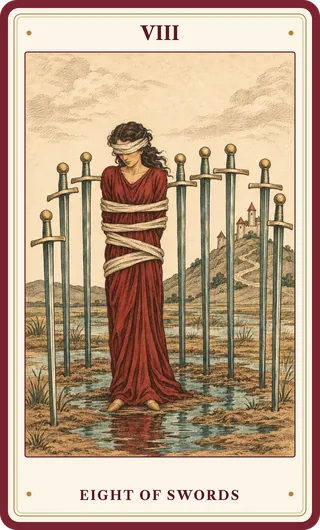
The blindfold
It stands for a view of life that is cut off by fear and assumption. Reversed, the cloth slips or comes off, and you see what was always there.
The loose bindings
The cloth wrapped around her body is loose, not tight. Reversed, you finally test the restraint and find it will not hold.
The eight swords
They form a ring of blades that looks like a cage but has gaps. Reversed, you notice the gaps and the open path between them.
The bare feet in water
Water is the emotional world, and she walks through it unprotected. Reversed, you take a step, and the ground turns out to be passable.
The castle on the cliff
The distant building stands for safety, structure and the life you can reach. Reversed, it comes into view as something you are heading toward.
The grey sky
It shows a mind clouded by worry and overthinking. Reversed, the grey begins to lift as thinking clears.
The woman's pose
She is upright, still and waiting, which shows a person who has stopped moving rather than one who cannot move. Reversed, she starts to act.
Spiritual meaning
Spiritually, the Eight of Swords reversed is about dropping beliefs that kept you small. These might be inherited ideas about what you deserve, rigid rules about how a spiritual path must look or the story that you are somehow behind. As they loosen, you have more room to explore.
Traditional systems link this card with Jupiter in Gemini, which is a fitting pairing: Jupiter expands, Gemini thinks, and together they suggest a mind that is being widened. The reversal is that widening beginning. Meditation, journaling and honest conversation work especially well with this energy, since they help you hear the thoughts that run the show.
The Eight of Swords reversed as a person
As a person, this card describes someone in the process of changing how they see their life. They might be leaving a controlling situation, recovering from a period of fear or standing up to someone who has dominated them. They are often a little raw, but they are more honest than they used to be.
On the shadow side, it can describe someone who keeps others at arm’s length while insisting they have no choices. They may blame their circumstances, justify staying put and resist advice. They are not bad people, simply stuck, and the card asks for patience as well as clear limits.
If you are the one in the reading, this is a card for you to claim. You are not the woman waiting to be rescued anymore. You are the one who takes the cloth off.
Yes or no
Reversed, the Eight of Swords leans towards yes. That holds best when the question is about freedom: Can I leave? Will I find a way out? Will this fear ease? The card says the path exists, and you are more able to take it than you believed.
It becomes a cautious answer when the question depends on fear staying in place, or when the surrounding cards are heavy. A good reading might be “yes, once you stop avoiding it”. You can see the card in its normal position in the Eight of Swords yes or no guide, which compares both directions.
Timing and how fast things change
The reversed Eight of Swords usually points to a shift that is already beginning. The change is internal first: a new thought, a clearer look. Outer events often follow within days or weeks, since a decision does not take long once you stop arguing with yourself.
Because it is a Swords card, it relates to air and thought, and it tends to move quickly once the mind is clear. If you want a more systematic approach to timing, see tarot timing.
For the tightening reading, timing is open-ended. The trap stays as long as the avoidance does, and nothing moves until you look.
Cards that change its meaning
Pairings shape this card more than almost any other. With the Ace of Swords, the clear thought arrives with real force, and with the Six of Swords reversed, you may be resisting a move you need to make. With the Nine of Swords or the Moon, anxiety is still loud, and with the Hanged Man, the pause is a conscious choice instead of a trap.
With the Tower, the cage breaks suddenly, and you may be freed by events rather than by your own choice. With the Strength or the Chariot, you have the will to get out and use it. With the Devil, you are dealing with attachment as well as fear, so look hard at what you are getting out of staying.
When the Eight of Swords reversed turns up in a three-card spread, its position matters. In the past, it shows a trap you already left. In the present, it is the turning point itself. In the future, it promises relief that depends on your willingness to look. A simple 3 card tarot layout is a good frame for this.
What to do when it appears
The card invites action in small, concrete steps. Do not wait for a perfect plan, because the bound figure is stuck partly because she keeps waiting for certainty. A single step that tests the bindings is worth more than a month of thinking.
Here is a simple sequence to follow:
- Name the trap in one sentence, in plain words.
- Write down what you believe will happen if you leave or change it.
- Ask someone you trust whether that picture is realistic.
- Choose the smallest action that would test it.
- Take that action within three days.
If the card describes a situation where someone is hurting, controlling or frightening you, get outside help first. The Eight of Swords reversed is a signal to look for exits, and the safest exits often need support.
Try this: Pull one card as a follow-up, a Swords card if you have one, and ask “What is the first gap I can walk through?” Write down what you see in the card and do the first thing it suggests.
When the reversal is not just in your head
The upright Eight of Swords is often described as self-imposed, and that is usually true. But some traps are real: financial dependence, a controlling partner, an unsafe job or a health condition. When a reversal falls in such a reading, the card is not blaming you for being trapped. It is asking you to see the full picture, including the part that is real.
Look at the part you control. You may not control every circumstance, but you can control how clearly you see it, who you talk to and what you try first. This is the real freedom of the card: you do not have to be certain the way is open, only willing to check.
For more cards in the suit that deal with mental strain and its release, see the full Swords suit meanings. The Eight of Swords reversed is a reminder that the way out was often there all along, and that seeing it is the first step in using it.
Questions readers ask
What does the Eight of Swords reversed mean?
It most often means release from a mental trap: the blindfold comes off, you see options you had ruled out and you start to act. Less often, it shows fear deepening, with someone sinking further into helplessness. The cards around it and the question you asked tell you which one applies.
Is the Eight of Swords reversed a good card?
Usually yes, since it is one of the more hopeful reversals in the Swords suit. It marks the moment you stop waiting for rescue and start acting. It can also be a warning that you are avoiding a hard truth, so read it alongside the rest of the spread.
Is the Eight of Swords reversed a yes or no?
It leans towards yes, especially if your question is about getting free, leaving or making a change. If you are asking about something that depends on fear or avoidance staying in place, the answer may be 'not as you expect'. Surrounding cards decide the final answer.
What does the Eight of Swords reversed mean in love?
For singles, it means letting go of the belief that love is unavailable or that past hurt decides your future. In a relationship, it points to speaking up, changing a pattern or making a decision you have put off. It can also show you leaving a situation that left you feeling trapped.
What does the Eight of Swords reversed mean as someone's feelings?
It describes a person who is coming out of confusion or fear and starting to see their situation clearly. They may be ready to be honest about how they feel. If the card is negative in context, it can mean they feel stuck and cannot yet say what they want.
Can the Eight of Swords reversed mean someone is really trapped?
Yes. Upright, the card is about restrictions that are mostly mental, but a reversal can reflect a situation that has actually become harder to leave. If you are in a relationship or job where you are being controlled or harmed, take the card as a prompt to seek outside support, not as a sign that it is all in your head.