
Two of Swords Reversed (Meaning in Love, Work & Life)

- Arcana
- Minor Arcana, Suit of Swords
- Element
- Air
- Yes or no
- Maybe
stalematedifficult choiceavoidance
confusionrecoveryrelease of mental strain
The Two of Swords reversed means the stalemate is breaking. The blindfold is slipping, the avoided decision can no longer wait, and the truth you have been holding at arm’s length starts to show. For some people that brings clarity and relief. For others it brings overwhelm, because too much information or too much pressure arrives at once.
This is a card of two possible outcomes, and your question tells you which one applies. If you have been stuck and are ready to move, it points to a choice being made. If you have been spinning in anxiety, it warns that the indecision is getting heavier. The sections below cover love, work, money, health, feelings and yes or no questions, and show how to tell which version you have drawn. If you want the card’s base meaning first, start with the Two of Swords upright and reversed guide.
Two of Swords reversed at a glance
The core keywords are decision made, truth revealed, confusion, information overload, release and delayed choices. The first three describe a stalemate ending. The last few describe what happens when you stay in it too long and the strain begins to leak out.
Think of the upright card as a held breath. The woman sits very still, swords crossed over her chest, eyes covered. Reversed, that breath is let go. Sometimes it is a relief, and sometimes it is a gasp.
- Upright: indecision, avoidance, stalemate, a guarded heart
- Reversed: a choice is forced or finally made, a hidden truth surfaces, or overwhelm takes over
What changes when the card flips
The Two of Swords works because of tension. Two blades balance each other, and she holds them so neither side wins. The blindfold stops her from seeing the facts, which keeps the balance intact. Reversing the card disturbs that balance, and every symbol in the image can shift with it.
The blindfold may come off, which means seeing what you did not want to see. The swords may drop, which means the defensive posture ends. The still water may ripple, and the feelings she has kept in check begin to move. None of this is dramatic on its own. It is the point at which “I’ll think about it” stops working as an answer.
If you are newer to reading cards upside down, the guide on how to read reversed tarot cards explains the different approaches, and this card is a good example of why context matters.
The two ways this card plays out
The first version is the stalemate breaks. A choice is made, either by you or for you. You have the conversation, send the email, hand in the notice, or accept the answer you already knew. This version often feels like pressure lifting, even if the decision itself is hard.
The second version is overload and confusion. Here the blindfold is gone but you cannot make sense of what you see. You have read every article, asked every friend and made every list, and you feel further from an answer than when you started. Reversed, the card describes a mind with too many inputs and no way to sort them.
Both can show up in the same reading. A common pattern is that the truth arrives first, then confusion about what to do with it, and only after that a choice. Ask yourself which stage you are in right now. That usually settles which meaning fits.
Read Two of Swords for your question
Upright: You are torn between two people or paths, or you are avoiding a conversation that your relationship needs.
Reversed: The avoidance ends: you finally choose, say the hard thing, or a truth comes out that changes how you see someone.
Upright: They feel guarded and conflicted, keeping emotion under tight control so they do not have to pick a side.
Reversed: Their guard is slipping, so feelings are surfacing, though they may be confused, overwhelmed or pushed into a decision.
Upright: You are stuck between two offers or options and putting off the call.
Reversed: A decision can no longer wait, or office politics and hidden information come into the open.
Upright: You are weighing two financial choices and refusing to look at the real numbers.
Reversed: You start seeing your finances clearly, which is uncomfortable but is the first step to a plan.
Upright: Pause, gather what you need, and admit that not choosing is also a choice.
Reversed: Take off the blindfold: set a deadline, stop collecting opinions, and act on what you already know.
Upright: Stress is held in the body because you are suppressing what you feel.
Reversed: Mental overload and anxiety are catching up with you, and rest, boundaries and honest support are needed.
Two of Swords reversed in love
In a love reading, this card says the waiting is over. A person who would not choose between two options, or between staying and leaving, finally does. Or a conversation that has been avoided for months gets said out loud. It can also mean a truth comes out (about a partner, a feeling, or yourself) that changes how you see the relationship.
If you are in a relationship, the card often points to a quiet standoff that can no longer continue. You and your partner may both be avoiding a topic such as commitment, money, children or a rift with family. Reversed, someone raises it, or circumstances do.
If you are single, the card can describe someone avoiding dating altogether because of worry or past hurt. The blindfold is protection. Reversed, it suggests the protection has become a cage, and a small step toward openness is due.
When you are torn between two people
A reversed Two of Swords in a love triangle or “who do I choose” reading says the fence-sitting has a limited life. Someone will feel the strain, whether that is you, one of the two people, or all three. Stop asking for more evidence and ask what you would feel if you chose each option and told no one about it. The answer you notice first is usually informative.
Two of Swords reversed as feelings
As a person’s feelings, the upright card describes someone guarded who keeps emotion under rational control. Reversed, that control is slipping. The person you are asking about may be more affected than they have let on, and they may be confused about it.
This does not automatically mean they will act on it. Someone with a reversed Two of Swords may be overwhelmed by what they feel and need space, or they may be about to open up. Read the neighbouring cards. If you see something like the Two of Cups reversed or a cold court card nearby, the picture changes quite a bit.
If the card describes how someone sees you, it may suggest they view you as indecisive or as someone who avoids hard choices. That can be useful feedback rather than a verdict.
Try this: Write down the one decision or conversation you have been avoiding for longest. Under it, list only the facts you actually know, not guesses or fears. If the list has fewer than three items, you are overthinking, not under-informed.
Two of Swords reversed at work
At work, the card usually means a decision can’t be put off any longer. A job offer has a deadline, a manager wants an answer, or you realise you have been staying in a role mainly because leaving felt too hard. It can also mean office politics or hidden information is coming into the open, which ends a quiet stand-off between colleagues.
Sometimes the choice is made for you. The reversed Two of Swords can show up before a restructure or lay-off in a role you could not bring yourself to leave. That is not a prediction of loss. It reflects the pattern of a decision being taken out of your hands because you did not take it yourself.
The other face of this card at work is mental overload: too many tabs open, too many conflicting instructions, a team arguing over two options with no tie-breaker. The fix is usually a deadline and a decision-maker, not more data.
Two of Swords reversed in money
In a money reading, the blindfold coming off often means seeing your real financial position for the first time in a while. That can be uncomfortable, but it is the beginning of a plan. People who draw this card sometimes have not opened a statement or checked a balance in weeks.
It can also show a conflict between what you want and what you can afford, such as a purchase, a loan or an investment you keep going back and forth on. The card advises against paralysis. Make a small, reversible choice rather than none, and review it in a month.
If you want a structured way to read money questions, try the money tarot spread.
Two of Swords reversed for health and wellbeing
For health, this card is about the link between worry and the body. Long-term suppression of feelings and constant mental looping can show up as tension, poor sleep, headaches or a sense of being wired and tired. Reversed, the strain is catching up and asks for attention.
The practical message is to give your mind fewer inputs and your body more rest. That might mean cutting back on news and scrolling, talking to someone you trust, or getting professional support if anxiety is taking over. Tarot can reflect a pattern, but it does not replace medical or mental health care.
Two of Swords reversed in spirituality and personal growth
On a spiritual path, this card can show clarity arriving after a long period of uncertainty. It can also show the opposite: you are pulled between too many practices, teachers or systems, and reading more has become a way to avoid actually practising.
Reversed, the moon in the image asks you to trust your own sense. The woman has intuition available the whole time, but she has covered her eyes and put her faith in the swords. If you have been collecting opinions about what to believe or what to do, the card invites you to stop and listen to what you already know.
Is the Two of Swords reversed a yes or no?
Reading sources differ here, and that is fair, because the card does not fit a simple answer. Some call it a clear yes because the deadlock breaks and things move. Others treat it as “not as asked” because the real issue is the avoidance, not the outcome you are asking about.
My reading is that it leans yes to “will a decision happen?” and stays open on “will it be the one I want?” If your question is “should I finally do this?”, the card supports acting. If your question is “will they choose me?”, it says the choice is coming, and it does not promise the result. For a quick answer based on the card alone, the Two of Swords yes or no page gives the standard reading.
Two of Swords card symbols
Choose a symbol to read what it means on the card.
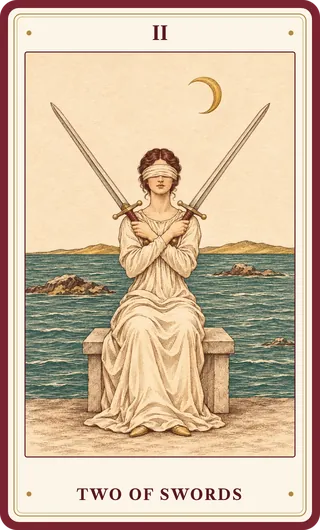
The blindfold
She chooses not to see. Reversed, the blindfold slips or is pulled off, and the truth she avoided becomes visible.
The crossed swords
Two blades held in balance show a stalemate with no side allowed to win. Reversed, the cross loosens and the deadlock breaks.
The crescent moon
The moon points to intuition and what lies beneath conscious thought. Reversed, it asks you to stop overthinking and trust what you already sense.
The calm sea
The water behind her looks still, but emotion sits just under the surface. Reversed, the surface ripples and feeling comes through.
The jagged rocks
Rocks rise from the water as hidden dangers and unseen obstacles. Reversed, they are exposed, so you can finally see what you were avoiding.
The stone seat
She sits on a bench at the water's edge, held in place and not moving. Reversed, the stillness ends and you are forced to stand up.
The white robe and open stance
Her plain pale clothing and upright posture suggest neutrality and composure. Reversed, that careful calm cracks under pressure.
Two of Swords reversed in past, present and future positions
In the past position, the card says you avoided a decision that is still affecting you, or that a stalemate ended in a way that shaped where you are now. Ask what you refused to look at back then.
In the present position, it describes the moment of breakdown or breakthrough. You are either at the edge of choosing or feeling the weight of not choosing. This is the most active position for the card.
In the future position, it suggests a decision is coming that you cannot postpone, or that new information will end a period of confusion. It is a heads-up to prepare, not a warning of disaster. In a simple three card spread, look at what sits beside it: the card before shows what caused the stalemate and the card after shows what happens once it breaks.
Upright versus reversed Two of Swords
The easiest way to separate them is by movement. Upright, nothing moves: you are holding balance, protecting yourself and delaying. Reversed, something has to give.
Upright can also be a healthy pause. A moment of deliberate neutrality before a major choice is not a flaw. Reversed is less patient. It says the pause has either worked and you can move, or it has gone on too long and the cost is rising.
In emotional terms, upright is control and reversed is the loss of it. That loss can be a release or a flood, and which one you get depends partly on how long you have been holding on.
Is the Two of Swords reversed a bad card?
No. It can feel harsh because it takes away the comfort of not deciding, but most of what it brings is useful: a truth, a deadline, a decision, a clearer head. A real problem arises only when you read it as permission to rush.
The more cautionary version is the overload version. If you are anxious and cannot sort your thoughts, the card is a sign to slow down, reduce the noise and look after yourself before choosing. A choice made in a panic is often just another way of avoiding the issue.
Compare it with the sharper cards in the suit. The Eight of Swords reversed is also about removing a blindfold or binds, but there the freedom is about self-imposed limits, while the Two is about a specific choice. For the whole suit and how these cards relate, see the Swords suit overview.
Cards that combine well with the Two of Swords reversed
Pairings help tell you which version of the card you have. A few worth knowing:
- Ace of Swords: a sudden clear truth cuts through the confusion, and the decision becomes simple.
- Seven of Swords: hidden information or something not being said, so the “truth surfacing” meaning is strong.
- Justice: a fair and final decision with real consequences.
- Nine of Swords: the anxiety version, with worry and sleeplessness around the choice.
If the Two of Swords reversed is followed by the Ace of Swords, the stalemate ends with a breakthrough. If it sits next to the Nine of Swords, the overload and worry reading is probably the one to trust.
Questions to ask yourself when it appears
Because the card has two sides, questions work better than rules. Use them to decide which version you are in:
- What decision or conversation have I been avoiding, and for how long?
- Do I need more information, or do I already have enough?
- Is the pressure I feel coming from a real deadline or from my own fear?
- What would I choose if nobody else’s opinion mattered?
- What is the smallest honest step I can take this week?
Notice which question produces the strongest reaction. That reaction is where the card is pointing.
How to work with this card
Start by naming the choice in one clear sentence, such as “I am deciding whether to leave this job by March.” Vague dilemmas stay stuck, and a specific one can be answered. Then set a date by which you will decide, even a soft one.
Next, limit your inputs. Pick one or two people whose judgement you trust and stop asking everyone else. The reversed Two of Swords often shows up when we use opinions as a way of postponing responsibility.
Finally, accept that you will not have perfect certainty. The woman on the card is waiting for a clarity that her blindfold prevents, and no extra research will remove it. Make the best choice available, and plan to adjust if you learn something new.
Try this: Draw one more card, using the random tarot card generator, and ask “what happens if I decide this week?” Do not pull a third. Treat the answer as one more input, then write down your decision.
When the card is upright but reads like it is reversed
Sometimes a Two of Swords drawn upright fits the reversed story, and sometimes a reversed draw describes a quiet, healthy pause. Cards are not bound by position. If you pulled it upright and you are plainly overwhelmed, you can lean on the overload side. If you pulled it reversed but you are calm and reflective, the card may be asking you to simply continue a considered wait.
The test is your actual situation, not the orientation alone. Ask whether the stalemate is still holding or already giving way. That answer matters more than which way the card was facing when it landed on the table.
Try this: For the next three days, note each time you catch yourself saying “I’ll decide later.” Write what you are waiting for. By day three you will usually see whether it is new information or simple reluctance.
Questions readers ask
What does the Two of Swords reversed mean?
It usually means a stalemate is ending. A decision is made, a truth surfaces, or information overload becomes impossible to ignore. It can also mean that the indecision is getting worse, so the surrounding cards matter.
Is the Two of Swords reversed a good or bad card?
It is neither. It can feel uncomfortable because the avoidance ends, but it often brings relief and clarity. It becomes a warning only when you stay stuck or let anxiety make the choice for you.
What does the Two of Swords reversed mean in love?
It means the waiting is over. You may finally choose between two people, end an avoided conversation, or learn something that changes how you see your partner. It can also describe someone avoiding dating out of worry.
Is the Two of Swords reversed a yes or no?
It leans yes, in the sense that a decision is coming and things will move. It is not a clean yes to the specific outcome you want. Treat it as a sign that the choice is yours to make now.
What does the Two of Swords reversed mean as someone's feelings?
The person has been holding their feelings back, and that control is now slipping. They may be confused, overwhelmed or ready to be honest. Whether it works in your favour depends on the cards around it.
How do I tell upright and reversed Two of Swords apart in a reading?
Upright is the stalemate itself: you are holding still and refusing to choose. Reversed is the moment the stalemate breaks or the strain of it becomes too much to bear.