
Eight of Cups as a Yes or No Answer

- Arcana
- Minor Arcana, Suit of Cups
- Element
- Water
- Yes or no
- No
walking awayseeking more
emotional blockswithdrawalimbalance
The Eight of Cups is a no when your question is about staying put, waiting or investing more in something that has stopped satisfying you. It is a yes when your question is about leaving, moving on or changing direction. Upright, the card leans no. Reversed, the answer softens into not yet, because the figure on the card is hesitating instead of walking away.
That split is the part most quick answers skip. The card does not simply say no to everything. It says no to the situation you are in and yes to the decision to leave it. The wording of your question decides which of those you hear, so this page shows you how to read both.
The short answer: upright leans no, reversed means not yet
In a yes or no reading, the upright Eight of Cups says no to the thing you are asking about if that thing is a familiar situation you hope will start working. Will this job finally feel right? Will he change? Should I put another year into this? The card says no, and it says so gently. Something has been lost that effort cannot bring back.
Reversed, the Eight of Cups is not a clean yes or a clean no. It describes a person who has started to leave and stopped, or who left and is now looking back. The honest reading is “not yet” or “it depends on a decision you have not made.” You can read more on the card as a whole on the Eight of Cups meaning page.
If you need a single word, use no for upright and maybe for reversed. Then check your wording, because that single word changes depending on what you asked.
Why the Eight of Cups leans no
Look at what the card shows. Eight cups are stacked in a tidy arrangement, all of them full, and a figure turns away from them. A card that shows someone abandoning what they have built is not going to say “yes, go ahead and keep it.” Its core message is that what you have is not enough, even though it looks like plenty.
That makes the card a no to continuing. It is a no to the relationship that is polite but empty, the job that pays but drains you, and the plan you keep pursuing out of habit. The no is not a punishment. It is an honest reading of the emotional temperature: you already know the answer, and part of you has been walking away for some time.
The card is also a no to quick fixes. The figure carries a staff and heads for mountains, so the way out is long. If you ask whether things will be resolved soon and easily, the Eight of Cups tells you that nothing here is quick.
When the Eight of Cups is a yes
The same card turns into a yes as soon as you ask the question from the figure’s side. Should I leave this relationship? Should I quit? Should I walk away from this deal? The Eight of Cups backs the decision to go. It tends to appear for people who have already thought it through and need permission to act on it.
A useful test is to ask whether your question is about keeping or about releasing. Questions that start with “should I stay,” “will it get better” or “can I make it work” get a no. Questions that start with “should I leave,” “is it time to move on” or “should I let this go” get a yes.
This is why the card feels contradictory when you search for a simple answer. It is not unclear. It is consistent: it favours leaving over staying, and your question just has to be pointed in a direction it can answer.
Read Eight of Cups for your question
Upright: Yes to ending a relationship that no longer feeds you, and no to hoping it will fix itself unchanged.
Reversed: Not yet: you are hovering between leaving and staying, or looking back at someone you already walked away from.
Upright: They feel a quiet emptiness and are pulling away emotionally, even if nothing dramatic has happened.
Reversed: They feel torn, nostalgic or afraid to commit to a decision, so their feelings are unsettled rather than gone.
Upright: No to staying in a role that has stopped meaning anything, and yes to a considered exit or a change of direction.
Reversed: Not yet: you are stuck in a job you have mentally left, and fear is doing the deciding.
Upright: No to putting more into a venture or arrangement that looks solid but leaves you cold, and yes to redirecting your resources.
Reversed: Hold still: do not move money out of fear or in a rush, and do not stay put only because it feels safe.
Upright: Leave deliberately, take what you learned and walk toward something with real meaning.
Reversed: Stop drifting: either commit to staying for named reasons or commit to going with a plan.
Upright: No to ignoring burnout, and yes to rest, changing a draining routine and looking after your emotional health.
Reversed: Avoidance is the risk: a problem you keep putting off needs attention, and so does the exhaustion behind it.
Eight of Cups reversed as yes or no
Reversed, the Eight of Cups usually points to fear, delay or drifting. The cups still stand, but the figure either has not left or has turned around. In yes or no terms that makes the answer conditional: not yet, not like this, or not until you decide. Our page on the reversed Eight of Cups covers the full meaning, and the general logic of reversals is explained in how to read reversed tarot cards.
There are three common versions. In the first, you want to leave and cannot make yourself do it, so the answer to “should I go” is yes but you are not ready. In the second, you left and are now tempted to return, so the answer to “should I go back” is a cautious maybe, because the original reasons for leaving have not gone away. In the third, you are staying but you are numb, drifting without a reason, and the card asks you to turn staying into a real choice.
Do not automatically flip the upright answer when the card is reversed. Treat the reversal as a condition. The answer is still shaped by the same theme of leaving, but with friction, doubt or delay attached.
How the wording of your question changes the answer
Since the card reads differently depending on direction, write your question before you draw. A few patterns help:
- Questions about staying, continuing or repairing lean no: “Will this relationship work as it is?”
- Questions about leaving, ending or changing lean yes: “Is it time for me to move on from this job?”
- Questions about a new beginning with no history lean unclear: “Will I meet someone this year?” The card speaks to what you must release first.
- Questions about a return lean maybe: “Should I get back in touch with my ex?”
If your question is vague, the card will be too. A question like “Is this the right path?” has no direction, so the Eight of Cups may simply answer that you already know it is not. Rewrite it as one clear choice with two sides, and the answer sharpens. A list of good prompts is on our page of questions for a tarot reading.
Try this: Write your question in one line, then underline the verb. If the verb is stay, keep, fix or wait, expect a no. If it is leave, end, release or move, expect a yes. Rewrite the question until the verb matches what you honestly want to know.
Eight of Cups yes or no in love
In love, the upright Eight of Cups answers no to “will this work out as it is?” and yes to “should I let go?” It often describes a relationship that has no clear problem but no spark either. You gave it your effort, and part of you has quietly checked out.
For singles, the card usually does not say yes to new romance. It says you are still turning away from something, whether an old partner, an old pattern or an expectation of what love should look like. If you ask “will I meet someone soon,” a better reading is that you need to finish the emotional business first. Pair it with the Ace of Cups or Two of Cups for a hopeful tone.
Reversed in love, the card is the classic sign of someone who cannot decide. They linger, text a former partner, break up and return. The answer to “are we getting back together” is maybe, and it depends on whether anything has changed since the reasons for leaving first appeared.
Eight of Cups yes or no for career
At work, the card says no to staying in a role that no longer means anything to you, even if the pay and title are good. If you ask “should I stay at this company,” the answer leans no. If you ask “should I apply for a different kind of work,” it leans yes.
The card does not say to quit tomorrow. The figure leaves at night with a staff, which suggests planning and resolve rather than a dramatic exit. A good reading is to start preparing: update your skills, test the market and set a leaving date that you can stand behind.
Reversed, it often describes staying in a job out of fear and resentment. The answer to “will I leave this job” is “not until you stop letting fear decide.” If you are weighing a specific choice, the Compass Spread for making a move is a useful structure.
Eight of Cups yes or no for money
With money, the Eight of Cups is a no to sinking more resources into something that looks secure but feels empty. It can show up for a business you have outgrown, an investment you hold from loyalty, or a spending habit meant to fill an emotional gap.
It is a yes to redirecting your resources toward something that fits your values. That might mean downsizing, changing careers for lower pay and more meaning, or closing an account tied to an old plan.
Reversed, the card warns against two opposite mistakes: abandoning your finances in a rush of frustration, and clinging to a safe option only because change feels frightening. Pause and run the numbers before you act.
Eight of Cups yes or no for health
In health readings, the card is less about a diagnosis and more about energy. It is a no to pushing through burnout, and a yes to rest, a slower pace and leaving routines that drain you. It also asks you to look after your emotional state, especially if you have felt flat for a while.
Reversed, it points to avoidance. A symptom, a habit or a worry that you keep delaying needs your attention. The card does not predict illness. It names the pattern of looking away.
Tarot cannot replace medical advice, so treat any health question as a way to reflect on how you live, and talk to a professional about physical symptoms.
Eight of Cups card symbols
Choose a symbol to read what it means on the card.
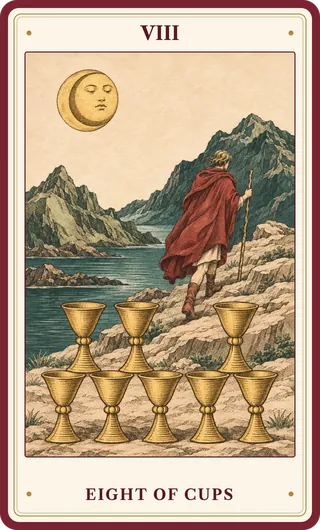
The walking figure
The figure turns their back on the cups and walks away alone. This is a choice made with open eyes, not an escape in panic.
Eight stacked cups
The cups are neatly arranged and still full, which shows that nothing is obviously wrong. A gap in the stack hints that something essential is missing.
Red cloak and boots
Red carries passion, will and the weight of feeling. The figure leaves with their emotions intact, not numbed.
The staff
The walking stick shows that this is a long trek, not a quick exit. It also says the figure has prepared for hard ground.
The moon
A moon with a circle inside its crescent hangs over the scene, like an eclipse. It points to intuition, endings and things understood in the dark.
The mountains
The figure heads toward rocky heights, which stand for the effort of seeking something deeper. The reward is meaning, not comfort.
The river and barren ground
Water runs through a rough, empty landscape, linking the emotional suit to a bare path. What you leave for may be less certain than what you leave behind.
Eight of Cups yes or no as feelings
When you ask what someone feels, a yes or no answer needs a different framing. “Do they still love me?” is not a good fit for this card, because the Eight of Cups shows emotional withdrawal. Upright, it suggests the person has pulled back, feels dissatisfied, or is thinking about leaving. The answer leans no if you hope for close, warm attention right now.
That does not mean the feeling is gone for good. The card can also show someone who is stepping back to understand themselves, especially if it appears with the Hermit or the Four of Cups. The key is that they are looking inward, not toward you.
Reversed, their feelings are unsettled. They may miss you, doubt their decision, or be too afraid to act. Do not read this as a promise of return. It is a sign of confusion, and it needs clear words, not guesses.
What the symbols tell you about the answer
The picture supports the yes or no reading. The cups are stacked and full, so nothing is wrong in a way you can point to. The gap in the stack says that something is still missing. This is why the card says no to staying: the problem is not visible, but the absence is real.
The figure walks away at night under a moon with an inner circle, a sign of intuition and of truths that show up in the dark. Mountains lie ahead, and the ground is rough. The card never promises that the next place will be easy, only that it will be more honest. If your question needs a guarantee of success, this card will not give one.
The red cloak and boots show feeling and will. The person is not numb. They walk with passion, grief and resolve together, which is why the card is often a no that feels like a loss and a relief at once.
How timing works with this card
The Eight of Cups is slow. A yes or no from this card rarely means “this week.” The figure walks a long road at night, so the timeline is measured in weeks or months, or whenever you finish your preparation. Reversed, timing stretches further, because the delay is internal.
If you want a timeframe, ask a separate question and draw another card, or use the methods on our page about tarot timing. Keep the first answer separate so you do not blur the message. Pisces and the element of water are linked with this card in some systems, which fits its slow, emotional pace.
For the decision itself, a good rule is that you should leave when the reasons are clear and the plan is in place, not when the mood is worst. The card honours a calm departure.
Cards that change the answer
Neighbouring cards tell you whether the no is a hard stop or a gentle redirection, and whether the yes to leaving is safe. Common pairings include:
- Ace of Cups or Ten of Cups: the leaving leads somewhere warm, so the answer to “will I be happier” becomes yes.
- Five of Cups: grief clouds the decision, so wait before you act.
- Four of Cups: boredom and apathy, so you may be withdrawing without a clear reason.
- Six of Cups: nostalgia is pulling you back, so ask whether you miss the person or the past.
- Three of Swords: a painful ending is part of the picture.
You can see how pairs work in a 3 card tarot spread: put the situation, the Eight of Cups as the obstacle or advice, and the likely outcome in a row.
Common mistakes with this card
The first mistake is reading the card as a rejection of you. It is a rejection of a situation that no longer fits. The second is treating it as an order to leave immediately. The figure takes time and carries supplies, so the card supports a prepared exit, not an impulsive one.
The third mistake is drawing it for a question where it cannot answer. If you ask “will I get the job offer,” the card may only say that you are already turning toward something else. Choose a question that has a clear stay or go form.
The fourth is asking repeatedly. If you pull cards until you get a yes, the reading stops being useful, and you drift into exactly the avoidance the reversed card describes.
Try this: Take a sheet of paper and draw a line down the middle. On the left, list what is good about your situation. On the right, list what is missing. If the right side holds one thing that no amount of effort has solved, you have your answer, and the card has confirmed it.
What to do after you draw it
First, accept the answer for what it is: an honest read on how you feel, not a verdict from outside. If it surprised you, notice whether the surprise is relief or fear, because that tells you a lot.
Second, turn the answer into a small step. If the card says no to staying, name one thing you will do this week to test that: have the conversation, look at job listings, or make an appointment. If it says yes to leaving, plan the exit before you announce it.
Third, if you want a deeper answer than yes or no, move to a fuller layout. You can try a Celtic Cross for a complex decision, or draw once more with the question “what will I find if I leave?” The card gives direction, and you choose the pace.
Try this: Tonight, say your question out loud, draw one card for “what am I leaving for?” and write down the first image or word that comes to you. Compare it with how you feel in the morning.
Using a yes or no spread with the Eight of Cups
If you are reading with a dedicated yes or no method, such as a single card or a three card pull, the Eight of Cups usually counts as a no in the first position and a cautious yes in a “should I leave” position. The yes or no tarot reading tool on this site works on the same logic.
In a three card yes or no pull, count the answers: two nos and a maybe lean no, two yeses and a maybe lean yes. If the Eight of Cups is the odd one out, use it as the note that explains the gap. The card often shows what is being left behind, even when the other two cards point forward.
Whatever method you use, keep the question the same through the whole reading and write down the answer before you read the card meanings. The most accurate readings come from people who decide how to count before they draw.
Questions readers ask
Is the 8 of Cups a yes or no card?
Upright, the Eight of Cups leans no. It says no to staying where you are, to waiting for things to improve on their own, and to more effort in the same place. It is a yes only when your question is about leaving, moving on or changing direction.
Is the Eight of Cups reversed a yes or a no?
Reversed, it is best read as not yet or maybe. It often means you are hesitating, drifting or going back and forth about a decision. Make a real choice, either to stay for reasons you can name or to leave with a plan.
Does the 8 of Cups mean someone is leaving me?
It can. The card shows a person walking away from something that looks fine on the surface but no longer satisfies them. If it sits next to cards of grief or conflict, a separation is likely, but it can also mean a person is simply stepping back to think.
Is the Eight of Cups a good card to get for a job question?
It depends on the job. If you ask whether you should stay in your role, the answer leans no. If you ask whether you should apply elsewhere or change careers, it leans yes, because the card favours moving toward work that fits.
Can the Eight of Cups mean yes to a new relationship?
Rarely on its own. It points to endings and soul searching, so it often says you need to finish something or sort out your own needs first. Pair it with a card such as the Ace of Cups or the Two of Cups for a clearer yes.
Should I pull another card if I get the Eight of Cups?
A single clarifier is fine if you pull it with a clear question, such as what you need to leave behind. Repeating the draw until you get the answer you want weakens the reading. Treat the first draw as the answer and use any extra card to add detail.