
Seven of Cups (7 of Cups) Tarot Card Meaning

- Arcana
- Minor Arcana, Suit of Cups
- Element
- Water
- Yes or no
- Maybe
choicesfantasyillusion
emotional blockswithdrawalimbalance
The Seven of Cups is the tarot card of too many choices and not enough clarity. Upright, the 7 of cups meaning centres on daydreams, wishful thinking and illusion: you see several appealing options, and you cannot yet tell which are real. It does not say your dreams are worthless. It says that dreaming has to be followed by choosing, or nothing will ever come of it.
Reversed, the card shifts towards clarity, a reality check and a decision, though it can also show disillusionment or avoidance that has hardened. Below you will find the image explained cup by cup, then the meaning in love, feelings, career, money and health, how to read the card as a yes or no answer, and what it does next to other cards.
Seven of Cups meaning at a glance
If you only have a minute, these are the essentials. The card is part of the Minor Arcana, belongs to the suit of Cups (water, emotion, imagination) and carries the number seven, which in tarot is about assessment and the gap between what is seen and what is true.
- Upright keywords: choices, fantasy, illusion, wishful thinking, daydreams, temptation, scattered focus, procrastination
- Reversed keywords: clarity, decision, reality check, focus, disillusionment, avoidance, sobriety
- Element and planet: water, with Venus in Scorpio in the Golden Dawn tradition
- Yes or no: conditional, usually “not yet” or “maybe”
The short version of the advice: list your options, test them, then choose one. The rest of this page shows how that plays out in different parts of life.
What the Seven of Cups shows in the Rider-Waite-Smith deck
In the Rider-Waite-Smith image, a figure stands in dark silhouette with their back to us. In front of them, seven cups float on a bank of cloud, each holding a different vision. The figure has one arm slightly raised, as if in surprise, and seems to be taking in the display with wonder, or perhaps with confusion.
Two details matter most. First, we see the scene from behind the figure, so we see only what they see. There is no sign of whether the visions are real, and that is the point: this is a mental picture, not a physical place. Second, this is the only card in the suit where the cups are not resting on anything solid. Every other cup in the suit sits on a table, in a hand, on the ground or in a stream. Here nothing supports them, which is a quiet hint that these options have no foundation yet.
The colours also help. Bright cups against a dark figure give an impression of glamour and dazzle, with the person themselves almost lost in shadow. It is a picture of attention being pulled outwards towards a show of possibilities rather than inwards towards a decision.
The seven cups and what they hold
Each cup holds a different temptation, and reading them one at a time is the quickest way to understand the card. Different readers assign slightly different meanings, but the common ones are these:
- The shrouded figure: mystery, the unknown, a hidden talent or a person you cannot quite see clearly
- The face or head: a person you are drawn to, or your own identity and the version of yourself you picture
- The snake: temptation, desire and instinct, but also wisdom if you respect it
- The castle: a secure, impressive future, a home or status
- The jewels: wealth, luxury and quick reward
- The laurel wreath: success, victory and recognition
- The dragon: fear, a monster or a challenge that feels bigger than it is
Notice that the list moves from love and identity through status, money and success to fear. These are the main things people chase or avoid, all offered at once. The dragon is often read as the “price” or the hidden risk: some visions look glorious from far away and turn out to carry a cost.
You do not need to match every cup to your situation. Ask which one pulls hardest at you. That cup usually tells you what you are most tempted by right now, and what you may be avoiding looking at squarely.
Read Seven of Cups for your question
Upright: You may be idealising someone, or juggling several romantic possibilities, without seeing any of them clearly.
Reversed: The rose-tinted glasses come off, and you finally see a person or a situation as it really is.
Upright: Their feelings are tangled up with fantasy, and they may be in love with an idea more than with you.
Reversed: Their head is clearing, and they are starting to know what they actually feel.
Upright: Too many paths and too little commitment: great ideas that stay in the clouds.
Reversed: You pick one direction, set realistic goals and start doing the work.
Upright: Get-rich daydreams and scattered financial plans are costing you focus, so test every option against real numbers.
Reversed: You see your finances honestly and choose a plan you can follow.
Upright: Write the options down, cross out the fantasies and take one small real step toward the one that survives.
Reversed: Trust the clarity you have, and choose before the fog creeps back.
Upright: Escapism, restless sleep or vivid daydreaming may be covering stress that needs a plain, practical look.
Reversed: Grounding routines and honest self-assessment help you return to a steadier baseline.
Seven of Cups upright meaning
Upright, the Seven of Cups says you are in a moment of overwhelming possibility. Your imagination is running faster than your decisions, and the mind prefers pleasant daydreams to concrete steps. You may have a long list of ideas, plans, wishes or people you could choose, and every one looks good from where you stand. That is exactly the problem: none has been tested yet, so none of them is real.
The card is not a rebuke. Imagination is how all good plans start, and being spoiled for choice is a better problem than having none. The warning is about what happens next. If you stay in the clouds, you drift, you postpone, and months later you may find you have chosen nothing and the options have moved on.
Common upright themes include wishful thinking, procrastination, fantasy that stands in for action, being tempted by shiny distractions, and difficulty telling real opportunities from pretty ones. It can also appear when someone is deceiving you, or when you are deceiving yourself. The question to ask is always the same: which of these could I actually begin this week?
Try this: Write every option you are considering on a separate line. Beside each one, note the first concrete step it would need and how long that step takes. Cross out anything with no clear first step. What is left is your real shortlist.
Seven of Cups reversed meaning
Reversed, the fog lifts. The cups that floated so invitingly come down to earth, and you see them for what they are. Often this means a decision finally gets made: you narrow the options, drop the fantasy and commit to a path. It is a card of sobering up, in the best sense, and it often brings relief.
There is a less comfortable reading too. Reversed can mean disillusionment, where a dream you cherished falls apart and leaves you flat. It can also mean the opposite problem to the upright card: you stop dreaming altogether, shut down possibility and settle for whatever is in front of you. And sometimes it shows a person who still avoids choosing but has now run out of daydreams, so they simply feel stuck.
To tell these apart, look at the surrounding cards and at how you feel when you pull it. If the sense is “I finally see clearly,” take the first reading. If it is “I have given up,” the card is asking you to revive some hope before you decide. For a deeper look at each of these shades, see the full guide to the Seven of Cups reversed, and our general page on how to read reversed tarot cards if you are unsure whether to use reversals at all.
Seven of Cups in love
In a love reading, the upright Seven of Cups usually points to idealisation. You may be in love with who someone could be, or with the story you have built around them, rather than with the person who actually texts you back (or doesn’t). It can also describe having several romantic options and being unable to commit to any, or a situation where someone is giving mixed signals and letting you fill in the blanks.
For people in a relationship, the card suggests drifting into fantasy about what else is out there, or about how things “should” be. It may be worth asking whether the dream is covering something that needs a direct conversation. For singles, it often shows a long list of hopes about a future partner that no real person could fit, or a crush that exists mostly in your head.
Reversed in love, the card usually means clarity: you see the relationship or the person without the glow, and you know what you want. That can lead to ending something that was never real, or to committing to something that was. It can also show a heart that has become guarded after disappointment. Compare it with the Eight of Cups, the very next card in the suit, which is what happens when someone finally walks away from an unfulfilling situation after seeing it clearly.
Seven of Cups as feelings
When the Seven of Cups describes what another person feels about you, the honest answer is often that their feelings are not settled. They may be attracted to you, but they are also imagining, comparing or keeping their options open. They could be in love with an idea of you, and the real you may not match it yet.
This does not mean their feelings are fake. It means they are mixed up with fantasy and indecision, and the card rarely signals a clear, steady commitment. If you are the one holding the card, ask yourself the same question: are my feelings about this person, or about what they represent?
Reversed as feelings, it usually means the person is working out what they feel and getting more realistic about it. That can go either way for you, so look at what they do rather than what they say. Actions are the opposite of the cloud, and they are the best test the card offers.
Seven of Cups in career
At work, the Seven of Cups describes a person with many ideas and plenty of possibilities who struggles to focus. You might be considering several jobs, a career change, a side business and a course of study all at once. Each looks promising, and none is moving forward. It can also describe a workplace where there is plenty of talk about big plans and little follow-through.
The best use of the card in a career reading is as a filter. Pick the options that match your skills, finances and energy, and ask what each would look like six months in, with the glamour gone. The cups with a castle or a laurel wreath are tempting because they promise status. The card asks whether you want the work that earns it.
Reversed, you are ready to focus. A decision about a job offer or a direction may be close, or you are about to turn a vague idea into a real plan. It can also warn of burnout from spreading yourself too thin, or the disappointment of realising a job you imagined as perfect isn’t.
Seven of Cups in money
In financial readings the upright card warns against get-rich-quick thinking and scattered plans. This could mean a handful of investments or schemes chosen on excitement rather than research, or spending money now on the life you picture having later. The jewels cup is a good reminder: sparkle is not the same as value.
The practical advice is to slow down and check the numbers. Test any opportunity against figures, reviews, contracts and a second opinion before committing money to it. If an offer sounds like all of the cups at once, treat it with extra caution.
Reversed, you start to see your finances honestly. You may build a budget, cancel a plan that never added up, or choose one realistic goal over several vague ones. For a steadier approach to money, the Two of Pentacles and Four of Pentacles show different ways of handling resources in practice.
Seven of Cups card symbols
Choose a symbol to read what it means on the card.
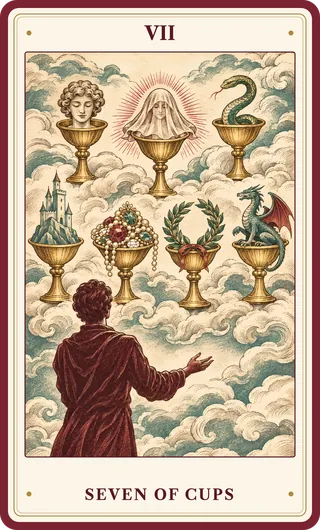
The silhouetted figure
We see the figure from behind, so we share their view of the cups and cannot see their face. This suggests that the visions are projections of the person's own mind.
Seven floating cups
The cups hang on a cloud with nothing holding them up, the only time this happens in the suit. They stand for wishes, fantasies and options that have not been grounded in reality.
The snake
The serpent stands for temptation, instinct and hidden wisdom. It asks whether a desire is feeding you or fooling you.
The dragon
The dragon is the fear or the monster behind a tempting vision. It can show how big and unmanageable choices feel when you have not looked at them closely.
The castle
The castle represents security, status and a grand future. It is a lovely goal, but here it sits in the clouds and has no foundations yet.
The jewels
The pile of jewels stands for wealth, attraction and quick rewards. They are easy to want and hard to verify.
The laurel wreath
The wreath of victory promises success and recognition. Because it sits in a cup of fantasy, it asks whether you want the win or just the idea of winning.
Seven of Cups for health and wellbeing
For health, the Seven of Cups is mostly about the mind. Upright, it can suggest escapism, whether through excess daydreaming, scrolling, drinking or sleeping too much, as a way of avoiding stress or uncomfortable feelings. Vivid dreams, restless sleep and difficulty concentrating can fit the picture too. The card is not a diagnosis, and any physical symptoms should be checked by a medical professional.
The gentle message is to ask what you are avoiding. If the fantasy is a pleasant break, it is fine. If it has become the place you hide, the cups are covering something that needs a plain look.
Reversed, the card encourages grounding: regular routines, time outdoors, honest conversations and practical habits that bring you back into your body. It may also describe the moment when you recognise an unhelpful pattern and decide to change it.
Try this: When you notice yourself drifting into a daydream, name it out loud: “That is a cup.” Then ask whether it needs a decision, a plan or just a rest. This keeps imagination as a resource without letting it replace action.
Is the Seven of Cups positive or negative?
It depends on what you do next. Seen as a pure gift, the card celebrates imagination, creativity and a mind rich with possibility. Artists, writers and entrepreneurs often start exactly here, with a cloud of ideas. Seen as a caution, it warns about illusion, self-deception and the trap of dreaming without acting.
Most experienced readers treat it as a card of discernment: the visions are neither good nor bad until you test them. The snake can be wisdom or temptation, the castle can be a goal or a fantasy, and the dragon may be a real danger or an imagined one. Your job is to tell them apart.
That is why the card sits so comfortably between the Six of Cups, which looks back with nostalgia, and the Eight of Cups, which walks away. The seven is the moment between memory and decision, when you sort out what is worth keeping.
Seven of Cups as a yes or no answer
As a yes or no answer, the Seven of Cups is conditional. Upright, the honest reply is “not yet” or “maybe”: the situation is too unclear, or too full of wishful thinking, for a firm yes. It does not mean no. It means the answer depends on a choice you have not made or facts you have not checked.
Reversed, it leans towards yes, but only once you have made a real choice and stopped treating the options as fantasy. If the question was about something unrealistic, the reversed card can also become a gentle no.
A better move with this card is to change the question. Instead of asking “will this happen?”, ask “which option am I willing to take a real step toward?” You can see how the card fits into simple draws on our Seven of Cups yes or no page.
Seven of Cups in a reading: position and neighbours
The meaning shifts a little depending on where the card lands. In a past position, it points to a time of confusion or fantasy that shaped your choices. In the present, it describes the cloud you are in right now. As advice, it tells you to filter your options. As an outcome, it suggests that things stay unclear unless you act, so it often works better as a warning than as a final result. As a person, it can describe a dreamy, charming, indecisive individual, or someone who tells flattering stories.
Neighbouring cards add detail. Near the Eight of Cups, it shows the fog giving way to a decision to leave. Beside the Moon, it doubles the sense of illusion and deception, so double-check everything. Next to the Magician, it asks you to turn ideas into action, and next to Justice it adds a call for honest evaluation. With the Seven of Swords, be alert to deception by others.
Pay attention to the suit mix, too. A spread full of Cups shows a strongly emotional situation, while Swords and Pentacles nearby bring thinking and practical facts that can ground the visions.
Numerology, element and astrology
Seven in tarot numerology is the number of reflection, testing and the inner search. It follows the first six steps of a cycle and asks you to stop, look at what you have built or imagined, and judge it. In the Cups it takes the form of emotional assessment: what do I actually want? You can see how the other numbers fit together on our page about tarot numerology.
The suit of Cups belongs to water: feelings, intuition, relationships and imagination. Water is shapeless and takes the form of whatever holds it, which suits a card where emotion and fantasy blur together. See the full suit of Cups for how the seven fits among the rest.
In the Golden Dawn system the card is assigned to Venus in Scorpio. Venus brings desire, attraction and the pull of what we love, and Scorpio adds intensity, secrets and depth. Together they describe wanting something deeply and being unsure whether it is good for you. If you like this layer of meaning, our guide to tarot and astrology correspondences covers the others.
How to work with the Seven of Cups
When this card shows up, treat it as a prompt to turn clouds into a short, honest list. The process below works for love, work or money questions alike.
- Write down every option, wish or story you are holding, without judging any of them.
- Next to each, write one fact you know to be true and one thing you are assuming.
- Mark the options that depend mostly on assumptions as “unproven.”
- Pick the one you would try this week if you had to, and define one small action.
- Review in two weeks. Did the option survive contact with reality?
If every option vanishes under this test, that is useful information too. It may mean the real wish is something simpler, or that you are avoiding a decision that has already been made quietly in your heart.
Try this: Pull the Seven of Cups beside a card drawn from the random tarot card generator and ask what the second card says is real. Treat that second card as the cup that has come down to earth.
Seven of Cups questions people ask
People often ask whether the Seven of Cups is about cheating or having multiple partners. It can point to romantic options or temptation, but it is not a literal sign of infidelity. Context and neighbouring cards matter far more than this one image.
Another common question is whether the card is about spiritual visions. The imagery of floating chalices has led some readers to link it with visions, meditation and psychic impressions. If you are exploring that, the card suggests grounding any insight with practical checks and with what you see in daily life.
Lastly, many beginners wonder how to remember it. Think of a daydreamer looking at a shop window full of beautiful things: it is lovely to look, but you can only walk out with one. Choose well, and the others will not be missed. For a wider overview of card meanings, our full tarot meanings list will help you place the Seven of Cups in context.
Questions readers ask
What does the Seven of Cups mean?
The Seven of Cups is the tarot card of choices, daydreams and illusion. It shows a person facing many tempting options and not yet able to tell which ones are real. It asks you to sort fantasy from possibility and commit to one thing.
Is the Seven of Cups a good or bad card?
It is neither. The imagination and creativity it shows are real gifts, but the card warns that dreaming without choosing leads nowhere. It becomes a positive card when you use the vision to pick a direction.
What does the Seven of Cups mean in love?
In love it points to idealising a partner, crush or ex, or keeping several romantic options open without committing. It asks you to look at what the person actually does, not what you imagine they could be.
What does the Seven of Cups mean reversed?
Reversed, the fog lifts. You gain clarity, make a decision and see through illusions. It can also show disillusionment, or a person who still avoids choosing and has simply stopped dreaming.
Is the Seven of Cups a yes or no card?
It leans towards a conditional answer: not yet, or maybe. Upright, the situation is too unclear for a firm yes. Reversed, it tends towards yes once you have made a real choice.
What zodiac sign is the Seven of Cups?
In the Golden Dawn system the Seven of Cups is linked to Venus in Scorpio. This fits a card about desire, attraction and deep emotional pull.