
7 of Cups Yes or No: What the Card Really Answers

- Arcana
- Minor Arcana, Suit of Cups
- Element
- Water
- Yes or no
- Maybe
choicesfantasyillusion
emotional blockswithdrawalimbalance
The Seven of Cups is a maybe when it comes up upright, and it leans toward “not yet” more than toward yes. Reversed, it leans yes, as long as you are willing to choose one real option and drop the rest. The card does not say no to your question. It says the question has too many possible answers at the moment, and some of them are daydreams.
That is why it frustrates people who want a quick verdict. A better way to read it is as a filter. If you can name the single option you would still pick after the glamour wears off, the answer is closer to yes. If you cannot, the answer is “not yet”, and the card is asking you to do some sorting before you ask again. For the full picture of the card beyond yes and no, see the Seven of Cups meaning.
Is the Seven of Cups a yes or no card?
Most tarot cards lean one way. The Ace of Cups is a warm yes and the Ten of Swords is a hard no. The Seven of Cups sits in the middle because its picture is not about an outcome. It shows a person standing in front of seven cups on a cloud, each holding a different vision, and nobody has picked one. The story stops before the choice, so the answer does too.
Readers disagree about how to handle this, and you will see it called a yes, a no and a maybe in different places. The most reliable approach is to separate the two positions. Upright, the card is a maybe that leans toward “wait and clarify”. Reversed, it leans toward yes because the choosing has finally started. Both readings follow from the same image: before you choose, there are only possibilities, and after you choose, there is a path.
If you only remember one thing, remember this: the Seven of Cups answers “which?” far better than it answers “should I?”. When your question is shaped like a choice between options, the card is at home. When it is a flat yes or no about one thing, you will usually need more cards.
Why the upright card is a “not yet”
The cups on the cloud hold a mix of things that appeal and things that threaten. Jewels, a castle and a laurel wreath sit next to a snake and a dragon. Nothing is labelled, and the figure cannot tell which is which from where he stands. Upright, that is the situation you are in: you have not tested your options against reality, so a yes would be premature.
A “not yet” is different from a no. A no closes a door. The Seven of Cups leaves every door open and asks you to look through each one properly first. If you asked “Should I take the job?” and drew this card, it does not say refuse. It says you do not have enough information, or you are imagining the job more than you are assessing it.
This makes the upright card a strong signal to pause, not to act. It is also a reminder that the pause has a purpose. You are not waiting for luck to decide. You are waiting until you have sorted fact from fantasy, which is work you can start today.
Try this: Write your question at the top of a page. Under it, list every option you are considering, then mark each one “real” (I could start this week) or “cloud” (I only like imagining it). Pull the Seven of Cups again tomorrow and see if the answer has shifted.
Seven of Cups reversed as a yes or no
Reversed, the card describes the moment the mist thins. You stop wanting everything and start wanting something. Six of the cups turn out to be decoration, and one proves solid. That is why the reversed Seven of Cups leans yes: a decision is available and the energy is moving toward making it.
The lean is conditional. A reversed Seven of Cups can also mean you are escaping into fantasy harder than before, or that the confusion is deepening instead of lifting. The way to tell the two apart is to look at what you are being asked to do. If the question already has an answer you quietly trust, the reversal is the clear-headed yes. If you are still avoiding something obvious, it reads as a no until you stop.
There is a full guide to this version of the card at Seven of Cups reversed. If reversals are new to you, how to read reversed tarot cards explains the different ways a flipped card can behave, including the blocked, the internal and the softened.
Read Seven of Cups for your question
Upright: Not yet: you are drawn to a fantasy or to several options, so wait until you see the real person and choose.
Reversed: Leaning yes: the glamour fades, you see someone as they are, and a real commitment becomes possible.
Upright: They are daydreaming, torn between options or unsure what they actually want.
Reversed: Their feelings are settling and they are becoming clearer, though they may still need a push to commit.
Upright: Too many ideas and not enough follow-through, so pick one and test it before saying yes.
Reversed: Leaning yes: you drop the scattered options and commit to one realistic direction.
Upright: Be wary of get-rich dreams and impulse spending, and check every offer against real numbers.
Reversed: A sensible yes once you have costed it out and cut the speculative extras.
Upright: Write down which options are real, then choose one to try.
Reversed: You already know the answer, so stop keeping every door open and act on it.
Upright: Ask a professional to clarify mixed signals and avoid chasing every new fix at once.
Reversed: Leaning yes to a simple, grounded routine instead of constant experimenting.
A simple rule for reading the answer
When the card lands in a yes or no spread, run it through a short check before you commit to an answer. These four questions cover most cases:
- Is the card upright or reversed?
- Is your question about a single option, or a choice between several?
- Can you describe the outcome in concrete detail, not only in feelings?
- Have you taken one small real step toward it?
If the card is upright and the answer to the last two questions is no, treat it as “not yet”. If it is reversed and you can answer yes to the last two, treat it as a yes. If it is upright but your question is a choice between named options, read it as “choose one and test it”, which is closer to a conditional yes than a no.
This is also a good moment to remember that yes or no readings are a convenience, not the strongest use of tarot. If you want a quick answer with a simpler system, the yes or no tarot reading tool gives you a draw. For anything weighty, use the Seven of Cups as the start of a conversation with yourself, not the end of one.
Seven of Cups yes or no in love
In love, the card asks whether you are seeing the person or the idea of them. It often appears when dating feels like a menu of possibilities, when you are caught between two people, or when someone is so appealing in imagination that you have not noticed what they are like day to day. For a question such as “Is this person right for me?”, the upright card usually says you do not know yet.
For questions about a new relationship, take it as “get to know them first”. The card is not warning you off, but it is warning you not to commit based on potential. For a long-term relationship, it can point to wandering attention or comparing your partner to other possibilities. If the question is whether an ex will come back, the card suggests nostalgia may be doing most of the talking, so ask what is real now.
Reversed, the love answer becomes a cautious yes. You see more accurately, and you may be ready to choose one person or to commit to being single and clear about it. If you are weighing someone’s feelings, the Knight of Cups is another card that blends romance with idealism, and it is worth comparing how it answers the same question.
What it means when someone else’s feelings are the question
When you ask whether someone likes you, the Seven of Cups usually describes a person who is unsure, fantasising or keeping options open. They may enjoy the idea of you, but they have not yet chosen. This is the reason a yes or no answer feels slippery: there may not be an answer to find yet, because the other person has not made up their mind.
Do not read it as rejection, and do not read it as a promise. Read it as a prompt to look for evidence. Do their actions match their words? Do they make plans, or only talk about them? The cups on the cloud are visions, and visions are not commitments.
Reversed, their feelings are settling into something clearer. That can go either way for you, but it is movement, and it often means a straight conversation will now get a straight answer.
Career and money questions
At work, the Seven of Cups points to too many ideas, too many paths and not enough follow-through. Asked “Should I switch careers?”, it says you may be enchanted by what the other job looks like from outside. Asked “Should I start the business?”, it says the idea is real enough to be tempting, but you have not tested which version of it will work.
With money, the card is a caution against fantasy. Be careful with get-rich plans, speculative investments and any offer that looks like a castle and a pile of jewels with no cost attached. Upright, it leans to “not yet”. Reversed, it becomes a yes if you have done the sums, checked the terms and cut the extras.
If you want a card that answers a money question more firmly, the King of Pentacles is a steadier yes, and it makes a good contrast: where he builds slowly on solid ground, the Seven of Cups is still looking at clouds.
Try this: Choose the most appealing option from your list and give it one concrete test this week, such as a single phone call, a small trial or a price check. Whatever you learn, note whether your excitement grows or fades. That response is often your real yes or no.
Health and wellbeing
For health questions, treat the Seven of Cups as a note about clarity, not a diagnosis. It can describe mixed signals, a long list of possible fixes, or the temptation to try every new remedy at once. Asked “Will this treatment work?”, it tends to say the picture is not clear and you may need more information or a second opinion.
It can also point to escapism: using fantasy, scrolling, food or substances to avoid something uncomfortable. If that sounds familiar, the card is a gentle prompt to look at what you are avoiding. Reversed, it leans yes to simple, grounded routines, such as one plan you can follow consistently instead of constant experimenting.
Tarot is not a substitute for medical advice. If your question is serious, use the card to prepare questions for a professional, not to decide what to do about your health.
Seven of Cups card symbols
Choose a symbol to read what it means on the card.
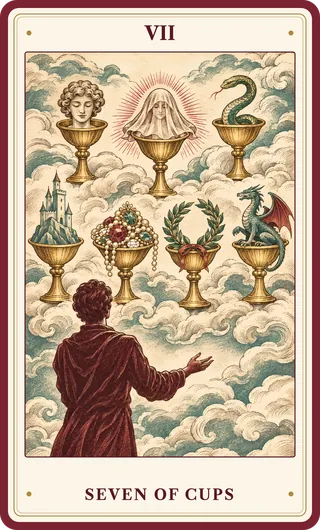
Silhouetted figure
The dark figure faces the cups with his back to us, so we see the dream through his eyes. He stands for the part of you that is looking at options but has not touched any of them yet.
Cloud
The cups float on a cloud, not on a table. It tells you these visions are not grounded yet and can drift away.
Covered figure and head
One cup holds a face and another a veiled, glowing shape. They stand for people, hopes and mysteries we project onto when we do not know the facts.
Snake
The snake shows a temptation or a hidden risk. It can also stand for wisdom, so it asks you to look closely before you reach.
Castle and jewels
The tower and the heap of jewels represent security, status and wealth. They are the rewards we daydream about without picturing the work.
Laurel wreath
The wreath is the fantasy of victory and recognition. It is attractive, but a win you have only imagined cannot answer a real question.
Dragon
The dragon is the fear or the monstrous cost hiding in the pile of prizes. Not every option is a gift, and some are dangers dressed up as dreams.
How to word a question for this card
The way you phrase the question changes how useful the Seven of Cups is. It handles “which of these?” and “what am I not seeing clearly?” very well. It handles “will X happen?” poorly, because it is not a card of outcomes. If you were hoping for a firm yes or no, try rewording until the question is about a choice you control.
Some versions that work better:
- “Which of these two offers is more real?”
- “Am I seeing this situation clearly?”
- “Should I commit to this option now?”
The last one is a true yes or no, and the Seven of Cups answers it well: upright means not yet, reversed means go ahead. Avoid asking the same question repeatedly in the hope of a different card. That is the Seven of Cups pattern in action, keeping options open to avoid choosing. For more ideas on phrasing, see the questions for tarot reading page.
Cards that change the answer
Because the Seven of Cups is a maybe, the cards next to it often decide the outcome. A strong, grounded card nearby pushes it toward yes. A confusing or avoidant card pushes it toward no. A few pairings come up often:
- With the Ace of Pentacles or the Magician, a real, doable opportunity is on the table, so lean yes.
- With The Moon, the confusion is deeper than a decision problem, and the answer is wait. The Moon as a yes or no card explains why that card is also an “ask again later”.
- With the Eight of Cups, you may already be ready to walk away from the options, which can be a yes to leaving.
- With the Two of Pentacles, you are juggling, so simplify before you decide.
If the neighbouring cards are all more of the same, the answer is still “sort it out first”. If you want to see how another card in the same suit handles walking away from a situation, read the Eight of Cups yes or no page.
Reading it in a spread
In a single card pull, the Seven of Cups can feel unhelpful, but in a spread it becomes much clearer. A simple three-card layout works well: the first card is the situation, the second is the real option, and the third is the outcome if you choose it. If the Seven of Cups lands in the first position, the situation is cluttered, and you can expect the next cards to show what to keep.
If it appears in the middle, it tells you the “real option” is still partly imagined, so examine it. If it lands in the third position, it warns that choosing this path could lead to more fantasy and not enough results. The 3 card tarot spread gives more ways to lay this out.
Past, present and future positions also give the card a time context. In the past, it describes options you have already outgrown. In the present, it is the cloud you are standing in. In the future, it is a warning that a decision is coming and you should prepare for it.
What the picture is telling you
The Rider-Waite-Smith image repays a slow look. The figure is a silhouette with his back to us, so we are inside his experience. The cups sit on a cloud, which tells you these things have no ground under them. Each cup holds a different prize or danger: a face, a veiled figure, a snake, a tower, jewels, a wreath and a dragon.
Notice that the prizes and the threats are mixed together, and none of them is labelled. That is the lesson of the card for yes or no questions. In real life, options do not come with warnings or promises attached, and you have to test them. The card is in the element of Water, linked to emotion and imagination, and in the Golden Dawn tradition it is tied to Venus in Scorpio, which adds desire and temptation. The number seven often points to reflection and assessment, which fits a card about looking before choosing.
That mix is why the card works as a yes or no card only when you add a decision. Without one, you get a picture of options. With one, you get an answer.
How long until the answer is clear?
The Seven of Cups does not give a fixed timeline, because its clarity depends on you. It tends to describe a stage that lasts as long as you keep putting off the decision. Some readers read it as weeks, since it is a card of mental sorting and not of events. A good practical rule is to give yourself a deadline and treat the card as valid until then.
If you pull the card again after you have chosen and tested your option, the answer often changes, and a reversed Seven of Cups is a common sign of that shift. If you want more on how to estimate time in a reading, tarot timing covers the common methods.
If the card keeps appearing, that is information in itself. It usually means a choice is still being delayed. Pick one option, commit to a small trial, and review it at a set date. That is the only reliable way a Seven of Cups becomes a yes.
Common mistakes when reading it as yes or no
The first mistake is reading it as a straight yes because it looks like a card full of gifts. The cups are attractive, but the figure has not taken any of them. The second is reading it as a firm no because of the snake and the dragon. They are only two of the seven, and the other cups are real possibilities.
A third mistake is ignoring the reversal. Many readers treat upright and reversed the same, but with this card the difference is large: one is the cloud, and the other is the landing. A fourth is asking again and again. If you draw this card three times in a row, the card is not broken. The question probably needs to be narrower.
Finally, do not use the card to avoid acting. A maybe is not a place to settle. If the Seven of Cups is your answer, the most useful next step is a small, real action, such as a conversation, a test or a list. That turns the maybe into something you can actually answer.
When to trust your own answer more than the card
Sometimes you draw the Seven of Cups and you already know what you want. If a single option stands out as clear and calm, that is the reversed energy, whatever way the card fell. The cards are a mirror, and this one is especially good at showing you where your attention is split.
If you feel pulled in several directions and your answer changes every day, trust that too. It is a sign you need more information, not a better card. Tarot works best when it prompts you to look at your own reasoning, and the Seven of Cups is one of the most direct examples of that.
If you want to practise with other cards, draw a random card and ask yourself where it sits on the scale from yes to not yet. Over time you will build a feel for which cards give clean answers and which, like this one, ask you to do some of the work.
Questions readers ask
Is the 7 of Cups a yes or a no?
Upright, the Seven of Cups is a maybe that leans toward not yet. Reversed, it leans yes, because the fog has cleared and you can choose. It is the card of too many options, so it rarely gives a clean answer on its own.
Is the 7 of Cups reversed a yes or no?
Reversed, it leans yes, provided you commit to one real option. If you are still avoiding the decision, it reads as a soft no until you face it.
Is the 7 of Cups a yes or no in love?
Usually not yet. It warns that you may be in love with an idea or with the chance of someone, not the actual person. Reversed, it becomes a cautious yes once you see them clearly.
Is the 7 of Cups a good card to draw?
It is neutral, not bad. It reflects imagination and possibility, and it also warns about illusion and procrastination. How good it is depends on whether you use the options or get stuck among them.
What should I do when I pull the 7 of Cups for a yes or no question?
Ask again with a narrower question, or sort your options into real and imagined before you decide. A second card or a three-card spread will usually give a firmer answer.
Why does the 7 of Cups keep showing up?
Repeated appearances usually mean a choice is still being put off. Pick one option, test it for a set time, and the card often stops appearing.