
King of Pentacles as a Yes or No Answer

- Arcana
- Minor Arcana, Suit of Pentacles
- Element
- Earth
- Yes or no
- Yes
wealthdisciplinesecurity
setbackspoor planningfinancial worry
The King of Pentacles is a yes in a yes or no reading. It is a steady, practical yes, the kind that says go ahead if you build it properly, manage it well and give it time. Reversed, the King of Pentacles leans towards no or not yet, usually because money, control or planning is off balance.
That condition is what makes this card useful. Most pages stop at the single word, but the King rarely gives a bare “yes”. He gives a yes with terms: a budget, a track record, a sensible pace. Below you will find how to read that answer for love, work and money, which questions it suits badly, and how nearby cards raise or lower its strength. For the full picture of the card, see the King of Pentacles meaning.
The short answer: yes, with conditions
Upright, the King of Pentacles is a clear yes. It is one of the most reliable yes cards in the deck because it stands for mastery in the material world: money, work, property, health and everyday competence. When the card lands in a yes or no spread, it usually tells you that the thing you are asking about can work, and that you already have, or can gain, what it takes.
The conditions are built into the card. The king is not a gambler or a dreamer. He represents wealth that was earned slowly and kept carefully. So the answer is “yes, if the foundation is sound”. If your plan is thin, your budget is a guess or you are hoping for a shortcut, the King will read as a gentler, more demanding yes: yes, once you have done the work.
Reversed, flip that. The card leans no or not yet. It is rarely a final no. More often it says the current version of your plan will not hold, so fix the foundations and ask again.
Why the King of Pentacles reads as a yes
Yes or no readings depend on whether a card’s energy moves a situation forward or holds it back. The King of Pentacles is a card of completion. He sits at the top of the suit, which is the suit of earth, so he stands for results you can see, touch and count. Nothing in his image is unfinished.
His surroundings reinforce this. The throne is carved with bulls, the robes are covered in grapevines, and behind him stands a castle. These are signs of strength, harvest and security. The card shows someone who has already arrived where many querents hope to go. That is why it tends to approve of questions about building, saving, buying and leading.
It also helps that Pentacles belong to the earth element, which is stable and slow to change. A card of earth rarely says “no, it will fall apart” when it is upright. It says “yes, and it will last”. The suit of Pentacles overview is useful if you want to see how the whole family leans.
What kind of yes does the upright King give?
It is a durable yes, not a thrilling one. Think of a bank approving a loan, a manager confirming a permanent contract or a partner who promises to stay and then does. The answer carries weight because it comes from competence rather than hope.
It is also a yes that expects responsibility. The King provides, protects and manages. If you ask whether you should take on a mortgage, start a business or commit to a long-term partner, the card agrees that it is possible, and quietly asks whether you are ready to carry it. If the answer to that is yes, the card’s yes is strong.
Compare it with a different kind of yes: the Ace of Pentacles offers a new opportunity, while the King offers the mature result. The Ace says a door is opening, and the King says the house is built. If you are asking whether something will start, you may want the Ace. If you are asking whether something will succeed and last, the King is a stronger sign.
Try this: Write your question in one sentence, then add the words “and I am willing to plan it carefully.” Pull your card. If the King of Pentacles appears, notice whether you feel relief or resistance when you read the added words. That reaction tells you how ready you are for the yes.
Read King of Pentacles for your question
Upright: A clear yes to commitment, loyalty and a relationship built on dependable daily behaviour, though not to a fast or flashy romance.
Reversed: A no or not yet when the other person is controlling, withholding or treating love as a transaction.
Upright: Steady, protective and generous feelings that show up through actions rather than big speeches.
Reversed: Feelings tangled up with control, possessiveness or a fear of losing security.
Upright: A yes to promotion, leadership, a business decision or a role where proven skill counts.
Reversed: A no or not yet while the plan is poorly managed, the boss is rigid or ambition has turned to greed.
Upright: A yes to building wealth, saving and sound investing, as long as you stay disciplined.
Reversed: A no to risky gambles, overspending or any deal that looks good only on the surface.
Upright: Go ahead, but plan it, budget it and give it time to grow.
Reversed: Pause, check your numbers and loosen your grip before you commit.
Upright: A yes to steady routines and sensible habits that support your body, though it is no substitute for a doctor's advice.
Reversed: A no to excess, burnout or neglecting the basics, and a nudge to rebuild your routines.
King of Pentacles reversed: no or not yet
Reversed, the King shows what happens when security turns into a trap. He becomes greedy, stubborn, wasteful or controlling. He may cling to money, status or old methods long after they stopped serving anyone. In a yes or no reading that points to a no, or at least a pause, for plans that depend on these traits being kept in check.
The reversal can show up in two opposite ways. One is excess: overspending, gambling, buying status symbols, chasing quick profit. The other is rigidity: refusing to take any risk, hoarding, or ruling a household or workplace with an iron hand. In both cases the card says the balance is off, and the plan needs adjusting before it can succeed.
The best reading of a reversed King is usually “not yet” rather than “never”. Ask what would make the foundation sound. Often it is a clearer budget, an honest conversation about control, or a plan that does not rely on luck. The page on the King of Pentacles reversed goes deeper into each of these patterns. If you are unsure whether a card is reversed in your deck, the guide to reading reversed tarot cards explains how to approach it consistently.
King of Pentacles yes or no in love
In love, the upright King of Pentacles is a yes to loyalty, commitment and a relationship that offers real security. If you ask whether a partner is reliable, whether a relationship will last or whether you can build a home with someone, the card responds positively. It points to someone who shows love through actions: paying the bill, fixing the door, turning up when they said they would.
It is a weaker or slower yes for questions about passion, spontaneity or sudden attraction. If you ask “will they message me tonight?” or “is this a fiery romance?”, the King is not the most natural voice. He represents steadiness, so the answer may be yes in the long run, with little drama along the way.
Reversed, the King in love leans no. It can describe a partner who uses money or status to control, someone emotionally unavailable behind a comfortable lifestyle, or a relationship where security has become more important than affection. If you are single and asking whether a particular person is ready for commitment, a reversed King suggests they are not yet.
King of Pentacles yes or no for career and business
Work is where the King of Pentacles is at his strongest. Upright, he answers yes to questions about promotion, leadership, a business launch, a pay rise, a long-term contract or a major decision based on proven skill. He rewards experience and reliable results, so the more you have of both, the stronger the yes.
Some typical questions and how the card reads:
- Will I get the promotion? Yes, especially if you have a clear track record.
- Should I start my own business? Yes, if you have planned finances and a steady base.
- Is this job stable? Yes, it points to security and a sound employer.
- Should I take on a leadership role? Yes, he suggests you can handle the responsibility.
Reversed, the same questions get a no or not yet. The card warns of a manager who is rigid, a company that puts money above people, or ambition that has become greed. If you ask about a new venture and the King appears reversed, review your costs and your risk before moving. Related cards for work questions include the Eight of Pentacles, which answers yes to effort and skill-building, and the Queen of Pentacles, which brings a warmer, more nurturing yes.
King of Pentacles yes or no for money
For money, the King is among the best cards you can draw. Upright, he says yes to saving, investing sensibly, building wealth, buying property or sticking to a financial plan. He is the card of the person who reads the contract, keeps the receipts and lets compound growth do its work.
Be careful to read “yes” as “yes to the sound option” rather than “yes to anything”. If you ask “should I put my savings into this risky scheme?”, the King does not approve because the scheme exists. He approves of prudent management. A cautious reading is: yes, if the numbers hold up under a calm look.
Reversed, the answer to money questions is usually no. Think of overspending, bad investments, debt taken on for status, or a refusal to look at your finances honestly. If you want a deeper look at your situation, a money tarot spread can show what is helping and what is draining your resources. As always, tarot is no replacement for professional financial advice on large decisions.
When the answer is weaker or less clear
The King of Pentacles is a poor fit for some questions, and it is worth knowing which. Questions about speed, spontaneity, creative inspiration or emotional breakthroughs do not suit his energy. He moves at the pace of an established estate, not a firework.
If you ask whether you will fall in love suddenly, whether a creative idea will catch fire or whether a situation will change overnight, a King of Pentacles answer may be a quiet “not like that”. The card does not necessarily forbid the outcome. It simply says that the route will be slow, practical and built on steady effort.
The card is also a weak voice for health questions. It can suggest that steady habits help, and that routine and care are on your side, but tarot cannot diagnose or predict a medical outcome. For anything medical, speak to a qualified professional and treat the card as a prompt for self-care, not a verdict.
King of Pentacles card symbols
Choose a symbol to read what it means on the card.
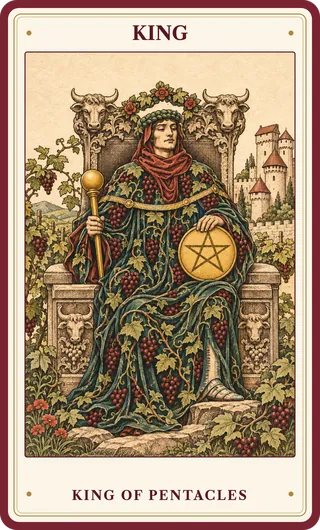
Throne carved with bulls
Bulls are tied to Taurus and to strength, patience and physical abundance. They show that this king's power is solid and slow to move.
Grapevines
Vines wrap the king's robes and the garden around him, pointing to harvest and enjoyment of what has been earned. Prosperity here is cultivated, not stumbled upon.
Pentacle in his hand
The coin rests in his lap or hand as if it is simply his to manage. It stands for money, resources and the confidence of someone who has already built them.
Sceptre
The sceptre in his other hand marks formal authority. He leads by responsibility and track record, not by force.
Castle behind him
The stone castle shows security, property and a lasting foundation. It tells you the success in this card is visible and real.
Blooming garden
Flowers and greenery surround the throne, showing that wealth has been tended and kept alive. Growth continues because someone keeps caring for it.
Crown and robes
The leafy crown and richly embroidered robe signal mastery of the material world. He wears success lightly because he has had it a while.
How strong is the yes? Reading it in context
Not every yes weighs the same. A King of Pentacles in a clear, well-phrased question about work is a strong yes. In a vague question about your whole future, it is a general sign of stability with less precision. Use three things to judge strength: how well the question fits the card, which way up it falls, and what sits beside it.
A useful rule of thumb is a three-level scale:
- Strong yes: upright, the question is about money, work, property or commitment, and nearby cards agree.
- Conditional yes: upright, but the question is about speed or emotion, or the neighbours add caution.
- Not yet or no: reversed, or surrounded by cards of loss, delay or deception.
This keeps you from treating every upright King as the same blanket approval. It also keeps you honest, because you decide the strength before you start to hope.
Cards that change the answer
When you read the King of Pentacles in a spread with other cards, his neighbours can sharpen or soften his answer. Cards that show growth and reward strengthen the yes. The Ten of Pentacles adds family wealth and long-term security, and the Nine of Pentacles adds independence and comfort earned through effort. The Six of Wands brings public success on top of the King’s stability.
Cards of caution make the yes conditional. The Four of Pentacles beside the King can mean the money is there but you may be holding it too tightly. The Five of Pentacles warns of hardship or a sense of lack that needs attention first. Swords cards, especially the Seven of Swords, suggest someone may not be telling the whole truth about the deal.
For combinations beyond your own spread, the tarot card combination calculator can help you see how two cards interact.
Try this: Pull the King of Pentacles and one card on each side of it. Ask yourself which neighbour makes the yes feel safer and which makes it feel shakier. Write one sentence about each. You have just turned a flat answer into a plan.
How to phrase a question for the King
The King answers best when the question is concrete, grounded and about something you can act on. “Should I accept this job offer?” or “Will I get the loan approved?” gives him something to hold. “Will I be happy?” does not.
Keep the question specific and time-bound if you can, such as “Will this budget work for the next six months?” Avoid questions that ask the cards to decide something that is entirely your choice, like “Should I leave my job?” It works better to ask “What happens if I stay in this job for another year?” and read that answer. If you need help with wording, the list of questions for a tarot reading offers many examples.
Positive phrasing tends to give clearer results than negative phrasing, because a double negative can confuse the reading. Ask “Will this plan succeed?” rather than “Will this plan not fail?” If you want a quick one-card answer from a fresh deck, the yes or no tarot reading tool is a handy way to practise.
When the King is a person, not an answer
The King of Pentacles is a court card, which means he can describe a real person as well as give a verdict. In many readings he represents a reliable, financially secure, practical adult, often someone who is older or in authority. That might be a boss, a banker, a landlord, a parent or a partner who handles the money.
If your question is about a person, such as “Will he commit?”, read the card both ways. As an answer, it leans yes. As a description, it tells you what kind of person you are dealing with: dependable, protective, a provider, but possibly rigid about money or control. A little attention to the person helps you decide whether the yes is reassuring or suffocating. For how court cards behave across all four suits, see the guide to court cards in tarot.
The card can also describe you. If you pull it and you are in a position of responsibility, he may be asking you to act like the King: steady, fair and clear about your resources.
Timing: how soon will the yes arrive?
Pentacles are slow cards. The King does not promise a quick result. When you ask “when?”, read his answer as months rather than days, and often as a result that comes after consistent effort. A common convention is to link Pentacles to autumn, the season of harvest, though this is a tradition rather than a fixed rule.
That means if you are hoping to hear back from an employer tomorrow, a King of Pentacles reading says the matter is in a stable process, but it may take its time. If you are asking about a long-term goal such as saving for a deposit or building a business, it says the timeline is realistic as long as you keep going. Our guide to tarot timing covers other ways to read this.
Reversed, timing stretches further or becomes uncertain. A delay here is often caused by poor planning or someone holding on too tightly, so the fastest way to bring the answer closer is to fix what is out of balance.
A simple three-card yes or no spread with the King
For a fuller answer than one card gives, try a short spread. Pull three cards in a row, treating the first as the situation, the second as what supports or blocks the answer, and the third as the likely outcome. If the King of Pentacles appears in the outcome position, upright, the yes is strongly supported. In the middle position, he shows that resources or stability are the key factor.
If you want a ready layout, the 3 card tarot page offers several, and the Celtic Cross is there for a longer look at a major decision. Whatever you choose, treat the answer as a snapshot of the present direction, not a sealed fate.
Try this: Ask a money question you genuinely care about, draw one card, and write down the yes, no or not yet. Then write one action you could take this week that would make a “yes” more likely. The action matters more than the card.
Limits of yes or no tarot
Yes or no tarot is a shorthand, and the King of Pentacles gives you its strongest shorthand: a calm, grounded yes. But it is still only a lean, not a promise. Tarot can reflect likely directions based on the current situation, and your choices continue to shape what happens.
Use the answer as a prompt to think more clearly. If the King says yes and your own gut says no, ask why. If he says no and you have ignored warning signs, that is worth taking seriously. A good reading leaves you more informed, not more dependent.
For major legal, medical or financial decisions, treat tarot as one input among many. The King himself would tell you to check the figures, read the contract and ask an expert. For a wider view of how the deck works, the guide on how to read tarot is a good place to build your confidence.
Questions readers ask
Is the King of Pentacles a yes or no card?
Upright, the King of Pentacles is a yes card. It is a steady, practical yes that comes with conditions: planning, patience and sound management. Reversed, it leans towards no or not yet.
What does the King of Pentacles reversed mean as a yes or no?
Reversed, it usually means no or not yet. The card points to poor financial judgement, greed, stubbornness or a plan that has not been built carefully enough to hold weight.
Is the King of Pentacles a yes to love questions?
Yes, if you are asking about loyalty, commitment or a stable partnership. It is less reliable for questions about quick romance, passion or sudden change, where the answer is often slower or weaker.
How long until a King of Pentacles yes happens?
Pentacles are slow, so think in months rather than days. The King shows an outcome that is built and maintained, not one that arrives overnight.
Can the King of Pentacles be a no?
Yes. Reversed, or beside cards of loss, delay or deception, it can mean no. It can also be a no when the question is about something fast, reckless or emotionally impulsive.
Does the King of Pentacles mean a person in a yes or no reading?
It can. As a court card it often describes a reliable, financially secure man or a person who behaves that way. When you ask a yes or no question, though, read it first as the answer and second as a description.