
6 of Wands Yes or No: What the Card Really Answers

- Arcana
- Minor Arcana, Suit of Wands
- Element
- Fire
- Yes or no
- Yes
victoryrecognitionconfidence
delayslost motivationscattered energy
The Six of Wands is a yes. In a yes or no reading it points to success, recognition and a result you have earned, so when it lands upright you can answer yes with real confidence. Reversed, it shifts to “not yet” or a soft no, because the win is delayed, unseen or clouded by ego.
That answer comes from the card’s image and its place in the suit. A rider moves through a cheering crowd after a hard stretch of effort, and the card is built around being seen and rewarded. Below you will find how to read the yes in different kinds of question, where it can mislead you, and how to use the card’s own advice once you have your answer. For the full card meaning, see our Six of Wands guide.
Why the Six of Wands leans yes
Yes or no readings in tarot rest on the energy of each card. Cards of growth, completion and support lean yes. Cards of loss, delay and blockage lean no. The Six of Wands sits clearly in the first group because its whole story is about a result arriving.
The card follows the Five of Wands, where everyone fought over position and nobody was winning. The Six is the moment the noise settles and someone comes through. That order matters: the yes here is not luck, it is the outcome of a conflict or a long effort that has already happened. Your question is being answered from the far side of the work.
Numerology adds to this. Six is a number of harmony and balance, and in the fire suit it brings drive into a settled, shareable form. If you want the wider pattern, our page on tarot numerology explains how each number shapes the suits.
What the card shows
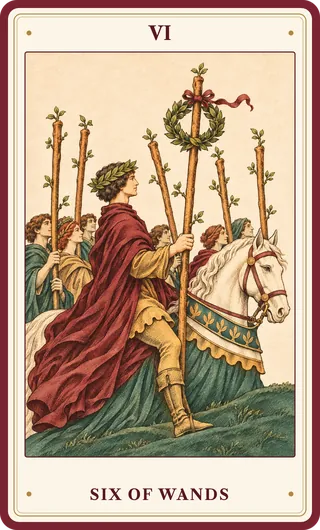
The Rider-Waite-Smith image is simple and very readable. A rider in green sits on a white horse, a laurel wreath on his head and another tied to his raised staff. Around him, men on foot carry their own staves and look on. Nobody is fighting. The crowd is part of the win.
For a yes or no reading, three details carry the answer. The wreath says the result is real and honoured. The crowd says it will be witnessed. The upright wand says the energy behind it is clear and confident. Together they describe a yes that others will see, which is why this card fits questions about reputation, results and visibility best.
One more detail is worth noticing: the rider looks ahead, not at the people cheering. The card allows you to enjoy the moment, but it keeps your attention on what comes next.
Upright: a yes with one condition
Upright, treat the Six of Wands as a confident yes. The condition is that the yes belongs to something you have actually worked for. This is a card of earned results, not wishes. If you have put in the effort, prepared, applied, trained or shown up, the card says the reward is coming and people will notice.
That condition keeps the reading honest. If you ask “Will I win the lottery?” and draw the Six of Wands, the card has nothing to say about luck. It speaks of victory that follows effort. In that case the best reading is that the question is the wrong shape, and you can reframe it, which is covered below.
When the yes holds, it holds strongly. This is one of the clearer affirmative cards in the minor arcana, in the same family of positive energy as the Four of Wands (celebration and stability) but with more emphasis on personal achievement.
Try this: Before you draw, write down the effort you have already put into your question. If you can fill three lines, the Six of Wands yes is on solid ground. If you cannot, ask a question about what you still need to do.
Read Six of Wands for your question
Upright: Yes: you are admired, the bond is strong, and the relationship can be proud and visible.
Reversed: Not yet: pride, comparison or a hidden insecurity is getting between you, so the answer waits.
Upright: They feel proud of you, respect you openly and want to be seen at your side.
Reversed: They feel unsure how to measure up, or they feel overlooked and want more acknowledgement.
Upright: Yes to the promotion, the award, the successful launch or the public result you have earned.
Reversed: Not yet: credit goes elsewhere, the launch slips, or a win is spoiled by ego.
Upright: Yes, gains and rewards arrive as a direct result of effort you have already put in.
Reversed: Not yet: payment is delayed, a bonus is smaller than hoped, or a win has been overvalued.
Upright: Accept the recognition, thank those who helped, and keep your momentum.
Reversed: Stop chasing applause, rebuild your confidence privately and let the work speak first.
Upright: Yes to recovery and visible progress, with strength and confidence returning.
Reversed: Not yet: progress is slower than you want, so avoid pushing hard to prove you are well.
Reversed: not yet, rather than never
Reversed, the Six of Wands leans no, but it is usually a gentler no than cards like the Ten of Swords or the Tower. Read it as “not yet”, “not in this form” or “not for the reason you hope”. The effort may be real while the recognition is missing, delayed or handed to someone else.
Reversed, the card can also warn about the shadow side of a win: arrogance, a premature victory lap, or a need for applause that has grown larger than the work. In that case the answer to your question may technically be yes, but with a cost. If you suspect this, our page on the Six of Wands reversed goes deeper into each meaning.
Not every reading treats reversals the same way. Some readers ignore them in yes or no work and read every card upright. If you do read reversals, our guide to reversed tarot cards shows how to decide which approach suits you. Pick one method and keep it for the whole session so your answers stay consistent.
Questions the Six of Wands answers best
This card gives its strongest yes when the question is about an outcome that other people will judge or see. Good examples include:
- Will I get the promotion or the job offer?
- Will my project, launch or performance be well received?
- Will I pass the exam or be chosen for the team?
- Is my relationship ready to be shared openly?
- Will I recover my confidence after a hard period?
All of these ask about a visible result, and the card replies in kind. It also suits questions about leadership and about whether to put yourself forward. When you ask whether you should apply, speak up or enter the competition, the Six of Wands says go, and expect the response to be positive.
It also answers “Have I done enough?” with a quiet yes. If you are doubting a decision that you already carried out, the card tells you the effort was worthwhile.
Questions where the yes can mislead
A card that celebrates success can pull you towards a happy answer that does not fit the question. The yes weakens or changes when the question is about something that is quiet, private or not yet built.
Take a question like “Will this secret relationship become serious?” The Six of Wands is a public card, so it may be pointing out that the bond would have to leave hiding to succeed. Or take “Should I quit my job without a plan?” The card says there is success to be had, but it assumes effort and preparation, which an unplanned leap does not yet have.
Also be careful with questions about winning at the expense of others. The card carries the idea of honour and shared celebration. A victory gained by cutting corners is not the one this rider is enjoying. If your question involves a rivalry, look at neighbouring cards, such as the Seven of Wands, to see how hard the defence will be.
Six of Wands yes or no in love
In love, the Six of Wands is a yes, particularly when you ask whether someone admires you or whether a relationship is ready to be public. It describes pride in a partner, mutual respect and a couple who feel good about being seen together. For new love, it points to attraction that comes with real regard, not only chemistry.
For long relationships, it answers questions like “Are we doing well?” with a yes and often marks a milestone: an engagement, moving in together, or surviving a difficult stretch as a team. It is a card of celebrating what you have built.
Be more careful with questions about reconciliation or an ex. The card says a win is possible, but it does not say it will come without work. Look at the cards beside it. If they are heavy (like the Three of Swords), the yes is conditional on healing first. Our yes or no tarot reading tool can help you draw a clean first answer, then use a longer spread if the situation is more complex.
Six of Wands yes or no for career and money
At work, the Six of Wands is among the best cards you can draw. It says yes to promotions, awards, positive reviews, successful pitches, a good interview and public results of any kind. It suggests that decision-makers have seen what you have done, and that reputation is on your side.
For money, the yes is real but has a condition: the gain comes through work you have already done. Think bonus, raise, commission, a successful sale or payment for a finished project. It is less suited to questions about windfalls or speculation, where effort has no direct link to the result.
If you freelance or run a business, it can mean a client, review or campaign will bring both income and visibility. If the card comes reversed, check whether you are underselling your work or waiting for credit that you will need to claim yourself. Reversed, the answer to a money question is often yes after you speak up.
Try this: Ask your career question in the form “Will my work on [project] be recognised?” and draw once. Write the answer, then list one thing you can do this week to make your work easier to see.
Six of Wands card symbols
Choose a symbol to read what it means on the card.
Laurel wreath
The rider wears a wreath of victory, an ancient sign of honour. It tells you the win is earned and publicly acknowledged.
Second wreath on the staff
A wreath hangs from the rider's wand, so the victory is carried forward, not only worn. It shows success that inspires and can be shared with others.
White horse
White stands for clarity and a clean, honourable win. The horse also shows the rider is carried by something larger than his own effort.
Crowd of staves
Footmen walk alongside with their wands raised, a mix of followers and supporters. Your success is witnessed, and the community around you matters to it.
Upright wand
The rider holds his wand straight and high, a sign of confidence and a clear sense of direction. It echoes the Ace of Wands, now matured into achievement.
Green garments and foliage
Green and leafy growth link the win to fertility and fresh energy. The victory is alive and still growing, not a final ending.
Rider facing forward
He looks ahead, not at the crowd. Pride is allowed, but his focus stays on where he is going.
Six of Wands yes or no for health
Health questions deserve extra care, and tarot cannot diagnose or replace medical advice. Used as reflection, the Six of Wands is a hopeful card. Upright, it points to improvement, returning strength and confidence in your body or your recovery. It suits questions like “Am I making progress?” with a yes.
Reversed, the card warns against pushing too hard to prove you are well. Someone coming back from illness or injury may feel pressure to celebrate early. The reversed card suggests slowing down and letting progress show itself without forcing it.
The card also touches on mental wellbeing. Recognition from others can lift mood, and the Six of Wands encourages you to accept kind words rather than brush them off. If you are struggling, speak to a doctor or a qualified professional. Tarot can reflect how you feel, but it does not replace care.
How to word your question
The best question for this card is specific, open to a clear result and about something you can influence. Vague questions get vague answers, and the Six of Wands needs a real outcome to point to.
Compare these:
- Weak: “Will I be happy?” (too broad for a single card)
- Better: “Will I get the lead role in the play?”
- Weak: “Will it work out?” (what is “it”?)
- Better: “Will my proposal be accepted at Thursday’s meeting?”
Add a time frame if you want, such as “in the next month”. Our page on questions for tarot reading offers more ideas for turning a worry into a question a card can answer. Ask once, draw once and accept the answer before you try another angle.
Position and neighbouring cards
A single card can give a quick answer, but its meaning shifts with context. In a three card spread, the Six of Wands in the future position is a strong promise of success. In the past position it says you have already had your win, and the question is what you do next. In the present position it says the moment of recognition is happening now.
Nearby cards can strengthen or temper the yes. The Eight of Wands beside it means the win comes fast. The Five of Wands before it shows the struggle that led there, while the Seven of Wands after it suggests you will have to defend your position. Cards of loss or delay, like the Five of Cups or Ten of Swords, ask you to look at what is still holding back the celebration.
If you want to build a fuller answer around a yes or no draw, a 3 card tarot spread works well. Use one card for what is helping, one for what is in the way and one for the likely result.
How strong is the yes
Not every yes is equally loud. The Six of Wands sits near the top of the scale for positive outcomes, but a few cards are firmer still, such as the Sun or the Ten of Cups. It is a strong yes about results and a moderate yes about long-term happiness, because it speaks of a moment more than a lasting state.
You can think of it this way. The Ace of Wands says a new beginning is possible. The Six of Wands says the work has paid off. The Ten of Wands may follow and say the burden of keeping up that success is heavy. The yes is real, but the card shows a point on a road, not the whole map.
If your question is about permanence, such as “Will this success last?”, use the Six as a signal that the present is good, then draw one more card for what follows.
What to do after a yes
The Six of Wands gives advice as well as an answer. Accept the recognition without shrinking it. People who draw this card often downplay their wins, and the rider’s open posture is a reminder to let praise land.
Then share the credit. The crowd walking beside the rider is part of why the victory counts. Thank the people who helped, whether that is a team, a mentor or a partner. This keeps your success from turning into the pride the reversed card warns about.
Finally, use the momentum. Wands are fire, and fire fades if you do not feed it. Set the next goal while confidence is high, and make a small action within a few days of your reading.
Try this: After a Six of Wands yes, write down one person who helped you and send them a short thank you today. Then name your next goal in one sentence.
When the answer feels wrong
Sometimes you draw the Six of Wands and your gut says no. Before you discard the card, ask what the situation lacks. Often the card is pointing at a part of the question you have not looked at, such as the recognition you are not receiving, or the pride that is quietly driving the decision.
If the card truly does not fit, check the question. Did you ask about something private, unfinished or outside your control? Reframe it and draw again, but avoid drawing repeatedly until you get the answer you want. That habit weakens your trust in the cards and in your own intuition.
If you are new to reading, our how to read tarot guide covers how to balance card meanings with your own sense of the situation. The card’s yes is a strong signal, not a command, and you stay in charge of the decision.
Quick reference
Use this short summary when you need an answer fast:
- Upright: yes, especially for recognition, results and moving forward
- Reversed: not yet, or a soft no, with ego or delay in the way
- Love: yes to admiration and a confident, open relationship
- Career: yes to promotions, awards and successful launches
- Money: yes to rewards from work already done
- Health: yes to visible progress, with patience if reversed
Remember that a single card is a starting point. The Six of Wands tells you the energy around your question is victorious, and your next step is to meet it with effort, gratitude and a clear next goal.
Questions readers ask
Is the Six of Wands a yes or no card?
Upright, the Six of Wands is a yes. It stands for victory, recognition and earned success, so it favours questions about results and progress. Reversed, it usually means not yet or no.
What does the Six of Wands reversed mean as a yes or no answer?
Reversed, it leans towards no or not yet. The win may be delayed, unnoticed or tangled up with ego. It rarely means the goal is impossible, only that the recognition is not ready.
Is the Six of Wands a yes in love?
Yes, usually. It points to admiration, pride in each other and a relationship that can be open and confident. If you ask about a secret or casual situation, treat the answer with more care.
Is the Six of Wands a yes for a job or promotion?
Yes. It is one of the best cards for promotions, awards, successful interviews and public results. It works best when the question is about work you have already done.
Does the Six of Wands always mean yes?
No card guarantees an outcome. The Six of Wands is a strong yes when your question is about recognition, results or moving forward. It weakens when the question is about something private, quiet or still unfinished.
What is the difference between the Six of Wands and the Eight of Wands in a yes or no reading?
Both lean yes, but the Six says yes to the result and recognition, while the Eight says yes to speed and fast movement. The Six answers whether you will win. The Eight answers how soon things will happen.