
Six of Wands Reversed (Meaning in Love, Work & Life)

- Arcana
- Minor Arcana, Suit of Wands
- Element
- Fire
- Yes or no
- Yes
victoryrecognitionconfidence
delayslost motivationscattered energy
The Six of Wands reversed means that a success is real but the recognition around it has gone wrong. Credit may be late, it may go to someone else, or you may have the win and still feel like you do not deserve it. In other readings the same card points the other way, to pride that has swollen past what the achievement justifies.
So this is less a card of failure than a card of the gap between achievement and acknowledgement. Upright, the Six of Wands shows a rider returning to cheering crowds. Reversed, the crowd is quiet, distracted or looking elsewhere, and the rider has to decide what the win is worth without applause. Below you will find what that means in love, work, money, health and as feelings, plus how to tell which reading fits your question.
Six of Wands reversed at a glance
Here is the short version before the detail. The card is about recognition, confidence and ego, and the reversal bends all three out of shape.
- Keywords: delayed recognition, self-doubt, imposter feelings, hollow victory, ego, pride before a fall, private success.
- Element and suit: Wands, which is fire, so the themes are drive, pride, visibility and willpower.
- Number: six, the number of harmony and earned reward, which is disturbed when the card is reversed.
- Yes or no: a delayed or uncertain yes.
- Core question: whose approval are you waiting for, and what happens if it never comes?
If you are new to reading cards upside down, the guide to reversed tarot cards explains why a reversal usually softens, blocks or turns inward the energy of the upright meaning rather than simply flipping it into its opposite.
What the reversed Six of Wands is really saying
The upright card is a public moment. A rider on a white horse carries a laurel-wrapped wand through a crowd, and everyone can see that he has won. Reversal takes that public moment and complicates it. Either the audience is missing, or the rider cannot enjoy the attention, or the attention has gone to his head.
That is why the card has several faces that look contradictory. One reader sees insecurity, another sees arrogance, another sees a quiet private win. They are all describing the same break: what you have achieved and what you can receive from it no longer line up. Your job in a reading is to work out which side of the gap is the problem, the outside world, your own inner voice or your ego.
The best summary is a question. When you did the thing, who was supposed to notice, and what did you expect to feel? The reversed Six of Wands appears when the answer to either half has been disappointing.
The five main meanings of Six of Wands reversed
Most readings of this card fall into one of five patterns. Once you recognise them, the card stops feeling vague.
Delayed or missing recognition
You did good work and nobody has said so. A boss overlooks you, a partner takes your effort for granted, or a project succeeds under someone else’s name. The card says the achievement stands, but the applause is late.
Imposter syndrome and self-doubt
Here the recognition may be there, but you cannot take it in. The promotion lands and you wait for someone to find out you are not ready. This is the version where the win is real and the feeling of deserving it is not.
A hollow victory
You got what you chased and it does not satisfy. The card then asks whether you were chasing the right thing, or only the version of success that looks good to other people.
Ego and pride
Sometimes the reversal describes success gone to someone’s head: showing off, needing to be the centre of attention, putting down others to stay on top. The old saying about pride coming before a fall fits here.
A private win
Not every victory needs a parade. Occasionally the reversed Six of Wands simply says that your success is yours for now, and that quietly knowing it is enough.
Read Six of Wands for your question
Upright: Pride in each other and in the relationship, and the confidence to be openly happy together.
Reversed: Insecurity, feeling unappreciated, or one partner's ego taking up too much room.
Upright: They admire you, respect you and are proud to be connected to you.
Reversed: They may admire you but feel insecure, overshadowed or unsure they measure up.
Upright: Visible success, praise and a promotion or win that people actually see.
Reversed: Credit is delayed or goes elsewhere, a win feels hollow, or workplace pride gets in the way.
Upright: Financial progress that you can see and be proud of.
Reversed: Money that looks good on the surface but feels shaky, or gains that bring pressure instead of relief.
Upright: Accept the applause, enjoy the win and use the momentum to keep building.
Reversed: Stop measuring your worth by outside approval and define success on your own terms.
Upright: Recovery, renewed energy and a body or mind that is getting stronger.
Reversed: A slow recovery or a minor setback, often tied to doubt, pressure or pushing too hard to look fine.
Six of Wands reversed in love
In a relationship reading, the card usually points to one of two problems. The first is insecurity: one or both of you feel unappreciated, as though effort goes unseen. The second is ego: someone is keeping score, competing, or treating the relationship as something to show off rather than live in. Look at whether the relationship looks better from outside than it feels from inside, because that gap is exactly what this card describes.
If you are single, the card often points to self-esteem. You may believe you are not enough to attract the person you want, or you may be presenting a confident, polished version of yourself that keeps people from knowing the real one. Neither is a verdict on your love life. It is an invitation to work on how you see yourself before you look for someone else’s approval.
For a new relationship, the reversed Six also warns against rushing to announce it or needing friends and family to validate it. Let it be real before it is public. If you want to compare a fuller picture of the cards that tend to show up around romance, the love tarot cards page is a good companion.
Six of Wands reversed as someone’s feelings
When you ask how a person feels about you, this card suggests admiration mixed with insecurity. They may see you as impressive, successful or out of their league, and that makes them hold back, go quiet or act defensive. It does not read as a lack of interest. It reads as a lack of confidence about being good enough to match you.
The card can also describe someone who needs to be admired. In that case the feelings are real but self-focused, and you may find you do all the cheering while they take the attention. Pay attention to how they behave when you succeed. If they celebrate you, the first reading is likely. If they go cold or compete, the second is.
Either way, the card advises honest conversation. Insecurity thrives on guesswork, so saying plainly what you value in each other tends to loosen it.
Try this: Write down three things you have achieved in the last year that nobody congratulated you for. Then say one of them out loud to someone you trust and notice how it feels to be seen.
Six of Wands reversed in career
At work, this card usually means your contribution is not being acknowledged the way it should be. You might be passed over for a promotion, find that a colleague presents your idea, or deliver a result that goes unmentioned. The card does not say you failed. It says the credit has not landed where it belongs, at least not yet.
It can also describe a win that does not feel like one. A promotion that brings more stress, a client you finally landed who turns out to be a nightmare, a title that does not match the work. Here the question becomes whether your career goals are still yours or have drifted into what looks good on paper.
Finally, watch for workplace ego. The card can point to a boss or coworker who hogs credit, or to your own pride getting in the way of teamwork. If you are job hunting, be realistic and do not rely on flattering promises, and prepare as carefully as if no one will vouch for you. The Eight of Wands reversed is a useful card to compare if your real issue is delays and stalled momentum rather than recognition.
Six of Wands reversed in money
Financially, the reversed Six of Wands often describes gains that look better than they feel. Your income may be up while your stress is too, or you may be spending to look successful rather than building anything solid. The card asks you to check whether the money you are chasing matches what you actually want from it.
It can also point to a financial win that comes with strings attached: a bonus that triggers a bigger tax bill, a raise that comes with longer hours, or a business success that suddenly demands more capital. None of that is a disaster. It is a prompt to look closely at the details before you celebrate.
Practically, this is a good time to be methodical. Track what is actually coming in and going out, and resist the urge to make big purchases that signal success. If you want a fuller picture, a money tarot spread can show what is underneath the surface numbers.
Six of Wands reversed in health
For health questions, the card tends to describe a slower recovery than you hoped for, or a minor setback after good progress. It does not usually predict a serious relapse, and it should never replace medical advice. What it more often reflects is the mental side: pushing yourself to look fine, doubting that you are really getting better, or feeling pressure to be the person who recovered well.
It can also mean you are getting better but nobody around you has noticed how hard it has been. In that case the card gives permission to acknowledge your own effort, even if others have moved on.
If the card appears alongside heavy cards in a health reading, treat it as a nudge to rest and seek proper support rather than a prediction.
Six of Wands card symbols
Choose a symbol to read what it means on the card.
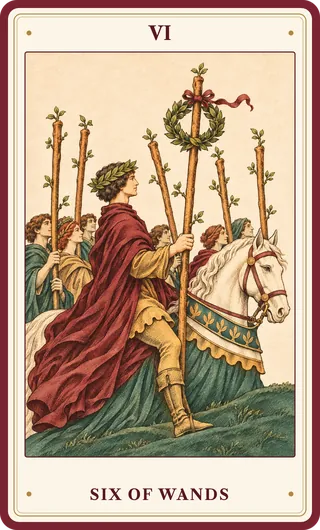
White horse
The horse stands for purity, strength and a victory carried with dignity. Reversed, it suggests the momentum is still there but the rider is not sure they deserve to sit on it.
Laurel wreath on the rider's head
The wreath is the ancient crown of the winner and shows that effort has been formally recognised. Reversed, it points to recognition that is late, missing or worn uneasily.
Wand tied with a laurel wreath
The rider lifts the wand like a trophy, announcing the win to everyone. Reversed, the trophy may be held up for show, or kept quietly out of sight.
Crowd of wand-bearers
The people on foot hold their wands upright and cheer the rider on. Reversed, the crowd can go silent, look away or turn into a pressure to keep performing.
Rider's upright posture and forward gaze
He sits tall and looks ahead, comfortable being seen. Reversed, that ease is lost, and the card asks whether you are hiding, bragging or simply unsure.
Horse's red-draped back
The cloth shows that the victory has been prepared for and ceremonially honoured. Reversed, it is a reminder that the ceremony can look better than the win feels.
Six of Wands reversed as a person
As a person, the reversed Six describes someone at one of two extremes. The first is the person who craves validation so much that they cannot do anything without an audience. They may be charming and ambitious, but their warmth depends on being admired, and success can make them unkind.
The second is the quiet achiever who has done remarkable things but does not believe in their own worth. They deflect compliments, downplay results and expect others to find them out. If this is you, the card is gentle: you are more capable than you allow yourself to think.
Context matters. If you pulled the card for yourself, ask which of these two feels familiar. If it describes someone else, notice whether they need less applause or more.
Six of Wands reversed and self-worth
Underneath all of the practical meanings sits one theme: where does your sense of worth come from? The upright Six lets you borrow confidence from the crowd. The reversed Six removes the crowd and asks whether you have any of your own.
That is hard, and it is also freeing. If your satisfaction depends entirely on other people noticing, you will always be one missed email away from feeling like a failure. If you can recognise your own effort, outside praise becomes a bonus rather than a requirement.
Spiritually, the card can also point to going along with a group because it feels safer than following your own path. Ask whether your beliefs and goals are chosen or inherited. The Seven of Wands reversed explores a related theme of giving up your ground under pressure, and the two cards pair well in a reading about confidence.
Try this: Before your next win, however small, decide privately what would make it count for you. Write it down. When the day comes, check yourself against your own measure first and everyone else’s second.
Is the Six of Wands reversed a yes or no?
In a yes or no question, the reversed Six of Wands is a delayed or uncertain yes. Success is still possible, but it may take longer, require you to work through doubt, or arrive without the recognition you wanted. If your question is specifically about being acknowledged, praised or chosen, the answer leans closer to no for now.
Context changes the answer. If you ask whether you will win a competition, the card suggests a hollow or contested result. If you ask whether you have done well enough, it says yes, and you should stop waiting for permission to believe it. For a quick comparison of how the upright card answers, see Six of Wands as a yes or no answer.
How to tell which meaning applies to your reading
Because the card has several faces, the position and your question decide which one speaks. Ask yourself these in order:
- Did you actually achieve something? If yes, the card is about recognition or feeling, not failure.
- Is the problem outside you (no credit) or inside you (no belief)? That separates the delayed recognition reading from imposter syndrome.
- Does anyone in the situation seem to be boasting, competing or taking over? If so, ego is likely the point.
- Is the situation calm and you simply do not need an audience? Then it may be a private win.
Surrounding cards help. A reversed Six beside the Eight of Cups suggests you are about to walk away from a success that does not satisfy, while beside the Queen of Wands reversed it points more strongly to confidence knocked out of balance. If your own intuition disagrees with a textbook meaning, take that seriously and weigh it too.
What to do when the Six of Wands appears reversed
The card does not ask you to give up. It asks you to change where you look for confirmation. Here are practical steps that fit most readings:
- Record your own wins, privately and in detail, so your sense of progress does not rely on anyone else.
- Ask directly for feedback or credit where it is due, calmly and with specifics.
- Share credit generously if you are the one at risk of taking too much.
- Check whether the goal you reached is still the goal you want.
- Be patient with timing. Recognition often arrives after the work, not with it.
If you suspect pride is at fault, look at the Seven of Wands as a contrast: it shows what it takes to hold ground without needing to dominate. The reversed Six is not telling you to shrink. It is telling you to stay steady whether the crowd shows up or not.
Six of Wands reversed compared with the upright card
The clearest way to understand the reversal is to put the two side by side. Upright, the card shows earned confidence and public success, with a rider who is comfortable being seen. The meaning is mostly external: people notice, people cheer, and you receive it.
Reversed, it becomes mostly internal. The same victory is complicated by doubt, ego or silence, and the conversation shifts from what the world gives you to what you give yourself. A good way to remember it is that upright is a parade and reversed is a mirror.
Neither is better or worse. The upright card rewards you for what you have done. The reversed card asks whether you can be fully at peace with it, even without the parade.
Reading it in a spread
In a past position, the reversed Six of Wands suggests a past achievement that was never properly acknowledged, or a time when pride cost you something. In the present, it points to the current gap between effort and recognition. In the future, it is a gentle warning that a coming win may be quieter or more complicated than you expect, so prepare your own sense of its meaning in advance.
As advice, it tells you to stop chasing applause. As an obstacle, it names self-doubt or ego as the thing in your way. In a simple 3 card tarot reading, try pairing it with a card for what you have done, one for how it is received, and one for what to do next. That structure fits the card’s themes neatly.
Try this: Draw the Six of Wands from a shuffled deck and reverse it on purpose. Study the image upside down for a full minute, then write one sentence on what the rider would need to feel as proud with an empty street as with a full one.
Questions readers ask
What does the Six of Wands reversed mean?
It most often means delayed or missing recognition, self-doubt after a real achievement, or pride that has grown too large. The win itself is usually real. What has gone wrong is how it is received, or how you feel about it.
Is the Six of Wands reversed a bad card?
Not really. It is an uncomfortable card, but it rarely predicts outright failure. It points to a gap between what you have done and what you feel or what others acknowledge, and that gap can be closed.
Is the Six of Wands reversed a yes or no?
It leans towards a delayed or uncertain yes. The outcome you want may be achievable, but expect a wait, some doubt to work through, or less applause than you hoped for.
What does the Six of Wands reversed mean in love?
It points to insecurity, feeling unappreciated, or an ego clash between partners. For singles it often shows low self-esteem or a polished image that hides how you really feel.
What does the Six of Wands reversed mean as someone's feelings?
The person likely admires you but feels insecure, overshadowed or unsure of where they stand. It can also describe someone who needs praise so much that it gets in the way of being warm.
How is the reversed Six of Wands different from the upright card?
Upright, victory is earned and publicly celebrated. Reversed, recognition is delayed, denied, kept private or distorted by self-doubt or ego, so the same achievement feels smaller or more complicated.