
Five of Wands Tarot Card Meaning (Upright & Reversed)

- Arcana
- Minor Arcana, Suit of Wands
- Element
- Fire
- Yes or no
- No
competitionconflictrivalry
delayslost motivationscattered energy
The Five of Wands means conflict, competition and clashing opinions. Five people wave their staffs in the air, each pushing their own way, and no one is in charge. In a reading it points to disagreements, rivalry or a crowded situation where everyone wants to be heard, usually with more commotion than lasting damage. You may also see the card written as 5 of Wands or V of Wands (the Roman numeral five).
The card is not a prediction of disaster. It describes friction, and friction can wear you down or sharpen you, depending on how you handle it. The sections below cover the imagery, upright and reversed meanings, love, feelings, work, money, health, advice and how the card compares with its near neighbours.
Five of Wands at a glance
Here is the quick version before the detail.
- Suit and element: Wands, fire
- Number: Five, the number of disruption and change
- Upright keywords: conflict, competition, tension, diversity of opinion, rivalry, restless energy
- Reversed keywords: resolution, avoidance, suppressed anger, inner conflict, backing down
- Astrology: Saturn in Leo (Golden Dawn tradition)
- Yes or no: maybe, leaning yes with effort
If you only remember one thing, remember this: the Five of Wands is a scuffle, not a war. Energy is high, egos are out, and the question is what you do with all that heat.
What the Five of Wands card shows
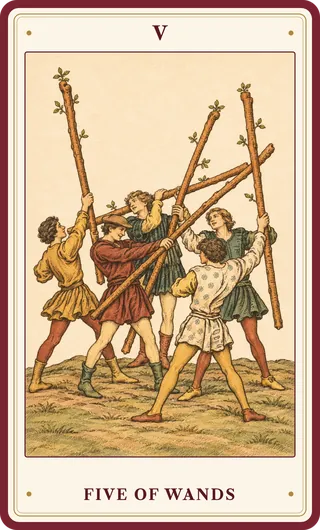
In the Rider-Waite-Smith image, five young people stand on open ground, each gripping a wooden staff. They lunge and swing, and the staffs cross above their heads. Arthur Edward Waite described the scene as something like mock warfare, a sham fight or sport. That framing matters, because it shapes how the card should be read.
Look at what is missing. There is no blood, no fallen figure, no weapon anyone could call lethal. The ground is green and the sky is clear. Nobody wins here and nobody is losing badly. What the picture captures is a moment when a group has too many ideas and too little coordination.
The clothing is the second thing to notice. No two figures dress alike. The artist, Pamela Colman Smith, gave each one a different colour and cut, which reads as different backgrounds, different views and different priorities. The conflict does not come from anyone being wicked. It comes from five valid agendas colliding.
Why nobody is getting hurt
Many readers see this card and brace for a vicious row. A better reading begins with the fact that the wands are raised, not striking. This is the card of energy that has not yet been given a direction.
Think of a group chat where everyone is typing at once, a brainstorm where every idea is shouted over the last one, or a family dinner where a minor topic gets loud. It feels chaotic from inside it, but a calm observer would see five people who each care about the outcome. That care is the raw material.
This is also why the Five of Wands sits in the middle of the Wands story. After the planning and confidence of the earlier cards, the ideas meet the real world and the real world pushes back. The Four of Wands offers a settled moment of celebration and stability, and the Five breaks it open again. Growth is rarely tidy.
Read Five of Wands for your question
Upright: Arguments, rivalry or clashing needs, usually noisy rather than serious, that need honest talking instead of point scoring.
Reversed: Either the fighting is finally easing, or one of you is swallowing what needs saying and keeping a false peace.
Upright: They feel frustrated, restless or competitive, and may be stirring things up because they care and don't know how to say it.
Reversed: They feel worn out by the friction and want peace, or they are hiding their irritation instead of voicing it.
Upright: A busy, competitive workplace full of clashing ideas, where you must speak up and show your strengths to be noticed.
Reversed: Office tension is settling down, or you are avoiding a necessary confrontation and letting others take the lead.
Upright: Competition for income, clients or budget, with several people pulling in different directions over resources.
Reversed: Financial disputes are being settled, or you are dodging a money conversation that would clear things up.
Upright: Stay in the room, make your case, listen to the others, and treat the friction as a way to sharpen the plan.
Reversed: Stop fighting for the sake of it, or stop avoiding the one honest conversation you keep putting off.
Upright: Stress, tension and an overloaded system, or a determined fight against illness, plus sports injuries from rough play.
Reversed: Recovery and rest after a stressful stretch, though bottled-up tension can still show up in the body.
Five of Wands upright meaning
Upright, the Five of Wands describes active friction. You may be in a disagreement, a contest or a crowded field, and the situation feels busy, irritating or exhausting. It often shows up when people are talking past each other, each convinced they are making the obvious point.
It can also mean competition in a healthy sense: a sports match, a pitch against other bidders, a writers’ room, a lively debate. In those settings the clash improves everyone. The card does not say the conflict is bad. It says the conflict is real, and that you cannot wish it away.
On the personal side, the card can describe inner restlessness. You might have several goals fighting for your attention, or a part of you that wants to attack and a part that wants to hold back. If the scene is happening inside your own head, the advice is the same: let each voice speak, then choose.
The card also carries a hint of “diversity” in the positive sense. Different opinions, when heard properly, give you a fuller picture than agreement ever would. The trouble is only that nobody is listening yet.
Five of Wands reversed meaning
Reversed, the card splits into two quite different readings, and the rest of your spread usually tells you which one applies. The first is relief: the fight is winding down, people are tired of arguing, and a workable peace is arriving. The second is avoidance: you or someone else is stuffing down a real disagreement because confrontation feels unpleasant.
Both readings can be true at once. A reversed Five can mean the noise has stopped, but the question is whether the quiet came from resolution or from silence. If the issue was actually settled, there is a sense of lightness. If it was buried, there is a low hum of tension that returns at the worst moment.
Reversed Fives can also point to inner conflict, such as doubt about where you stand, fear of being disliked, or anger you do not want to admit. For a full guide to love, work and life with the card upside down, see Five of Wands reversed. If you are new to flipped cards in general, how to read reversed tarot cards explains the options.
Try this: Take a conflict you currently feel in the reversed Five of Wands. Write two sentences: one on what has genuinely been resolved, and one on what you are still avoiding. The second sentence is your next step.
Five of Wands in love
In a relationship reading, the upright Five describes bickering, competing needs or a stretch where you cannot seem to get on the same page. It might be about chores, time, ambition or who is right. Often the issue itself is minor, and the real force behind it is two strong personalities wanting to be seen.
The key question is whether the friction is productive. Some couples spark each other, argue loudly and make up easily. Others use arguments to avoid deeper matters. The Five of Wands asks you to check which pattern you are in. If you are fighting about the dishwasher but really fighting about respect, name the real subject.
For single people, the card can mean competition for someone’s attention, a dating scene with a lot of noise and not much clarity, or a partner who enjoys the chase more than commitment. It may also describe your own restlessness: lots of energy, mixed signals, no clear direction.
Reversed in love, the card often means the arguing has run its course and both people are ready to talk calmly. It can equally warn that one partner has stopped speaking up to keep the peace. Peace built on silence is thin, and the reversed Five asks you to check.
Five of Wands as feelings
When this card stands for what someone feels about you, it often describes a mix: attraction with irritation, excitement with uncertainty. They may feel competitive, defensive or on edge around you. It can also show someone who enjoys a bit of verbal sparring and reads banter as bonding.
The card does not describe calm, settled love. It describes strong feeling that has not found a calm outlet. If other cards in the spread show warmth, the Five suggests a playful rivalry. If the surrounding cards are heavy, it points to real frustration.
Reversed, the person may be tired of the friction and want to make peace. They may also be hiding how they feel to avoid a scene. Pay attention to what they do, not just what they say, and keep your own boundaries clear while you wait for clarity.
Five of Wands in career
Work is where this card feels most at home. Upright, it describes a competitive environment: several people going for one promotion, a team where ideas collide, a crowded creative field or a project with too many cooks. If you are in sales, media, startups or any role with open competition, it is a fairly ordinary appearance.
The practical message is to take part and take it seriously. Prepare your case, listen to the other ideas, and look for what is useful in them. Competition rewards the people who stay calm enough to think. If a team is stuck, someone needs to set a structure: who decides, what the goal is, how contributions get weighed.
Reversed, the card can mean workplace tension is easing, a rivalry has been settled, or a chaotic project has finally found its footing. It can also warn that you are backing out of a contest you could win, or leaving a conflict unresolved because speaking up feels risky. Ask which one it is for you.
Try this: Before your next meeting where opinions clash, write the one outcome everyone in the room wants. Open with it. Shared goals turn a brawl into a discussion.
Five of Wands in money
Financially, the Five of Wands describes competition over resources. You may be bidding against others, chasing the same clients, or watching a budget get fought over. It can also show a household where partners disagree about spending, or a business where partners pull in different directions.
The card does not say you will lose money. It says the money question is contested and will need negotiation. If you are asking about an investment or a purchase, expect competing offers and some noise, and keep your own limits in view so the excitement does not decide for you.
Reversed, the card can show a financial dispute settling, a compromise being reached, or a refusal to look at a money conversation you have been putting off. If you have been avoiding a bill, a shared account or a tough talk about debt, the reversed card nudges you to deal with it. For a broader view of an earnings question, a money-focused spread can help sort the competing pressures.
Five of Wands in health and spirituality
Health readings with this card often point to stress, nervous tension or an overstimulated body. It can also show a fight against illness, the sense of battling something and staying determined. Contact sports and physical rivalry can bring minor injuries, so the card sometimes appears for bruises and strains rather than anything serious.
Because Wands are fire, the Five often links to inflammation, heat and restless energy. As a general reading, it suggests easing the pace, moving the body in a way that releases tension, and not letting adrenaline run all day. Tarot is not medical advice, so see a qualified professional for any real health concern.
Spiritually, the card is about integrating opposing parts of yourself. You may be pulled between ambition and rest, loyalty and independence, or old beliefs and new ones. Rather than choosing one voice and silencing the others, the Five asks you to let them argue it out until a position forms that you can live with.
Five of Wands card symbols
Choose a symbol to read what it means on the card.
Five wands
Each figure holds a staff of living wood, the tool of the Wands suit and a symbol of drive and ambition. The wands cross and clash in the air, but none of them lands a blow.
Five figures
Five young people each go their own way with no leader and no shared plan. They stand for competing wills, egos and ideas all pushing at once.
Mismatched clothing
Every figure wears different colours and styles, which shows different backgrounds, values and opinions. The differences are the cause of the clash, and also the source of its energy.
Green ground
The grass underfoot is fresh and open, not a battlefield of mud or blood. It hints that this struggle is growth-oriented and survivable.
Clear blue sky
Nothing threatening hangs overhead, so the conflict is contained. It suggests the situation is more noise and effort than real danger.
Raised, unbroken wands
The sticks are lifted and crossed, but nobody is hurt. This is the clue that the scene reads as mock combat or sport, not war.
Leaves on the wands
Some wands show small green leaves, a reminder that Wands are living fire energy. The competition can still produce something fertile.
Five of Wands as advice
As advice, this card tells you not to back down, and also not to lose yourself in the noise. You are allowed to compete, disagree and defend your position. You are also allowed to listen, since every figure in the picture has a point.
A few concrete ways to act on it:
- Say your position plainly, once, without escalating.
- Ask each person what they actually want from the situation.
- Separate the issue from the ego: what is the problem, and who is merely loud?
- Choose one person or process to decide, so the energy has direction.
- Rest afterwards, because fire burns out.
The card also cautions against fighting for sport. If you notice you are arguing because the adrenaline feels good, pause and ask whether the matter deserves your time.
Five of Wands as a person
Read as a person, the Five of Wands is energetic, competitive and often in the middle of some sort of friction. They have strong opinions, enjoy a debate and may stir things up without meaning harm. They can be great fun in a team that needs spark, and exhausting in a team that needs calm.
They are usually quick, fiery and a little restless. Think of the colleague who challenges every idea, the sibling who plays to win, or the friend who loves a heated discussion. They respect people who push back with confidence and lose interest when everyone agrees.
Reversed, the person may suppress their competitiveness or anger, often to their own cost. They might avoid conflict, appear withdrawn, and then explode over something small. If this describes you, the card is a gentle push toward saying things earlier and more calmly.
Is the Five of Wands a yes or no card?
The honest answer is “yes, with effort”, or a cautious maybe. The Five of Wands rarely blocks an outcome. It tells you the road will include competition, opposition or disagreement, and that the result depends on how you handle it. If your question is about winning a contest, a bid or a place, the card favours people who show up prepared.
Reversed, the answer shifts. If the conflict is ending, the reversed Five leans toward yes, since the obstacle is dissolving. If the reversed card shows avoidance, it leans toward “not yet”, because something needs resolving before you move on. Use the cards around it to tell which one applies. For a fuller breakdown, see Five of Wands as a yes or no answer.
Five of Wands compared with similar cards
Several cards share the theme of conflict, and mixing them up is common. The difference is in the stakes and the style of fighting.
The Five of Swords is a conflict with a winner and losers, where words cut, someone walks off with the spoils and others are left hurt. The Five of Wands is more even, more physical and more playful. Nobody has stolen anything, and nobody leaves ashamed.
The Seven of Wands shows one person defending high ground against a crowd. It is about holding your position under pressure. The Five has no hill and no defender, only a crowd of equals jostling. If the Seven is a stand, the Five is a scrum.
Within the suit, the numbers matter too. The Five arrives after the stability of the Four and before the Six, where victory and recognition appear. Seeing it as the testing step between stability and success keeps its meaning in proportion. You can compare every card in the suit in the suit of Wands overview.
Five of Wands in astrology and numerology
In the Golden Dawn tradition, the Five of Wands corresponds to Saturn in Leo, and some decks title it Strife. Leo is a proud, expressive fire sign, and Saturn is the planet of limits and tests. When a showy sign meets a restricting planet, you get egos and ambitions running into resistance, which is exactly the card’s scene.
The fire element is about will, energy and passion. Fire in the Five is not calm or controlled. It is crackling, wild and needs to be directed. When it is, it warms and creates. When it is not, it scorches whoever is nearby.
In numerology, five is the number of change, instability and freedom. It sits at the midpoint of the one to nine cycle, where things can tip either way. All the Fives share this mark: disruption that forces a rethink. You can see how this plays out across the deck in the guide to tarot numerology.
Five of Wands with other cards
Cards around the Five of Wands shape the tone considerably. A few common pairings:
- With the Four of Wands: a stable situation is being shaken up, or conflict is settling into harmony.
- With the Ace of Wands: a new creative drive meets competition, so expect to defend a fresh idea.
- With the Three of Swords or Nine of Swords: the friction is causing real hurt or anxiety, not just noise.
- With the Six of Wands: the contest ends in recognition and a win.
- With the Eight of Cups: you may walk away from a fight you no longer want.
If the Five lands in a position representing the past, the conflict is behind you and you may still be clearing up its effects. In the future position, it warns of coming competition and invites preparation. As an outcome card, it says the matter ends up unsettled or contested, or that it gives you something to push against and grow from.
Questions to ask yourself when you draw it
Because the card is about conflict, the most useful readings often come from a few honest questions. Who or what am I in conflict with? Is this a real disagreement, or is it noise? What do I actually want from the situation, and what do the other people want?
It also helps to ask whether you are fighting too much or too little. Some people draw the Five because they are in a constant skirmish and need to put the stick down. Others draw it because they have avoided every disagreement for years and need to pick it up. Same card, opposite medicine.
Try this: Pull a Five of Wands in a daily reading and note every moment of friction that day, however small. At the end, mark each one as useful, pointless or avoided. Patterns usually show themselves within a week.
Keeping the Five of Wands in perspective
The Five of Wands is one of the most human cards in the deck. Everyone has been in a room where five voices speak at once, and everyone has felt the mix of irritation and energy that follows. It reminds you that disagreement is part of being alive and working with others.
The healthiest response is to stay engaged without turning every difference into a duel. Make your case, hear the others, and decide what you will fight for and what you will let go. If you want to see where the card sits among all seventy-eight, the tarot card meanings page lays out the full deck.
Questions readers ask
What does the Five of Wands mean in tarot?
The Five of Wands means conflict, competition and clashing opinions. It shows several people or impulses pulling in different directions, usually with more noise than real harm. It asks you to take part, listen and sharpen your position.
Is the Five of Wands a good or bad card?
It is neither purely good nor bad. It can describe stressful arguments, but it can also describe healthy rivalry, brainstorming and the effort that produces better work. The surrounding cards show which version you are in.
What does the Five of Wands mean in love?
In love it points to bickering, rivalry, mismatched needs or a relationship where the sparks are not all romantic. It is rarely a sign of a breakup by itself. It asks both people to speak plainly instead of trying to win.
What does the Five of Wands reversed mean?
Reversed, it can mean a conflict is ending and peace is returning, or that you are avoiding a fight that needs to happen. It can also describe suppressed anger and inner tension. Context tells you which reading fits.
Is the Five of Wands a yes or no card?
It leans toward a cautious maybe: yes, but not without effort. The thing you ask about is possible, though you will have to compete, argue your case or work through disagreement first.
What is the Five of Wands in astrology?
In the Golden Dawn system it is linked to Saturn in Leo, and it belongs to the fire element of the Wands suit. The pairing of a heavy, restricting planet with a proud fire sign fits the card's theme of egos meeting resistance.