
Five of Wands as a Yes or No Answer

- Arcana
- Minor Arcana, Suit of Wands
- Element
- Fire
- Yes or no
- No
competitionconflictrivalry
delayslost motivationscattered energy
The Five of Wands is a no, or at least a not yet, when it appears upright in a yes or no reading. The card shows five people swinging staves with no shared plan, so the situation you are asking about is crowded, contested or poorly agreed. Reversed, it softens to a maybe that leans yes, because the conflict is easing and a workable compromise is within reach.
That answer is firmer than it sounds, but it is not a doom card. The Five of Wands describes friction, not disaster, and friction often passes. The rest of this page explains why the card reads this way, how its answer changes with the question, and what to do next when it lands in your spread. For the card’s full meaning outside of yes or no, see the Five of Wands card meaning.
The short answer: upright is no, reversed is maybe
Here is the quick verdict, so you can see it at a glance:
- Upright: No, or not yet. Expect competition, delays and disagreement before anything gets resolved.
- Reversed: Maybe, leaning yes. Tension is cooling or being faced, but it is not fully settled.
- With strong positive cards nearby: A qualified yes, earned through effort.
- With heavy or negative cards nearby: A firmer no, often because the conflict is bigger than it first looks.
A yes or no draw always compresses a card into one word, so some nuance is lost. The Five of Wands is a good example. It does not say “this will never happen.” It says “not without a struggle, and not while everyone is still shouting.” Reading it that way keeps the answer honest and useful.
Why the Five of Wands leans no
Look at the picture. Five figures with staves are caught in a scramble, each facing a different direction, each dressed differently. There is no leader, no referee and no agreed goal. That is the exact opposite of what a clean yes needs, which is alignment and momentum.
When you ask a yes or no question, you are usually asking whether something will go smoothly. The Five of Wands answers that directly: it will not go smoothly. Plans will be challenged, a rival may appear, or the people involved will disagree about what they want. Even if the outcome is eventually fine, the road there is noisy.
The card also belongs to the suit of Wands, which is the suit of fire, drive and ambition. Five is the number of disruption, the point where the stability of four breaks down and something has to change. Fire plus disruption gives you competition and clashing energy. If you want to understand more about how numbers shape these answers, our guide to tarot card numbers explains what each one adds to a card.
Why it is a soft no and not a hard no
Not every no is equal. Cards like the Ten of Swords or the Tower describe endings and collapse. The Five of Wands describes a scuffle. The figures on the card are young, energetic and apparently playing as much as fighting, and the staves cross in mid-air rather than landing on anyone.
That is why many readers treat it as a “not yet” instead of a flat refusal. The conflict is real, but it is survivable and often productive. Competition sharpens ideas. A heated meeting can lead to a better plan. A rival can push you to improve.
So if you draw the Five of Wands, you can usually read it as: the answer is not a clean yes right now, and it may become one after the dust settles. If your question allows no time frame, treat it as no. If your question is about whether something will work out eventually, treat it as maybe, with effort required.
Try this: Write your question, then add one line underneath: “Who or what is in conflict here?” Name the people, opinions or inner voices that are pulling in different directions. If you can name them, you already know what the Five of Wands is pointing at.
Read Five of Wands for your question
Upright: Upright it is a no for now: egos, mixed signals and unspoken rivalry are making the connection noisy rather than easy.
Reversed: Reversed it is a maybe leaning yes: the arguing is easing or being faced honestly, so there is room to repair or begin.
Upright: Upright it suggests the person feels crowded, defensive or competitive, and is not yet settled enough to say yes.
Reversed: Reversed it suggests they are tired of the fight and want peace, though they may still be avoiding the real conversation.
Upright: Upright it is a not yet: expect competition, clashing opinions and a team that has not agreed on a direction.
Reversed: Reversed it is a cautious yes: rivalry is cooling and a workable compromise is within reach.
Upright: Upright it is a no to rushed money moves, especially shared finances or deals with several opinions involved.
Reversed: Reversed it is a maybe: disputes over money can be settled, but only if everyone's terms are written down.
Upright: Upright it advises you to slow down, listen to every side and agree on rules before pushing forward.
Reversed: Reversed it advises you to stop avoiding the issue and settle it, or to stop fighting a battle that no longer matters.
Upright: Upright it is a no to overdoing it: stress, tension and restless energy need an outlet before they become a problem.
Reversed: Reversed it is a maybe: the strain is easing, but suppressed stress can resurface if you ignore it.
Five of Wands reversed as a yes or no answer
Reversed, the Five of Wands changes character. The core idea is still conflict, but now it is cooling, being avoided or being worked through. That moves the answer from no to maybe, leaning yes, as long as the resolution is real.
There are two ways the reversed card can play out. In the good version, the argument ends, people find common ground and the way forward opens. In the less helpful version, nobody is fighting because nobody is talking. The tension has been pushed under the surface, and it can return. That second version is why the answer is a maybe rather than a clean yes.
To decide which one you are dealing with, check the card beside it. A warm, stable or forward-moving card suggests a true resolution. A tense or hesitant card suggests the conflict is only buried. For the full reversed meaning, including love and work, see the Five of Wands reversed page, and for general guidance on how to approach flipped cards, see reversed tarot cards.
Five of Wands yes or no in love
In a love question, the upright Five of Wands means not yet. There is friction between you and the other person, or between you and your own mixed feelings. It might be jealousy, a rival, constant bickering, different goals or simply two strong personalities who have not worked out how to share space.
It does not mean the relationship cannot work. Plenty of couples argue, and the card can describe the lively, sparring phase where people are still working out how they fit. What it rules out is a smooth, instant yes. If you ask “will they commit?” or “will we get back together?”, expect a conversation or two first.
Reversed, the card suggests that the arguments are quietening. If you ask “will we make up?”, that is a hopeful sign, provided both people actually address what caused the fight. If you ask about a new connection, reversed can also hint that you are tired of drama and want something calmer. For more on how the card reads in love and feelings, the Five of Wands page covers it in depth.
Five of Wands yes or no in career and work
At work, the Five of Wands is a strong signal of competition and committee energy. Ask “will I get the job?” and the card says you are one of several candidates. Ask “will this project go ahead?” and it says people have not agreed on how. Ask “will I get the promotion?” and it suggests you may have to compete for it openly.
The answer here is often a conditional yes if you are willing to compete and a no if you hope to win without effort. Wands cards love action. The Five of Wands rewards people who show up, speak up and bring ideas to the table, and it punishes people who hope the tension will go away on its own.
Reversed, it suggests the competition is easing. You might get a clearer decision, or the team might settle on one plan. It can also warn that someone is avoiding a necessary conflict, such as a conversation with a manager or a colleague. The Six of Wands yes or no page covers what usually comes next when the scramble ends and someone wins.
Try this: Before asking a work question, write down the one decision-maker who will settle the matter. If the Five of Wands appears, your next step is not to wait. It is to get that person’s view in writing.
Five of Wands yes or no for money
For money questions, the upright Five of Wands advises caution. It often shows up when finances are tangled with other people’s opinions: a shared account, a family inheritance, a business partnership or a negotiation where everyone wants a different outcome.
As a yes or no answer, it generally means no to a quick, clean financial move. It does not predict loss. It says there will be arguments about the terms, and rushing will make them worse. Agree on numbers, roles and deadlines first.
Reversed, a money dispute can be settled. It leans towards a maybe: a compromise can be reached, but both sides have to see it written down. If you are asking about a purchase, investment or loan, it is worth checking a more grounded card as well, such as the Ace of Pentacles, which speaks to concrete new financial beginnings.
Five of Wands yes or no for health and energy
Health questions are less common with this card, but when they appear, the Five of Wands relates to stress, tension and restless energy. A yes or no question like “should I push harder with this training plan?” gets a no: you are already running hot.
The card can also point to health conflicts of a more practical kind, such as disagreements with a doctor, a confusing array of advice or an internal tug of war about whether to change habits. The answer is to gather one clear plan instead of five.
Remember that tarot does not diagnose, and it is not a substitute for medical advice. Use the card as a prompt to ask where your body or mind is under strain, and take any real symptom to a qualified professional.
Five of Wands card symbols
Choose a symbol to read what it means on the card.
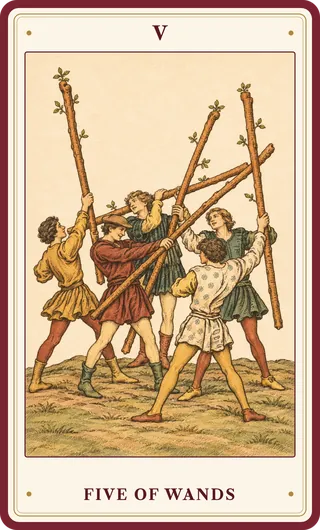
Five figures with staves
Five young people swing wooden staves in different directions. Nobody is clearly winning, which is why the card describes disorder rather than a real war.
Mismatched clothing
Each figure wears a different colour and style. This shows five separate perspectives, goals and egos in the same space.
Crossed and clashing staves
The staves tangle in the air but rarely strike a body. The conflict is loud and energetic, more like a scramble or a sparring match than a fight to harm.
Bare, open ground
The scene has no shelter, no fence and no path. Nothing has been organised yet, so the group has no shared structure to channel its energy.
Clear blue sky
The sky above is calm and open. It hints that the tension is temporary and the situation is not truly dangerous.
No leader or referee
No single figure takes charge. The next card, the Six of Wands, brings the leader, so this absence points to what is missing now.
Five of Wands for competitions, contests and “will I win?”
Questions about winning are where the Five of Wands gives a more interesting answer. The card is the only one in the Wands suit that depicts an open contest with no victor. So if you ask “will I win?”, the card says you will be in the fight, but it does not promise the trophy.
Treat it as a yes to participating and a maybe to winning. It can be a good sign if you thrive in competitive settings, because the Five of Wands energy is spirited and high-stakes without being hostile. It is less encouraging if you hope for an easy win.
The Six of Wands, which follows it in the deck, is the card of victory. If you want a clearer answer on winning, ask a follow-up and see whether it appears. You can also compare the Seven of Wands yes or no, which covers defending a position you already hold.
How to ask a question the Five of Wands can answer
The Five of Wands gives its most useful answer when your question is specific and has a clear time frame. “Will I get the apartment?” works better than “Will my life get better?” The card describes friction, so it needs something concrete to attach to.
Closed questions work best for a yes or no draw. Avoid asking for two outcomes at once, such as “Should I quit and start my own business?” Split it into two questions, and draw once for each. If you are looking for ideas on how to word them, our list of questions for tarot reading is a good place to start, and the yes or no tarot reading tool lets you draw a card and see the answer straight away.
Also avoid asking the same question repeatedly until you get the answer you want. If the Five of Wands keeps appearing, it is usually telling you that the real issue is the conflict itself, not the outcome you are asking about.
Cards that change the Five of Wands answer
The answer shifts when the Five of Wands sits next to other cards. In a yes or no spread of two or three cards, read the neighbours as modifiers.
- Six of Wands or the Chariot: the conflict ends with a winner. This points to a qualified yes.
- Temperance or Two of Cups: the sides find balance or agreement. A softer maybe or yes.
- Five of Swords or Seven of Wands: the conflict is sharper and more personal. A firmer no.
- Ten of Wands or Nine of Swords: the struggle is exhausting and may not be worth it. A no, with a note to rest.
A three-card draw is helpful for this, and our 3 card tarot guide shows simple layouts you can use. Put the situation first, the obstacle second and the likely outcome third, and the Five of Wands will usually show up in the obstacle position.
What to do after a Five of Wands answer
Treat the card as a call to action. The no is not a wall, it is a signal that something needs sorting before you go ahead. Start by naming the conflict, then ask who is involved and what each person actually wants.
If the conflict is with another person, have the conversation you have been avoiding. If it is within a group, agree on rules and a decision-maker. If it is inside your own head, write down both sides of the argument and see which one you really believe.
Try this: Draw one clarifying card with the question “What would settle this?” Keep the answer practical. If it shows a person or a number, make that the next step.
Then wait, and ask again once the tension has eased. A second draw after real action is far more informative than a second draw made in frustration.
Five of Wands compared with other conflict cards
Several cards describe conflict, and their yes or no answers differ in useful ways. The Five of Wands is friction among equals. It is noisy, energetic and often temporary.
The Five of Swords yes or no answer is harsher, because that card shows a bitter win where someone is left hurt. The Seven of Wands is also a no-leaning card, but it describes defending a position rather than scrambling over one. The Six of Wands is the answer that follows, and it is a clear yes.
This is a helpful way to separate them. If the conflict feels like a lively sparring match, it is the Five of Wands. If it feels cruel or manipulative, it is the Five of Swords. If you are protecting something you have already earned, it is the Seven of Wands.
Common mistakes when reading the Five of Wands as yes or no
The first mistake is treating it as a flat no and giving up. Because the card shows a scuffle and not a catastrophe, the answer is usually “not yet” or “with effort,” and a person who stops there can miss the real message.
The second mistake is ignoring the question’s context. A yes or no answer for a competition is not the same as one for a relationship, and the card flexes accordingly. Always match the answer to the actual subject.
The third is forgetting that tarot is not a promise. Use the answer to prepare, not to settle a decision for you. If you are new to reading, our tarot for beginners guide covers how to hold a reading lightly, and you can always return to this page when the Five of Wands appears again.
Questions readers ask
Is the Five of Wands a yes or no card?
Upright, the Five of Wands leans no, or more accurately not yet. The situation involves conflict, competition or too many opinions, so the path forward is not smooth. Reversed, it becomes a maybe that leans yes as tension eases.
Is the Five of Wands reversed a yes?
Reversed, it is a maybe with a lean towards yes. The conflict is settling or being avoided, so the answer depends on whether the underlying issue is truly resolved. Check the surrounding cards to see which way it falls.
Does the Five of Wands mean no in a love reading?
Upright, it usually means not yet. There is friction, rivalry or mixed signals that need to be dealt with before the relationship can move on. It is not a permanent no, and a good talk can change the picture.
Is the Five of Wands a bad card?
No. It describes friction and competition, which can be healthy, energising and productive. It becomes a problem only when nobody agrees on the rules or listens to the others.
What should I do if I draw the Five of Wands for a yes or no question?
Treat it as a pause, not a verdict. Clarify what is in conflict, talk to the people involved, then ask the question again or draw a clarifying card.
Can the Five of Wands mean yes if I want to win something?
It can mean yes to a competition you enter with energy, but it does not promise victory. It says you will have to work and compete for the result.