
Seven of Wands as a Yes or No Answer

- Arcana
- Minor Arcana, Suit of Wands
- Element
- Fire
- Yes or no
- Yes
defenseperseverancestanding firm
delayslost motivationscattered energy
The Seven of Wands is a conditional yes. Upright, it says yes, provided you are ready to defend your choice and keep working for it. Reversed, it leans no, or at least “not yet,” because the card then points to exhaustion, overwhelm and a fight that may no longer be worth it.
That “yes, but” is the whole character of the card. The Seven of Wands does not hand you an easy green light. It tells you the position is worth having, that someone or something will push back, and that the outcome depends on whether you hold steady. This guide explains why the answer comes out that way, how it changes with the question, and how to firm up a reading when the card feels unclear. For the full meaning behind the verdict, see the Seven of Wands card meaning.
The short answer: yes, if you will stand your ground
Think of the Seven of Wands as a yes with conditions attached. Upright, the answer is: yes, you can have this or keep this, but you will need to protect it. The card does not predict that things will be smooth. It predicts that the thing you are asking about is real, defensible and worth the effort.
Here is the quick version:
- Upright: conditional yes. Go ahead, and be ready for pushback.
- Reversed: leans no, or not yet. Rest, reassess, or drop the fight.
- Surrounded by Wands: a stronger, faster yes, with more heat and more opposition.
- Surrounded by heavy Swords or Cups of loss: a weaker answer, because the card’s defensive energy gets drained.
If you need a single word for an upright draw, say yes. If you need a single word for a reversed draw, say not yet. Everything else in this article explains how to tell which kind of yes or which kind of no you are looking at.
Why the Seven of Wands leans yes
Look at the picture. A figure stands on high ground, gripping one wand, while six wands rise from below. In the Rider-Waite-Smith deck, he is the only person you can see. He is outnumbered, but he is above them, and he has not been knocked off the hill. That position is why the card reads as a yes: you are not asking for a place to stand, you already have one.
The card follows the Six of Wands, which is the victory. The Seven asks what happens after you win. Success draws attention, doubt and competition, and this card tells you that you are strong enough to hold the result. A yes here means “yes, and you can keep it,” which is a more useful answer than a simple go-ahead.
The element helps too. Wands are Fire, the suit of action, drive and willpower, and fiery cards tend to push yes answers forward. The Seven of Wands is Fire under pressure, which is why the answer is yes, but a yes with stress built in.
Seven of Wands reversed: yes or no?
Reversed, the card leans no. The defender is tired, the hill feels steeper, and the six wands seem closer. Where the upright card says “hold on,” the reversed card asks “should you?” The answer tends to be: not in this state, and perhaps not at all.
This is rarely a hard, permanent no. More often it means one of three things: you are too exhausted to carry this through right now, you are defending a position you no longer believe in, or you are about to give in to pressure and then regret it. A reversed Seven of Wands can also point to a fight that has been going on from habit, where you keep guarding something because you always have.
Reversed cards are never a flat opposite of the upright, so it helps to read the nuance. The Seven of Wands reversed page covers it in depth, and the guide on how to read reversed tarot cards explains why a reversal usually softens, delays or internalises a meaning rather than cancelling it.
Try this: Draw the Seven of Wands reversed in answer to a question? Write down what you are defending and what it costs you each week in time, sleep and attention. If the cost is higher than the prize, treat the card as a firm no. If the cost feels fair, treat it as “not yet” and rest first.
Read Seven of Wands for your question
Upright: Yes, if the relationship or boundary is worth defending, but expect to speak up for it rather than coast.
Reversed: Leans no: you are tired of defending the connection, or the guarding has turned into a habit that pushes your partner away.
Upright: They feel protective, determined and ready to stand up for you or for what you share.
Reversed: They feel worn down, defensive or unsure whether the fight is still worth having.
Upright: Yes, you hold a position worth keeping, and you can hold it against competition if you stay prepared.
Reversed: Leans no for now: burnout, a lack of support or an indefensible stance suggests stepping back or changing tactics.
Upright: A conditional yes: protect what you have built, budget firmly and be ready to say no to pressure to spend or lend.
Reversed: Leans no: you are stretched thin, so avoid a risky commitment until your finances feel secure again.
Upright: Hold your ground calmly, choose your battles and do not let criticism talk you out of a sound decision.
Reversed: Put the shield down, rest, and ask which fight is worth continuing and which you can let go.
Upright: Yes to protecting your energy and routines, and to standing firm with your doctor or yourself about what you need.
Reversed: Leans no to pushing on: stress and exhaustion are signalling that you need rest and support.
What the image tells you about the answer
The picture contains useful detail for a yes or no reading. The figure wears mismatched footwear, one boot and one shoe, which suggests he jumped up in a hurry. This matters: a yes from the Seven of Wands does not require perfect preparation. You will probably be improvising, and the card is fine with that.
Notice also that the opponents are never shown. All you see are six wands pointing up from below the ledge. Readers often take this to mean that some of the opposition is real and some is anticipated, and that part of your task is to figure out which is which. If you asked a yes or no question and the Seven appeared, ask yourself whether the resistance you fear has actually shown up yet.
Finally, he is on the high ground, not in a valley. That tells you the question is one where you have some advantage: experience, a claim, a head start, or the moral high ground. A yes from this card carries more weight when you can name that advantage.
Seven of Wands yes or no in love
In a love question, the Seven of Wands is a yes with a condition: you must be willing to protect the relationship, or to protect yourself within it. If you ask “Is this relationship worth keeping?” or “Should I stand up for what I need?” the answer is yes. Love questions that include a rival, family disapproval or friends who doubt the match usually draw this card, and it says the bond can survive if you refuse to be pushed off it.
The warning is about defensiveness. If you ask “Will we get along?” and the Seven turns up, the answer may be yes, but you or your partner may be quick to bristle. The card can show a couple who spend too much energy guarding against each other. A yes is possible, but only if you lower the shield at home.
Reversed in love, the answer leans no. Common readings include being tired of the fight, feeling unsupported, or realising that you have been competing for attention you should not have to compete for. When someone feels this way about you, the card can show a person who is protective but overwhelmed. If your question is about what they feel, the Six of Wands before it and the Nine of Wands after it help show whether the tension is easing or building.
Seven of Wands yes or no for career and work
Work is where the Seven of Wands is at its strongest. If you ask “Should I apply for the promotion?” or “Will I keep my position?” an upright Seven says yes: you have earned the spot, and you can defend it. It often shows up when colleagues are competing, when you are new to a role and being tested, or when you have just had a success that others resent.
The card does not promise that no one will challenge you. It says that you can hold your position if you stay prepared, keep your facts straight and do not take every criticism as a verdict. In a question like “Should I start my own business?” it is a yes, but it asks whether you can handle competition from day one.
Reversed, it leans no for now. Burnout, fighting alone and defending an untenable stance are the main themes. If you ask “Should I stay and fight this restructure?” and draw the reversed Seven, the card often suggests picking a different battle, finding allies or leaving a fight you cannot win. It is not a card of failure, but it does ask you to be honest about your energy.
Seven of Wands yes or no for money and finances
For money questions, the Seven of Wands is a yes that centres on protection. “Can I hold on to what I have?” gets a yes. “Should I defend my savings from a risky request?” gets a yes. The card favours the person guarding existing resources over the person chasing new ones.
It is less helpful for “Will I make more money?” or “Is this investment going to pay off?” because it speaks about defence rather than growth. If you want to know whether income will increase, look to cards like the Ace of Pentacles or a dedicated money spread. If you draw the Seven in this context, the more honest reading is: keep what you have, and do not be rushed or pressured into a decision.
Reversed, the answer leans no. You may be stretched too thin, giving in to pressure to spend, or hanging on to a financial position that is costing more than it returns. The reversed card suggests pausing before you commit.
Seven of Wands yes or no for health
Health questions are best treated with care, since tarot is not a substitute for medical advice. As a symbolic prompt, the Seven of Wands upright says yes to standing firm about what you need: asking for a second opinion, sticking to a routine or setting a limit with people who drain you. It is a card of resilience.
Reversed, it leans no to pushing on. It often appears when stress, overwork or constant vigilance is wearing you down. If you ask “Should I keep going at this pace?” the reversed card says no, and the next step is to rest or get support.
If a health question worries you, treat the card as a prompt for reflection and speak to a qualified professional about the actual issue.
Is it a yes about getting back together or making a big decision?
Two question types come up often with this card: reconciliation and major life choices. For “Will my ex and I get back together?” the Seven of Wands upright is a conditional yes. It shows that someone is willing to fight for the connection, but it also shows that both of you may have defensive walls. If those walls come down, the answer holds. If not, the pressure stays.
For big decisions such as moving, quitting or committing, the Seven says yes if you are confident in your reasons. It is a good card for the person who has already decided and wants to know whether the choice will hold up. It is weaker for a person who is still undecided, because the card’s energy is about defending a position, not choosing one.
Try this: Before asking the cards, finish this sentence aloud: “If the answer is yes, the thing I will have to defend is ___.” If you cannot fill in the blank, the Seven of Wands may be a poor fit for your question, and a different card or spread will serve you better.
Seven of Wands card symbols
Choose a symbol to read what it means on the card.
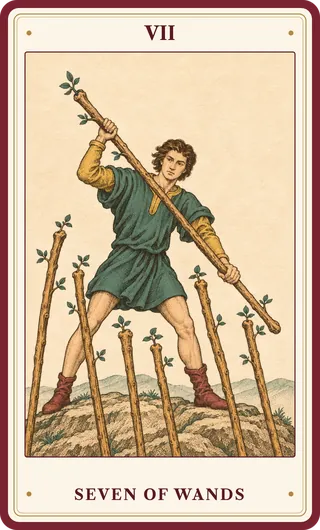
The figure on the hilltop
He stands on higher ground, which shows you already hold an advantage. It is the reason a yes is possible, because the position is worth keeping.
The single wand in his hands
He grips one wand and uses it to hold off the others. It stands for personal resolve and the one tool you really need.
Six wands rising from below
The six wands are the challenges, rivals and criticisms pressing in. Nobody is visible behind them, which hints that some of the pressure may be in your head.
Mismatched shoes
He wears one boot and one shoe, as if he leapt up in a hurry. It suggests you are defending without perfect preparation, and that a yes needs improvisation.
The rugged high ground
The rocky ledge is steady but not comfortable. It shows that a hard-won position needs continued effort to keep.
The number seven
Seven is the number of testing and assessment. After the win of the Six of Wands, the question is whether you can keep what you gained.
When the answer becomes a maybe: neighbouring cards
A single card gives a lean, not a verdict, and the cards beside the Seven of Wands can push the answer in either direction. The Seven gets stronger beside cards of victory and momentum, and weaker beside cards of defeat or withdrawal.
- Six of Wands before it: a clear yes. You have won, and you are being asked to keep the win.
- Eight of Wands after it: a yes, with a speedy outcome once the pressure breaks.
- Ten of Wands nearby: the yes comes at a heavy cost. You may be carrying too much to keep it.
- Four of Swords nearby: yes, but you need a real rest before you can fight on.
- Eight of Cups nearby: a no, because you are ready to walk away from the fight.
When two or three cards in a row carry the same message, trust the pattern. When the cards disagree, treat the Seven as a description of the conditions for a yes rather than the verdict itself.
How soon will the answer arrive?
The Seven of Wands is not an instant answer. It describes a situation in progress, so the timing is “during the contest” rather than “tomorrow.” Fire cards tend to move quickly, but this one is about holding steady for a while, often a matter of weeks rather than days.
The yes tends to come once the pressure has been tested. Think of it as “yes, after you have shown you will not back down.” If the card is followed by the Eight of Wands, the resolution may arrive fast. If it is followed by the Nine or Ten of Wands, expect the contest to be long.
Questions the Seven of Wands answers badly
Because the card is about defence, it is a poor match for questions that are not about holding or protecting something. “Will I meet someone new?” or “Is this the start of something?” are better served by cards that speak to beginnings. The Seven answers questions about what you already have.
It also struggles with vague questions. “Will things get better?” gives the card nothing to defend. Rephrase to name the thing: “Will I keep my place on this team?” or “Can this relationship survive this pressure?” The more specific the question, the more reliable the Seven’s yes or no.
Questions about other people’s motives are another weak spot. The card shows your stance, not theirs. If you ask what someone else will do and draw the Seven of Wands, the reading is usually about how you will respond to them.
How to ask a better yes or no question
Good yes or no questions are specific, personal and about a single outcome. A weak question is “Will it work out?” A strong one is “Should I accept this offer?” or “Will I keep this job through the next quarter?” Clear questions make the Seven’s conditional answer much easier to read.
Here are some habits that improve the result:
- Name one thing you are asking about.
- Ask about your own action, not someone else’s mind.
- Set a time frame, such as the next month.
- Decide before you draw how you will treat an upright or reversed card.
- Draw once, then use a clarifier rather than repeating the draw.
Drawing the same question again and again until you get the answer you want weakens the reading. If the card is clear, trust it. If it is not, add a second card rather than reshuffling.
Confirming the answer with a clarifier or a short spread
The easiest way to confirm a Seven of Wands answer is to pull one clarifier card and ask, “What do I need to know to make this a yes?” Another approach is to use a simple 3 card tarot line: situation, obstacle and outcome. The Seven often lands in the obstacle position, where it describes opposition you can handle.
If you want a quick draw before using the card in a longer reading, you can use the yes or no tarot card reading tool and compare its answer with your own interpretation. Treat the tool as one voice among several.
Try this: Draw the Seven of Wands and two clarifiers. Read the first as the thing you are defending, the second as the pressure, and the third as the outcome if you hold firm. If the third card is warm and open, take it as a yes.
Why you will see different answers online
You will find a range of answers for this card: some sources say yes, some say maybe, and a few say no. That is because yes or no tarot is a convention, not a rule from the original deck. Readers assign answers by weighing the card’s mood, and the Seven of Wands has two moods at once: strain and strength.
Those who read it as a no focus on the stress, the isolation and the sense of being under attack. Those who read it as a yes focus on the high ground, the determination and the fact that the figure is not defeated. Both readings are defensible. The approach in this guide is the middle one: a conditional yes upright, and a lean towards no reversed.
The best habit is to pick one system, stay consistent and let the surrounding cards and your question add the nuance. Many experienced readers treat yes or no as a starting point and then read the card’s full meaning for the reasoning. If you are new to this, tarot for beginners covers the basics of reading a single card with confidence.
The takeaway
Upright, the Seven of Wands says yes, with a firm hand on the wand. You have the ground, you have the grit, and you will need to use both. Reversed, it says not yet, or no: rest, reassess, and decide what is truly worth defending.
The most useful way to read the card is to treat it as a question back to you: “Is this worth fighting for?” If your honest answer is yes, the card agrees. If you hesitate, the hesitation is the real answer.
Questions readers ask
Is the Seven of Wands a yes or no card?
Upright, it is a conditional yes. The answer is yes if you are willing to defend your choice and keep putting in effort. Reversed, it leans no or not yet.
Is the Seven of Wands reversed a yes or no?
It leans no. Reversed, the card points to exhaustion, giving up ground or fighting a battle that no longer deserves your energy. A yes becomes possible once you rest or change your approach.
Does the Seven of Wands mean yes in love?
Usually yes, with a condition. It supports a relationship or boundary you would choose again, but it warns that you may face opposition, rivals or your own defensiveness along the way.
Is the Seven of Wands a good card for a job question?
Yes, it is one of the stronger Wands cards for work. It shows you already hold a position and have the grit to keep it, though competition or criticism will probably continue for a while.
Why do some sources say the Seven of Wands is a no?
The card shows a figure under attack, so some readers focus on the stress and read it as a no. Most readers weigh the high ground and the determination more heavily, which gives a conditional yes.
How do I confirm a Seven of Wands yes or no answer?
Pull a clarifier card, or draw a three-card line that shows the situation, the obstacle and the outcome. Check which neighbouring cards support or weaken the answer.