
Seven of Wands Reversed (Meaning in Love, Work & Life)

- Arcana
- Minor Arcana, Suit of Wands
- Element
- Fire
- Yes or no
- Yes
defenseperseverancestanding firm
delayslost motivationscattered energy
The Seven of Wands reversed means you are worn down by defending your position and are either tempted to give up, or you are being so defensive that you create conflict where none is needed. Upright, this card is about holding your ground with courage. Turned upside down, that courage has either run out or hardened into stubbornness, and the card asks you to be honest about which one is happening.
Most readers also see a third strand: overwhelm. You may feel criticised, outnumbered or judged, and the pressure is making you doubt your right to the place you have earned. Below you will find what this looks like in love, feelings, work, money and health, how to tell strategic rest from surrender, and what to do next.
What the Seven of Wands reversed means
In the Rider-Waite-Smith image, a lone figure stands on a hilltop and fights off six staves rising from below. The card is about defence: protecting your work, your relationship, your beliefs or your territory against challenge. The upright Seven of Wands is a card of conviction and stamina.
Reversed, that defensive energy goes wrong in one of two directions. Either it drains away, leaving exhaustion, self-doubt and the urge to say “fine, you win”, or it overflows into aggression, suspicion and fights nobody asked for. Both come from the same place: a person who has been on guard for too long.
Keywords for the reversed card include overwhelm, burnout, giving up, yielding, backing down, defensiveness, self-doubt, unnecessary conflict and loss of confidence. A less common reading is compromise: sometimes the reversal simply shows two sides agreeing to share the hill instead of fighting over it.
Why the card reads this way
Look at the image and the reversal makes sense. The figure on the hill has the advantage of height, but he is alone, and his mismatched shoes suggest he was caught off guard. Upright, he makes the best of a hard position. Reversed, the strain shows: the high ground feels exposed, and the six wands below feel like too many to handle.
The card also carries fiery Wands energy, and the traditional link to Mars in Leo adds pride and a fighter’s instinct. Fire that is blocked or turned inward burns you out. Fire that is turned outward without a target burns whoever is nearby. That is why this reversal can describe a person on the verge of quitting and a person who snaps at everyone, depending on the question and the cards around it.
If you are new to reading reversals, the guide on how to read reversed tarot cards explains the main approaches. For this card, treat the reversal as a shift in how the defensive energy is being used, not as the opposite of the upright meaning.
Three ways this card shows up
Exhaustion and giving up
This is the most common reading. You have been holding your ground for a long time, and your reserves are empty. Perhaps it is a difficult colleague, a family conflict, a legal matter or a long campaign for something you want. The reversed Seven says the fight is costing more than you can keep paying.
The key question is whether quitting would be wisdom or just fatigue. Sometimes walking away is the right call. Sometimes you are about to give up a position just before it pays off, and a rest would show you that.
Defensiveness and needless battles
In this version, you are the one creating the war. You hear criticism in neutral remarks, treat every disagreement as an attack and guard your position so tightly that others cannot get close. People may describe you as prickly, stubborn or impossible to reason with.
If this reading fits, the card is not asking you to fight harder. It is asking which walls you can take down.
Avoidance and self-doubt
The third pattern is quieter. You avoid confrontation, play small to prevent backlash, or question whether you deserve the success you have. You may have stopped speaking up in meetings, dropped a project to avoid criticism, or let someone else’s opinion override your own.
This pattern often hides behind a reasonable-sounding excuse such as “it’s not worth the drama”. Check whether that is truly your assessment or whether fear is doing the talking.
Read Seven of Wands for your question
Upright: You are standing up for a relationship or for your own needs, and you are willing to do the work of protecting what you have.
Reversed: You are worn down by outside pressure or your own defensiveness, and you may be giving in, picking needless fights or putting up walls.
Upright: They feel protective, determined and ready to stand by you despite the obstacles.
Reversed: They feel overwhelmed, unsure or on the defensive, and may pull back rather than say what is really going on.
Upright: You hold your position, defend your ideas and refuse to be pushed off your ground by competition.
Reversed: You are burned out by workplace battles, tempted to quit or concede, or you are fighting fights that do not matter.
Upright: You guard your income, savings or business position and keep your standards under pressure.
Reversed: You are leaving your finances unprotected, giving up a good position under stress, or clinging so tightly that you miss better options.
Upright: Hold your ground on what truly matters and do not let the noise move you.
Reversed: Decide which battles deserve your energy, rest before you decide to quit, and drop the ones you are only fighting out of habit.
Upright: You have the stamina to keep fighting for your recovery and to stand firm with advice that serves you.
Reversed: Your reserves are low, so rest, support and a gentler pace matter more than pushing through.
Seven of Wands reversed in love
In a relationship, this card often shows that you or your partner are tired of defending the connection against outside pressure. It could be family disapproval, long distance, a difficult ex, money stress or simply the grind of a hard season. One of you may be close to giving up, not because the love has gone, but because the effort has become too much.
The other face of the card is a guarded, defensive dynamic. You may be reading criticism into everything your partner says, picking fights to prove a point, or acting jealous and over-protective. A reversed Seven can describe a partner who guards you so tightly it feels like control.
If you are single, the card often points to timidity. You may like someone and avoid showing it because you fear rejection, or you may have written off dating after a few knocks. It can also suggest holding on to a situation that is not healthy, defending a connection that has stopped being good for you.
Whatever your situation, the reversed Seven of Wands says communication has gone quiet. Say the real thing instead of guarding it. If the pressure on a relationship is coming from outside, ask whether the two of you are facing it together. The Five of Wands reversed often follows in readings where conflict has been avoided rather than resolved.
Try this: Write down the last three arguments or tense moments in your relationship. Next to each, note whether you were defending something that mattered or defending your pride. Share the first list with your partner if it feels safe.
Seven of Wands reversed as feelings
When you ask what someone feels about you, the reversed Seven of Wands suggests they feel overwhelmed, defensive or uncertain. They may care but be under pressure from other directions, whether work, family opinion or their own fears. Their feelings are not absent, but they are hard for them to express or act on.
You may notice behaviour that matches the card: they get prickly when you raise certain topics, they back away when things get serious, or they say they cannot handle another conflict. The person may also feel judged by you, or feel that they have to defend their choices whenever you talk.
This card does not say they have stopped caring. It says the emotional load is heavy and their instinct is to protect themselves. If you want to know where you stand, a calm and low-pressure conversation will tell you more than another round of guessing. For more on reading emotions in a spread, see what a 3 card tarot layout can show about past, present and what comes next.
Seven of Wands reversed in career
At work, this card often describes burnout from constant battles: competing with colleagues, defending a project, proving yourself to a sceptical manager or fighting for credit. You may be considering leaving a role, conceding a point just to end the tension, or lowering your standards so that people leave you alone.
It can also warn that you are about to give up on a project or position just before it pays off. If you have put in months of effort and feel like walking away, look closely at whether the finish line really is out of reach or whether you are merely exhausted.
On the other side, the reversal can describe a difficult working style: being defensive about feedback, treating every suggestion as an attack, or turning small disagreements into territorial disputes. If colleagues seem to be avoiding you, this may be the reason.
If you are job hunting or going for a promotion, the card suggests you are not at your most confident right now. Rest, prepare and build allies before you step into the arena. When you are ready to take a firm position again, the Nine of Wands shows the last-stretch resilience that carries you through.
Seven of Wands reversed in money
In financial readings, the reversed Seven often means your money is not as well defended as it should be. You may have skipped insurance, ignored a contract clause, left savings exposed or failed to protect a business position from competitors. It can also suggest giving up a good financial position under stress, such as selling at a loss out of panic.
Another reading is that financial pressure has made you rigid. You may refuse to consider new options because you are guarding what you have, even though the safe-looking choice is the one that is holding you back.
A practical response is to review the basics: your emergency fund, your debts, your contracts and your protections. The card does not predict disaster. It points to the gap between what you have built and what you are doing to keep it safe. For a structured way to look at this, the money tarot spread is a good place to start.
Seven of Wands reversed in health
For health, the reversed Seven of Wands often points to a body and mind running low. You may be tired of fighting an illness, an injury or a long recovery, and losing the will to keep going. This is common in chronic situations where progress is slow and setbacks are frequent.
The message is gentle: rest is part of the fight, not a failure of it. Ask for support, lower the demands you place on yourself and avoid framing your health as a battle you must win every day. If low mood, exhaustion or hopelessness are persistent, talk to a doctor or a trusted professional, because a tarot card is not a substitute for care.
The card can also describe stress-related defensiveness, such as tense shoulders, clenched jaw or constant alertness. A reversed Seven asks you to let the guard down somewhere safe.
Seven of Wands card symbols
Choose a symbol to read what it means on the card.
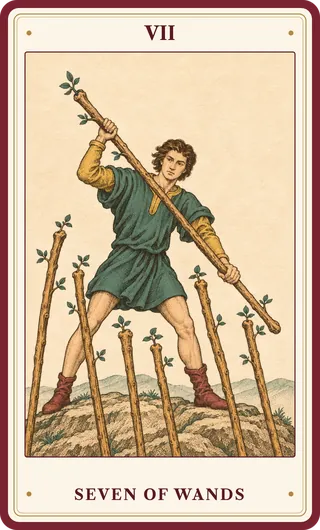
The hilltop
The young man stands on higher ground, which is his advantage in the upright card. Reversed, that position feels shaky or too exposed, and the effort of holding it begins to cost more than it gives.
The six wands below
Six staves rise up from below him, representing challengers, critics or pressures. Reversed, they can feel overwhelming, or they can show that the opposition is partly imagined.
The single wand in his hands
He grips one staff, his only tool for defence. Reversed, a loosening grip means giving up, while a white-knuckled grip means defensiveness that pushes everyone away.
Mismatched shoes
He wears one boot and one shoe, a sign he was caught off guard and had no time to prepare. Reversed, this points to reacting in a rush and being stretched thin.
His upward glance
He looks down and across at the wands, alert and ready. Reversed, that watchfulness can turn into anxiety, suspicion or an inability to relax.
The green, leafed wands
The staves are alive, which is why this struggle is about growth and something worth protecting. Reversed, the question is whether what you defend is still alive or has simply become habit.
The open sky
The wide, empty background shows he stands alone with no allies in sight. Reversed, it highlights isolation and the need to ask for backup.
Backing down or knowing when to stop?
The hardest part of this card is telling wise retreat from giving up too early. Both can look the same from outside. A few questions help separate them:
- Is the thing I am defending still alive, or have I kept it going out of habit?
- Do I feel relief at the thought of letting go, or dread and regret?
- Is the opposition real and ongoing, or have I exaggerated it?
- If I rested for a month, would I still want to fight for this?
- What am I afraid will happen if I stop, and what if I continue?
Relief usually points to a healthy release. Dread, shame or a sense that you are abandoning your values points to giving up too soon. Neither answer is permanent, and you can always stop for now and return later with more energy.
Try this: Take one battle you are currently fighting and give it a score from 1 to 10 for how much it matters to you in a year. Put your energy only into the ones that score 7 or above, and let the rest go for a week.
Is the Seven of Wands reversed a yes or no?
In a yes or no question, the reversed Seven of Wands leans towards no, or towards “not yet”. The goal may be sound, but you are not currently in the best position to pursue it. You may be depleted, outnumbered or too reactive to act well, and pushing now would cost more than it gains.
It can also mean the answer is yes only if you stop giving up. In that case, the obstacle is your own willingness to continue rather than the situation itself. The cards drawn alongside it will help you decide which reading fits. You can see how the upright version answers the same question on the Seven of Wands yes or no page, or try your own question with the yes or no tarot reading tool.
The reversed Seven of Wands as a person or situation
As a person, the reversed Seven of Wands describes someone who has been fighting too long. They may be a defensive, touchy character who sees threats everywhere, or a former fighter who has gone quiet and given up. Either way, they tend to be under pressure and not coping well with it. If the card represents you, it asks you to look kindly at how tired you are.
As a situation, it often shows a conflict that is draining all parties, a dispute that has dragged on, or a position that is no longer worth defending. As an outcome, it suggests you will need to reconsider which fight you are in, since pushing ahead the same way is unlikely to work.
As advice, it is clear: step back, rest, choose your battles and ask for help. You do not have to defend every inch.
Reading it with neighbouring cards
Context changes the card’s tone. Next to the Ten of Wands, it describes a person carrying too much, and the Ten of Wands reversed shows what happens when they finally put some of it down. Near the Five of Wands, it can show a conflict that was never settled and has now worn you out.
With cups cards, the emphasis shifts to emotional exhaustion and sensitivity to criticism. With pentacles, the focus moves to practical protection of money, work or property. With swords, expect arguments and mental strain. With strong positive cards like the Sun or Strength, the reversal often softens into a simple need for rest before success.
When the reversed Seven appears as one of several cards, notice whether the surrounding cards show help is available. A supportive card nearby suggests you do not have to fight alone.
Upright and reversed side by side
The two positions are easiest to understand as a contrast:
- Upright: you stand firm, believe in your position and have the energy to defend it. Reversed: you waver, tire or overreact.
- Upright: opposition is a sign you are doing something worth defending. Reversed: opposition feels crushing, or you invent it.
- Upright: pride in your stand. Reversed: self-doubt or stubbornness.
- Upright: courage to hold the hill. Reversed: the urge to leave it, or to attack everyone who comes near.
Compare this with the Six of Wands, where victory is public and recognised. The Seven comes next in the sequence, and it asks what you do once you have something to lose. The reversal shows the cost of that vulnerability.
What to do when this card appears
Start by naming what you are defending. Be specific: a job, a relationship, a reputation, a belief, a plan. Then ask whether that thing still deserves the energy. If the answer is yes, find rest and allies so you can keep going. If the answer is no, give yourself permission to let it go without calling it failure.
Next, look at how you are defending it. If you are quick to snap, explain too much or assume bad intent, try a slower response. Wait a day before replying to a message that angers you. Ask a trusted person whether you are coming across as firm or hostile.
Finally, rebuild your confidence in small steps. Reversed Wands cards often respond to action, so choose one small thing you can do this week that shows you can still stand up for yourself in a calm way. A clear boundary, a direct request or a plain “no” can restore more energy than a long argument.
Try this: Draw one more card, using the random tarot card generator, and ask, “What would help me hold my ground without burning out?” Write one sentence on how it answers you, and act on it today.
Is the Seven of Wands reversed a bad card?
It is not. The reversed Seven of Wands is uncomfortable, but it brings useful information: you are tired, defensive or doubting yourself, and you can do something about all three. Many readers see it as a pause button, not a failure.
The card is also a reminder that strength includes knowing when to stop. Standing on a hill forever is not heroic if there is nothing left up there to protect. Rest, compromise and honest reassessment can all be strong moves.
For the full picture of how this card fits with the rest of the suit, see the Suit of Wands, where each card shows a different stage of drive, ambition and challenge.
Questions readers ask
What does the Seven of Wands reversed mean?
It usually means you are tired of defending yourself and are tempted to back down, or that your defensiveness has gone too far and is creating needless conflict. The card asks whether you are protecting something worth keeping or simply fighting from habit.
Is the Seven of Wands reversed a bad card?
No. It is a warning and a prompt for honesty, not a verdict. It often shows up when you need rest, support or a clearer sense of which battles matter, and those are all things you can act on.
What does the reversed Seven of Wands mean in love?
It can mean giving up on a relationship under pressure, or being so guarded and quick to argue that you push a partner away. For singles, it often points to timidity or fear of rejection holding you back.
Is the Seven of Wands reversed a yes or no?
It leans towards no, or towards not yet. The goal may still be worth pursuing, but you are not currently in a strong enough position or state of mind to push for it.
What does the Seven of Wands reversed mean as feelings?
The person you are asking about may feel overwhelmed, defensive or unsure how to handle their emotions about you. They may be pulling back because of outside pressure or their own self-doubt, not because they do not care.
How is the Seven of Wands reversed different from the Five of Wands reversed?
The Five of Wands is about scattered, many-sided conflict, and reversed it points to avoiding or resolving it. The Seven is about defending one position against challengers, and reversed it points to giving up that defence or overdoing it.