
Seven of Wands Tarot Card Meaning (Upright & Reversed)

- Arcana
- Minor Arcana, Suit of Wands
- Element
- Fire
- Yes or no
- Yes
defenseperseverancestanding firm
delayslost motivationscattered energy
The Seven of Wands (also written 7 of Wands or VII of Wands) means standing your ground. You have worked your way into a good position, and now someone or something is pushing against it. The card asks you to hold firm, stay calm and defend what matters without becoming reckless. Reversed, it points to exhaustion, giving up too soon, or fighting a battle that is not worth the energy.
This is one of the most personal cards in the Wands suit, because it is about identity and conviction, not just action. Below you will find the imagery, the upright and reversed meanings, how the card reads in love, work, money and health, what it means as a yes or no, and how to tell a battle worth fighting from one you should walk away from.
What the Seven of Wands Means at a Glance
The Seven of Wands is the card of defending a position you have earned. Its core keywords are perseverance, defence, courage, conviction and challenge. Where the cards before it showed growth and victory, this one shows the cost of holding on to success: other people notice, and some of them want what you have.
Reversed, the card flips toward overwhelm, defeat, defensiveness or retreat. It can mean you are giving in too fast, or it can mean you have been fighting so long that you can no longer tell why. The reversed card is rarely about weakness. It is more often about running low on fuel.
Most readers treat the card as positive, since the figure on it is winning for now. The message is not “fight harder.” It is “you are in a strong place, so do not abandon it.”
The Imagery: A Lone Figure on the High Ground
In the Rider-Waite-Smith image, one figure stands on top of a green hill, gripping a wand. Six other wands rise from below the edge, all pointed at him. He has the high ground, which gives him an advantage, but he is clearly outnumbered, and the scene has no sense of rest.
Look closely at his feet and you will see that his shoes do not match. This detail is easy to miss and says a lot: he did not get ready for this. He was pulled into the fight mid-stride and is still holding his ground. It makes the card more human. You do not need perfect preparation to defend something that matters to you.
His gaze is also worth noticing. He looks down at what is coming at him, not out at the horizon. That is exactly the card’s warning: it is easy to become so focused on the fight that you forget to look up at the larger picture.
Seven of Wands Upright Meaning
Upright, the Seven of Wands says you are being tested, and you are able to meet the test. It often appears after a win, a promotion, a new relationship or a decision you have made for yourself. Once you have something worth having, you will be questioned about it. The card tells you the questions are not a sign that you are wrong.
The key quality is conviction, which is different from aggression. The figure on the card is not charging into a crowd. He stays where he is and keeps his position. The upright card favours people who know what they believe, can say it plainly and do not need everyone’s agreement to stay steady.
It can also be a warning against over-explaining. If you have to justify yourself to every critic, you will lose energy and clarity. Pick the position that matters, hold it, and let go of the rest.
Try this: Write down the one thing you are currently defending (a decision, a boundary, a piece of work). Then write one sentence beginning “I am standing firm because…” If you cannot finish it, the card may be asking you to reconsider.
Read Seven of Wands for your question
Upright: You are protecting your relationship, or your own boundaries, from outside pressure, and it is worth the effort.
Reversed: You are worn out from defending the relationship, or you have become so guarded that no one can get close.
Upright: They feel protective and determined, and they are willing to stand up for you or for what you share.
Reversed: They feel defensive, cornered or tired, and may be backing away or lashing out rather than saying what is wrong.
Upright: You hold a position of some advantage and need to defend your ideas, role or results against competition or criticism.
Reversed: You are overloaded, losing ground to rivals, or spending energy on arguments that do not matter.
Upright: You are guarding savings, income or a financial decision, and staying firm protects what you have built.
Reversed: Financial pressure feels like too much, or you are giving in on something you should have protected.
Upright: Pick your position, plant your feet and hold it calmly without apologising.
Reversed: Stop and ask whether this fight is worth the cost, then either rest and regroup or put down the weapon.
Upright: You have the resilience to keep up a hard routine or recovery plan, as long as you pace yourself.
Reversed: Stress and fatigue are taking their toll, so rest and support matter more than willpower right now.
Seven of Wands Reversed Meaning
Reversed, the Seven of Wands usually points to one of three situations. You may be overwhelmed and ready to quit. You may be backing down because conflict feels unbearable. Or you may be fighting so hard and so often that defence has become a habit, and every conversation feels like an attack.
The reversed card does not say you were wrong to hold your ground. It asks how long you have been holding it and what it has cost. If you are tired, the right response is often rest, support or a clearer line about what you will and will not defend. For a fuller breakdown, see the Seven of Wands reversed page.
There is also a gentler reading. Sometimes the reversed card shows up when you have been defending a position that no longer fits who you are. Putting down the wand is not a defeat if the fight has stopped serving you.
Seven of Wands in Love
In a love reading, the upright Seven of Wands often points to a relationship under outside pressure: disapproving family, a rival, a long-distance strain or an old pattern trying to creep back in. The card says what you have is worth defending, and that you can do it calmly. It can also mean you are setting a firm boundary with a partner, which is healthy when it comes from clarity and not from fear.
For singles, the card suggests you are holding standards that matter to you. You may be getting pressure to settle, or you may be defending your decision to wait. The card backs you. It also asks you not to become so defensive that new people cannot reach you.
Reversed, the card can show someone who has stopped fighting for the relationship, or someone who is so guarded that closeness feels like a threat. It can also describe a relationship where one person is doing all the defending. If the effort feels one-sided, that is the real message.
The Seven of Wands as Feelings
When this card describes what someone feels for you, it usually shows protectiveness and determination. They care enough to stand up for you, or they are working to keep something between you alive. They may not be soft or especially chatty about it, but they are willing to act.
There is a caveat. This is also a card of defensiveness, so the person may feel cornered, criticised or unsure where they stand. If you are asking about someone who is pulling back, the upright card can mean they feel pressure from other people or their own doubts and are not sure how to handle it.
Reversed, their feelings may be tired or unexpressed. They might be backing away because it feels like too much, not because they have stopped caring. Look at the surrounding cards to see whether the energy is withdrawing or just waiting.
Seven of Wands in Career
At work, the Seven of Wands is a competition card. You hold a position, a project or a reputation, and others want it or want to question it. The card encourages you to defend your ideas with facts, stay calm under criticism and not give up ground that you earned honestly. It often appears in readings about promotions, pitches, job interviews against strong candidates and office politics.
It can also describe a stage of your career where you are no longer the newcomer. People notice you, and with that attention comes scrutiny. The card says this is part of success, not a sign you are failing.
Reversed, it suggests you may be overloaded, losing ground to a rival or giving in on something you should have defended. It can also point to a pointless argument that is eating your energy. Ask whether the fight serves your goals. If not, step away and put the effort into something that does.
Seven of Wands in Money
In a money reading, the upright card says you are protecting what you have built. That could mean holding to a budget, defending a pay rise request, refusing a risky deal or guarding savings against pressure to spend. The message is to stay disciplined and not be talked out of a sound decision.
It can also warn that you have competition. A business may be facing rivals, or a negotiation may be harder than expected. The card says you are in a good position and that holding it will take steady nerves.
Reversed, it can show financial pressure that feels like too much, or a compromise you made too quickly. If you are spending money or energy defending the wrong thing, the card asks you to stop and review. The Ace of Pentacles is a good contrast: where that card brings new financial opportunity, this one is about keeping what you have already got.
Seven of Wands card symbols
Choose a symbol to read what it means on the card.
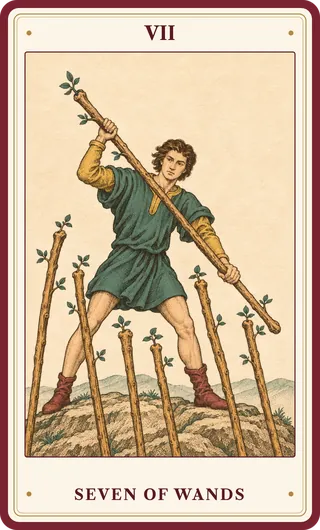
The hilltop
The figure stands on higher ground, which means he fights from a position of advantage and earned success. It also shows that being visible and successful invites challenge.
Six wands from below
Six staffs push up from beneath the edge of the hill, representing rivals, critics or pressures that you cannot fully see or count. They are all aimed at one person, which is why the card feels so lonely.
The single wand
The figure holds one wand and uses it to keep the others back. This shows that one clear, steady position can be enough to hold off many attacks.
Mismatched footwear
He wears one boot and one shoe that do not match, a detail that suggests he was caught off guard and rushed into the fight. He is defending without perfect preparation, which makes his grit more impressive.
The wide stance
His feet are planted apart and his body is braced. This is the posture of someone who has decided not to move.
The downward gaze
He looks down at the wands below, not at an escape route. His attention is fixed on the challenge in front of him, which is both his strength and his limit.
Seven of Wands in Health
For health, the upright card points to resilience. You may be keeping up a demanding routine, recovering from illness or fighting off the urge to give up a habit you are building. The card says you have the strength for it, but that you need to pace yourself, since this is a long defence and not a sprint.
It can also point to stress. A body that is constantly on guard pays for it, and the card can describe the physical effects of long-term tension. If that sounds like you, treat it as a signal to look at your load.
Reversed, the card suggests fatigue, vulnerability and a need for rest or support. Tarot cannot diagnose anything, so for real symptoms speak to a doctor. As a reflection tool, the reversed card asks whether willpower alone is enough or whether you need help.
Try this: Notice where your body braces when you think about the situation you drew this card for (jaw, shoulders, stomach). Spend two minutes consciously loosening that spot, then ask yourself what you actually need to defend.
Is the Seven of Wands a Yes or No?
Upright, the Seven of Wands leans yes, with a condition: you will have to stand up for what you want. It does not promise an easy path. It says the outcome is available if you keep your nerve, hold your position and do not let pressure talk you out of it.
Reversed, it leans no or not yet, especially if you are exhausted or the fight is bigger than you can handle. It can also mean the question itself is the wrong one, and the real issue is what you are willing to defend. For a quick pull on a specific question, use the Seven of Wands yes or no page.
As with all tarot yes or no answers, treat the card as a lean and not a verdict. Read the cards around it, and think about what the situation is asking from you.
Number, Element and Astrology
Seven in tarot is a number of testing. After the groundwork of earlier numbers, the seven asks whether what you have built can hold up under pressure. If you like to read cards through number patterns, tarot numerology shows how sevens behave across all four suits.
Wands belong to fire, which means energy, will, ambition and passion. The Seven of Wands is fire at its most defensive: the flame guarding itself. In Golden Dawn astrology the card is linked to Mars in Leo. Mars brings courage and a readiness to fight, and Leo brings pride and a strong sense of self. Together they describe someone who defends what is theirs.
That pairing also explains the card’s two modes. Used well, Mars in Leo is brave and dignified. Used badly, it is bristly and quick to take offence.
The Seven of Wands as a Person
When the card describes a person, it often shows someone who is a fighter in the best sense: loyal, direct, brave under pressure and unwilling to be pushed around. They stand up for the people and causes they care about. In a family or workplace they are the one who says what others will not.
The shadow side is defensiveness. This person can treat feedback as an attack, assume the worst of others or carry on a fight long after it has stopped being useful. If the card is reversed, they might be burned out, hiding behind a wall or too quick to give in.
If you are the person, the card asks you to keep your backbone and also check whether each battle is yours. If you are dealing with someone like this, give them direct answers and avoid triggering their need to defend.
Seven of Wands With Other Cards
The Seven of Wands reads best in sequence. After the Six of Wands, it shows the cost of success: the win has been noticed, and now it must be protected. Before the Eight of Wands, it suggests that holding your ground is what finally frees things to move quickly.
Next to the Five of Wands, the Seven shows how a messy argument becomes a clear stand. The Five is a scramble with no sides. The Seven is one person who has picked a position. With the Nine of Wands, the message is endurance: you have defended for a long time and need to decide how much more you can give.
Some quick pairings:
- With the Magician or the Emperor: you have the skill and authority to win the argument.
- With the Hermit or Four of Swords: step back and rest before the next round.
- With Justice: fairness matters, so make sure your case is sound.
- With the Eight of Cups: you may be better off leaving than defending.
When to Fight and When to Stand Down
The card’s best lesson is discernment. Not every challenge deserves a response. Before you defend anything, ask three questions: Does this matter to me? Is the person or situation worth my energy? Will holding my ground change anything?
If you answer yes, plant your feet and keep your tone steady. Speak once, clearly, and do not escalate. If you answer no, the reversed card is giving you permission to walk away. Choosing not to fight can be a strong move, not a defeat.
Try this: Draw a line down a page. On one side list the challenges you are facing, and on the other mark each as “mine to defend” or “not mine to carry.” Act only on the first column this week.
How to Use the Seven of Wands in a Reading
In a daily draw, the card is a reminder to stay centred when someone challenges you. Ask yourself where you feel pushed today and whether you need to hold your position or let it go. In a three-card spread it often sits well as the “challenge” position, since it already carries that meaning. You can find layouts to try on the tarot card spreads page.
If the card shows up repeatedly, take that as a sign that you are in a longer defence than you realise. Look at what has stayed the same across the readings. The pattern usually points to a person, a habit or a belief you have not yet resolved.
Finally, read the card against your actual situation, not against a script. The same card can mean “stand up for your relationship” for one person and “stop being so defensive in your relationship” for another. The difference is in your honest answer to what is being defended, and why.
Questions readers ask
What does the Seven of Wands mean in tarot?
The Seven of Wands means standing your ground. You have reached a position worth defending and someone or something is testing it. The card asks for courage, focus and a clear sense of what you are protecting.
Is the Seven of Wands a good or bad card?
It is a good card with a hard edge. It shows you have something worth defending and the strength to do it, but it also admits that the pressure is real. It turns difficult only when you fight everything or fight alone until you burn out.
What does the Seven of Wands mean in love?
Upright, it means protecting your relationship or your boundaries from outside pressure such as family, rivals or old habits. For singles it can mean refusing to lower your standards. Reversed, it points to exhaustion, defensiveness or giving up too soon.
What does the Seven of Wands reversed mean?
Reversed, the card points to being overwhelmed, backing down too easily, or fighting a battle that is not worth the energy. It can also describe someone who is so defensive that every comment feels like an attack. The fix is usually rest, perspective and a smaller set of priorities.
Is the Seven of Wands a yes or no?
Upright, it leans yes, but a yes that you will have to work and stand up for. Reversed, it leans no or not yet, especially if you are depleted. The answer depends on whether you have the energy and the will to defend your position.
What is the difference between the Five and Seven of Wands?
The Five of Wands is a free-for-all of competing egos with no clear side. The Seven of Wands is one person holding a clear position against challengers. One is chaos, the other is a stand.