
Six of Wands (6 of Wands) Tarot Card Meaning

- Arcana
- Minor Arcana, Suit of Wands
- Element
- Fire
- Yes or no
- Yes
victoryrecognitionconfidence
delayslost motivationscattered energy
The 6 of Wands (the Six of Wands) is the tarot card of victory, public recognition and earned confidence. It shows a rider crowned with laurel moving through a cheering crowd, which is the moment when effort pays off and other people see it. Upright, it tells you that you have done something worth celebrating and that you are allowed to feel proud.
Reversed, the card points to delayed or missing recognition, private wins, self-doubt, or a pride that has outgrown the achievement. Below you will find what the card means in love, career, money, health and spirituality, how to read it as feelings or as a yes or no, and how it sits among the cards around it.
Six of Wands at a glance
The Six of Wands is a Minor Arcana card in the suit of Wands, which is the suit of fire, drive and ambition. It is the sixth card in the suit, so it comes after the conflict of the Five and before the defence of the Seven. Its core message is simple: your effort has been noticed.
- Upright keywords: victory, recognition, success, confidence, pride, leadership, public praise, progress
- Reversed keywords: delayed recognition, private achievement, ego, insecurity, hollow victory, fall from grace
- Element: fire
- Astrology: Jupiter in Leo (Golden Dawn tradition)
- Number: 6
- Yes or no: yes
That is the short version. The rest of this guide explains where those keywords come from and how to apply them to a real question.
The Six of Wands card image
In the Rider-Waite-Smith deck, a young rider sits on a white horse, wearing a laurel wreath on his head and holding a wand wrapped with another wreath. Around him a crowd of people on foot carry their own wands and look up at him. The horse is dressed for a procession, and the ground ahead is open.
Notice the details that tell the story. Only the rider’s wand carries the victory wreath, so this card is about one person’s achievement, not a team effort. The crowd is plain and unadorned, which makes them witnesses rather than rivals. And the rider looks straight ahead, not down at the people cheering. That gaze matters: the best version of this card enjoys the praise without needing it.
The scene also reads as a homecoming. Many readers see a soldier or athlete returning after a hard campaign, which fits the card’s place right after the Five of Wands, where everyone was fighting with no clear winner.
Six of Wands upright meaning
Upright, the Six of Wands means you have succeeded and people know it. It can be a finished project, a goal reached, an exam passed, a performance that landed, or a personal battle you finally won. The card does not describe luck. It describes results that follow sustained effort, so it validates the work you put in.
There is also an emotional side. The Six gives you permission to feel good about yourself. Many people draw this card when they are quick to dismiss their own progress, and the message is to stop minimising it. Take the compliment, accept the thanks, and let the win be real.
Finally, the Six of Wands carries a leadership note. The rider is out in front, and others are following. When the card appears, you may be asked to step into visibility, speak up, lead the group, or become the example other people look to. Confidence is the quality being tested, and the card says you have grounds for it.
Try this: Write down three things you have finished or improved in the past year, however small they seem. Next to each, note who benefited or who noticed. Read the list aloud once. This is the Six of Wands in practice: seeing your own procession.
Read Six of Wands for your question
Upright: You feel admired, chosen and proud to be seen with your partner, or a single person's confidence starts drawing people in.
Reversed: You feel overlooked or unappreciated, or pride and score-keeping are getting in the way of real closeness.
Upright: They respect you, are proud of you and openly admire what you have achieved.
Reversed: They feel insecure or unseen, or they are competing with you instead of celebrating you.
Upright: A promotion, successful launch or public thank-you arrives, and your work is finally seen by the people who matter.
Reversed: Credit is delayed or goes to someone else, or a win feels hollow because the recognition never comes.
Upright: Effort turns into visible financial reward, such as a raise, bonus or a project that pays off.
Reversed: A payoff is slow, smaller than expected, or you are spending to look successful instead of building security.
Upright: Accept the praise, share the credit and let yourself enjoy a win that you earned.
Reversed: Stop measuring yourself by applause, name your own wins privately and keep your ego in check.
Upright: Your energy and morale lift after a hard stretch, and a recovery milestone deserves real celebration.
Reversed: Pushing for approval has drained you, or low confidence is slowing a recovery that is actually going well.
Six of Wands reversed meaning
Reversed, the Six of Wands usually asks one question: where does your sense of success come from? The most common reading is delayed or missing recognition. You did the work, but the praise is slow, goes to someone else, or never arrives. This can be a real injustice at work or a quieter feeling that nobody saw what it cost you.
The card can also point inward. You may have achieved something that is private, such as recovery, a boundary you finally held, or a decision no one else knows about. Reversed Sixes often ask you to define success on your own terms, because the crowd is not coming. There is also an imposter side, where you reach the goal but cannot enjoy it, convinced you do not deserve it.
The shadow of the card is ego. Reversed, the rider may be showing off, chasing attention, or treating the crowd as an audience to impress. A “fall from grace” is the traditional warning: pride before a stumble. If you want to go deeper into every version of this, the Six of Wands reversed guide covers it for love, work and life.
Six of Wands in love
In a relationship, the upright Six of Wands shows a couple who feel proud of each other. You are admired, supported and happy to be seen together. It can mark a milestone such as meeting the family, moving in or going public, but the real theme is a confident “we” that does not need to hide. It can also describe a partner who is charismatic, warm in public and good at making you feel like a winner.
If you are single, the card suggests that your confidence is your most attractive quality right now. You are more likely to meet someone when you are out in the world doing what you are good at, so the advice is to show up, not wait. Often this card follows a personal win, such as a career step or a finished chapter, and love comes as a side effect of feeling more yourself.
Reversed in love, the Six of Wands can mean feeling unappreciated, overlooked or taken for granted. It can also describe competitiveness between partners, one person’s success overshadowing the other, or a need for constant validation that wears the relationship down. The fix is usually honest conversation: say what you need to be seen for, and ask your partner the same.
Six of Wands as feelings
When you ask how someone feels about you and the Six of Wands appears, the answer is usually respect and admiration. They are impressed by you, proud to know you, and may talk about you warmly to other people. In an early romance this can read as attraction mixed with a little awe. In a longer relationship it reads as pride in who you are.
This is a confident card, so the person does not usually hide their interest. They may want to be seen with you, introduce you to friends, or celebrate your wins loudly. The one caution is that the Six of Wands loves a public moment, so look for consistency in private too.
Reversed, the feelings are more conflicted. They may feel insecure around you, worry about measuring up, or struggle with jealousy. Sometimes it describes someone who wants admiration more than they want connection. Treat it as a prompt for honest communication rather than a verdict.
Six of Wands in career
Career is where the Six of Wands is most at home. Upright, it points to a promotion, a successful launch, a presentation that impresses, an award, a strong performance review or a public thank-you. It often arrives after a difficult period of long hours or conflict, and it confirms that the effort was worth it. If you are job hunting, it suggests a strong interview and a good chance of an offer.
The card also speaks to reputation. You may be becoming known for something, and that visibility can open doors. This is a good time to ask for what you have earned, update your portfolio, speak at an event or take on a leadership role. The Six rewards people who are willing to be seen.
Reversed, the card describes work that goes unnoticed. A colleague may take credit, a manager may overlook you, or a win may come without the recognition you expected. It can also describe a success that does not satisfy, because you realise you were chasing someone else’s idea of achievement. Document your results, ask for feedback directly, and decide what recognition you actually want.
Six of Wands and money
In a money reading, the Six of Wands suggests financial reward that follows effort. That might be a raise, a bonus, a successful sale, income from a creative project or a business milestone. It is less about quiet saving, which belongs to the Pentacles, and more about earning through visibility and action.
Because Wands is a fire suit, the card can be quick. Money may come through public work, networking or a reputation you have built. It also favours confident negotiation, so this is a decent moment to quote your real price. For slow, steady wealth, look at the cards around it, and the suit of Wands overview helps put this energy in context.
Reversed, watch for spending that is designed to look successful. Image purchases, status upgrades and celebrating before the money has arrived are the classic traps. The reversed Six can also mean a payoff that is delayed or smaller than hoped, so avoid committing to expenses you cannot cover yet.
Six of Wands for health and wellbeing
For health, the Six of Wands is a card of rising morale and recovery milestones. It can show you passing a hurdle such as finishing treatment, hitting a fitness goal or simply feeling like yourself again after a rough patch. Celebrating these steps is part of healing, not vanity. Tarot is not medical advice, but the card does speak to how it feels to be recovering.
It can also point to confidence in your body. You carry yourself differently, stand taller and trust your energy. This is a good card for anyone returning to exercise, performing or competing.
Reversed, the card may show someone pushing too hard to prove something, or feeling discouraged because progress is slower than their ideal. It can also show that low self-esteem is dragging on your wellbeing. Be kind about your pace, and measure improvement by how you feel rather than by what others can see.
Six of Wands spiritual meaning
Spiritually, the Six of Wands is about owning your light. It asks you to recognise the gifts you have developed and to stop hiding them out of modesty. Many traditions treat humility as important, and this card does not argue with that. Instead, it separates humility from self-erasure and shows that acknowledging your growth can be a form of gratitude.
The card also links to service. A leader in the procession carries the group’s energy, and that comes with responsibility. If the Six of Wands appears in a spiritual reading, ask how your recent growth could help other people, and whether you are ready to teach, share or mentor.
Reversed, it can mark a lesson in ego. Spiritual pride, comparing your path with others, or needing to be seen as “advanced” are all reversed Six of Wands patterns. The remedy is quiet practice and honest self-review, without an audience.
Six of Wands card symbols
Choose a symbol to read what it means on the card.
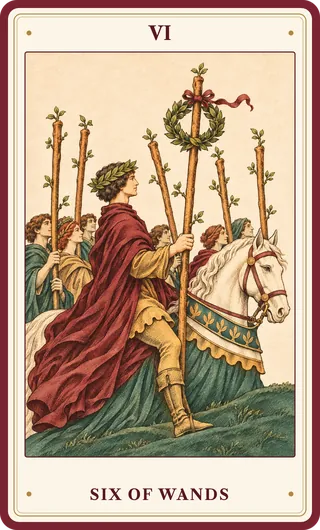
Rider on a white horse
The rider is the centre of the procession, which shows a person who has moved from struggle to leadership. The white horse stands for control, purity of purpose and strength that has been trained rather than wild.
Laurel wreath on the rider's head
The laurel crown is an ancient mark of victory, given to winners in battle and in games. It tells you the success is earned and publicly acknowledged.
Wand tied with a wreath
The rider holds one wand raised high with a wreath fixed to it, so the victory is carried like a flag. Wands are fire, will and ambition, and here that fire has reached its goal.
The crowd of footmen
The people on foot carry plain staves and look up at the rider. They represent supporters, witnesses and the community that gives a win its meaning, but they are also a reminder that applause comes from others.
The rider's forward gaze
The rider looks ahead rather than at the crowd. It suggests that true confidence does not depend on the cheering and that the next goal is already in view.
Decorated horse cloth
The horse is dressed for a parade, which marks this as a moment of public ceremony. Ceremony turns private effort into something shared and remembered.
Open ground and sky
The scene is wide and uncluttered, with nothing blocking the procession. After the chaos of the Five, the path is clear and the way forward is open.
Is the Six of Wands a yes or no?
In a yes or no tarot reading, the Six of Wands is a yes. It describes success, momentum and a good outcome, especially for questions about work, goals, competitions, applications or being recognised. If you ask “Will I win?” or “Will my effort pay off?”, this is a strong positive.
Reversed, it softens to a “yes, but later” or “yes, with conditions”. The outcome may still arrive, but there could be a delay, a lack of acknowledgement, or a cost to your ego or confidence. For more detail, see the dedicated Six of Wands yes or no page.
As always, the surrounding cards can change the answer. A Six of Wands beside a heavy suit like Swords may suggest a win that comes with strain, while next to Cups it can suggest a victory that feels emotionally good.
Numerology, element and astrology
The number six in tarot stands for harmony, balance and reward after effort. In many suits the sixth card is where things settle after the instability of five, and the Six of Wands follows that pattern: the conflict ends and a result is recognised. If numbers help you remember cards, tarot numerology shows how the sixes in each suit echo one another.
Wands belong to fire, so the Six carries heat: courage, pride, ambition and the urge to be visible. The traditional Golden Dawn attribution is Jupiter in Leo. Jupiter brings expansion, generosity and good fortune, and Leo brings the performer’s confidence and the wish for an audience. That combination explains the card well, because it is optimism and leadership with a stage.
Where the Six of Wands sits in the Wands story
The Wands suit follows a creative drive from spark to completion. The Six sits near the middle, after the struggle of the Five of Wands, where competing ideas and egos fought with no clear leader. The Six resolves that: someone emerges, wins and is recognised.
Then comes the Seven of Wands, where the winner has to defend their position. This is a useful way to read the Six in practice. Victory is not the end of the story, and the confidence you gain here is what you will need when your position is challenged. If you draw the Six and then the Seven in a spread, expect success followed by pushback.
This sequence also explains why the Six can feel bittersweet. Being on top means being visible, and visibility draws both admiration and criticism.
Six of Wands compared with similar cards
The Six of Wands is often confused with other victory cards. The Four of Wands celebrates stability and shared joy, such as a wedding, a home or a team milestone. The Six celebrates individual achievement and the recognition that follows it. One is a gathering, the other is a spotlight.
The Chariot is another driven, triumphant figure, but the Chariot is about winning through discipline and control while the journey is still underway. The Six of Wands shows the moment the win is already acknowledged. The World is a larger completion, the end of an entire cycle, while the Six is a chapter win within a bigger story.
Eight of Wands is about speed and news, and Ten of Wands about burden. Neither is about recognition, so if your question is about being seen and praised, the Six is the card that answers it.
Six of Wands as a person
When the Six of Wands represents a person, it describes someone confident, charismatic and often admired. They may be a leader, performer, athlete, teacher or anyone used to being in front of others. They tend to be generous with praise because they are secure, and they like to win in ways that include other people.
Reversed, the same person may need applause to feel real. They can be boastful, competitive or quietly insecure beneath the confidence. The way to read this depends on the question: it can describe a colleague, a partner or yourself on a day when you are performing instead of being honest.
If you are drawing a court card as well, the King of Wands shares a similar leadership energy, but he leads from authority while the Six leads from recent success.
Reading the Six of Wands in past, present and future
Position changes the emphasis of the card, so it helps to think about where in the spread it falls.
- Past: A recent win or milestone is shaping your confidence now. It may also point to a time you were applauded and have not fully absorbed it.
- Present: You are in a moment of recognition or about to be. Prepare to be visible and accept it graciously.
- Future: Success is on the way, usually after effort you are already putting in. It is not passive, so keep working.
- Obstacle position: Pride or the need for approval may be the thing slowing you down.
- Advice position: Share the credit, celebrate properly and then set the next goal.
In a single-card daily draw, treat the Six as an invitation to notice recognition when it appears, such as a thank-you, a good result or a moment of pride, instead of waiting for something huge.
How to work with the Six of Wands
If the card keeps appearing, it often asks you to practise receiving. Many people are better at doing than at accepting appreciation, and the Six of Wands trains the second skill. Here are four practical steps:
- Name the win clearly, in one sentence, without apologising for it.
- Thank the people who helped you, because shared credit makes the win last longer.
- Mark it in some way, whether that is a dinner, a note in a journal or a day off.
- Pick the next goal so confidence turns into direction.
Try this: Next time someone compliments your work, reply with “thank you” and nothing else. No deflecting, no joke, no listing flaws. Notice how it feels over a week, then pull the Six of Wands again and see what shifts.
For readers drawing the card as part of a longer spread, a three card tarot reading is a simple way to see what led to the win and what comes after. And if you want to see where the card turns up for your own questions, the random tarot card generator is a good place to practise.
Common mistakes when reading the Six of Wands
The first mistake is treating the card as a guarantee. The Six describes earned success, so if the querent has not done the work, the card may be encouragement, not a promise. Ask what effort is already in place before predicting a win.
The second is ignoring the reversed message because the upright is so pleasant. Reversed Sixes often show someone who needs to hear that their worth does not depend on a crowd. The third is reading the card as fame or celebrity in every context. For most people the “crowd” is a team, a family, a class or one important person.
Try this: Pull the Six of Wands and write down who your crowd actually is. Then write who you are performing for when you work. If the lists differ, that gap is where the card wants you to look.
Questions readers ask
What does the Six of Wands mean in tarot?
The Six of Wands means victory, public recognition and confidence earned through effort. It shows the moment after a struggle when your work is seen and appreciated. Reversed, it points to delayed credit, self-doubt or pride.
Is the Six of Wands a good card?
Yes, upright it is one of the most encouraging cards in the Wands suit. It signals success you have earned and the right to feel proud. Reversed it is not a disaster, but it asks you to look at ego, insecurity or missing recognition.
What does the Six of Wands mean in love?
In love, the Six of Wands shows admiration, pride and feeling valued, either in a relationship or in the way you are attracting attention as a single person. It can also mean a relationship you are happy to show the world. Reversed, it suggests feeling unappreciated or letting ego create distance.
Is the Six of Wands a yes or no card?
The Six of Wands is a yes. It points to a successful outcome and forward momentum, especially if the question is about work, a goal or being recognised. Reversed, it becomes a delayed or conditional yes.
What does the Six of Wands reversed mean?
Reversed, the Six of Wands can mean recognition that is missing or delayed, a private victory, imposter feelings, or pride that has grown too big. It often asks you to define success on your own terms rather than waiting for applause.
What is the difference between the Six of Wands and the Four of Wands?
The Four of Wands is a shared celebration of stability, like a wedding or homecoming. The Six of Wands is about individual achievement and being recognised for it. One is a party, the other is a parade.