
Five of Wands Reversed (Meaning in Love, Work & Life)

- Arcana
- Minor Arcana, Suit of Wands
- Element
- Fire
- Yes or no
- No
competitionconflictrivalry
delayslost motivationscattered energy
The Five of Wands reversed means conflict is easing, hiding or turning inward. In the best case, an argument, rivalry or tense stretch is ending and people are finding common ground. In the harder case, the fight has not been settled at all: it has been avoided, swallowed or pushed underground, and the quiet you feel is tension waiting to return.
That double meaning is the key to reading this card well. Upright, the Five of Wands is noisy and obvious. Reversed, you have to work out whether you are looking at peace or at silence, and the rest of this guide shows you how to tell the two apart in love, work, money, feelings and advice readings.
What the Five of Wands Reversed Means
Most readers agree on the core of this card: the energy of the upright Five of Wands has changed direction. Upright, five people clash over ideas, status or territory. Reversed, that clash is stopping, going quiet or moving inside. The card sits in the suit of Wands, which is about drive, ambition and creative fire, so the conflict is usually about something you care about: a goal, a role, a say in a decision.
Typical keywords are resolution, compromise, truce, cooperation and relief on the positive side. On the shadow side they are avoidance, suppressed anger, passive aggression, fear of confrontation and inner tension. Both groups are valid. Which one applies depends on the question, the cards around it and how the situation actually feels to you.
A useful rule of thumb: ask whether anything has actually changed. If someone apologised, a decision was made or the rivalry ended, you are likely seeing resolution. If nothing was said and everyone is simply being careful, you are likely seeing avoidance.
The Rider-Waite-Smith Image, Flipped
On the standard Rider-Waite-Smith card, five young people swing wooden staves on open ground. Their clothes do not match, nobody is bleeding, and the sky is clear. It reads as a rough, energetic scrap more than a battle, which is why the card is often described as creative friction rather than real harm.
Turn the card upside down and the picture changes. The staves point toward the ground, the tangle in the middle loosens, and the figures look like they are stepping back. That visual shift matches the two meanings: either the weapons are being laid down, or they are being held behind the back.
Look at your own deck’s version too. Some decks show the figures laughing as they play-fight, others show real aggression. A reversed card that shows a friendly scuffle leans toward lightness and release. One that shows tense faces leans toward suppressed anger.
Two Readings: Resolution or Avoidance
The first reading is resolution. People have talked, compromised or simply run out of energy to fight, and a calmer period begins. This is the version you will see in a spread about a workplace dispute that is winding down, a family row that has been patched up, or a creative disagreement where everyone finally agreed on a direction.
The second reading is avoidance. Here the card describes conflict that exists but is not being faced. You might be biting your tongue in meetings, skipping a hard conversation with a partner, or backing out of a competition because you fear losing. The conflict has not ended, and it has probably moved inside you, where it shows up as stress, resentment or self-doubt.
There is also a third, quieter reading: the fight was never yours. Sometimes the reversed Five of Wands says you have been dragged into other people’s drama and can simply step away. Letting go of a conflict that does not belong to you is a healthy use of this card.
Read Five of Wands for your question
Upright: Arguments are cooling, you talk things through, and the relationship settles into a calmer rhythm.
Reversed: A real issue is being buried to keep the peace, so the calm is only on the surface.
Upright: They are tired of fighting and want to make peace with you.
Reversed: They feel tense or resentful but will not say so, and they are pulling back instead of speaking up.
Upright: Office rivalry fades, a dispute is settled and your team starts pulling in the same direction.
Reversed: Tension has gone quiet rather than away, or you are avoiding a competition or conversation you need to face.
Upright: A financial dispute is settled or a stressful stretch of money pressure begins to ease.
Reversed: A money argument is being avoided, or you are dodging a hard talk about shared costs and debts.
Upright: Let the fight go, accept the compromise on offer and put your energy somewhere useful.
Reversed: Stop avoiding the issue, say what you actually think and deal with the tension before it grows.
Upright: Stress and inner turmoil settle, and your body gets a chance to recover.
Reversed: Suppressed stress and frustration are building up, so rest and an honest outlet matter.
How to Tell Which One You Are Seeing
You do not need to guess. A few practical checks usually settle it:
- Has anything concrete changed, such as an apology, an agreement or a decision? If yes, lean toward resolution.
- Do you feel lighter when you think about the situation, or tight in the stomach? Relief points to resolution, tightness points to avoidance.
- Are both sides still talking, or has everyone gone silent? Silence is the warning sign.
- Is the topic that caused the conflict still mentioned, or has it become something nobody says out loud?
Then look at the neighbouring cards. A warm card such as the Four of Wands or the Ten of Cups beside it supports genuine peace. A heavy card such as the Eight of Swords or the Nine of Swords suggests the quiet is the silence of someone feeling trapped or anxious.
Try this: Write down the situation in one sentence. Underneath, list what has changed in the last month and what has not been said. If the second list is longer than the first, treat the card as avoidance.
Five of Wands Reversed in Love
In a relationship reading, the reversed Five of Wands often means you are coming out of a rough, argumentative stretch. Misunderstandings clear up, one of you says sorry, or you both realise the fighting was costing more than any single point was worth. If you have recently done the work of being honest with each other, this is a good sign.
The other reading is a relationship where the arguments have stopped because nobody is saying what they feel. You may be keeping the peace by agreeing to everything, or your partner may go quiet whenever a tricky subject comes up. The house is calm, but small resentments are stacking up. In that case the card is asking you to start the conversation you have been postponing, calmly and without trying to win.
If you are single, the card can suggest you are avoiding dating because you fear rivalry, rejection or a repeat of an old fight. It may also say you are leaving a competitive or drama-filled dating pattern behind. It is not a breakup card, and one reversed Five of Wands never settles the fate of a relationship alone. For a full picture, a relationship tarot spread gives each person’s side and the dynamic between you.
When the Tension Is Not Just Conflict
Most of the time this card describes ordinary disagreement. But a reversed Five of Wands can also appear when someone is afraid of a partner’s temper, feels intimidated or walks on eggshells to avoid a blow-up. If that sounds familiar, the card is naming something that deserves more than a tarot reading.
If you feel unsafe, it is worth talking to someone you trust, or contacting a local support service or helpline in your country. A tarot card can reflect how you feel, but it cannot replace real support, and no one should have to keep the peace at the cost of their safety.
The Reversed Five of Wands as Feelings
When the card describes what someone feels about you, it points to a person who is tired of conflict. They may want to make peace, let an old argument go or find a way back to cooperation. If the two of you have been through a clash, the card says they are ready to soften.
It can equally describe someone who feels frustrated but is holding it in. They may be avoiding you rather than facing the issue, giving short replies, or keeping their opinions to themselves. In that case the card is not about indifference. It is about a person who does not know how to say what they feel without it becoming a fight.
Read their actions beside the card. Someone who reaches out, apologises or makes small gestures of goodwill is likely in the peacemaker camp. Someone who disappears whenever the topic comes up is more likely in the avoider camp. As a reading of your own feelings, the card usually reflects inner tension: you are torn, and part of you wants the argument to be over even if you have not decided how.
Career and Work
At work, the reversed Five of Wands often says the competitive pressure is easing. A rivalry cools, a decision is made, a team that was bickering over direction starts to function, or a chaotic project finally finds its footing. If you have been in a tense workplace, expect some relief and room to focus on your own tasks.
It also has a cautionary side. You may be avoiding a competition, a pitch or a confrontation with a colleague because you fear the outcome. Office politics may have gone from open argument to quiet cold shoulders, which is harder to deal with because nothing is said out loud. Another possibility is that you are shrinking your ideas to keep everyone comfortable.
Sometimes the card is a nudge to step out of a cutthroat environment altogether. If a job runs on constant rivalry and you are exhausted by it, the reversed Five of Wands can support the decision to move toward a more cooperative setting. If you want a card that shows what happens when you push through opposition, the Nine of Wands reversed shows the other side of fatigue after a long fight.
Money and Finances
With money, the card has two shapes. In the first, a period of financial stress or a dispute over money is settling down. A disagreement over a settlement, shared costs or a business split moves toward agreement, and you can finally stop worrying about it.
In the second, there is a money argument you have been avoiding: with a partner, a business partner, a parent or yourself. It could be a bill nobody wants to discuss, a debt that is not mentioned, or a conversation about who pays for what. The card suggests that avoiding it is costing you more than the discussion would.
It is not a strong predictor of gains or losses on its own. Think of it as a card about money relationships and communication, and pair it with cards such as the Four of Pentacles or the Two of Pentacles if you want to understand the practical side.
Health and Spirituality
For health, the reversed Five of Wands usually points to stress. Suppressed frustration, an unresolved row or a constant internal debate can show up as tension in the body, poor sleep or irritability. It can also describe an inner fight with yourself over habits or choices. Treat it as a prompt to rest and find an outlet for what you are holding in, and see a professional for any physical symptoms.
Spiritually, the card describes the quieting of inner argument. You stop wrestling with competing beliefs or voices and settle into a practice that feels right. If you have felt pulled in several directions, this reversal says you do not need to resolve every question today, only to stop fighting the part of you that already knows what it wants.
Try this: Take five minutes with a pen. Write the loudest argument going on in your head right now, then write one sentence that ends it, even if it only says, “I will decide on Friday.”
Five of Wands card symbols
Choose a symbol to read what it means on the card.
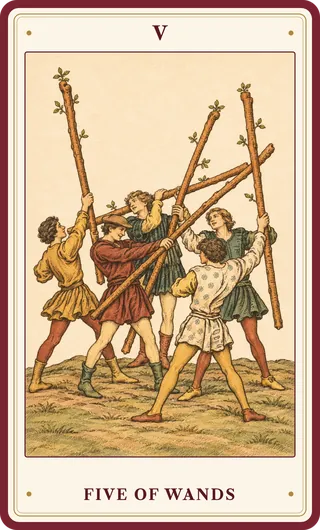
Five wooden staves
Each figure holds a staff of green wood, the fire energy of drive and ambition. Reversed, the staves point down or lose their clash, which shows energy being put away, blocked or turned inward.
Five young figures
They stand for rival ideas, egos or people who all want to be heard. Reversed, the group scatters or goes quiet, so the noise either settles into cooperation or gets pushed out of sight.
Mismatched clothing
Every figure wears different colours, which shows five different points of view with no shared uniform. Reversed, the question is whether they have found common ground or are simply keeping their differences hidden.
Bare, open ground
The fight happens on flat, empty earth with no walls or hiding places. Reversed, that openness is lost, which is why the card can describe conflict that has retreated behind closed doors.
Tangled staves
The staves cross and tangle in the middle of the picture, with no clear winner. Reversed, the tangle loosens, meaning a stalemate is ending or the knots are being tied in private.
Clear blue sky
The sky is calm and nobody is injured, so this is a scuffle and not a war. Reversed, it hints that the situation is less serious than it feels, and that the real work is internal.
Is the Five of Wands Reversed a Yes or No?
Reversed, the card leans toward a cautious yes. The struggle is ending, the pressure is lifting and things are likely to calm down. That makes it a better answer than the upright card, which tends toward “yes, but only with a fight.” You can see the upright reading on the Five of Wands yes or no page.
The yes comes with a condition. If the cards beside it show avoidance, secrets or fear, the answer shifts to not yet: something needs to be said or settled first. Treat it as a yes for questions about ending a conflict or finding peace, and a “wait and talk first” for questions about moving forward while an issue is still being dodged.
For a quick draw, the yes or no tarot reading tool is useful, but always read the answer against the question you asked.
Five of Wands Upright vs Reversed
Upright, the Five of Wands is conflict out in the open: competing opinions, rivalry, a scramble for position. It can be productive, because friction sharpens ideas, and it is usually temporary. Everyone is making a point and nobody is truly hurt.
Reversed, the same energy is blocked, ending or internal. The noise is gone, but what remains depends on you. Some people feel peace, others feel pressure with nowhere to go.
A short comparison helps:
- Upright: loud, visible, active, competitive, short term.
- Reversed: quiet, hidden or ending, cooperative or avoidant, often emotional.
Seeing the shift between the two can also tell you where you are in a story. A reading that moves from an upright Five of Wands in the past position to a reversed one in the present says the worst is over, or has gone underground.
Reversed Five of Wands as Advice
As advice, the card asks you to stop treating every disagreement as a contest. You do not have to win. Sometimes the strongest move is to let a small point go, accept a fair compromise and save your energy for what matters.
It also asks for honesty. If you have been silent to avoid trouble, the card says speak calmly and plainly. A reversed Five of Wands is not a reason to start a fight, it is a reason to stop pretending there is no issue.
Here is a simple order of action:
- Name the issue to yourself in one sentence.
- Decide whether it is yours to resolve or someone else’s drama.
- If it is yours, pick a calm time to speak and say what you need.
- If it is not, step away without guilt.
Pairing It With Other Cards
Neighbouring cards decide whether the reversal reads as peace or as pressure. A few useful pairings:
- With the Six of Wands: the dispute ends with someone being recognised, so look for who gets the credit.
- With the Five of Swords reversed: the conflict has left emotional scars, and making amends matters more than being right.
- With the Seven of Wands reversed: you are tired of defending your position and may be ready to give ground.
- With the Three of Swords: peace has come, but there is hurt to heal first.
If the cards around it are heavy, say so in your reading instead of softening them. A reversed Five of Wands next to the Ten of Swords, for example, is more likely to describe collapse than calm.
Reading It in a Spread
Position changes the emphasis. In a past position, the card says a conflict has ended or you stepped away from one. In the present position, it describes a stretch of easing tension or avoided conversations. In the future position, it predicts a drop in competition or a conversation you will need to face.
As an obstacle, the card shows what is blocking you: fear of conflict or the habit of keeping quiet. As an outcome, it suggests peace, with the caution that you should check the peace is real. In a three card tarot reading, it works well as the middle card, showing where the tension currently sits.
Not everyone reads reversals, and that is fine. If you prefer to read all cards upright, take the upright meaning and add the softer side: the conflict is calmer than it looks. If you do use reversals, the guide on reading reversed tarot cards explains the main methods. You can also see the other fire cards in the suit of Wands overview.
Questions to Ask Yourself
Cards work best when they lead to useful questions. If the reversed Five of Wands turns up, try these:
- What conflict am I pretending is not there?
- Is the quiet I feel peace or avoidance?
- Where am I shrinking my opinion to keep others comfortable?
- Which fight am I still carrying that is not mine?
- What would I say if I knew it would not cause a scene?
Answer them honestly, and you will usually know which reading applies. The card rarely hands you the answer. It points to the place where you already know something is unsaid.
Try this: Draw one more card as a clarifier. Ask, “What is the real issue underneath?” and give it five minutes of free writing before you decide what to do.
The Bottom Line on the Reversed Five of Wands
The reversed Five of Wands is a gentle card with a sharp question. It often brings relief, whether from an argument that is ending, a rivalry that has cooled or a stretch of stress that is easing. In those moments, accept the calm and use it.
When it carries the shadow side, it asks you to look at what you are avoiding. Peace that rests on silence does not last, and speaking up calmly now costs less than letting resentment grow. Read the card against what has actually changed, listen to how you feel, and you will know which version you are holding.
Questions readers ask
What does the Five of Wands reversed mean?
It usually means conflict is winding down, through compromise, exhaustion or a decision to stop competing. It can also mean the conflict is being avoided or has moved inside you, so you need to check whether the peace is real.
Is the Five of Wands reversed a good or bad card?
It is a mild card, not a warning of disaster. It often brings relief, but it turns unhelpful when it shows suppressed anger, fear of confrontation or a quiet cold war.
What does the Five of Wands reversed mean in love?
In love it can mean you are making peace after a rough patch, or that both of you are avoiding a conversation you need to have. It does not mean a breakup on its own.
Is the Five of Wands reversed a yes or no?
It leans toward a cautious yes, because the struggle is easing. If the surrounding cards show avoidance, read it as not yet, since something must be said or settled first.
What does the reversed Five of Wands mean as someone's feelings?
The person is tired of conflict and may want peace. They may also be holding back frustration or avoiding the subject of you, so look at their actions and not only the card.
What is the difference between the Five of Wands upright and reversed?
Upright, the conflict is loud, visible and active. Reversed, it is ending, hidden or happening inside your own head.
Can the Five of Wands reversed mean fear of confrontation?
Yes. It often points to holding your tongue, backing out of competition or shrinking yourself to keep others comfortable. The fix is to speak up calmly, not to start a fight.