
Nine of Wands Reversed (Meaning in Love, Work & Life)

- Arcana
- Minor Arcana, Suit of Wands
- Element
- Fire
- Yes or no
- Maybe
resiliencepersistencelast stand
delayslost motivationscattered energy
The Nine of Wands reversed means you have been defending, enduring or pushing for so long that your strength has turned into a problem. It most often points to burnout, guardedness, stubbornness or the urge to quit just before the finish. It can also describe the opposite, a person who is finally ready to lower their guard and rest.
Upright, this card shows someone wounded but standing, braced for one more challenge. Reversed, the question changes from “can you hold on?” to “is holding on still helping you?” The answer is rarely a simple no. This page walks through what the card means in love, work, money, health and as feelings, how to tell which version you are looking at, and what to do next. For the standard reading of the card, see the Nine of Wands meaning.
What the upright card sets up
To read the reversal well, start with what the card shows when it is upright. A bandaged figure stands in front of a fence of eight wands, gripping the ninth and glancing back over his shoulder. He has been through eight rounds of trouble and he is expecting a ninth. He is tired, but he has not given up and he is very close to the end.
That is the baseline: resilience, boundaries and one last push. The reversed card takes the same figure and asks what happens when the effort has no outlet. Strength that is never rested becomes brittleness. Caution that never switches off becomes suspicion. A fence that is never opened becomes isolation.
This is also why the reversed Nine of Wands rarely feels like a surprise to the person who draws it. The tiredness, the wariness or the temptation to walk away are usually already present. The card names them and asks you to decide what to do about them.
Core meanings of the Nine of Wands reversed
Different readers lean on different keywords, but the card keeps returning to the same cluster of ideas. The most common are:
- Burnout and chronic fatigue after a long fight
- Defensiveness, paranoia or a chip on the shoulder
- Stubbornness and refusal to compromise
- Giving up too early, with the finish line close
- Walls or boundaries that are too rigid, or the reverse, boundaries that have collapsed
- Old wounds and resentment shaping present choices
- Readiness to lower your guard and accept help
Notice that these point in two directions. Some describe too much resistance (stubbornness, paranoia, armour). Others describe too little (exhaustion, surrender, quitting). The rest of the reading, and your own situation, tells you which side applies. Often it is both: someone defends too hard because they are too tired to do anything else.
When the reversal means burnout
The first and most common reading is burnout. You have given a long stretch of your energy to a job, a relationship, a family situation or a goal, and the reserves are empty. The upright figure can keep going on adrenaline and pride. The reversed figure has run out of both.
Burnout rarely announces itself as collapse. It looks like irritability, flat motivation, small tasks feeling enormous, and a sense that nothing you do makes a difference. You may still be performing well on the outside, saying “I’m fine” in a bright voice while you are far past fine. The reversed card is often a polite way of telling you that the performance has gone on long enough.
If this reading fits, the card’s advice is plain. Reduce the load before you make any large decision. Exhaustion distorts judgement, and the idea of quitting, staying or fighting looks very different after a proper rest.
Read Nine of Wands for your question
Upright: You have been guarding your heart for good reasons, and you are close to deciding whether to let someone in or keep the walls up.
Reversed: Past hurt or relationship fatigue has turned protection into distance, so intimacy cannot get through.
Upright: They care and they are loyal, but they are wary and tired from what they have been through.
Reversed: They feel suspicious, drained or withdrawn, and may be close to shutting down or walking away.
Upright: You are nearly at the finish of a demanding project and only need one more push.
Reversed: Burnout, stubbornness or a defensive attitude is stalling you, or you are tempted to quit just before the finish.
Upright: You have held your finances together through a hard stretch and the pressure is about to ease.
Reversed: Financial stress is making you avoid the numbers, or you are clinging to a plan that is not working.
Upright: Keep your boundaries, finish what you started and accept that you are nearly there.
Reversed: Rest, drop the unnecessary armour and ask for help before you decide anything big.
Upright: You are worn but resilient, and recovery is within reach if you pace yourself.
Reversed: Chronic fatigue, stress or an old injury is asking for real rest, not more pushing through.
When the reversal means over-defending
The second reading is about armour. You have been hurt or let down, and you now expect it to happen again. The Nine of Wands reversed shows the point where over-defending starts to cost you more than the threats ever did.
This can look like hearing criticism in neutral comments, refusing help because accepting it feels like weakness, assuming people have bad motives, or holding on to a grievance long after the situation changed. In some readings it describes someone with a chip on their shoulder who is quick to bristle. It can describe you, or someone close to you, and the surrounding cards help you tell which.
The kindest way to read this is as a protection that outlived its purpose. The fence was built for good reasons. The reversed card asks whether the danger it was built against is still in front of you, or whether you are now guarding against a memory.
Try this: Write down three things you are currently defending (a decision, a boundary, a grudge, a plan). Next to each, write what you are afraid will happen if you stop. Circle any fear that belongs to the past rather than to today.
When the reversal means quitting too soon
The third reading is the one that stings most. The Nine of Wands is the second-to-last wand, so the finish is near. Reversed, the card often shows someone who gives up at exactly that point because the fatigue is louder than the evidence that they are nearly there.
This can show up as quitting too soon: leaving a job without a plan, ending a project days from completion, walking out of a relationship in the middle of a rough patch, or abandoning a goal because one more setback felt unbearable. The card does not say you must stay. It asks you to check whether you are leaving because the path is wrong or because you are depleted.
A useful test is to separate the situation from your state. Ask whether you would still want to leave if you were rested, fed and had slept well for a week. If yes, leaving may be sound. If no, the answer you are being offered may be a symptom of tiredness rather than a decision.
Nine of Wands reversed in love
In love, the card most often describes walls. Someone in the relationship, possibly you, has been hurt enough that protecting themselves has become the main activity. Closeness feels risky, so it is kept at arm’s length, and the partner on the other side of the fence feels shut out.
In an established relationship, the reversal can show a stalemate in which both people are tired and neither wants to be the first to bend. It can also show one partner carrying most of the effort and slowly running dry. If you are in the early stages, it can point to a new partner (or yourself) arriving with old wounds that have not been dealt with yet.
For singles, the card has two faces. It can mean you are afraid to try again and are using self-sufficiency as armour. It can also mean the guard is finally coming down, and you are ready to let someone see you without the full suit of protection. The rest of the spread will show which, and the relationship tarot spread is a good way to look at both sides of a connection at once.
Nine of Wands reversed as feelings
When this card describes what someone feels about you, it points to a person who is guarded, drained or suspicious. They may care, but they are carrying a lot, and they do not trust easily right now. Their feelings are often hidden behind distance, short answers or a defensive reaction when you get close.
Reversed, it can also mean they feel they have already given too much. The thought underneath is something like “I have tried and I am not sure there is anything left.” That is different from not caring. It is a person near the limit of what they can offer, and pressure will make them retreat further.
Reading this card as feelings, resist the urge to push for reassurance. The approach that works with a Nine of Wands person, upright or reversed, is patient and low-pressure. Show that you are safe rather than persistent, and let them come forward in their own time.
Nine of Wands reversed in career
At work, this card is a burnout signal first. You have been defending your position, covering for others, fighting for a project or answering messages at all hours, and the enthusiasm that once powered it has gone. The work may still be getting done, but it is costing more than it should.
It can also describe stubbornness. You may be sticking with a strategy, a role or a company because you have already put so much in, when the situation really calls for a change of approach. Some readers call this flogging a dead horse. Another reading is the defensive colleague: someone who treats every suggestion as an attack and is hard to collaborate with.
In job-change questions, the card cautions against resigning in a fit of frustration with nothing lined up. If you are close to finishing a project, a qualification or a probation period, the usual advice is to find a way to rest and complete it, then decide. If you want a second card for context, pair this one with the Eight of Wands reversed to check whether delays or scattered effort are part of the problem.
Nine of Wands reversed in money
In money readings, the card describes financial strain that has become draining. You have been holding things together, perhaps through a long run of unexpected costs, and the fatigue now shows up as avoidance. Not opening statements, not checking balances and putting off hard conversations are all typical signs.
It can also warn against clinging to a financial plan that is not working out of pride or fear of admitting a mistake. A defensive attitude to advice, such as refusing to talk to someone who could help, is a common version of this. The card suggests that the rescue is likely to come from facing the figures and asking for support, not from more grinding alone.
Practically, the reversal favours a small, calm audit over a dramatic move. Look at the real numbers, find the next smallest step, and take it. Large risks taken from an exhausted, defensive place tend to go badly.
Health and wellbeing
For health questions, the Nine of Wands reversed points to depletion. The body and mind have been under strain for a long time, and the reserves are low. It can indicate chronic tiredness, stress that has not been dealt with, or an old problem that flares up again because it was never properly rested.
It also touches on keeping up appearances. The upright figure keeps standing because he must, and the reversed figure may be pretending he is fine when he is not. This card is a prompt to stop pretending, not a diagnosis. Tarot cannot assess your health, so if you are unwell or worried, speak to a doctor or a qualified professional, and treat the card only as a reminder to take your own limits seriously.
Try this: Choose one real rest you have been putting off (a full night of sleep, a day without messages, a medical appointment). Book it in the next seven days and treat it as non-negotiable.
Nine of Wands card symbols
Choose a symbol to read what it means on the card.
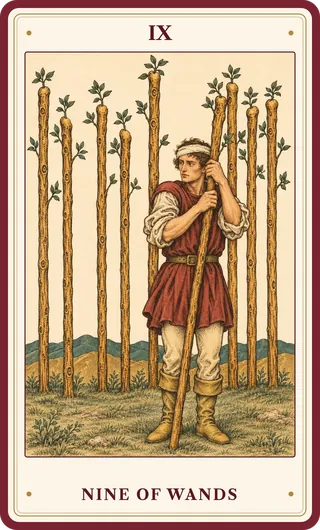
The bandaged head
He is wounded, and the injury is visible. Reversed, it points to hurt that has not been rested or treated, and to old pain still shaping how you act.
The staff he leans on
The wand is both support and weapon. Reversed, you may be leaning too hard on willpower alone, or you may be ready to put the staff down.
The eight wands behind him
They form a fence built from past battles. Reversed, the fence can become a cage that keeps people and help out.
The sideways, watchful glance
He is looking over his shoulder for the next threat. Reversed, that alertness can tip into suspicion, or it can finally ease off.
The weary, braced posture
His stance shows he is tired but still standing. Reversed, the body is signalling that endurance has reached its limit.
The open landscape and low horizon
The setting is quiet, and no enemy is actually in view. Reversed, it asks whether the danger is real or has become a habit of the mind.
The ninth wand he holds
He is on the ninth of ten, so the finish is close. Reversed, this is the moment people either stop too soon or refuse to change tactics.
Is the Nine of Wands reversed a yes or no?
For yes or no questions, the reversed Nine of Wands leans towards no, or more fairly, not yet. The thing you are asking about may still be possible, but you are not in a state to get it right now. The card says rest, change approach, or lower your guard first, and the answer may then look different.
The exception is when you are asking whether to give up. In that case the reversal usually works as a nudge against quitting in haste, especially if the finish is close. If the question is whether you should keep fighting the same way, the answer is no: the method needs to change, even if the goal does not.
For a quick answer alongside this card, the Nine of Wands yes or no page gives the upright and reversed reading side by side, and the yes or no tarot reading tool lets you ask a fresh question.
Reading the symbols upside down
The imagery helps you decide which reading to use. The bandage is the first clue: reversed, it suggests an injury that has been ignored or has not healed, physically or emotionally. The sideways glance is the second. Is he scanning for a real threat, or is he scanning out of habit?
The eight wands behind him are the third. They are his history, the fence of past battles. Reversed, they can turn from protection into a barrier that keeps others out, or they may look like something he is ready to walk away from. The staff he leans on can be read as the thing you are leaning on too heavily, usually willpower.
Finally, look at the landscape. Nothing in the picture is attacking him. That absence is the question the reversed card asks: how much of what you are guarding against is actually in front of you? For a fuller look at how images change when a card turns, the guide to reversed tarot cards covers the main approaches.
How it differs from its neighbours in the suit
Several Wands cards share themes with this one, and mixing them up is common. The Seven of Wands reversed is about giving up a defence under pressure, usually because of overwhelm or a sense of being outnumbered. The Nine of Wands reversed comes later, after a longer fight, and the weariness runs deeper.
The Ten of Wands reversed is about the burden itself: carrying too much and finally putting some of it down. The Nine is about the guard you keep up while carrying it. In a sequence they read like a story: defending, then bracing, then overloaded.
If a spread shows the Nine of Wands reversed next to cards of rest or retreat, such as the Four of Swords reversed, the message is amplified: the body and mind are asking for a pause and you have been refusing it. If it appears with strong upright Wands, the situation is less about collapse and more about rethinking tactics.
The positive side: lowering your guard
Not every reversed Nine of Wands is a warning. For many people it marks the moment the fight ends. The battle is over, the threat has passed, and the figure can finally put the staff down. If you have been bracing for something that has already happened, or that never came, the card can be a relief.
This reading is especially strong when the surrounding cards are gentle or hopeful. In love, it can mean you are ready to be open again. At work, it can mean you have proved what you needed to and can stop proving it. In life generally, it can mean that survival mode is no longer needed, and you are allowed to choose something other than endurance.
The sign that this is the reading to use is how you feel when you picture setting the armour down. If the feeling is relief, you are probably looking at readiness. If the feeling is fear or shame, the card is more likely showing defensiveness, and a slower, more gentle approach is needed.
What to do when this card appears
The reversed Nine of Wands rewards small, honest actions more than big dramatic ones. A sensible order is to rest first, then review, then act. Pressing on, quitting and picking fights are all poor choices from an empty tank.
- Name what you are tired of, in one sentence, without softening it.
- Rest in a way that is real: sleep, time off, fewer obligations for a few days.
- Ask yourself which defences are still protecting you and which are only habit.
- Tell one trusted person what you are carrying, and accept one piece of help.
- After resting, decide whether to continue, change tactics or stop.
If you want to explore the issue further, a 3 card tarot spread with the positions “what I am protecting,” “what it costs me” and “what to do next” works well. For other cards in this suit, the Wands suit overview shows how the energy develops from the Ace to the King.
Try this: Draw one more card with the question “What would help me put my guard down safely?” Treat it as a suggestion, and write down one action it gives you.
Reading the card in a spread
Position matters. As the past, the Nine of Wands reversed shows an exhausting period or a decision made in defence. In the present, it describes where you are now: tired, guarded or on the edge of letting go. In the future, it warns of a coming stretch where burnout or defensiveness could cause trouble if you do not prepare.
As an outcome, it suggests the matter will end in withdrawal or exhaustion unless something changes, or in a loosening once the fight has ended. As advice, it tells you to stop defending and start recovering. Look at the neighbouring cards and the question to choose between those readings.
If you are new to reversals, remember that they are not simply opposites. Some readers treat them as blocked energy, others as internalised energy, and others as a softer or excess version of the upright meaning. The Nine of Wands is a good card to practise with, because all three approaches lead to the same practical advice: look at how you are using your strength.
When the card appears again and again
If the reversed Nine of Wands keeps turning up, take it as a pattern rather than a coincidence. Repeated appearances usually mean the underlying issue has not been addressed: you keep returning to the fight because you have not taken the rest, made the change or had the conversation the card is asking for.
Pay attention to what is different each time. A first appearance might point to work fatigue, a second to a strained relationship, a third to your own habit of armouring up. Together they often reveal that the real theme is not any single situation but a style of coping that began long ago and no longer fits.
A pattern like this is worth taking to a friend, a counsellor or a mentor, not only to the cards. Tarot is a good mirror, but the change itself happens in daily choices: how you rest, who you let in and how you ask for help.
Questions readers ask
What does the Nine of Wands reversed mean?
It usually means exhaustion, defensiveness or stubbornness. You have been holding the line for a long time, and the effort is now costing more than it protects. It can also mean you are about to give up when the goal is close.
Is the Nine of Wands reversed a bad card?
No. It is a warning and an invitation to rest, soften or change tactics, not a prediction of failure. Many readers also see it as a sign that you are finally ready to lower your guard.
What does the Nine of Wands reversed mean in love?
It points to walls that are too high for intimacy, or to fatigue after a relationship that has asked too much of you. For singles it can mean fear of getting hurt again, or readiness to open up at last.
Is the Nine of Wands reversed a yes or no?
It leans towards no, or more accurately not yet. The goal may still be reachable, but you need rest, a change of approach or less defensiveness first.
What does the Nine of Wands reversed mean as feelings?
The person is guarded, tired or suspicious, and may be pulling back because they feel they have given too much. They are not necessarily uninterested, but they are not open right now.
How is the Nine of Wands reversed different from the Ten of Wands reversed?
The Nine of Wands reversed is about holding out and guarding yourself until you crack or quit. The Ten of Wands reversed is about the load itself: carrying too much and finally putting some of it down.