
Four of Swords Reversed (Meaning in Love, Work & Life)

- Arcana
- Minor Arcana, Suit of Swords
- Element
- Air
- Yes or no
- Maybe
restrecoverycontemplation
confusionrecoveryrelease of mental strain
The Four of Swords reversed means rest that is being refused, interrupted or finished. Upright, the card shows a knight lying still in a chapel, recovering. Turned upside down, it usually points to restlessness, anxiety and burnout, the feeling that you cannot switch off even though you badly need to. It can also mean the reverse: that the quiet period is over and you are ready to return to life.
So the card carries two readings that look opposite but share one theme, your relationship with rest. In one, you are running on empty and fighting stillness. In the other, you have had your stillness and the next step is to come back gently. This guide shows you how to tell them apart, and what the card says about love, work, money, health and yes or no questions.
Four of Swords Reversed Meaning at a Glance
The core meaning is a broken rest cycle. Something has gone wrong with recovery: you are not allowing yourself to rest, rest is being denied to you, or you are cutting it short. The mind is busy, the body is tired, and the two are not cooperating.
Common keywords for the reversed card include:
- Restlessness and agitation
- Burnout and exhaustion
- Insomnia and racing thoughts
- Refusing to slow down
- Rushing back too soon
- The end of a rest period, and readiness to re-engage
The upright card is calm and complete. The reversed card is the same scene with something out of balance, where the peace is either missing or has served its purpose. If you want the full baseline first, the upright Four of Swords explains the original message of recovery and strategic retreat.
The Two Main Readings
Reading one: rest refused
Here the card is a warning. You have been pushing through exhaustion, filling every gap in your day, and telling yourself you will rest later. Your mind keeps running over problems even when you finally lie down. The card says the system you are running cannot last, and that the longer you ignore the signals, the more likely it is that your body will force the pause for you.
This reading fits best when the question is about stress, work pace or health, or when the cards nearby are heavy, anxious or exhausted in tone.
Reading two: rest ending
Here the card is relief. You have been through a difficult stretch, taken time out, and now your energy is coming back. The reversed Four marks the morning after a retreat, when the stillness has done its job. Staying in the chapel any longer would turn healing into hiding.
This reading fits best when you have already been resting, grieving or withdrawing, and the question is about what comes next. The cards around it are usually lighter, more active, or point to movement and new beginnings.
Why the Card Flips This Way
Reversals in tarot often show an energy that is blocked, overdone or internal. If you want a deeper look at how to approach them, the guide to reading reversed tarot cards covers the main methods. For the Four of Swords, each approach leads to a similar place.
Read as blocked, the reversal shows rest that cannot happen. Read as excessive, it shows too much stillness that has become avoidance or stagnation. Read as internal, it shows a mind that will not settle, even if your life looks quiet from the outside.
Numerically, four is the number of structure and stability, and in Swords that structure is a pause for the mind. Reversed, that stability wobbles. It is less a catastrophe than a signal that your foundations need attention.
Read Four of Swords for your question
Upright: Upright, you need quiet time apart or alone to heal before you open up to love again.
Reversed: Reversed, restlessness or avoidance gets in the way of closeness, or a break from love is ending and you are ready to reconnect.
Upright: Upright, the person feels calm, withdrawn and in need of space to think.
Reversed: Reversed, the person feels anxious, unsettled or impatient, or has finished retreating and is ready to come back.
Upright: Upright, a pause, leave or sabbatical protects your energy before the next push.
Reversed: Reversed, burnout, overwork or a rushed return to work before you have recovered.
Upright: Upright, hold off on big financial decisions until things settle.
Reversed: Reversed, money stress is keeping you awake, or you are ready to start making decisions again after a pause.
Upright: Upright, stop, rest and let your mind go quiet.
Reversed: Reversed, stop pushing through exhaustion, or ease back into action slowly if your rest is truly done.
Upright: Upright, recovery, sleep and healing are working in your favour.
Reversed: Reversed, insomnia, anxiety and exhaustion are signs your body is asking for the rest you keep refusing.
Symbolism When the Image Is Upside Down
Everything in the Rider-Waite-Smith image points to deliberate stillness. A knight lies on a tomb with his hands joined in prayer. Three swords hang on the wall behind him, and a fourth lies beneath him. A stained glass window shows a scene of care and mercy. Each detail asks you to compare it with your own situation.
Reversed, you can ask whether your swords are still hanging on the wall. Many people who draw this card are still holding them, running over arguments, deadlines and worries while their body lies still. The three blades that should be out of reach feel like they are swinging above your head.
The window is the quiet reminder that comfort exists, but you have to look up to see it. And the folded hands show surrender, which is exactly what the reversed card says you are struggling to do.
Try this: Look at the Four of Swords image and name the three swords on the wall as three specific worries you are carrying. Write them on paper, fold it, and put it away for one evening. Then see whether the card feels more like a warning or a release.
Four of Swords Reversed in Love and Relationships
In love, the reversed card shows restlessness or avoidance. One or both partners may be unable to settle, unwilling to talk, or withdrawing in a way that has started to hurt the other person. Stress from outside the relationship often spills into it, and the card asks whether you are bringing your exhaustion home.
For couples, the message is to make rest part of the relationship rather than something you do instead of it. Name what you need, whether that is an evening alone or a quiet weekend together, and do not leave your partner guessing. Avoided conversations tend to grow louder in the dark.
The other reading is a relationship coming back to life after a hard patch. After illness, grief, conflict or distance, the reversed Four can mark a slow recovery. You are both ready to reconnect, and the work now is to do it without rushing.
For singles
For singles, the reversed card often means a period of healing from a breakup or loss is ending, and you are ready to date or open up again. Check that you are not forcing it. If you are rushing back out because the silence feels uncomfortable, the card is asking whether you are really healed or just restless. Compare it with the grief in the Five of Cups, where the work of looking back before moving on matters.
Four of Swords Reversed as Feelings
When this card describes what someone feels, it shows a person who is unsettled. They may be anxious about their emotions, unable to relax around you, or stuck in a loop of overthinking. It is not usually coldness. It is more often a mind that has no room left.
It can also describe someone who stepped back to process and is now ready to return. If they have been quiet or distant, this card suggests the distance is ending. You will see it in a small thaw: a message, a check in, a willingness to talk.
Read the card against what the person has actually been doing. A real change in behaviour matters more than any single card.
Four of Swords Reversed in Career and Work
At work, this is the burnout card. It shows overwork, long hours, constant stress and no real time off, even when you technically take a break. You may be answering messages on holiday or lying awake planning tomorrow. The card says to treat this as a problem to solve now, not a badge of honour. If the exhaustion is mostly about carrying too much alone, the Ten of Wands reversed is a useful companion card.
It can also show a rushed return. Maybe you came back from leave before you were ready, or you are being pressured to restart when you have not recovered. The practical advice is to negotiate a gentler pace, even for a few weeks, and protect your sleep.
If you have been on leave, between jobs or on a break and you draw this card, it can signal that the rest is over and you are ready to look for work or take up responsibility again. Start with small steps rather than leaping in at full speed.
Four of Swords Reversed with Money
Money worries are a classic cause of sleepless nights, and this card often points straight at them. Reversed, it can show anxiety about finances that keeps you from resting, or a tendency to make hurried decisions because the stress feels unbearable.
The advice is to avoid big financial moves while you are exhausted. Decisions made when the mind is racing tend to be reactive. Sleep on them, write down your numbers, and talk with someone you trust.
In a positive reading, it can mean a financially tense period is ending and you are ready to plan again. If the surrounding cards are steady, it may be time to review your budget and restart goals that you set aside during a hard time.
Try this: Pick one money worry and give it a fixed slot, ten minutes at the same time each day. When it appears at night, tell yourself it has its time tomorrow, and see whether your mind lets go more easily.
Four of Swords Reversed and Health
For health, the reversed Four of Swords is about sleep, stress and recovery. Insomnia, anxiety, constant tension and the sense of being wired and tired at the same time all fit this card. It does not diagnose anything, and persistent symptoms are worth taking to a doctor.
As a tarot message, it suggests that your body has been asking for rest and you have been talking over it. Small changes can matter: a consistent bedtime, less screen time at night, short breaks during the day. If you have been recovering from illness or surgery, it can also warn against jumping back into full activity too early.
For mental health, the card points to a mind that cannot find peace. It is a prompt to seek support, whether that is a friend, a counsellor or a professional, rather than trying to think your way to calm alone. Compare it with the spiralling worry of the Nine of Swords, which shows what this restlessness can turn into if it goes unattended.
Four of Swords card symbols
Choose a symbol to read what it means on the card.
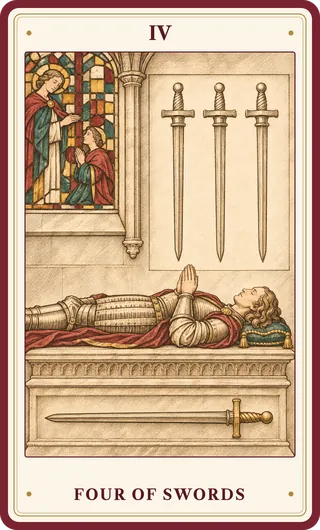
Effigy on the tomb
The knight lies in stillness with hands pressed in prayer, a picture of deliberate rest. Reversed, it asks whether you are lying still in body but not in mind, or whether it is time to rise.
Three swords on the wall
Three blades hang point down above the figure, the pains and conflicts that have been set aside for now. Reversed, they can feel like they are swinging again, as worries crowd back in.
The single sword beneath
One sword lies under the effigy, pointing along the length of the body, showing the mind kept in order even during rest. Reversed, it suggests you have not yet made peace with your thoughts.
Stained glass window
The window shows a figure kneeling before a holy figure, a sign of comfort, mercy and care in the middle of struggle. Reversed, you may be turning away from help or from the quiet that would give it room.
The stone chapel
The cold, quiet interior is a shelter built for stillness, away from the battlefield. Reversed, it can feel like a cage if you are stuck there too long, or like a place you have not let yourself enter.
Folded hands
The hands joined in prayer show surrender and trust that rest is allowed. Reversed, they point to clenched effort, difficulty letting go and an inability to switch off.
Spiritual Meaning
Spiritually, the reversed card questions your relationship with silence. Many people stay busy to avoid what they would feel in stillness. The reversal asks what you are running from and whether you are ready to sit with it.
It can also mark the end of a retreat, a spiritual rest or a period of deep inner work. You may feel pulled back into the world with new clarity. The challenge is to carry what you learned out with you, rather than leaving it in the chapel.
Meditation, prayer, time in nature or simple quiet walks can all be answers here. The method matters less than the willingness to stop for a while.
Is the Four of Swords Reversed a Yes or No?
It leans towards no, or not yet, if your question is about rushing, forcing an outcome or making a big move while stressed. The card says your energy or clarity is not ready, and waiting will give you a better answer. For a quick take on the card as a plain answer, see the Four of Swords yes or no page.
It becomes a tentative yes when your question is about returning to something after a break. If you have rested and feel genuinely recovered, the card supports a slow restart. The word to remember is “gently”.
The test is simple: ask whether you are restored or just impatient. If it is the second, wait.
How to Tell Which Reading Applies
The same card can mean opposite things, so use context. These questions usually settle it:
- Have you actually been resting recently, or have you been going flat out?
- Does the question point to stress and overload, or to recovery and what comes next?
- Are the neighbouring cards heavy and anxious, or light and forward moving?
- Does your gut feel tired and tense, or restored and curious?
If you answer mostly with exhaustion, it is the warning reading. If you answer with recovery, it is the return reading. If it is a mix, which is common, the message is to come back gradually and keep protecting your rest.
In Past, Present and Future Positions
In the past position, the reversed card shows a time when you ran yourself into the ground or avoided rest, and its effects still linger. It can also show a retreat that has ended. In a three card spread, it often explains how you got to the present stress.
In the present position, the card describes your current state: tired, tense, or just emerging from a quiet phase. It asks you to be honest about which. In the future position, it warns that burnout is coming if nothing changes, or it promises a return to activity once you have rested.
As advice, the card is nearly always practical: put limits on your commitments, stop trying to solve everything in one night, and treat recovery as part of the plan.
Card Combinations Worth Knowing
The reversed Four of Swords changes tone depending on its neighbours. Paired with the Eight of Cups, the rest may be about walking away from something that no longer feeds you. With the Hermit reversed, it suggests loneliness from isolating too much. With Temperance, it points to learning balance between effort and recovery.
When it sits near other Swords cards, it usually shows the mental side of the situation. The suit of Swords deals with thought, conflict and communication, so an agitated cluster of them suggests an overloaded mind. A calm card such as the Star nearby shows that healing is available.
Cards of action, such as the Eight of Wands or the Knight of Wands, show that the break is over and speed is returning. In that case the Four reversed asks you not to sprint before you are ready.
Questions to Ask Yourself
Reflective questions often get more from this card than any list of meanings. You might ask:
- What am I doing to avoid being still?
- What would I notice if I stopped for one full day?
- Which worry keeps returning at night, and what would settle it?
- Am I coming back from a break because I am ready, or because I feel guilty?
- Who could take something off my plate this week?
Write down your answers without editing them. The patterns are usually clear within a few lines. If one answer makes you uncomfortable, that is probably the card pointing at the real issue.
Try this: Draw the Four of Swords reversed and choose a 24 hour rule: no work messages after a set time, and one thing you do purely to rest. At the end of the day, note how your mind and body responded.
What the Reversed Four of Swords Asks of You
The message under all the meanings is that rest is part of the work, not a reward you earn after it. The upright card shows it done well. The reversed card shows it done badly or not at all, and invites you to try again.
If you are drawing it because you are depleted, start small and make it non-negotiable: sleep, boundaries, a quiet hour. If you are drawing it because the pause is ending, move forward slowly and check in with yourself as you go. Either way, the card does not ask for a dramatic change, only an honest one.
Return to the card after a week or two and see how your situation has shifted. You can draw another with the random tarot card generator if you want a second perspective, but the first answer is often the right one to act on.
Questions readers ask
What does the Four of Swords reversed mean?
It points to rest that has been refused, interrupted or cut short, which shows up as restlessness, anxiety and burnout. It can also mean a period of rest is ending and you are ready to return to normal life. The surrounding cards and your question show which one applies.
Is the Four of Swords reversed a bad card?
Not really. It is a warning more than a verdict, and it is often a good sign when it marks the end of a hard stretch. It becomes unhelpful only when it is telling you that you are ignoring exhaustion and need to stop.
What does the Four of Swords reversed mean in love?
It can mean restlessness, avoidance or withdrawal that is hurting a relationship. For singles or people healing from a breakup, it often means the break is ending and you feel ready to connect again.
Is the Four of Swords reversed a yes or no?
It leans towards no, or not yet, when the question is about rushing something. It becomes a cautious yes when you have truly rested and the question is about restarting something. Check whether your energy is actually restored before you act.
What does the Four of Swords reversed mean for a job?
It most often signals burnout, overwork or being pushed back to work before you have recovered. It can also mark the end of leave or a quiet period, and the time to ease back into your responsibilities.
What does the Four of Swords reversed say about someone's feelings?
The person is likely restless, anxious or conflicted about their emotions and unable to settle. It can also mean they have finished a period of distance and are ready to reach out again.