
Four of Swords as a Yes or No Answer

- Arcana
- Minor Arcana, Suit of Swords
- Element
- Air
- Yes or no
- Maybe
restrecoverycontemplation
confusionrecoveryrelease of mental strain
The Four of Swords is a no in a yes or no reading, or more accurately a “not yet”. Upright, it tells you to stop, rest and hold off on the decision or action you are asking about. Reversed, it leans yes: the rest has worked, and you are ready to move again, gently.
This is a different kind of no from a card like the Tower or the Five of Swords. The Four of Swords does not warn of loss or defeat. It says the timing is wrong because you or the situation need recovery first. That is why it is worth reading the whole picture and not only the verdict, and why the sections below cover how the answer changes by topic. For the card’s full symbolism and meaning beyond yes or no, see the Four of Swords meaning page.
Why the Four of Swords leans no
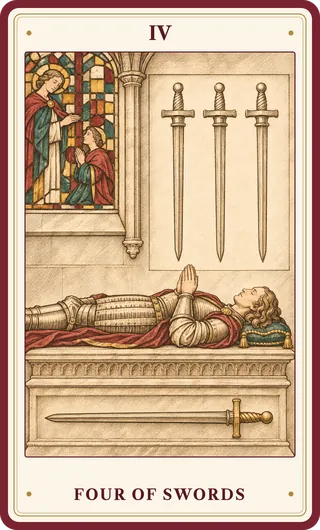
Yes or no answers in tarot come from the energy of a card. Cards of forward motion, new beginnings and success tend to read yes. Cards of delay, withdrawal and pause tend to read no. The Four of Swords is a card of withdrawal. In the image a knight lies still on a tomb, his swords out of reach, in a quiet church. Nothing is moving, and that is the point.
A yes or no question usually asks “should I do this now?” The Four of Swords answers “not in this state.” It belongs to the suit of Swords, which rules thought, stress and conflict, and it comes after the heavy emotional cards of that suit. The mind has been overworked, and the card steps in to stop it. A decision made inside that exhaustion would probably be a poor one.
The number four also matters. Four is the number of stability and structure, a foundation. Here the foundation is rest. You build your next move on it, so skipping the pause weakens whatever follows.
Upright Four of Swords as a yes or no answer
Upright, read the card as no for now. The answer is not “this will never happen.” It is “do not push this today.” If you asked whether to send the message, sign the contract, confront the person or start the project, the card advises waiting until you feel steadier.
In practice, a few signs tell you the no is genuine. You are asking from a place of tiredness, worry or overload. The situation has been draining for some time. You feel pressure to decide quickly. When those match, the card is describing your condition as much as the outcome, and it is right to hold off.
The softer side of the answer is that you are allowed to pause. People often draw this card while hoping to be told to hurry. It gives permission to do the opposite, and the permission is the useful part of the reading.
Try this: Before you ask your question, write down how rested you feel from 1 to 10. If the Four of Swords appears and your number is below 5, take it literally: sleep, switch off notifications for a day, then ask again.
Four of Swords reversed as a yes or no answer
Reversed, the Four of Swords leans yes. The figure is getting up from the tomb. The break has done its job, and the energy to act is coming back. If your question is about starting, returning or moving forward, this is a go-ahead, as long as you move at a sensible pace.
There is a second reading that matters. A reversed Four of Swords can also show a rest you refuse to take: pushing on through burnout, filling every hour, or ignoring a body that is asking for quiet. In that case the card is not a yes at all. It is a warning that you have skipped the recovery and the cost is building.
To decide which meaning applies, check how you actually feel. If you feel clear, calmer and curious about the next step, it is a yes. If you feel wired, tense and unable to switch off, read it as a no with an urgent note attached. The full picture is on the Four of Swords reversed page.
Read Four of Swords for your question
Upright: Upright, the answer is a gentle no for now: take space, heal and stop pushing for a decision or a big step.
Reversed: Reversed, the answer leans yes: you are rested enough to reconnect, talk honestly or open up to someone again.
Upright: Upright, the person or situation feels tired, withdrawn or overwhelmed, and needs quiet more than conversation.
Reversed: Reversed, the feelings are waking up again, though they may be restless, jumpy or still a little raw.
Upright: Upright, hold off on launching, applying or confronting anyone until you have recovered from burnout.
Reversed: Reversed, the break is over and a cautious yes to getting back into action is reasonable, as long as you pace it.
Upright: Upright, no to new risks or big purchases: pause, stop the worry loop and wait until you can think clearly.
Reversed: Reversed, a yes to moving forward on a financial plan, once you have rested and checked the numbers calmly.
Upright: Upright, retreat on purpose, switch off the noise and give your mind a real rest before you decide.
Reversed: Reversed, come back to the world in small steps and do not rush into everything at once.
Upright: Upright, your body and mind need rest and recovery, so sleep, slow down and let healing happen at its own speed.
Reversed: Reversed, energy is returning, but guard against overdoing it or ignoring symptoms that never really cleared.
What the image tells you about the answer
The picture supports the verdict. The knight lies in prayer on a tomb, hands pressed together. Three swords hang on the wall above, pointing down and out of use. One sword lies beneath the slab, close but out of hand. A stained glass window shows a figure offering comfort to someone kneeling.
The three swords on the wall are your worries put on hold. They are still there, which is why this card is not about denial. The single sword underneath is the one you will pick up again when you are ready, which is why the answer is not a permanent no. The window shows that help and healing are part of the scene.
Read together, the image answers a yes or no question clearly. The conflict has been set down for now, the fight can resume later, and the right action today is stillness.
Four of Swords yes or no in love
In love readings, the upright Four of Swords is usually a no for now. Should we get back together, should I say how I feel, should we move in together: the card says the timing is off. One or both people are tired, hurt or overwhelmed, and a big step taken from there tends to go badly.
If you are single and asking whether love is coming soon, the card suggests a period of rest and self-repair first. It does not rule love out. It says to heal from the last relationship, or from a stretch of exhaustion, before looking for the next. In an existing relationship, it can point to a need for space, quiet time together without pressure, or a break from a long argument.
The one exception is when your question is about taking space itself. “Should I take time to myself?” gets a clear yes. Reversed, the card leans yes to reconnecting: the cooling-off has worked and you can talk again, calmly and without ultimatums.
What about someone else’s feelings?
If you ask whether a person likes you or wants you back, the upright card often shows someone who is withdrawn, drained or processing privately. It is not a rejection. It suggests they are not in a place to respond right now, and that pushing for a reply will make it worse. The Eight of Cups yes or no answer is a useful contrast: that card is a person choosing to leave, while the Four of Swords is a person who needs to stop.
Four of Swords yes or no for career and work
At work, the upright card is a no to launching, applying, negotiating or confronting anyone while you are depleted. If you ask “Should I quit?”, it usually does not say stay forever. It says do not decide in the middle of burnout. Take leave, rest, and look at the question again with a clear head.
It is a yes to anything that supports recovery: a sabbatical, reduced hours, a holiday, a sick day, a period of quiet planning instead of frantic doing. If you have been working at full stretch, this is the card that says your next best career move is rest.
Reversed, it leans yes to getting back in. You may be returning from leave or a slow period, and the energy is coming back. Start with a manageable load rather than your old pace, because the reversed card also warns about relapsing into overwork.
Four of Swords yes or no for money
For money questions, the upright card says no to new risks. Do not make a large purchase, invest on impulse, lend money or sign a financial agreement while you are anxious or exhausted. Money decisions made out of worry are rarely good ones, and the card is telling you to wait until you can think straight.
It can also describe money stress itself: sleepless nights over bills, a mind that will not stop calculating. In that case the answer is to stop the worry loop. Write the numbers down once, then put them away and rest. Practical planning is fine, but frantic planning is not.
Reversed, it leans yes to moving on a financial plan once you have rested and checked the numbers calmly. If you want an answer about a specific purchase or investment, pair it with a card that speaks to resources, such as the Ace of Pentacles, which would add a green light the Four of Swords cannot give on its own.
Four of Swords yes or no for health
Health is where this card is most at home. Upright, it says yes to rest, sleep, recovery and quiet. If your question is about whether you need to slow down, the answer is plainly yes. It often appears after illness, surgery, stress or long periods of overwork, and it supports a slow, unforced recovery.
It is not a diagnosis, and tarot should never replace medical advice. If the card shows up alongside persistent symptoms, treat it as a nudge to get proper care, not as proof that rest alone will fix things.
Reversed, it suggests energy returning. It can also warn that you are rushing back to full activity too soon, or that tiredness has become restlessness and insomnia. Build back gradually, and do not take a good day as proof that you are fully better.
Four of Swords card symbols
Choose a symbol to read what it means on the card.
Effigy on the tomb
A knight lies stretched out on a stone slab like a carved figure on a tomb. It shows a deliberate, protected stillness, a pause that is not defeat.
Hands in prayer
The figure's hands are pressed together over the chest. This points to inner calm, meditation and trust, the opposite of struggle.
Three swords on the wall
Three swords hang above the figure, pointing downward and out of use. They stand for the worries and conflicts you have put on hold while you recover.
Single sword beneath
One sword lies under the slab, close at hand. It tells you the fight is not gone for good and you can pick it up again when you are ready.
Stained glass window
A stained glass window shows a figure giving help to a kneeling person. It suggests comfort, guidance and the quiet work of healing.
Church interior
The setting is a sealed, quiet space away from the noise of the world. It represents sanctuary and permission to be unreachable for a while.
Muted palette
The scene is calm and hushed, with soft colour in the glass and stone around the figure. It signals Air energy slowed down: thoughts settling rather than racing.
When the Four of Swords really is a yes
Some questions make the Four of Swords a clear yes. These are the ones it agrees with:
- Should I take a break or a holiday?
- Should I step back from this argument or situation?
- Should I turn off my phone and take a day to think?
- Should I rest before making this decision?
- Should I set a boundary and take time for myself?
In all of these, the question is already about pausing, so the card confirms it. This is the most useful thing to remember: the Four of Swords says no to action and yes to rest, and your question decides which one you are asking about. A simple way to check is to see whether your question starts with “should I do” (action) or “should I stop” (rest).
How long does the pause last?
The Four of Swords has no set timeline, but it points to a period of rest that takes weeks rather than days. A rough rule is that the pause lasts until you feel clear, not until a date passes. If you want to read timing more precisely with other cards, the tarot timing guide explains how to do it.
In the Golden Dawn tradition the card is linked to Jupiter in Libra, titled “Rest from Strife”. That fits: the strife of the previous cards is over, and the card holds a calm space before the next phase. It tends to fall between a stressful episode and a renewed start.
A practical approach is to ask again after you have genuinely rested. Do not redraw the same day to fish for a better answer. Take the card seriously, wait a week or two, and then ask the question in a fresh way.
Try this: Choose a pause that fits your situation (a no-meetings afternoon, a weekend offline, a week without checking a certain person’s profile). Do it fully, then draw one more card and ask, “What do I see now that I could not see before?”
How to ask so the card can answer
Yes or no tarot works best with a clear, closed question about one decision. “Should I accept the job offer?” works. “What will happen with my life?” does not. The Four of Swords is especially affected by this, because a vague question gets a vague “wait” back. If your wording invites a fast action, the card’s call to pause will feel like a no. If you ask about rest, it will feel like a yes.
Ask about the next step, not the whole outcome. “Is now a good time to bring this up?” is better than “Will this work out?” The card is about timing and condition, so it answers timing questions better than questions about the final result. For more ways to word your question, see questions for tarot reading.
If you want to pull a card for a quick answer, the yes or no tarot reading tool lets you draw one and read it using the same upright and reversed logic as this page.
Reading the Four of Swords with other cards
In a spread, the cards around it can sharpen the answer. The Four of Swords next to a yes-leaning card, such as the Ace of Swords, says the idea is good but the timing needs patience. Next to a heavy card like the Ten of Swords or the Nine of Swords, it shows rest after real suffering, and the pause is something you need, not a failure.
When it follows the Eight of Swords or the Seven of Swords, the rest follows a stretch of mental trapping or strategising, and it brings relief. When it comes before the Six of Swords, it shows a move toward calmer waters after the pause. When it sits beside the Knight of Swords, the clash is between racing and resting, and the advice is to slow down.
In a three-card yes or no spread, the Four of Swords in the first position says the question is rooted in exhaustion. In the middle, it means the pause is the answer. In the last position, it says the outcome involves a rest or reset, which is a quiet yes to recovery but a no to fast results.
Common mistakes when reading it as yes or no
The biggest mistake is reading the card as a permanent no. It is not. It says the moment is wrong, and it carries no hostility toward the plan itself. If you treat it as a door closing forever, you may drop something worth returning to.
The second is the opposite: ignoring it. People who are anxious for an answer pull a second or third card until they get a yes. That wastes the reading. If the Four of Swords showed up, there is probably a reason, and the reason is usually tiredness or overload that you already half know about.
A third mistake is confusing rest with avoidance. The card describes a deliberate, time-limited pause with a purpose. It does not support hiding from a problem indefinitely. If you notice you have been “resting” for months and the issue is no clearer, the pause has become avoidance, and the answer shifts toward gentle action.
What to do after you draw it
Treat the card as an instruction as well as an answer. These steps work for most questions:
- Postpone the decision by a set amount of time, such as a week.
- Cut one source of noise: a group chat, a news habit, an overloaded schedule.
- Do something restful that you actually enjoy, not just something productive.
- Write down the question and your current feelings, so you can see what changed later.
- Return to the question when you feel clear, and draw again.
The card also works as a check on your own state. If you keep drawing it across different questions, you are probably tired in a way that colours everything, and the answers will not change until you rest. That is a more useful discovery than any single yes or no.
The short version
Upright, the Four of Swords says not yet, leaning no for action and yes for rest. Reversed, it leans yes to moving again, with a warning if you are still running on empty. In love it asks for space, at work it asks for recovery, with money it asks for calm, and with health it asks for patience.
If you want to see how this card sits among its neighbours, the suit of Swords overview shows the full run from the Ace to the Ten. And if the answer disappoints you, remember what the knight on the tomb knows: a pause taken properly makes the next yes much stronger.
Questions readers ask
Is the Four of Swords a yes or no card?
Upright, the Four of Swords leans no, or more accurately not yet. It asks you to rest and wait rather than act. Reversed, it leans yes, because the rest has done its work and you are ready to move again.
Is the Four of Swords a yes or no in love?
Upright, it is usually a no for now: no to rushing, to pushing for answers, or to a big commitment while someone is worn out. It becomes a yes only when the question is about taking space or healing. Reversed, it leans yes to reconnecting.
What does the Four of Swords reversed mean as a yes or no answer?
Reversed, it leans yes. The pause is ending and you can start moving again. If you feel restless or burnt out rather than recovered, read it as a caution to slow down instead.
Can the Four of Swords mean yes?
Yes, when your question is about resting, taking a break, setting a boundary or stepping back. Then the card agrees with you. For any question that needs fast action or a big leap, it says wait.
How long should I wait if I draw the Four of Swords?
The card gives no fixed date, but it points to a period of weeks rather than days. Wait until you feel genuinely rested and your thinking is clear, then ask the question again.
What if I draw the Four of Swords and the answer was supposed to be yes?
Treat it as a yes that is not ready yet. The card does not say the path is closed: it says you would meet it tired and unclear. Rest first, then revisit the question.