
Five of Cups Tarot Card Meaning (Upright & Reversed)

- Arcana
- Minor Arcana, Suit of Cups
- Element
- Water
- Yes or no
- No
lossregretgrief
emotional blockswithdrawalimbalance
The Five of Cups means grief, regret and disappointment. It shows up when something has gone wrong, a hope has collapsed or a relationship has ended, and your attention is stuck on the loss. It is also a card of perspective: two cups still stand behind the mourning figure, and the card asks you to notice them once you have felt what you need to feel.
In a reading, it rarely predicts a brand new disaster. It describes the emotional aftermath of something that has already happened, and it asks how you are carrying it. Below you will find the card’s imagery, its upright and reversed meanings, how it reads in love, work, money and health, and how it compares with the cards it is most often confused with.
The Five of Cups at a glance
The Five of Cups is the fifth card of the Suit of Cups, the suit of emotion, relationships and intuition. Its core keywords are grief, loss, regret, disappointment, mourning, bitterness and perspective. Its element is water, and in the Golden Dawn system it is tied to Mars in Scorpio, which fits a card about deep, intense emotion and the sting of things not going to plan.
Upright, it describes a person caught in sorrow over what went wrong. Reversed, it describes someone beginning to recover, or someone who is avoiding the pain. For a wider view of how the suit works, the suit of Cups guide shows where this card sits between the calm of the Four and the departure of the Eight.
What you see in the Five of Cups image
A figure in a black hooded cloak stands with his head bowed, looking down at three cups that have fallen over. Their contents have spilled onto the ground. The sky is grey, and the mood is quiet and heavy. At first glance it is a picture of pure sorrow, and that first glance is exactly what the card is testing.
Look past the figure and the scene changes. Two more cups stand upright behind him, and he has not turned around to see them. A river runs through the middle of the picture, with a bridge crossing it toward a small house or castle on the far bank. So the card contains the loss, the leftover resources and the way home, all in a single frame.
The detail that matters most is the direction of his gaze. He is not wrong to grieve, because three cups really have spilled. But his body is angled toward what he lost, and everything that could help him is at his back. When this card lands, ask yourself what is standing behind you that you have not looked at yet.
Five of Cups upright meaning
Upright, the Five of Cups is the card of emotional loss and the regret that follows it. It can mean a breakup, a death, a betrayal, a failed plan or a missed chance. The size of the loss varies, but the pattern is constant: you are going over what happened, and it hurts.
It also points to a particular kind of tunnel vision. Disappointment can make the past feel like the whole story, and the card shows how that happens. You may find yourself replaying conversations, blaming yourself, or feeling bitter toward people you think let you down. None of that makes you weak. It is what a hurt heart does.
The upright card does not tell you to cheer up. Its advice is to acknowledge the grief as real and then keep going, slowly. The two cups that stay upright are a promise that the loss is not the whole of your life.
Try this: Take a sheet of paper and draw five cups. Mark three as spilled and write one loss in each. Then label the two upright cups with something that is still true and good in your life: a person, a skill, a place, a small hope. Keep the page where you will see it this week.
Read Five of Cups for your question
Upright: Heartbreak, a breakup or old romantic regret is still raw, and you are focused on what ended rather than on who is still beside you.
Reversed: You are starting to forgive, accept the end of something, or let a former partner or old hurt return to a place where it no longer controls you.
Upright: They feel sad, guilty or disappointed, and may be too caught up in what went wrong to show warmth or move toward you.
Reversed: Their mood is lifting, and they are ready to speak, apologise or open up again after a period of withdrawal.
Upright: A setback, lost opportunity, redundancy or failed project is weighing on you, and you may be replaying the mistake instead of planning the next step.
Reversed: You are recovering from a professional blow, taking the lesson from it and starting to look at the options that are still open.
Upright: A financial loss or poor decision is causing regret, and worry about what is gone is hiding the resources you still have.
Reversed: You are accepting a loss, rebuilding your budget and making a calmer plan instead of punishing yourself over the past.
Upright: Let yourself grieve properly, then turn around and look at what remains, because there is more left than you can see right now.
Reversed: Stop revisiting the loss, take the lesson, forgive where you can and take one small step toward what is still standing.
Upright: Low mood, sadness or grief is taking a toll on your energy and sleep, so rest, talk to someone and get support.
Reversed: Your emotional health is improving, and your mood and energy are returning as you process what happened.
Five of Cups reversed meaning
Reversed, the Five of Cups usually signals that the worst of the sorrow is easing. The figure has turned around. You are able to see the two standing cups, accept what happened and begin to forgive, whether that means yourself, someone else or the situation. Energy that was tied up in regret starts to return.
Reversal can also work the other way. If you have been refusing to feel the loss, pretending you are fine or rushing to move on, the reversed card can show grief that has been pushed down and is still waiting. It can also show someone clinging to the past so tightly that it blocks every new connection. In older readings, a reversed Five of Cups was also read as the return of something from the past, such as an old friend or a lost opportunity coming back around.
To tell which version applies, look at the surrounding cards and at how you actually feel. If you feel lighter, it is recovery. If you feel numb or tense, it is probably avoidance. For a fuller breakdown, see the dedicated page on the Five of Cups reversed, and the guide to reading reversed cards if you want a method for deciding between these readings.
Five of Cups in love
In a love reading, the Five of Cups points to heartbreak. It can describe a breakup, a divorce, a relationship that ended badly or an old wound that is still tender years later. If you are in a relationship, it often shows disappointment, a sense that something has gone missing, or grief about the way things have turned out.
It also warns about what grief does to attention. A person absorbed in a lost love can miss the partner who is standing right there, or fail to notice a new connection. If you are single, the card often says you are not ready to date yet, and that is a perfectly good answer.
In a reconciliation question, the card is honest rather than cruel. It acknowledges real hurt on both sides and suggests that nothing will be repaired until the regret is dealt with. Pay attention to the cups behind the figure: they may be the care that is left between you, or a reminder that your future happiness does not depend on one person. If you want to compare the heartbreak cards, the Three of Swords is the sharper, more immediate pain, while the Five of Cups is the slower mourning that follows it.
Five of Cups as feelings
When the Five of Cups describes what someone feels toward you, it usually points to sadness, guilt or regret. They may feel they have let you down, or that a relationship has not worked out the way they hoped. They can seem withdrawn, quiet or distant, and that is often grief, not indifference.
The card does not say whether they still love you. It says they are hurting, and that they are looking at the loss, not at the chance to repair it. They may need time before they can speak openly, and pushing for answers during that stage tends to make them retreat further.
If the card describes your own feelings, take it as permission to name them. Regret and sadness are information. Once you have named them, ask whether you are being kind to yourself, or going over the same ground again and again.
Five of Cups in career
At work, the Five of Cups points to a setback: a redundancy, a project that failed, a promotion that went to someone else, or a business that did not make it. It can also describe the mood after a bad review or a collapsed deal, where you are replaying the moment you think you could have done differently.
The card’s lesson here is about proportion. You are allowed to be disappointed, but a loss does not cancel your skills, your reputation or the options that remain. Take stock of what is still standing: your experience, your contacts, your training, your references. The two upright cups are usually practical assets you have stopped counting.
Reversed in a career reading, it often shows you recovering from a blow and starting to apply for roles, restructure your plans or learn from the failure. If it falls in a position about the near future, it can warn against making big decisions while you are in the middle of disappointment, since anger and shame make poor advisers.
Five of Cups and money
In money readings, the Five of Cups describes financial regret: a loss on an investment, a debt you wish you had avoided, a purchase you now see as a mistake, or an unexpected expense that has shaken your confidence. It is about the emotional weight of the loss as much as the amount.
The useful move is an honest count. Write down what you have lost, then write down what you still have: income, savings, assets, skills and people who can help. Shame often makes a bad month feel like a total collapse, and the card encourages you to look at the whole ledger.
Reversed, it suggests you are ready to learn the lesson, make a plan and stop punishing yourself. It can also show money you thought was gone coming back in some form. For a card that is more practical about rebuilding, look at the Four of Pentacles for the cautious, protective side of finances.
Five of Cups and health
For health, the Five of Cups relates mostly to emotional wellbeing. Grief, loneliness and low mood can drain sleep, appetite and energy, and the card suggests that your emotional state is affecting how you feel physically. It is a sign to slow down, rest, and talk to someone you trust.
If sadness has lasted for weeks and is getting in the way of daily life, speaking to a doctor or a counsellor is a sensible step. Tarot can help you reflect, but it is not a substitute for professional care, especially when the feelings are heavy.
Reversed, it can show emotional recovery: appetite returning, sleep improving, energy coming back as the loss is processed. It does not diagnose anything, and it should be read as a mood and energy card, not a medical one.
Five of Cups as advice
As advice, the Five of Cups says: feel it, then turn around. It does not tell you to bury the pain or hurry through it. It tells you to stop treating the loss as the only thing in the picture.
When this card shows up in an advice position, the following steps tend to fit:
- Name what you lost, in plain words, without softening it.
- Give yourself a set period, such as an evening or a week, to grieve without judgement.
- Write down what is still standing, as specifically as you can.
- Forgive one thing, whether it is a person, a decision or your own mistake.
- Take one small action toward the far bank, the way the bridge suggests.
None of these needs to be dramatic. The card values small, steady turns of attention over big declarations.
Try this: Tonight, sit quietly for five minutes and picture the card. Imagine standing beside the figure and gently turning him around to face the two upright cups. Then write one sentence about what you see.
Five of Cups card symbols
Choose a symbol to read what it means on the card.
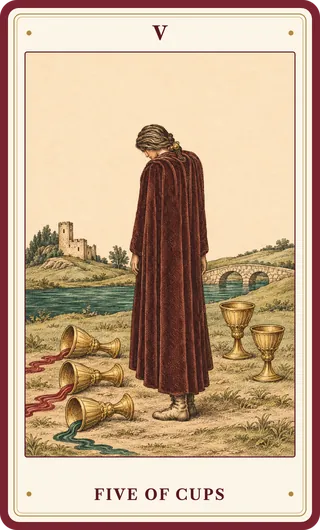
Hooded black cloak
The figure is wrapped in black from head to toe, the colour of mourning. It shows grief that has closed him off from everything around him.
Three spilled cups
The cups lie on their sides with their contents running onto the ground. They stand for the losses, failures and disappointments that have already happened and cannot be undone.
Two upright cups
Behind the figure, out of his line of sight, two cups still stand full. They are the support, love and opportunities that remain while his attention is fixed elsewhere.
River
A river runs across the scene, the water of emotion that keeps moving. It suggests that feelings flow on even when a person feels stuck.
Bridge
A bridge crosses the water in the background. It shows that a way across the loss exists and can be taken when he is ready.
Distant house
A small castle or house sits on the far bank. It represents shelter, safety and a place to return to once the grieving is done.
Grey sky
The sky is heavy and overcast, matching the figure's mood. It signals a hard stretch, not a permanent one.
Five of Cups as a person
As a person, the Five of Cups describes someone who is grieving or who tends to live in regret. They may be going through a loss, or they may have a habit of focusing on what went wrong. They can be sensitive, thoughtful and deeply feeling, but also withdrawn, pessimistic or hard to cheer up.
It can also describe someone who has been let down and now expects disappointment, so they hold back from hope. Around a person like this, patience and steady presence work better than advice. They usually know what the cups on the ground look like. What they need is company while they find their way to the ones still standing.
If the card describes you, it is a gentle flag that you may be more fixed on the past than you realise, and a reminder that being kind to yourself is part of recovery.
The Five of Cups and grief
Of all the cards in the deck, the Five of Cups is the one most closely tied to grief and bereavement. It can appear when someone has died, when a pet has been lost, when a relationship has ended or when a dream has fallen apart. The card does not hurry the process, and it does not argue with how much it hurts.
What it adds is a view of grief as something that moves. The river in the image keeps flowing, and the bridge is already built. The black cloak does not stay on forever, though it can feel that way at the start. When a reading touches loss, this card often says that sorrow is a natural response, not a failure of strength.
Tarot readings should never replace support from friends, family or professionals during bereavement. If you are reading for someone who is grieving, keep your tone soft, name what the card shows without predicting outcomes, and let them lead the conversation.
Five of Cups as a yes or no
As a yes or no answer, the Five of Cups leans toward no, or at least not yet. It describes disappointment and an outcome that did not go as hoped, so it rarely supports a confident yes about something you are hoping for.
The standing cups give it a small softener. In some questions, the answer is that the result you wanted is not available but something else is. For a detailed look, see the page on the Five of Cups as a yes or no answer. Always read the card in the context of the question and the cards around it, and treat the result as a prompt to think, not a verdict.
How the Five of Cups differs from similar cards
Several cards share its sadness, so it helps to separate them. The Three of Swords is acute heartbreak, the stab of the moment itself. The Five of Cups is the mourning that comes after, with its long look at what was lost.
The Four of Cups is apathy: someone sitting under a tree, ignoring a cup offered to them. The Five of Cups is the opposite problem, where the pain is loud and the person cannot look away. The Eight of Cups comes next in the suit and shows the decision to walk away from what is no longer working, which is often the natural next step once the grieving in the Five has done its work.
The Six of Cups is nostalgia, which looks back with fondness. The Five looks back with regret. The difference is whether the past feels warm or sore.
Five of Cups timing, element and numerology
Five is the number of disruption in tarot. After the stability of the Four, the Five arrives with change, conflict or loss, and it asks you to adapt. In the Suit of Cups, that disruption lands on the heart. The card’s water element speaks of emotion that is slow and deep, which is why grief rarely resolves on a schedule.
For timing, the Five of Cups usually points to a period of emotional processing that can last weeks or months, not a single day. It often marks the middle of a difficult phase and not the start, and the reversed card or a card like the Six of Swords after it can show relief arriving. Treat any timing as loose, since this card is about the pace of healing.
Astrologically, the Five of Cups is linked to Mars in Scorpio, a combination of intensity, depth and sometimes bitterness. That pairing fits the card’s mix of raw feeling and the temptation to hold a grudge.
Five of Cups card combinations
How the card reads depends on its neighbours. A few pairings come up often:
- With the Ten of Cups: grief giving way to emotional fulfilment, or sadness about a family situation that is not what you hoped.
- With the Three of Swords: deep heartbreak and the period of mourning that follows.
- With the Eight of Cups: you have grieved enough and are ready to leave what no longer serves you.
- With the Star: healing and hope arriving after a hard time.
- With the Nine of Swords: worry, sleepless nights and regret feeding on each other.
When the Five of Cups sits next to a card that shows action or hope, the message is nearly always that the loss is real but the story is not over. When it sits next to heavy, painful cards, the reading is simply asking you to be gentle with yourself. Try drawing a clarifying card with a random tarot card generator if you want a hint on what the “upright cups” are in your own situation.
Working with the Five of Cups
If this card keeps appearing, treat it as a request, not a punishment. Journal about what happened without editing yourself. Talk to someone who will listen without trying to fix you. Spend time near moving water if you can, since the river in the image is the same flow your own feelings are following.
When you are ready, take the bridge in small steps. That might mean forgiving someone, returning a call, applying for something or simply finishing a day without replaying the loss. The card does not say you must be fine by a certain date. It says that what is left matters, and that you are allowed to turn around when you are ready.
Try this: Pull the Five of Cups from your deck and place it next to a card that feels like hope to you. Look at both for a minute, then write down one thing you can do in the next 48 hours that moves you from one picture toward the other.
Questions readers ask
What does the Five of Cups mean in tarot?
The Five of Cups means grief, regret and disappointment over something that has been lost or has gone wrong. It also carries a quiet reminder that something remains, shown by the two upright cups behind the figure.
Is the Five of Cups a bad card?
It is a painful card, but not a doom card. It describes loss that has already happened, and it points toward recovery as soon as you are ready to look at what is left.
What does the Five of Cups mean in love?
In love it usually points to heartbreak, a breakup, regret or old relationship wounds that still hurt. It can also mean you are so focused on a past love that you are missing a good partner or a new chance in front of you.
What does the Five of Cups reversed mean?
Reversed, the Five of Cups usually shows healing, acceptance and forgiveness as you turn away from the loss. It can also mean grief is being suppressed, or that something from the past is returning.
Is the Five of Cups a yes or a no?
Usually it leans toward no, or not yet, because it reflects disappointment and an outcome that has not gone your way. Read the question and the cards around it, since the standing cups leave room for a better result later.
What does the Five of Cups mean as feelings?
It means the person feels sadness, regret or guilt, and may be withdrawn because they are focused on a loss. It does not always mean they do not care. Often they are hurting too much to act.