
Five of Cups as a Yes or No Answer

- Arcana
- Minor Arcana, Suit of Cups
- Element
- Water
- Yes or no
- No
lossregretgrief
emotional blockswithdrawalimbalance
The Five of Cups is usually a no in a yes or no reading, or more gently, a “not yet.” Upright, it shows grief, regret and disappointment, and it asks you to deal with those feelings before pushing ahead. Reversed, it becomes a cautious yes, because the sorrow is lifting and you can see what is still possible.
That simple label has limits, though. The Five of Cups is not a verdict that nothing good can happen. It is a card about timing and emotional readiness, and the answer changes depending on what you asked, which way up the card landed and what sits beside it. For the full picture of the card itself, see the Five of Cups meaning.
Why the Five of Cups leans no
The image does most of the work. A figure in a dark cloak stands with head bowed, staring at three cups that have tipped over and spilled. The sky is grey and the mood is heavy. Whatever the figure hoped for has gone wrong, and all of their attention is on that.
Yes or no questions are about forward movement: should I take this job, will this work out, can I go ahead. The Five of Cups answers a different question, which is “how are you feeling about what already happened?” When someone is deep in regret, they are rarely in a good position to make a clean decision. So the card tends to say no, or hold off, because the person asking is looking backward.
It also helps to remember the number. Fives in tarot are the point of strain and change in each suit. In Cups, which is the suit of emotion and relationships, that strain shows up as loss and disappointment. Traditionally the card is tied to Water, Scorpio and Mars, which suits a card of intense, stirred-up feeling.
Upright Five of Cups: no, or not yet
Upright, read the Five of Cups as a firm but kind no to the question as you asked it. The situation involves a loss, a letdown or an old wound, and that is shaping the outcome. Going ahead now means acting from sadness instead of clarity.
The “not yet” version matters. In many readings the card is not saying the thing will never happen. It is saying the conditions are wrong today. If you asked whether you should text someone, sign a contract or start over after a bad ending, the card suggests waiting until the emotional weather has cleared.
Think of it as an answer with a delay built in. The cloaked figure has not walked away from the cups, and they have not turned around either. Until they do, the honest answer is that things are not ready.
Reversed Five of Cups: a cautious yes
When the Five of Cups lands reversed, the figure has started to lift their head. Acceptance, forgiveness and healing are all in play, and the energy of the card shifts from stuck to moving. That is why it is generally read as a yes, with the word “cautious” attached.
The caution is worth taking seriously. A reversed Five of Cups can also mean grief that is being pushed down or ignored, not truly resolved. If you rushed through the sadness to get to the yes, the answer can wobble. Ask yourself honestly whether you have actually let go or only decided you are done talking about it.
For a deeper look at how this card behaves upside down, including the love and work meanings, read Five of Cups reversed. If you are new to reading flipped cards in general, reversed tarot cards explains the different approaches.
Try this: Before you pull a card, write down the one feeling you most want the answer to fix. If the Five of Cups arrives, read that sentence aloud. Often the card is answering the feeling, not the question.
Read Five of Cups for your question
Upright: A no to quick reconciliation or fresh romance while grief and regret are still driving the situation.
Reversed: A tentative yes: the hurt is easing, and openness to love or forgiveness is returning.
Upright: They are sad, disappointed or stuck replaying what went wrong, and not ready to move forward.
Reversed: They are starting to let go of the regret and may be ready to reconnect or at least talk.
Upright: No for now: a setback, a lost opportunity or low morale is clouding your judgment about the next step.
Reversed: Yes, cautiously: you are recovering from the disappointment and can see the options that remain.
Upright: No to a major financial move while you are focused on a loss; review what is still intact first.
Reversed: A yes to rebuilding: you have accepted the loss and can make a calmer plan from what is left.
Upright: Grieve honestly, then look at the two cups still standing before you decide anything.
Reversed: Pick up the cups that remain and walk toward the bridge; the mourning has done its work.
Upright: Emotional heaviness is draining your energy, so rest and support matter more than pushing on.
Reversed: Mood and energy are slowly lifting as you stop dwelling on what cannot be changed.
How firm is the no?
Not every Five of Cups no is the same strength. A useful way to gauge it is to look at three things: the question, the surrounding cards and your own state.
If your question was about something directly tied to loss, such as a breakup, a layoff or a falling out, the no is strong. The card is describing the exact situation and saying it is still raw. If the question was only loosely connected to a loss in your life, the no is softer and more about your mood than the facts.
The surrounding cards matter too. A Five of Cups between two warm, positive cards reads as a temporary dip. The same card among Swords and Tower energy reads as a harder, more lasting no. And if you drew it while angry or tearful, take that as information. The card may simply be mirroring where you are.
Five of Cups yes or no in love
In love, the upright Five of Cups leans no for anything that depends on pretending the hurt is not there. Will they come back, will this new person be the one, should we try again: the card says that regret or heartbreak is still in the room. It does not mean love is finished, only that the current setup is shaped by pain.
For single people, the card often suggests you are still carrying a past relationship. A fresh romance begun now would be built on top of grief, and the card would rather you tend to that first. Reversed, it can be a yes to opening up again, especially if you have recently felt your mood lift.
If you are asking what someone else feels, the card usually shows sadness, regret or confusion on their side, not coldness. For more on how the Cups cards read in this role, see the Page of Cups yes or no for a lighter, more hopeful contrast.
Five of Cups yes or no for reconciliation
Getting back with an ex is one of the most common reasons people reach for this card, and it is also where it is most easily misread. Upright, the Five of Cups says no for now. Both people may still be sorting through what went wrong, and a reunion built on regret tends to repeat the same pain.
That is not the same as saying the relationship is dead. The two cups still standing in the background are the part of the story that stayed intact: the shared history, the care, maybe the good memories. Whether they can become the foundation for something new depends on whether the grieving is done.
Reversed, the answer opens up. Forgiveness and acceptance suggest a conversation is possible. Even then, read it as a yes to talking, not a promise of full reconciliation.
Five of Cups yes or no for career
At work, the card often appears after a rejection, a failed project, a missed promotion or a job loss. As a yes or no answer, upright usually means no to the specific move you are asking about right now. Morale is low, and the decision may be coming from disappointment more than strategy.
That said, it can also be a useful pause. If you asked “should I quit?” the day after a bad review, the no is a nudge to cool down and see whether the job is truly the problem. If you asked “should I apply again?” the card points toward the opportunities that are still open rather than the one that closed.
Reversed, the card is a yes to moving on: updating the CV, trying again or accepting a different path. For a card that gives a more decisive career push, compare it with the Eight of Cups yes or no, where the figure actually walks away.
Five of Cups yes or no for money
Money questions work much like career ones. The Five of Cups upright warns against big financial moves made while you are focused on a loss: a bad investment, a debt, a deal that fell through. The answer is no to doubling down, chasing the loss back or making a quick emotional decision.
The more constructive reading is to count what is still standing. Two cups remain, which in money terms means savings, skills, income or assets that survived. A calm audit of those is a better next step than a gamble.
Reversed, the card allows a yes to rebuilding. If you have accepted the loss and can make a plain-headed plan, the energy is ready. Keep in mind that tarot is a reflective tool and not financial advice, so treat any money answer as a prompt to think, not an instruction.
Try this: Draw two columns on paper. In the first, list what you lost. In the second, list what is still intact. Then ask your yes or no question again and notice whether the answer feels different.
Five of Cups card symbols
Choose a symbol to read what it means on the card.
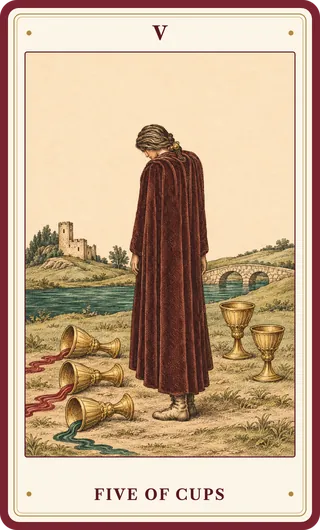
Cloaked figure
The dark cloak shows grief and withdrawal. The figure's back is turned, so they cannot see anything that is not loss.
Three spilled cups
These are the disappointments and losses that hold all the attention. Their contents are gone, which is why the card is so often a no.
Two standing cups
Behind the figure, two cups remain upright and full. They stand for what is still available once the person turns around.
River
The flowing water is emotion that keeps moving, whether or not you are ready. It suggests grief can pass if it is allowed to.
Bridge
The bridge crosses the river toward safety. It shows that a way forward exists, even if the figure has not noticed it yet.
Distant building
A house or castle sits far off in the background. It represents home, rest and stability waiting beyond the sorrow.
Grey sky
The heavy, overcast sky sets the mood of regret and discouragement. It also hints that the weather will change.
When the Five of Cups can mean yes
Because this card is about grief, it behaves differently when the question itself is about grief. If you ask “should I let myself feel this?”, “is it okay to mourn?”, or “should I accept that this is over?”, the Five of Cups can be a straightforward yes. It confirms that the loss is real and deserves attention.
The same goes for questions about letting go. “Should I stop chasing this?” can get a yes from the Five of Cups because the card names the loss and invites you to stop staring at it. In those cases, the card is not blocking you. It is agreeing with you.
This is why a fixed yes or no label is only a starting point. Read the card against the question, and when the question is itself about endings, the usual rule can flip.
How to word your question
Because the Five of Cups has a built-in tilt, how you phrase the question shapes what you learn. Questions that ask about starting, winning or reuniting will often return a no. Questions that ask whether to wait, rest or accept will often return a yes.
Good yes or no questions are specific and time-limited. “Should I contact them this week?” gives the card something to answer. “Will I ever be happy again?” does not, and it tends to invite grief into the reading instead of guidance. If you need help shaping questions, the page on questions for tarot reading has plenty of examples.
Avoid asking the same question repeatedly until the card changes. If the Five of Cups keeps appearing, that is usually the answer: there is something unresolved that needs your attention before anything else will move.
Cards that change the answer
The Five of Cups rarely arrives alone, and its neighbours can soften or deepen the no. In a three card pull, pay attention to what sits on either side.
- The Star next to it turns the no into hope. Healing is underway, and the answer improves with time. See the Star meaning.
- Two of Cups suggests a real connection survives alongside the sadness, so the no is less final.
- Four of Swords adds a rest period: the no becomes “not until you have recovered.” Its own answer is covered in Four of Swords yes or no.
- Death strengthens the sense that an ending must be accepted before anything new begins.
- Ace of Cups or Ten of Cups brightens the outlook considerably and turns the no into a later yes.
If you want to practise this kind of pairing, the yes or no tarot reading tool is a quick way to pull a card and then add one or two neighbours for context.
Health and wellbeing questions
Tarot cannot diagnose or predict illness, and a card should never replace medical advice. But if you ask a general question about your wellbeing or recovery, the Five of Cups tends to point at the emotional side. It suggests that sadness, stress or lingering grief is taking a toll, and that you will feel better by dealing with it, not by pushing through.
In that sense, upright is a no to carrying on as if nothing is wrong. Rest, talk to someone you trust and let yourself feel what you feel. If low mood has lasted a long time, speaking to a doctor or counsellor is a sensible step.
Reversed, the card hints at recovery. Energy and mood are beginning to lift, and you are ready for gentler routines and company.
What to do after a no
A no from the Five of Cups is more useful than most. It does not just block you; it tells you why. The grief is in the way, and the card also shows you where to look next.
Here is a simple way to respond:
- Name the loss plainly. Write down what happened without softening it.
- Give yourself a set period to feel it, such as a week, rather than avoiding it.
- Find the two cups still standing: people, skills, options or memories that remain.
- Take one small step toward the bridge, such as a walk, a call or a task you have been avoiding.
- Ask your question again after the period has passed, and note what has changed.
This is the real message of the card. The answer is not no forever; it is no until you turn around.
Common mistakes when reading it as yes or no
The biggest mistake is treating the no as a prediction of failure. The Five of Cups describes an emotional state, not a fixed outcome. Reading it as “this will never happen” misses the two standing cups and the bridge entirely.
Another is ignoring reversal and position. The same card means different things upright and reversed, and as a signal of your own mood versus the other person’s. A reversed Five of Cups from your own spread is very different from an upright one describing someone else’s sadness.
Finally, avoid pulling again and again for a softer answer. If you want more context, move to a fuller layout instead, such as the Celtic Cross, where the Five of Cups can show up as a past influence or hidden feeling rather than the final word on your question.
Try this: Pull one more card, not as a redo but as a follow-up: “What is still standing?” Place it beside the Five of Cups and read the two together.
Quick reference
Here is a short summary you can keep handy:
- Upright: no, or not yet, especially for new starts, reunions and big decisions.
- Reversed: cautious yes, as healing and acceptance take hold.
- Questions about grieving, accepting or letting go: often yes.
- Strongest no: questions tied directly to a recent loss or breakup.
- Softest no: when surrounded by positive cards like the Star or Two of Cups.
When in doubt, remember what the card is really showing. It is not a closed door. It is a person who has not yet seen the bridge behind them, and the answer you get depends on whether you are ready to turn around.
Questions readers ask
Is the Five of Cups a yes or a no?
Upright, the Five of Cups is usually a no, or at least a not yet. It points to loss, regret and an emotional state that is not ready for a clear yes. Reversed, it softens into a cautious yes.
Is the Five of Cups a yes or no for love?
Upright, it leans no, especially for reconciliation or a new relationship started on the back of grief. It says unresolved hurt is still in the way. Reversed, it can mean a yes once forgiveness and acceptance are real.
Does the Five of Cups always mean no?
No. It leans no for questions about starting, winning or getting something back right now. If you ask whether you should let go, grieve or accept a loss, the card can support a yes.
What does the reversed Five of Cups mean as a yes or no?
Reversed, it leans yes, with conditions. Healing has begun, you are accepting what happened and you can see what remains. Treat it as a yes that needs patience, not an instant green light.
Is the Five of Cups a yes or no for getting back together with an ex?
Upright, it usually says no, or not yet, because the pain and regret from the split are still active. Reversed, it can suggest a chance if both people have genuinely worked through what went wrong.
What should I do if I pull the Five of Cups for a yes or no question?
Pause rather than push. Give the feeling behind the question some honest attention, then ask what is still standing that you could build on. You can redraw the card later, once you have had time to process.