
Page of Cups as a Yes or No Answer

- Arcana
- Minor Arcana, Suit of Cups
- Element
- Water
- Yes or no
- Yes
creative ideasintuitiona message
emotional blockswithdrawalimbalance
The Page of Cups is a yes in a yes or no tarot reading. It is a gentle yes, warm and sincere, and it fits best with questions about love, creativity, honest messages and new emotional beginnings. Reversed, the answer softens into a maybe that leans toward no, usually because the feeling or idea is not ready yet.
That softness matters. This card is not a bold “go and do it now” the way the Ace of Wands can be, and it is not a legal contract either. It says that something tender is available to you and that approaching it with openness is the right move. The rest of this guide shows how to read that yes for different kinds of questions, when to downgrade it to a maybe, and how to avoid the common mistakes.
Why the Page of Cups leans yes
Every tarot card has a general direction, and the Page of Cups points toward opening up. The Cups suit is about emotion, intuition and relationships, and the Page is the youngest, most curious member of that family. The image shows a young person by the sea, holding a cup with a small fish peeking out. Nothing in the picture is threatening, blocked or in conflict.
When you ask a yes or no question, you are really asking whether a door will open. The Page of Cups says it will, and that you do not need to force it. The energy is receptive, so the answer is often about something arriving: a message, an invitation, an idea, a confession or a feeling you have been ignoring.
If you want the full picture of the card beyond the yes or no verdict, the Page of Cups meaning covers its keywords, imagery and symbolism in depth.
The upright answer: a soft, sincere yes
Upright, treat the Page of Cups as a yes with a gentle edge. It is the answer you get when the situation is promising but still young. Think of the first sketch of a painting, the first text after a long silence, or the first flutter of interest. The yes is real, but it has not grown up yet.
This matters for how much weight you put on it. A strong yes such as the Ten of Cups points to a settled, happy outcome. The Page points to a promising start. If your question is “will this lead to something?” the Page says yes to the start and leaves the ending open.
In practice, an upright Page works best as permission. Yes, ask the question. Yes, send the message. Yes, try the idea. It rewards sincerity and curiosity, and it does not reward pressure or game-playing.
The reversed answer: maybe, leaning no
Reversed, the Page of Cups stops being a clear yes. Most readers treat it as a maybe that leans toward no for now. The cup is tipped, the fish has gone quiet, and the page may be sulking, daydreaming or avoiding what they really feel.
That makes the reversed answer less about “never” and more about “not like this” or “not yet.” A feeling may exist but be confused. A creative idea may be real but blocked by self-doubt. Someone may be sweet in words and unreliable in action. If you want the full reading of the card on its own, the Page of Cups reversed page goes through what causes that block and how it shows up in love and work.
Some decks and readers read reversed cards as a plain no, and others ignore reversals altogether. If you do not use reversals, shuffle in a way that keeps every card upright and read the Page as a yes each time. If you do read them, the reversed tarot cards guide explains the main approaches so you can pick one and stay consistent.
Read Page of Cups for your question
Upright: A soft, sincere yes: a crush, a message or a new romantic opening is genuinely on its way.
Reversed: A shaky maybe: feelings may be real but immature, mixed up with fantasy, or not yet spoken.
Upright: They feel tender, curious and a little shy, and they may be working up the courage to say so.
Reversed: Their feelings are confused, moody or held back, and they may sulk or go quiet instead of speaking.
Upright: Yes to creative, people-centred or heart-led work, and to trying a fresh idea without overplanning.
Reversed: Not yet: a creative block, a half-formed idea or an emotional reaction is getting in the way.
Upright: A cautious yes for small, enjoyable or value-driven choices, but not a card for hard financial analysis.
Reversed: Lean no on impulse spending or risky bets made on a hopeful feeling rather than facts.
Upright: Say yes to the small, honest feeling or idea that is stirring, and follow it with curiosity.
Reversed: Slow down, name what you actually feel, and stop dismissing your intuition as silly.
Upright: A gentle yes for emotional healing, play, rest and creative outlets that lift your mood.
Reversed: Emotional strain or avoidance may be affecting you, so talk to someone and see a professional if symptoms persist.
What kind of yes it really is
The Page of Cups gives an emotional yes, not a practical one. It tells you that the feeling is real, the message is sincere or the idea has heart. It does not tell you that the plan is financially sound, that the other person is ready for commitment, or that the timing is perfect.
This is the main thing most quick yes or no answers leave out. A card that says yes to “do they have feelings for me?” is not the same as a yes to “will we be together in a year?” The Page can honestly confirm the first and say very little about the second.
A useful rule is to match the question to the card. Questions about feelings, openness, creativity, apologies and first steps get a clear yes. Questions about stability, contracts, deadlines and long-term outcomes get a yes with a question mark, and often need a second card to firm them up.
Page of Cups yes or no in love
For love questions the answer is yes, and it is one of the card’s strongest areas. Will I meet someone? Does this person like me? Is a message coming? The Page of Cups answers with a warm yes. It is the card of a first crush, a love note, a shy confession or a date that feels light and sweet.
Here is how it plays out across common love questions:
- Will they ask me out? Yes, probably in a sincere, slightly nervous way.
- Do they like me? Yes, they feel something, even if they are unsure how to show it.
- Is this a new relationship? Yes to the beginning. Watch how it matures.
- Will they commit? A maybe. The Page is sweet but young, and commitment is a later chapter.
If you want to see how the same energy looks when it moves into action, the Knight of Cups yes or no page shows the next step of the court, where the message turns into an offer.
Exes, reconciliation and existing relationships
Questions about an ex or a long-term partner are where the Page of Cups needs the most care. Upright, it can mean a message really is coming, such as a text, an apology or a “thinking of you.” It is the messenger of the court, so contact is plausible. But a message is not the same as a reunion.
For “will we get back together?” read the Page as a maybe. It shows a softening of feeling, perhaps nostalgia, but often with some idealism mixed in. The person may be remembering the good parts. The card asks you to notice whether the old problems have actually changed.
In an existing relationship, the Page is a sweet reminder to be playful and tender again. It can say yes to a small romantic gesture, an honest apology or a fresh start in how you talk to each other. It is less helpful for hard questions about whether to stay or leave, where you will want a clearer, more grounded card.
Try this: Write down two versions of your love question: one about feelings (“Do they care about me?”) and one about outcome (“Will we be together next year?”). Pull a card for each. A Page of Cups on the first and something steadier on the second is a very common, honest pairing.
Career, creativity and work questions
At work, the Page of Cups says yes to anything that involves creativity, empathy or heart. Should I pitch the unusual idea? Is a creative job coming? Will this project feel rewarding? The answer leans yes, especially if the work is something you care about and not only something you can do.
It is also a good yes for early steps. Start the portfolio, take the class, share the draft, apply for a role that excites you. The card likes experiments and low-risk beginnings. It does not promise a promotion, a raise or a contract by itself.
For strict business questions about deadlines, profit or negotiation, the Page is weaker. A card with more structure, such as the Eight of Pentacles, gives a better read on whether effort will turn into results. The Page tells you whether your heart is in it, which is a fair thing to ask before you commit your time.
Money and spending questions
Money questions are the Page of Cups’ weakest area. It leans toward a cautious yes when the spending is small, creative or tied to your values: a course, art supplies, a gift, a treat that genuinely lifts your mood. It does not lean yes for investments, loans or big purchases made on a hopeful feeling.
Think of the Page as the part of you that wants to buy the thing. That impulse is not wrong, but it is not a financial plan. If the Page of Cups appears on a question like “should I take out a loan for this dream project?”, read it as an emotional yes and a practical maybe, then draw another card or check the numbers.
Reversed, it can warn against impulse purchases, spending to soothe a mood, or trusting a story that sounds lovely but has no figures behind it. For bigger money questions, a money tarot spread gives you more cards to work with than a single yes or no draw.
Page of Cups card symbols
Choose a symbol to read what it means on the card.
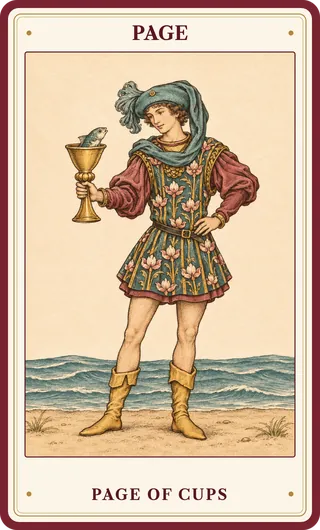
The cup
The page holds a golden cup out in front of them, offering emotion openly. It stands for the heart, imagination and a feeling that is ready to be received.
The fish
A small fish pokes its head out of the cup as if to speak. It is a message from the subconscious, a creative idea or a feeling that has just surfaced.
The blue tunic with flowers
The tunic is patterned with flower shapes, which suggest innocence, softness and an open heart. Blue ties the figure to the water and to calm, receptive emotion.
The sea behind
Waves roll quietly at the edge of the scene. They show the large emotional world the page is only beginning to explore, gentle for now.
The hat and scarf
The page wears a hat with a long flowing scarf, a slightly playful and artistic touch. It points to youth, creativity and a willingness to look a little different.
The relaxed stance
The page stands easily, with one hand on the hip and a curious tilt of the head. This is someone at ease with surprise and open to whatever the cup reveals.
Health and wellbeing questions
For wellbeing, the Page of Cups says yes to emotional healing, gentleness and play. It suggests that rest, creative hobbies, time near water, honest conversation and softness toward yourself will help. It is a good card for questions like “will I feel better soon?” in an emotional sense.
It is not a medical card, and it should not be used as one. Some readers connect it to news of a pregnancy or a new life, and people do ask about it, but a card cannot confirm either. Use a test or a doctor for certainty, and use the Page for how you feel about the news, or how you want to look after yourself in the meantime.
Reversed, the Page can point to emotional avoidance, moodiness or feelings being pushed down. If you are struggling, a trusted person or professional is a better source of answers than any card.
When the answer is really a maybe
Some yes or no questions do not suit the Page of Cups, and the honest reading is a maybe. Three situations come up again and again.
First, when the question is about a firm outcome such as a date, a result or a guarantee. The Page deals in first steps and feelings, not final outcomes. Second, when you already know the answer you want and are looking for a card to say it. The Page is easily read as a “yes” by hopeful people, which is exactly when to be most careful. Third, when the card lands reversed or beside a heavier card, which pulls the answer toward caution.
In each case, a maybe is still useful. It tells you the situation is open and that your own choices will shape it. It also tells you that the feeling or idea has something real in it, which is more than many cards can say.
Cards that strengthen or soften the yes
If you draw a second or third card, the neighbours can change the strength of the Page’s yes. A few useful pairings:
- Ace of Cups: strengthens the yes. A fresh emotional opening is sincere and ready. See the Ace of Cups yes or no for how strong that yes is on its own.
- Two of Cups: a mutual, balanced yes, usually in love.
- Eight of Swords: softens it to a maybe, because fear or self-doubt is slowing things down.
- Five of Cups: the yes is tangled up with disappointment or regret.
- Seven of Swords: pay attention to honesty and hidden motives.
Court cards matter too. If the Page lands beside other people cards, it may be describing a person: a young, gentle or creative figure in your life. The court cards guide shows how to tell whether a Page is a message, a mood or an actual person.
How to word the question
The quality of a yes or no answer depends on the question. The Page of Cups answers best to open, clear, emotionally honest questions. “Is this a good time to tell them how I feel?” works well. “Will I be rich?” does not, and “Should I?” with nothing after it gives the card nothing to say yes to.
A few habits help. Ask about one thing at a time. Keep the time frame short, such as the next month. Avoid questions with two ideas in one, like “Will they text me and want to meet?” And ask something you are genuinely willing to hear a “no” to. If you need more ideas for wording, the questions for tarot reading page has plenty of examples you can adapt.
Try this: Before you draw, write your question in one clear sentence that begins with “Will” or “Is.” Read it back and remove any “and” or “but.” If it still holds one question, you are ready to draw.
How to pull the card for a yes or no answer
You can draw a single card, shuffle until one jumps out, or use a yes or no tarot reading tool if you do not have a deck to hand. The method matters less than your consistency: decide in advance how you will read upright and reversed cards, and stick to it for that question.
A simple approach is to draw one card and read it with this scale: the Page of Cups upright is a yes, reversed is a maybe leaning no. Then, if the answer feels unclear, draw a second card as clarification, not as a second chance to get the answer you wanted. Pulling cards again and again until you like the answer teaches you nothing.
If you want more depth, a 3 card tarot draw gives you past, present and outcome in one go, so the Page’s yes sits in context and not on its own.
Common mistakes with this card
The biggest mistake is reading the Page of Cups as a guarantee. It is sweet, but it is young. A yes from this card says that something is beginning, not that it will last. The second mistake is ignoring the reversed meaning because the upright is so pleasant.
Another common error is treating a message card as a final word. A message may arrive and still not lead to the outcome you hoped for. Read it as information, then decide what to do. And last, do not ask the card to settle questions that need facts. If the answer depends on a date, a bank balance or a medical result, check the facts first and use the Page for the emotional layer.
A good test is to ask yourself whether you would still act the same way if the card were the opposite. If your plan only works because the card said yes, the card is carrying too much of the weight.
A quick reference for the Page of Cups
Here is the short version to keep in mind next time the Page of Cups turns up:
- Upright is a gentle, sincere yes.
- Reversed is a maybe that leans no for now.
- It is strongest for love, creativity, messages and first steps.
- It is weakest for money, contracts and long-term guarantees.
- A second card can confirm or soften the answer.
Above all, the Page of Cups asks you to stay open. It is a card of small, honest feelings, and it usually appears when one of them is ready to be heard. Say yes to that, give it time to grow, and use your own judgement for everything the card cannot see.
Questions readers ask
Is the Page of Cups a yes or no card?
Upright, the Page of Cups is a yes, though a soft and emotional one rather than a firm guarantee. It says yes to new feelings, creative starts and honest messages. Reversed, it becomes a maybe that leans toward no.
Does the Page of Cups mean yes in love?
Usually, yes. It points to a sincere new interest, a sweet message or a relationship opening with real warmth. It does not promise a long-term commitment, so treat it as a beginning.
What does the Page of Cups reversed mean as a yes or no answer?
Reversed, it is a maybe that leans no for now. The feeling or idea is blocked, immature or tangled up with fantasy. Ask again once you have clarified what you actually want.
Does the Page of Cups mean my ex will text me?
It can, because the Page is the messenger of the court. Expect something tender and low-pressure rather than a full reconciliation, and read it as a maybe for getting back together.
Can the Page of Cups mean pregnancy?
Some readers link the Page of Cups to news of a new life or a sweet surprise, but it is not a reliable answer to a medical question. Use a test or a doctor for certainty, and use the card for the emotional side.
How soon will the Page of Cups yes happen?
The Page tends to point to a short time frame, often days to a few weeks, because it carries news and first impulses rather than slow results. Treat any timing as a loose guide, not a date.