
Knight of Cups as a Yes or No Answer

- Arcana
- Minor Arcana, Suit of Cups
- Element
- Water
- Yes or no
- Yes
romancecharman offer
emotional blockswithdrawalimbalance
The Knight of Cups is a soft yes when it appears upright in a yes or no reading. It points to sincere feeling moving toward you or from you, such as an invitation, a declaration or an offer that comes from the heart. Reversed, it leans no, or more precisely “not yet”: the gesture is unfinished, idealised or not fully honest.
This is a yes with manners. It does not shout or rush. The knight rides at a walk with a cup held out, so the answer tends to arrive gently, and it asks you to answer in the same spirit. Below you will find what the card means for love, work and money, when it is a weak answer, how the cards around it change the verdict, and how to ask the question so the answer is worth having.
The short answer: yes, with a condition
Upright, the Knight of Cups says yes to questions about feeling, connection and creative risk. If you ask whether a message will come, whether to say how you feel, or whether an offer is genuine, this card leans toward agreement. The condition is that the yes depends on sincerity. If you are being honest about what you want, the card supports you. If you are fooling yourself, it will not rescue you.
Reversed, the same energy turns inward or sours. The reversed knight often means no for now, because the romance is more imagined than real, or a promise is being made that will not be kept. You can read more about that side of the card on the Knight of Cups reversed page.
Compared with a card like the Ace of Cups or the Sun, this is a measured yes. Think of it as around a seven out of ten: encouraging, with room for things to still need work. For the card’s full meaning outside of yes or no questions, see the Knight of Cups tarot card meaning.
Why the Knight of Cups leans yes
Knights in tarot are cards of movement. In the Cups suit, the thing in motion is emotion, so this knight is feeling made active. Where the Page of Cups receives a message, the Knight goes out and delivers one. That forward motion is why the card reads as agreement: something is already on its way, and it comes with good intent.
The suit matters too. Cups belong to water, which governs love, intuition, imagination and the heart. A question that sits in that territory has the card on its home ground, so it answers confidently. Ask about relationships, creative projects, reconciliation, a heartfelt apology or a leap of faith, and the knight is well placed to say yes.
It also helps that this card is oriented toward giving. The knight offers a cup, which means the yes often includes something being given to you: an invitation, attention, a chance. That is different from cards that say yes because you have earned or fought for something. Here the yes feels like grace.
Knight of Cups reversed: a no, or a not yet
When the card appears reversed, the answer shifts to no, but the reason matters. The reversed knight is rarely a hard rejection. It tends to describe a gesture that has not been delivered, a charming person whose follow-through is weak, or your own feelings running ahead of the facts. The honest answer is often “not like this” or “not yet.”
Common reversed themes include mood swings, jealousy, unrealistic expectations, and romance used as a way of avoiding real conversation. If you asked whether someone is serious about you, a reversed Knight of Cups suggests you should look at what they do, not what they say. If you asked about your own plan, it may mean your enthusiasm needs a structure behind it.
A useful habit is to ask what would turn the no into a yes. Often the answer is simple: a clearer message, a more honest conversation, or a calmer mood. Our guide to reading reversed tarot cards explains why a reversed card often points to a blocked or delayed version of the upright energy, which is exactly how the knight behaves.
Read Knight of Cups for your question
Upright: Yes: someone is offering real feeling, whether that is an invitation, a declaration or a gentle first move, and it is worth meeting with an open heart.
Reversed: Not yet: the words are prettier than the actions, so wait for behaviour that matches the romance before you say yes.
Upright: They feel warmly and sincerely toward you and are working out how to say so.
Reversed: Their feelings are tangled up with fantasy, mood or avoidance, so what they say and what they do may not line up.
Upright: Yes to the offer, pitch or role that excites you, especially in creative, caring or people-centred work.
Reversed: No for now: the opportunity sounds better than it is, or you are chasing a dream without a plan.
Upright: A cautious yes, as long as you have checked the numbers and not only the feeling behind the choice.
Reversed: No: impulse, wishful thinking or a promise that cannot be backed up is steering the decision.
Upright: Act on what you feel, but do it kindly, calmly and at a steady pace.
Reversed: Pause, ground yourself and make sure your actions are as sincere as your intentions.
Upright: Yes to rest, creativity and emotional expression as part of looking after yourself.
Reversed: Mood swings, escapism or ignoring your emotional needs are costing you more than you admit.
What the image says about your answer
The Rider-Waite-Smith picture explains the verdict better than any list of keywords. The knight sits on a pale horse that is walking, not galloping. He wears armour but carries a cup, and small wings sit on his helmet and boots. A river runs beside him, and the land behind is rocky and bare.
Read it as a message about pace and ground. The walking horse says the yes is real but not instant, so do not expect everything to resolve in a day. The wings say that inspiration or news is travelling toward you. The empty hills say the dream still needs a practical place to land, which is why the yes comes with a quiet note about follow-through.
The cup, held out, is the most important detail for yes or no. He is not clutching it or hiding it. Someone or something is ready to give, and the answer to your question probably involves openness: offering a feeling, accepting a gesture, or saying what you mean.
Knight of Cups yes or no in love
Love is where this card is strongest. Upright, it answers yes to questions like whether someone has feelings for you, whether a romantic gesture is coming, or whether you should say how you feel. It often shows a person who approaches with care and charm, or an invitation that feels sincere. It is one of the better cards to see when you are hoping for a proposal, a date or an honest declaration.
It also says yes to reconciliation when the question is whether an apology or heartfelt message is possible. Here the knight is the one riding back with a peace offering. Keep in mind that this is a yes about the gesture, not necessarily a guarantee of a lasting relationship. For that, look for cards such as the Two of Cups, which shows two people actually meeting in balance, with the Knight representing the approach and the Two representing the arrival.
The warning is about romance that stays in the imagination. This knight can fall for a feeling more than a person. If your question is about someone who has never acted on their words, the card is a yes to their feelings and a gentle question mark about their reliability. Reversed, it is more often a no to someone who is all charm and no follow-through.
Try this: Write down the one thing you most want to say to the person you asked about. If the Knight of Cups came up, decide whether you can say it this week, in your own words, without a script. If you cannot, the card may be pointing at your hesitation, not theirs.
Questions the Knight of Cups answers well
The card works best when your question is about something that can be offered, felt or expressed. A few examples:
- Will they reach out or make a romantic move?
- Should I tell them how I feel?
- Is this offer or invitation sincere?
- Should I follow the creative idea that excites me?
- Is it time to forgive or apologise?
All of these involve an emotional gesture moving from one person to another, which is exactly the knight’s job. Phrasing your question around a gesture, an offer or a message tends to give the clearest reading. If you want help shaping questions like these, our list of questions for a tarot reading has plenty of examples.
Notice that none of these questions ask for a date or a guarantee. The Knight of Cups gives you direction and tone, not a schedule. When the answer is yes, it usually means you can proceed with trust, not that everything is arranged.
Knight of Cups yes or no for work and creative plans
At work, the Knight of Cups leans yes to offers that excite you, especially in creative, caring or people-focused fields. A pitch you believe in, a collaboration with someone whose values match yours, a role that lets you use your imagination: these are all good matches for the card. It often shows an opportunity arriving through a person, such as an invitation or a recommendation.
The yes is stronger when passion and fit are present. If you are drawn to the work and the people, the card backs you. If you are only excited by the idea of a new start and have not looked at the details, it asks you to slow down and look. The knight is romantic, not reckless, but he can be swayed by a nice speech.
Reversed, it often warns about an offer that sounds better than it is. Check the contract, the pay and the day-to-day reality. A reversed Knight of Cups on a job question can also point to restlessness: you may want a change mostly because the current situation feels dull, not because the new one is better.
Knight of Cups card symbols
Choose a symbol to read what it means on the card.
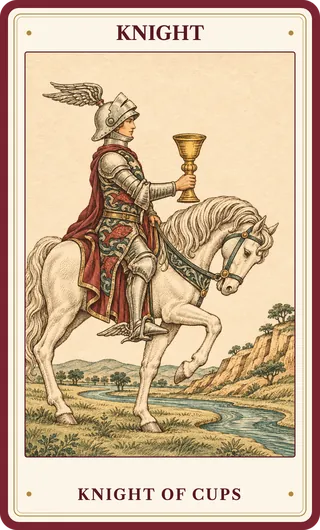
The offered cup
The knight holds one cup out in front of him like a gift. It shows feeling moving from the inside to the outside, as an offer, a message or a confession.
Winged helmet and boots
Small wings on his helmet and heels link him to messages and inspiration. They suggest that what is arriving is an idea, an invitation or a change of heart.
Pale horse at a walk
The horse is calm and unhurried, not charging. This is why the yes is gentle: it favours a considered approach over speed.
Fish on the tunic
Fish are creatures of water, the element of emotion and intuition. They show that this knight is guided by feeling and imagination.
The river
A river runs through the scene, a sign of feeling that keeps moving. It supports the idea that things are flowing toward you, though in their own time.
Barren hills
The background is rocky and empty beyond the water. It reminds you that a dream still needs real ground to land on.
Armour
He is dressed as a knight but carries a cup, not a sword. It points to courage that comes from tenderness, not force.
Knight of Cups yes or no for money and practical decisions
Money is where the Knight of Cups is weakest. The card is not about budgets, contracts or risk, so a yes here is faint. Upright, it can support a decision that is tied to something you love, such as funding a creative project or paying for something meaningful, but it does not vouch for the numbers.
For a clean answer on a financial question, treat the knight as a reminder to check your reasons. Are you spending because it feels romantic, generous or exciting? Or because it is sound? If the answer is only feeling, consider drawing a second card from a more practical suit. The Ace of Pentacles or King of Pentacles in the same spread would add the solid ground this knight lacks.
Reversed, it leans no. Impulse purchases, promises of easy money, and decisions made to impress someone or soothe a mood all fit here. If this card turns up reversed beside a money question, pause and wait for a calmer day.
Try this: Before acting on any money-related Knight of Cups, write the decision in one plain sentence with a number in it. If you cannot say the number, you are still running on feeling, and the answer is not ready yet.
How the surrounding cards change the answer
In a yes or no reading, one card is only a starting point. If the Knight of Cups lands with other cards, they colour how firm the yes is, and what kind of yes it turns out to be. Some pairings worth knowing:
- With the Two of Cups, Ten of Cups or Sun: a warm and likely yes, with real mutual feeling behind it.
- With the Five of Cups or Eight of Cups: a yes that carries grief or a decision to leave something behind.
- With the Seven of Swords or Three of Swords: the gesture may be insincere or may hurt, so slow down.
- With the Knight of Wands: more speed and passion, but less steadiness.
- With the Hermit or Four of Swords: yes, but only after a pause.
You can build these combinations into a short reading using a 3 card tarot spread, with the Knight of Cups as the middle card showing what is on offer. The first card shows what led up to it and the last shows where it goes.
Position also matters. As the answer card, the knight is a gentle yes. As an obstacle, he can represent a lovely idea standing in for action. As a person, he is often the romantic, creative, kind but slightly elusive character who appears in your life.
Knight of Cups compared with the other knights
Each knight answers differently because each rides a different element. The Knight of Cups is the most emotional and the least pushy. By comparison, the Knight of Swords yes or no answer is fast and blunt, often a yes that comes with a rush of conflict or hasty action. The Knight of Wands moves with fire and impatience. The Knight of Pentacles is slow and dependable.
In practice, if you want a quick, honest answer about feelings, the Cups knight is the one you want. If you want to know whether a project will move at speed, the Wands knight suits better. If you want to know whether something will last, the Pentacles knight does. The Cups knight is a good guide to how things feel and how they begin, and a less certain guide to how they end.
That is why the verdict here is a soft yes. All knights are carriers of something in motion, and the Knight of Cups carries feeling. Whether that feeling becomes something lasting is a separate question and may need a separate card.
When the answer surprises you
Sometimes you draw the Knight of Cups and feel disappointed, or you draw it reversed and feel relieved. Take that reaction seriously. A yes or no draw is useful partly because it shows you what you were hoping for the moment you see it. If the soft yes feels like not enough, perhaps you wanted certainty, and this card does not give it.
It can also help to ask the question a different way. “Will they text me?” is a very different question from “Should I reach out first?” The knight is an expert on the second kind. If the answer to a vague question feels vague, narrow the question and draw again, or use the yes or no tarot card reading tool to pull a fresh card.
Finally, remember what the card actually advises. Act from the heart, keep your pace steady, and stay honest. If you do those three things, the yes it offers tends to hold. If you skip them, even a yes can turn sour.
Try this: Draw the Knight of Cups again in your mind as a scene. Ask what you are offering and who you are offering it to. Write one sentence completing “The cup I am holding out is…” and let that sentence, not the yes or no, guide your next step.
How to ask the question so the card can answer
Yes or no tarot works best with one clear, specific question. “Should I accept the invitation?” works. “What will happen with my love life?” does not. Clear questions give the Knight of Cups something to answer, and they keep you from reading a soft yes as a promise about everything.
Set a timeframe if you need one, such as the next month, and decide beforehand what upright and reversed will mean to you. Many readers treat upright as yes and reversed as no, with the position of the question deciding the details. You can see the system we use on the yes or no tarot card reading page, and the card-by-card pages follow the same approach.
If you are new to this, our tarot for beginners guide covers shuffling, drawing and how to read reversals. The main point is to decide your method before you draw, and then stick to it. Changing the rules to get the answer you want defeats the purpose.
What the Knight of Cups is really asking you
Beyond the verdict, the card is an invitation to be sincere. It asks whether you are willing to express what you feel, to receive what others offer, and to do both without drama. The yes is conditional on that willingness. If you carry the cup openly, things tend to move toward you.
That is also why the answer reads as gentle. The knight cannot force an outcome. He can only offer, and then wait for a response. Your question may be about someone else, but the card often turns back to your own readiness: are you prepared to say yes when the offer comes?
If you take one thing from this page, let it be that the Knight of Cups says yes to honest feeling and no to empty charm. Ask clearly, watch what the surrounding cards add, and give the soft yes the steady response it deserves.
Questions readers ask
Is the Knight of Cups a yes or no card?
Upright, the Knight of Cups is a soft yes, especially for questions about love, creativity and emotional honesty. It says the energy is sincere and moving toward you, but it does not promise the outcome will be perfect or immediate.
Is the Knight of Cups reversed a no?
Usually it leans no, or more accurately not yet. The reversed knight points to a gesture that has not been made properly, or to feelings clouded by idealism and mood, so it asks you to wait and look for proof.
Is the Knight of Cups a yes for love?
Yes, it is one of the warmer love answers in the Cups suit. It often means an invitation, a declaration or a romantic move is on its way, though you should still watch whether the words become steady action.
Does the Knight of Cups mean yes to a job or money question?
It leans yes for creative work and offers that match your values. For pure money or legal questions it is a weak answer in either direction, so check the facts and consider drawing a second card.
How strong is the Knight of Cups yes?
It is a gentle yes, not a loud one. Think of it as a green light that asks you to proceed with sincerity, patience and a clear head.
What if the Knight of Cups feels like the wrong answer?
Notice that reaction, because it is useful information about what you were hoping for. Look at the cards around it, rephrase the question more clearly, or treat the draw as a prompt to examine your real feelings.