
10 of Wands Tarot Card Meaning: Burden, Love, Work and Reversed

- Arcana
- Minor Arcana, Suit of Wands
- Element
- Fire
- Yes or no
- No
burdenresponsibilityoverload
delayslost motivationscattered energy
The 10 of Wands tarot card means burden, overload and responsibility carried for too long. It shows someone bent under a huge bundle of sticks while walking towards a town that is already in sight, so it describes success or effort that has become heavy, with the end of the strain close by.
It is rarely a card of failure. It tells you that your work is real, your commitment is clear and the finish line is near, and it asks whether you are carrying more than you need to. Below you will find what the card means upright and reversed, how it reads in love, work, money and health, and how to act on it.
The 10 of Wands at a glance
Before the details, here are the core facts most readers want in one place:
- Upright keywords: burden, overload, responsibility, duty, hard work, stress, nearing completion
- Reversed keywords: burnout, collapse, delegating, setting the load down, saying no
- Suit and element: Wands, fire (ambition, drive, creative energy)
- Number: 10, the end of a cycle
- Astrology: Saturn in Sagittarius, in the Golden Dawn tradition
- Yes or no: leans no, unless the question is about finishing something already underway
The card belongs to the Minor Arcana and sits at the end of the suit. If you want to see how it fits among its siblings, the Suit of Wands page covers all fourteen cards.
What the card shows
In the Rider-Waite-Smith deck, a single figure walks across an open field with ten wands gathered into a tight bundle against the chest. The back is rounded, the head is down, and the wands are so wide that they hide the face and most of the view ahead. Behind the figure, a small town with a few buildings waits on the horizon, only a short walk away.
What the picture leaves out matters too. There is no enemy, no storm and no obstacle on the path. The ground is level and the route is clear. The only thing slowing this person down is the load, and the load is made of their own commitments. That is why the card is a mirror for overcommitment rather than for bad luck.
Notice also that the figure has not dropped anything. The bundle is carried all the way. This is a person who keeps going, which is both the strength and the problem of the card.
Upright meaning: success that has become heavy
Upright, the 10 of Wands describes a time when everything you took on is now on your back at once. It often arrives after the energy of the earlier Wands has done its job. You started a project, built momentum, defended your position and won some ground, and the reward has been more responsibility. The card says this is a natural outcome of ambition, but not a comfortable one.
The upright card carries two messages together. The first is acknowledgement: you are working hard, and the tiredness you feel is not imaginary. The second is a challenge to look at how you are carrying things. Many people who draw this card are not overloaded by a single big task. They are weighed down by a pile of small yeses, favours, expectations and habits that were never sorted into what matters and what does not.
Older readings, including Waite’s own notes, give the card a mix of meanings: oppression and difficulty on one hand, and gain or success on the other. Modern readers resolve this by treating the card as achievement with a cost. You can reach the town, but how you arrive depends on what you do in the last stretch.
Read Ten of Wands for your question
Upright: One partner is carrying the emotional, practical or financial load of the relationship, and the fun has been replaced by duty.
Reversed: You put down old baggage and set a boundary, or you admit the relationship has become too heavy to keep carrying alone.
Upright: They feel tired, stretched and responsible for too much, so affection may come out as distraction or irritability.
Reversed: They are either at the point of collapse or finally letting someone share the weight, and they need honesty more than pressure.
Upright: You are overloaded with tasks that were handed to you because you do them well, and the deadline is close but the strain is real.
Reversed: You delegate, say no or leave, or you have burned out and can no longer keep the pace.
Upright: Debts, dependants or heavy commitments are eating your income, and every extra expense feels like one stick too many.
Reversed: You restructure what you owe, cut an obligation or ask for financial help, and the pressure starts to ease.
Upright: Finish the last stretch, but first decide what you can drop, share or postpone.
Reversed: Stop carrying everything alone, and choose deliberately what is worth picking up again.
Upright: Chronic stress is showing in your body, especially in the back, shoulders, sleep and energy.
Reversed: Your body has forced a rest, or you are recovering by doing less and finally accepting support.
10 of Wands reversed
The reversed card splits in two directions, and the surrounding cards usually show which one applies. In the first, the load has become too much and something gives: exhaustion, a missed deadline, illness, a blow-up or a breakdown. The weight does not disappear, it just drops, and you are left sorting through the pieces.
In the second, the reversal is a release. You delegate, say no, cut a commitment or hand over a task you should never have held alone. The relief is real, and the reversed 10 often marks the moment you straighten your back. The reversed meaning can also include a warning about doing this carelessly, such as dropping responsibilities without a handover and damaging trust.
A third, quieter reading shows up for people who refuse help. The weight is not as heavy as it feels, but pride or fear keeps the arms locked around it. For the full breakdown by theme, see the page on the Ten of Wands reversed.
Try this: Write down everything you are currently responsible for, big and small, on separate lines. Mark each as “mine”, “shared” or “not mine anymore”. Pick one line to hand off or drop before the end of the week.
The 10 of Wands in love
In a relationship reading, this card points to an unequal load. One person may be managing the household, the money, the social calendar, the emotional temperature and the planning, while the other is barely aware of it. The relationship has begun to feel like a job, and the playfulness of the earlier Wands has gone quiet. The card does not say the love is gone. It says the work is not being shared.
If you are single, the 10 of Wands often describes a love life that has been crowded out by work, caregiving or old baggage. You may want connection but have no room for it. It can also describe carrying the weight of a past relationship into a new one, which makes dating feel heavy before it begins.
Reversed in love, it can show a long-overdue conversation about fairness, a boundary finally set, or the end of a relationship that has been more burden than joy. For a different angle on exhaustion in love, compare it with the Ten of Swords, which shows an ending that has already landed rather than a weight you are still carrying.
The 10 of Wands in career
Work is where this card feels most at home. Upright, it describes a full plate: you are the dependable one, so the tasks keep arriving. You may be managing a project that is nearly done, covering for a short-staffed team or doing two roles for the price of one. The card respects your effort and asks whether the way you are working is sustainable.
It often appears when success has created its own problem. A promotion brings more duties without more support, a business grows faster than its systems, or a freelancer cannot say no to a client. The solution is rarely to work harder. It is to prioritise, delegate, negotiate scope or move a deadline.
Reversed, it can mean you finally hand over work, change jobs or step back from a role that was costing too much. It can also mean burnout has arrived and your performance has dropped. If you are a manager, the card sometimes shows a leader who holds every decision personally and needs to trust the team.
The 10 of Wands in money
Financially, the 10 of Wands shows weight rather than ruin. You are probably holding up a lot of financial responsibility: a mortgage, debts, family support, business costs or a long list of fixed expenses. Income may be fine, but the demands on it are heavy, and any unexpected cost feels like the last straw.
The card suggests looking at the structure of your obligations. Which commitments are fixed, which are habits and which could be renegotiated? It also encourages asking for support, whether that is advice, a shared budget or a conversation with someone who depends on you.
Reversed, it can show a restructuring that lightens the load, such as clearing a debt, ending a costly arrangement or finally sharing expenses. It can also warn of financial strain that has reached a breaking point and needs attention now rather than later. For an upside to this theme, the Ace of Pentacles shows what a fresh, manageable money start looks like.
The 10 of Wands in health
In a health reading, the 10 of Wands is a stress card. It points to the body carrying what the mind keeps pushing aside: tight shoulders, a sore back, poor sleep, headaches or constant tiredness. These are traditional associations, not a diagnosis, and a doctor should look at any persistent symptom.
The practical message is to treat rest as part of the job. You may be able to hold the pace for a while, but the card shows it is a pace with a cost. Small changes often help more than dramatic ones: a fixed stop time, a proper meal, a walk, a day with no obligations.
Reversed, the card can describe recovery by subtraction, where you get better because you finally do less. It can also show that the body forced a rest the mind refused to take. Either way, it is a reminder that your health is not a resource you can spend without limit.
As feelings, as a person and as an outcome
When the 10 of Wands stands for someone’s feelings, it usually reads as tiredness and strain rather than indifference. The person may care a great deal but have nothing left to give. They may be dutiful, loyal and stubborn, carrying their responsibilities without complaint and without asking for help.
As a person, the card describes someone who takes on everything: the reliable colleague, the family organiser, the caregiver, the one who never says no. They tend to be hardworking and proud, and they often struggle to receive support. They are not weak, but they are tired.
As an outcome, the card says the situation resolves, but not without cost. You reach the goal, and it asks more of you than you expected. As advice, it says to finish what is nearly finished, then lighten the load. As a past card, it shows a heavy period that shaped you. As a future card, it is an early warning to limit commitments before they pile up.
Try this: Next time you feel you “have to” do something, ask: “What happens if I do not, or if someone else does it?” Note your honest answer before you decide.
Ten of Wands card symbols
Choose a symbol to read what it means on the card.
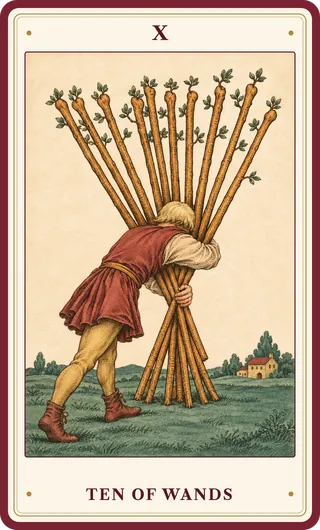
The bundle of ten wands
The wands are gathered into one awkward armful, which shows many separate commitments piled into a single load. Ten is the full count of the suit, so this is the whole weight of your effort and ambition at once.
The bent, forward-leaning posture
The figure leans hard into the load and keeps moving. It shows determination and stubbornness in equal parts.
The hidden face
The wands block the figure's view, and the face is turned away from us. When you carry too much, you lose perspective and cannot see your own options.
The distant town
Houses sit a short walk away on the horizon. The destination is near, which is the card's promise that the strain has an end.
The path and flat fields
The route is open and level, with no enemy or obstacle in sight. The difficulty comes from the load, not the terrain.
The warm, heavy sky
The yellow-gold sky suggests late effort and a day running down. It gives the scene a sense of urgency to arrive before nightfall.
Is the 10 of Wands a yes or no card?
For most questions, the 10 of Wands leans towards no, or at least “not without a lot of effort”. If you ask whether you should take on another project, add another commitment or push harder, the card is advising caution. It tells you the cost is already high.
It leans yes when the question is about finishing something already underway. The town is close, and the card affirms that persistence will get you there. In that case, the answer is “yes, but it will be heavy, and you should lighten it where you can”.
The clearer your question, the clearer the answer. “Will this goal be completed?” and “Should I add this to my plate?” get very different answers from the same card. For a fuller breakdown by question type, see Ten of Wands as a yes or no answer.
Numerology and astrology
Ten is the number of completion in tarot numerology, the point where a cycle has run its course and is ready to resolve. In the Wands suit, a cycle of drive and ambition has reached its limit. Reduce ten to one (1 + 0) and you get a hint of what follows: a new beginning once the old load is set down. For more on how this works across the deck, see tarot numerology.
In the Golden Dawn system, the card is linked with Saturn in Sagittarius. Saturn is the planet of limits, duty and consequences, and Sagittarius is the sign of expansion and big goals. Put together, they describe ambition that has run into its own limits, which suits the image of someone carrying too much towards a distant target.
The new beginning that ten points to often looks like the Ace of Wands: fresh energy, a spark and a clean start. The 10 of Wands is what needs to be cleared before that spark can catch.
10 of Wands compared with similar cards
The card gets mixed up with others that show strain, and the differences help with accuracy.
The Nine of Wands shows someone bandaged, wary and still standing guard. Its theme is resilience under pressure and defence of what you have built. The 10 of Wands comes right after: the fight is over, but the weight of what you have won or taken on has landed on your shoulders.
The Ten of Swords is a collapse that has already happened, usually imposed by events or other people, and its pain is mental and final. The 10 of Wands is different because the person is still on their feet and the burden is mostly chosen or accepted, which means it can be put down.
The Ten of Pentacles and Ten of Cups also end their suits, but in comfort and fulfilment. In contrast, the Ten of Wands is the only Ten that ends in strain, which makes it the one that asks you to change something rather than simply enjoy it.
Card combinations worth knowing
The cards around the 10 of Wands usually show what the weight is made of and what could relieve it. A few common pairings:
- With the Four of Swords: rest is the answer, and you should stop before you are forced to.
- With the Two of Pentacles: you are juggling too much, and priorities need ranking.
- With the Eight of Cups: walking away from the load is a real option.
- With the Six of Wands: the success is arriving, but so is the pressure that comes with it.
- With the Devil: the burden is held in place by fear, guilt or habit, not by necessity.
For more ways to read pairs of cards, the Tarot Card Combination Calculator is a handy companion.
What to do when you draw the 10 of Wands
The card asks for action, not self-criticism. A simple sequence works well:
- List everything you are carrying and mark what is truly yours.
- Identify the one task that unlocks the finish line, and protect time for it.
- Hand off, delay or drop at least two other things.
- Ask a specific person for specific help, with a clear request.
- Set a stopping point and plan some real rest after it.
Be honest about why you took everything on. Sometimes the cause is a real shortage of people. Sometimes it is perfectionism, guilt, pride or fear of being seen as unreliable. The card cannot tell you which one applies, but a quiet moment with the question usually can.
Remember that the town is close. The purpose of this card is not to make you quit; it is to help you arrive in better shape than you are in now.
Try this: Draw the 10 of Wands from your deck and place it where you work. When you notice yourself tensing your shoulders, set one item down, literally or on paper, and take three slow breaths.
Using the 10 of Wands in a reading
In a three-card spread, the card shows well in the middle position as the present situation, with a past card showing how the load built up and a future card showing what follows. If you are new to this layout, the 3 card tarot page explains how to read the positions.
Pay attention to the cards on either side. A Cups card nearby shows emotional strain, a Pentacles card points to money or physical labour, and a Swords card suggests the burden is mental, with worry or overthinking adding weight. A Wands run (Seven, Eight, Nine) beside it shows an escalation of effort that built up over time.
If the card appears repeatedly for the same question, take it as a sign that the advice has not yet been acted on. Repeated draws often stop once the load is actually shared. If you want a card to practise on, the random tarot card generator can give you a daily one.
The message in short
The 10 of Wands is a card of honest effort and honest limits. It respects how hard you have worked and refuses to pretend the weight is light. It tells you the end is near, and it asks you not to ruin the arrival by exhausting yourself on the way.
Read it as permission to set something down. Whether the cards around it are gentle or severe, the lesson is the same: you can still reach the town, and you do not have to carry every stick alone.
Questions readers ask
What does the 10 of Wands mean in tarot?
The 10 of Wands means burden, overload and responsibility carried for too long. It also says the goal is close, so the message is to finish the last stretch while lightening what you carry.
Is the 10 of Wands a good or bad card?
It is a difficult card, but not a doomed one. It confirms your effort is real and your finish line is near, while warning that the way you are working is not sustainable.
What does the 10 of Wands mean in love?
In love it points to an unequal load, where one person handles most of the emotional or practical work. Reversed, it can mean releasing that pattern or a relationship that has become too heavy.
What does the 10 of Wands reversed mean?
Reversed, it has two sides. It can mean you have burned out and the load has dropped on its own, or you have chosen to delegate, say no and put the weight down.
Is the 10 of Wands a yes or no card?
Usually it leans towards no for anything that adds more work, and towards yes only if you accept the effort it takes. For a clear answer, check the surrounding cards and whether the question asks you to take on more.
What is the difference between the 9 of Wands and the 10 of Wands?
The Nine of Wands is a guarded, battle-worn stand, while the Ten is the weight of everything you have taken on. The Nine is about defence and resilience, and the Ten is about overload and release.