
10 of Wands Yes or No: What This Card Answers

- Arcana
- Minor Arcana, Suit of Wands
- Element
- Fire
- Yes or no
- No
burdenresponsibilityoverload
delayslost motivationscattered energy
The Ten of Wands is a no in a yes or no reading. More exactly, it means “not like this”: the goal is probably within reach, but you are already carrying too much, and taking on more would cost you more than it gives. Reversed, the Ten of Wands softens into a conditional yes, because the weight is easing or you are finally willing to put some of it down.
Most yes or no cards give you a verdict. This one gives you a verdict and a reason, and the reason is the useful part. Below you will find how to read the card upright and reversed, how the answer shifts for love, work, money and health, how to handle timing, and what to do when the card shows up and you do not like it.
Why the Ten of Wands leans no
The image does the work here. A man bends forward under a bundle of ten wands so large it blocks his view. He is not lost or beaten. A village sits ahead of him, so the finish is close. But he is bearing everything alone, with his head down, and the question the card asks is whether you can keep that up.
In a yes or no reading, that picture translates to “you do not have room for this.” Ten is also the end of the number sequence in tarot, so the card shows a cycle pushed to its limit. If you want more on how the numbers shape each suit, the tarot numerology guide explains why tens tend to show saturation and completion at once.
This is why the card sits on the no side. It is rarely a verdict on the goal itself. It is a verdict on your capacity at the moment you asked. Fire energy, the element of Wands, burns fast, and the Ten of Wands is what the fire looks like when it has been fed too much for too long. For the full symbolism and keywords, see the main Ten of Wands meaning page.
Upright Ten of Wands as a yes or no
Upright, read it as no, or not yet, or not in this way. If you ask “Should I take on this extra project?” or “Can I add one more commitment this month?”, the card is telling you that your plate is full. It is a protective no, closer to a friend grabbing your arm than a door slamming shut.
There is one reading worth knowing about. A small number of readers treat the upright card as a yes with a cost: you can have the thing, but you will earn it through hard, heavy effort. That is a fair reading when your question is about a goal you already want badly and already have the strength for. It does not fit when you are asking whether to add something new on top of an already crowded life. When in doubt, look at your actual week. If there is no slack in it, the card is a no.
Think of it as a capacity test rather than a destiny test. The same question asked three months from now, after you have cleared some of the load, could get a different card.
Try this: Before you pull a card, write down everything you are currently responsible for, even small things. If the list is longer than a page, treat any Ten of Wands answer as confirmation, not as a mystery.
Ten of Wands reversed as a yes or no
Reversed, the Ten of Wands usually becomes a conditional yes. The weight is coming off: you delegate, drop a commitment, finish the heavy stretch or finally ask for help. Because the thing blocking the answer is going away, the answer turns positive.
The word “conditional” matters. The reversed card does not hand you a yes while you keep carrying everything. It says yes once the load is shared, trimmed or put down. If you pull it and change nothing, the yes can slide back into the upright no.
There is also a harder reading. Reversed can describe the moment the load collapses, when exhaustion forces you to stop. That version is not a yes to your plans. It is a yes to rest, because rest is about to become unavoidable. If the surrounding cards are tired or heavy, lean towards this meaning. The reversed Ten of Wands page covers both versions in depth, and the guide to reading reversed tarot cards explains how to decide between a release and a blockage when a reversal turns up.
Read Ten of Wands for your question
Upright: Upright is a no for now: one of you is carrying the whole relationship, and it needs sharing before the answer can improve.
Reversed: Reversed is a conditional yes: the weight is lifting, and things work once both people carry their half.
Upright: They care, but they are stretched thin, stressed and stuck in duty, so their feelings may not get much room.
Reversed: They are putting a burden down and have more space for you, or they have burned out and gone quiet.
Upright: A no to taking on more work, since you are already at capacity and the next task will cost you.
Reversed: A yes once you delegate, trim your list or hand something over, because the load is finally easing.
Upright: A no to extra financial commitments, as you are stretched and one more obligation could tip you over.
Reversed: A cautious yes if you cut the costs or debts weighing on you first.
Upright: Stop adding, ask for help and put something down before you decide anything new.
Reversed: Keep the lighter load you have found, and do not let old overcommitting habits creep back.
Upright: A no to pushing on: your body is signalling exhaustion, and rest is the answer.
Reversed: A yes to recovery, as long as you actually reduce the load and keep resting.
What a no from this card actually means
A no from the Ten of Wands is situational, not permanent. It is not a prediction that your plan will fail, that someone will refuse you, or that a door is closed for good. It is a statement about weight: right now, this is too much to carry on top of everything else.
That makes the card useful in a way a plain no is not. It points at what to change. Often the change is small: hand off a task, say no to a different request, move a deadline, or accept that something can be done less perfectly. Once you do that, the question you asked can usually be asked again with a better answer.
It also helps to separate “no” from “never.” The man in the card is nearly at the village. The goal is in sight, and what the card questions is the method of arrival. If you are tempted to quit entirely, look at that distant town before deciding. Often the right move is to keep the destination and change how you carry the load.
Ten of Wands yes or no in love
For love questions, the upright card is a no for now. Typically it means one person is doing too much, whether that is emotional work, household load, planning or keeping the peace, and there is little room left to build anything new. If you ask “Is this new relationship right for me?” while buried in work and family duty, the card is saying that you cannot give it a fair chance in this state.
In an existing relationship, the Ten of Wands asks who is carrying what. A yes becomes possible once the load is shared. That might mean honest conversations about chores, money, caregiving or emotional labour, and then following through on them.
Reversed, the answer lifts to a conditional yes. A reconciliation, a deeper commitment or a fresh start can work if both people are willing to carry their half and if old resentments about unequal effort have been addressed. For a longer look at how these cards read when someone is stretched thin, compare with the Nine of Wands yes or no answer, which describes the stage just before this one, when you are still standing but guarded.
Ten of Wands yes or no for career and work
At work, this card reads almost like a workload audit. Asked “Should I accept the promotion?”, “Should I take on this client?” or “Should I lead this project?”, the upright card says no if accepting means adding to a schedule that is already overflowing. It is not a verdict on your ability. The man in the card is strong. The problem is volume.
There is an exception: if the new role replaces your current load instead of adding to it, the question changes. Make sure you are asking the right thing. “Should I accept this job?” may get a different answer than “Should I accept this job on top of everything I am doing now?”
Reversed, the Ten of Wands is a yes with delegation. Hire help, hand off tasks, reduce your hours elsewhere, or negotiate scope. If you are already close to the end of a big project, the reversed card can also say yes, you will finish, and the heavy part is nearly over. Compare it with the Six of Wands yes or no, which is the card of recognition and a clear win, and which often follows a Ten of Wands stretch once the load has been handled.
Ten of Wands yes or no for money
For money, the Ten of Wands says no to stretching further. Take it as a cue to look at fixed costs, debts, loans and obligations that other people depend on. Questions like “Should I take out this loan?”, “Should I buy this?” or “Can I afford another commitment?” get a no because your finances, like your time, have little slack.
The card can also reflect money you carry for others: supporting family, covering shared costs or being the only earner. If so, the no is less about the purchase and more about structure. Who else can contribute? What can be cut? Which expenses are chosen and which are inherited habit?
Reversed, the answer becomes a cautious yes once something comes off the books. That could be clearing a debt, getting help with a bill, or ending a subscription or commitment you no longer need. The yes is real but small: it opens a bit of room, not a windfall. For a full yes or no on financial foundations, check the Ace of Pentacles yes or no answer, which is the opposite sort of card, a clean start with fresh resources.
Ten of Wands yes or no for health and wellbeing
Health questions are where this card is most literal. Upright, the answer to “Should I keep pushing?” is no. Your body and mind are telling you they are at the limit. Typical signs include broken sleep, tension, irritability, getting sick as soon as things slow down and a constant sense of being behind.
Treat the card as a nudge to rest, not as a medical opinion. Tarot cannot diagnose anything. If you are exhausted, in pain or struggling with your mood, speak to a doctor or a qualified professional, and use the card as a reminder that rest is a legitimate priority.
Reversed, the answer is a yes to recovery: you are coming out of a heavy period, or you are allowed to stop. It only holds if you actually lighten the load. A reversed Ten of Wands followed by more of the same is an answer you ignored.
Try this: Pick one thing you carry that someone else could take, even partly. Ask for it today, then redraw the card tomorrow and note whether the feeling of the question changes.
Ten of Wands card symbols
Choose a symbol to read what it means on the card.
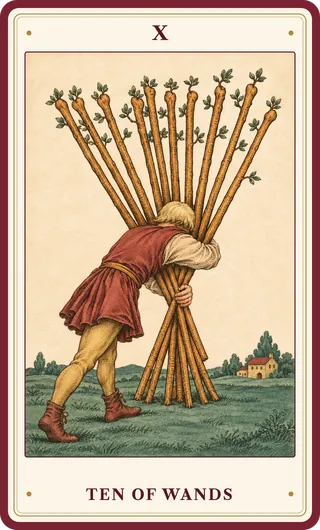
Ten wands in one bundle
The wands are the ten responsibilities, goals and promises the figure has gathered. Ten is the full count of the suit, so everything has been taken on at once.
Bent figure with head down
His bowed head and curved back show strain that has become normal. He is working hard but no longer looking up to check where he is going.
Bundle blocking the view
The wands rise in front of his face, hiding the path. Overload narrows your vision so you stop seeing options like help or rest.
Town in the distance
The buildings ahead mean the finish line is near. The goal is real and reachable, even if the way you are carrying it is not sustainable.
Worn path and open ground
The road is plain and unshaded, with no company on it. It shows effort done alone, mostly because he has not asked anyone to share it.
Gripping arms and hands
He holds the wands tightly in both arms. The card asks whether you are carrying this by necessity or because you cannot let go.
Simple work clothes
His plain tunic marks him as a worker, not a ruler. The burden is ordinary labour and duty, not glory.
What the Ten of Wands means for how someone feels about you
When you ask what someone feels, the yes or no frame is awkward, but the card still gives a clear read. Upright, the person is overloaded. They may care about you, but work, family, stress or responsibility has taken most of their energy. It is common for the Ten of Wands to describe someone who is distant because they are tired, not because they are indifferent.
That distinction matters. A person under this card is not necessarily withholding love. They may be slow to reply, cancel plans and seem preoccupied. Instead of taking it personally, look at their actual circumstances. Are they under pressure? Are they someone who never asks for help?
Reversed, the person is setting down a burden and may have more to give soon, or they have burned out and withdrawn. Look at the cards next to it. A warm card nearby suggests the first, and a cold or heavy one the second. For the full spread of feelings across the suit, the Knight of Wands yes or no answer shows what the opposite energy looks like: eager, fast and ready to move.
Timing: when does the load lift?
The Ten of Wands is a late-stage card, so the timing it suggests is “soon, but not yet.” The village is in sight. Readers often link the card to the end of a busy cycle: a deadline, the end of a quarter, the close of a project or the last stretch of a demanding season.
Numbers can help if you work with them. Ten suggests ten days, weeks or months, but treat that as a loose guide, not a rule. A more reliable method is to ask what, specifically, must finish for the weight to lift, and then read the timing from that. If the card appears with finishing cards such as the Six of Wands or the Ten of Pentacles, relief is likely nearer than it feels. For general methods, see the guide to tarot timing.
If you are asking “How long until this gets easier?”, remember that the card describes a condition you can change. Waiting without making any changes often just extends the period of strain. Delegating one task this week usually shortens it more than any prediction would.
Questions this card answers well, and ones it does not
The Ten of Wands is sharp on questions about capacity, workload and cost. It is blunt, but it is accurate. It is less useful on questions where the issue is not weight at all, such as “Does this person like me?” or “Will it be sunny at the wedding?” For those, a clearer card of feeling or fortune will tell you more.
Questions where this card works best:
- Should I take on this extra responsibility?
- Can I manage this project alongside my current work?
- Is it time to ask for help?
- Should I commit to this one more thing right now?
Questions where it gives a thin or misleading answer:
- Will I win, get chosen or be loved?
- Is this person my soulmate?
- Will an event happen on a certain date?
If you receive it on a question it does not suit, ask again with a more specific wording instead of forcing a meaning. The questions for tarot reading page has plenty of well-framed examples to borrow from.
How to ask a better yes or no question
Yes or no draws work best when the question is narrow, concrete and about your own choices. “Should I accept the job offer on Monday?” is far better than “Will my career improve?” because it gives the card something to weigh. When the Ten of Wands answers, it will tell you about weight, so make sure weight is relevant to what you asked.
Include the condition you care about. “Should I take on this project given what I already have?” invites the Ten of Wands to speak to capacity, which is what it does best. Avoid asking the same question over and over until you get the card you prefer. If you are drawing again and again, the real question is probably not the one on the table.
It also helps to set your rules before you draw: which cards count as yes, which as no, and how you will treat reversals. Our yes or no tarot reading tool follows consistent rules, which makes the result easier to trust and compare over time.
Reading the Ten of Wands with other cards
In a spread, neighboring cards decide whether the no is hard or soft. Beside the Eight of Pentacles or Four of Pentacles, it points to steady work or protective guarding of resources. Beside the Ace of Wands, it can show a promising new idea landing on someone with no room for it. Beside the Eight of Cups, it can suggest walking away from a load that no longer serves you.
Heavy cards nearby, such as the Ten of Swords, the Three of Swords or the Five of Cups, intensify the exhaustion and suggest the answer is a firm no until real recovery happens. Light and clear cards such as the Star, the Sun or the Six of Wands suggest the strain is temporary and the outcome is good.
Position matters too. In a three-card yes or no spread, the Ten of Wands in the middle often describes the obstacle between your question and the answer. Check the first and last cards to see what causes the weight and what happens when it lifts.
What to do after you draw it
The card is only useful if you act on it. A short process works better than vague reflection.
- Name what you are carrying, in writing, with no judgement.
- Mark each item as chosen, inherited or imposed.
- Choose one item to delegate, delay or drop this week.
- Ask for help from one specific person, with a specific request.
- Revisit your original question once something has shifted.
You do not have to remove everything. The point is to turn the abstract feeling of “too much” into a short list you can act on. Often one honest conversation changes more than a month of pushing harder.
Try this: Draw one more card with the question “What can I put down first?” and treat it as a suggestion, not an order. Then do one small thing about it before the day ends.
Quick reference: Ten of Wands answers at a glance
If you want the fast version, here is how the card tends to answer across the main topics. Treat it as a starting point and always weigh it against the question you actually asked.
- Upright, general: no, or not like this
- Reversed, general: conditional yes, once the load is shared
- Love: no for now upright, conditional yes reversed
- Career: no to extra work upright, yes with delegation reversed
- Money: no to more commitments upright, cautious yes after cutting costs reversed
- Health: no to pushing on upright, yes to rest reversed
If you are still learning how single-card answers fit into a bigger reading, the how to read tarot guide is a good place to build from. The main thing to remember about the Ten of Wands is that it is honest, not cruel. It sees how much you are carrying, tells you to stop adding to it, and points at the town ahead, where the carrying can end.
Questions readers ask
Is the Ten of Wands a yes or no card?
Upright, the Ten of Wands is a no, or more precisely a not like this. The goal may be reachable, but the load you are carrying makes the answer no until something changes.
Is the Ten of Wands reversed a yes or no?
Most readers treat the reversed Ten of Wands as a conditional yes. The weight is lifting through delegation, rest or letting something go, so the answer improves once you actually put some of it down.
Does the Ten of Wands mean I will fail?
No. The figure in the card is close to town and is not failing. The card warns about cost and capacity, not about defeat.
What does the Ten of Wands mean for a yes or no love question?
Upright, it says no for now, usually because one person is overextended or doing all the emotional work. Reversed, it becomes a yes if the load is shared more fairly.
Can the Ten of Wands mean yes in a reading?
Sometimes. A few readers say yes with a cost, meaning you can have it but only through hard work. Check whether the thing you asked about is worth that price and whether you have the capacity.
How should I ask a yes or no question for the Ten of Wands?
Ask something specific and answerable, such as whether you should accept a particular task. Vague questions like whether life will get easier give a muddy answer, because this card is about workload.