
Ten of Wands Reversed (Meaning in Love, Work & Life)

- Arcana
- Minor Arcana, Suit of Wands
- Element
- Fire
- Yes or no
- No
burdenresponsibilityoverload
delayslost motivationscattered energy
The Ten of Wands reversed means a heavy load is shifting. At its best, you are finally putting down duties that were never yours, delegating, saying no or letting someone help. At its worst, you have carried too much for too long and things are starting to drop. It is one of the few reversed cards that can mean relief and breakdown at once.
The upright card shows a figure bent under ten bundled staves, still walking. Turned over, the story changes from “keep going” to “something has to give.” Your job is to work out whether that giving is a choice you are making or a crash you have not admitted yet. The rest of this guide shows you how to tell the difference, and what the card says in love, work, money, health and more.
Ten of Wands reversed at a glance
Here are the core meanings in one place, so you can match them against your own situation:
- Releasing a burden you have outgrown
- Delegating, asking for help, setting boundaries
- Burnout, collapse, dropping the ball
- Avoiding responsibility that really is yours
- Working hard and getting nowhere
- Carrying someone else’s load out of habit or guilt
Notice that these pull in two directions. Some are healthy (release, delegating, boundaries) and some are not (burnout, avoidance). The card does not decide for you. It simply says the upright pattern of grinding on alone is no longer holding.
If you want the base meaning first, the upright Ten of Wands covers the original picture of overload and responsibility, and it helps to read both sides together.
Two readings of one card: release or collapse
The first reading is release. The figure has stopped pushing on at any cost. Perhaps you handed a project to a colleague, told your family you cannot host this year, or finally admitted a commitment was too much. The relief that follows is real, and the reversed Ten often turns up right when a person decides enough is enough.
The second reading is collapse. Here the wands do not get set down gently. They fall. Deadlines slip, you snap at people you love, you cannot make decisions, or your body simply stops cooperating. Nobody chose this, and it often follows months of “I’m fine.” The card is naming a limit that has already been passed.
There is also a quieter third version: avoidance. Some people draw this card when they drop everything, including things that truly belong to them. Letting go of an unfair load is wise. Walking away from a fair one and calling it self-care is something else. A good reader keeps all three options open until the question and the other cards narrow it down.
How to tell which meaning you are seeing
Start with how the situation feels in your body. Release usually brings lighter breathing, clearer thinking and a sense of “why did I not do this sooner?” Collapse brings dread, numbness, irritability or a sense of falling behind that you cannot stop. If the card appears and you feel relief at the idea of setting things down, lean toward release. If you feel panic, lean toward collapse.
Next, look at the cards around it. Supportive neighbours such as the Four of Swords (rest) or the Ten of Cups point toward recovery. Anxious or draining neighbours such as the Nine of Swords or Five of Cups suggest the weight is crushing you, not leaving you. The position in the spread matters too: in a “what is helping me” spot it leans toward release, and in a “what is blocking me” spot it leans toward overload.
Finally, ask whether the burden is moving by your choice. Release is deliberate. Collapse is forced. Avoidance is a dodge. That one question settles most readings.
Try this: Write down everything you are currently responsible for, one item per line. Next to each, mark it “mine,” “shared” or “not mine.” Pick one “not mine” item and hand it back this week.
Read Ten of Wands for your question
Upright: You carry the relationship alone, and the weight is starting to show.
Reversed: You either share the load at last, or you are so worn out that you pull away.
Upright: They care deeply but feel buried under responsibility.
Reversed: They are ready to put something down, or they have reached empty and have little left to give.
Upright: You are overloaded, doing the work of three people.
Reversed: You delegate and say no, or you hit burnout and drop things.
Upright: Financial duties pile up and every bill falls on you.
Reversed: You cut costs and share the burden, or debts and obligations outgrow your means.
Upright: Ask for help before you have to.
Reversed: Decide what is truly yours to carry, and put the rest down on purpose.
Upright: Stress and fatigue are building in your body.
Reversed: Rest and lighter demands help you recover, or exhaustion forces you to stop.
Ten of Wands reversed in love
In a current relationship, this card often shows an uneven partnership starting to rebalance. One of you has been carrying the emotional work, the household, the planning or the worry. Reversed, that person is either speaking up and sharing the load, or has run out of energy and is withdrawing. If the card appears for a couple who are talking openly, it is a good sign. If it appears for a couple who are not, the distance may be burnout and not lack of love.
For singles, the card usually points to old baggage. You may be tired from past heartbreak, caring for family, or a demanding job, and have no room left for dating. The reversed Ten says to clear that space first. It does not say you will be alone. It says a lighter you will meet people more easily.
When a relationship is the burden itself, the card can signal that you are ready to put it down. That needs care. Check with a card like the Eight of Cups before assuming it means a breakup. Sometimes it only means you need to stop being the only one holding things together.
Ten of Wands reversed as feelings
As someone’s feelings, this card describes a person who cares but is overwhelmed. They may be handling work, family or a personal crisis, and their silence or distance is more about capacity than affection. Reversed, they are often close to a turning point: either asking for support or pulling back to recover.
Do not read it as “they do not care.” The Ten of Wands is a card of too much responsibility, not too little feeling. If you are in the picture, the useful response is patience and practical support, not pressure. Offering to share a task often works better than asking for more attention.
If you ask about an ex, the reversed Ten suggests they, or you, are putting down the weight of the past. It rarely signals a return. It more often points to emotional unloading, and to a lighter way of thinking about what happened. Think of it as closure by relief, not reunion.
Ten of Wands reversed in career
At work, this is the burnout card and the delegation card. Reversed, it can show you finally handing off tasks, reducing your hours, declining extra projects or leaving a role that demanded too much. It can also show the other side: you said yes to everything and now deadlines are slipping, quality is falling and no one is helping.
Look at the pattern behind the pile. Many people draw this card because they struggle to refuse, or because they believe nobody else will do it properly. The reversal asks whether that belief is accurate. Often it is not, and the work gets done fine when shared. In a leadership position, the card can warn that micromanaging and hoarding tasks is costing the team and you.
If the card shows up before a decision, it is worth asking whether the job itself is the problem. Compare it with the Nine of Wands, which shows the same fatigue one step earlier, when you are still standing but guarded. The Ten reversed is the moment that fatigue demands action.
Ten of Wands reversed in money
Financially, the card points to obligations that are heavier than they need to be. Reversed, you may be cutting costs, consolidating debt, splitting expenses with a partner or finally asking for financial advice. That is a positive reading: the weight is being managed and your finances are becoming lighter.
The darker reading is spending, debt or financial duties that exceed what you can carry. This is common when you are supporting others, covering a household alone or running a business with no buffer. The card does not say you are doomed. It says the current structure does not work and needs to change before something breaks.
A useful practical step is to separate fixed obligations from ones you took on by habit or guilt. Money you send out of obligation, subscriptions you forgot, or loans you co-signed all deserve a fresh look. Sharing a clear budget with someone you trust is a very Ten of Wands reversed thing to do.
Ten of Wands reversed in health
Health readings follow the same pattern. Reversed, the card can show that you are reducing stress and your body is responding with better sleep, steadier energy and fewer tension symptoms. It is a good sign for anyone recovering from overwork, caregiving fatigue or a long, demanding stretch.
It can also warn that exhaustion has reached the point where your body is forcing a stop. Headaches, back and shoulder pain, constant tiredness and irritability all fit this card, since it is a picture of someone carrying a load on their back. Take it as a prompt to rest and seek proper advice, not as a diagnosis. Tarot cannot replace a doctor, and any persistent or serious symptoms deserve a medical check.
Emotional health fits here as well. If you feel you must hold everyone else together, this card suggests that you also deserve support, not just the people around you.
Spiritual meaning of the reversed Ten of Wands
Spiritually, the reversed Ten asks what you are carrying that is not yours. That can include inherited family roles, other people’s expectations, guilt, or an identity built on being the one who copes. Many people draw this card during a period of questioning why they feel they have to be strong all the time.
It also teaches that strength includes receiving. You are not weaker for being helped. The wand suit is about fire, drive and purpose, and the Ten is where that fire has been burning on duty instead of joy. Reversed, the invitation is to rekindle purpose by clearing away the extra fuel.
Rest is a spiritual practice here, not a reward. If the card appears in a reading about direction or calling, it may mean the path ahead is blocked only because your arms are full.
Ten of Wands card symbols
Choose a symbol to read what it means on the card.
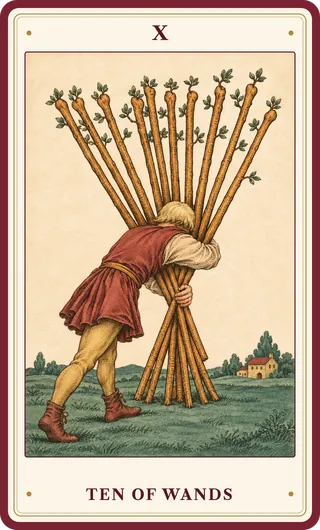
The bundle of ten wands
Ten staves are gathered in one armful, so many that they block the figure's view. They show duties that have piled up one at a time until they became too much.
The bowed figure
The man bends forward with his back to us and his head down. Reversed, this posture is either being straightened as the load comes off, or it is breaking.
The distant village
Buildings wait ahead at the end of the path. They stand for the finish line, rest and shared life that are still reachable if the burden is managed.
The worn path
A single track runs through the field toward the town. It reminds us that this load was taken on step by step, and can be set down the same way.
The plain work clothes
His simple, practical clothing marks him as a worker, not a ruler. His burden comes from effort and duty, not from status.
The number ten
Ten closes a suit and a cycle. Reversed, that ending is delayed, resisted or arrives suddenly as a crash.
The imagery turned over
Picture the standard Rider-Waite-Smith image: a man walking toward a small village, his arms wrapped around ten wands, his face hidden by the load. Now flip it. The bundle tips, the figure’s back is upside down, and nothing is stable. That is a good way to remember that the reversal is about the load losing its grip, either on purpose or by accident.
Two details help with interpretation. The wands block his view, so reversed, you may finally be able to see what is ahead, or you may realise how long you have been walking blind. The village is also close. Reversed, the card reminds you that rest and belonging are within reach, which is not always true of other heavy cards.
The ten wands also represent the end of the suit, and ten is a number of completion. Reversed, the cycle has not wrapped up neatly. Either you finish by letting go, or you stall at the last stretch. For more on how suits and numbers combine, see the full suit of Wands.
Ten of Wands reversed: yes or no
As a yes or no answer, the reversed Ten leans toward a qualified yes when the question is about lightening a load, finishing something, getting help or making a change that reduces pressure. It leans no when the question is about taking on more, because the card is telling you capacity is the issue.
Take “Should I take on this extra project?” The answer is probably no. “Will things get easier soon?” The answer is more hopeful, as long as you are willing to do something about it. The card rewards action: it is not a prediction that the weight will vanish without you.
For a quick draw on any question, the Ten of Wands yes or no page gives the upright and reversed answers side by side.
Timing and how long the burden lasts
The Ten of Wands often relates to the end of a long effort, so reversed can point to a delay in finishing or a slower release than you hoped. It does not give fixed dates, but ten days, ten weeks or ten months are common symbolic readings. A more useful way to read time here is “when you set it down.” The weight lifts as soon as you change what you carry, not when the calendar says so.
If the card showed up in a past position, the burden is probably already shifting. In the present, you are at the decision point. In the future, expect relief if you start now and collapse if you wait. For more general methods, the tarot timing guide explains how to approach timing questions with any card.
Cards that change the meaning
Pairings help you pin down which version of the reversed Ten you are looking at. Some useful ones:
- With the Four of Swords: forced or welcome rest after overwork
- With the Nine of Swords: anxiety over the load, sleepless worry
- With the Six of Pentacles: asking for or receiving help
- With the Eight of Wands: things speed up once the weight is shed
- With the Hermit: stepping back to recover alone
You can also compare it with the Two of Pentacles, which is a lighter picture of juggling, and with the Ten of Pentacles, where shared support is built into the family or legacy. The Ten of Wands reversed is often the step between those two worlds.
What to do when you draw it
Treat the card as a practical prompt, not a prediction. Pick one area where it fits, such as work, family or money, and ask what a lighter version of it would look like. Then take one concrete step.
- List what you carry and mark what is truly yours.
- Choose one item to delegate, postpone or drop.
- Ask one person for one specific kind of help.
- Say no to one new request this week.
- Schedule rest as if it were an appointment.
The aim is not to abandon your responsibilities. It is to carry the right ones in a sustainable way.
Try this: Draw a card from the random tarot card generator tomorrow morning and ask, “What should I put down today?” Compare its answer with what the Ten of Wands reversed told you.
Common mistakes when reading this card
The biggest mistake is assuming reversed always means relief. The card can just as easily describe someone buckling under the load. Another is reading it as laziness or failure. The person in the image has worked hard, and a reversal does not erase that.
A third mistake is ignoring the question. The same card means one thing for “Should I quit my job?” and another for “Why am I so tired?” Anchor your reading in the specific situation. If you are new to reading flipped cards, the guide to reading reversed tarot cards explains the main approaches, such as treating them as blocked, internal or opposite energy.
The last mistake is using the card to justify dropping every duty. A balanced reading asks what is yours, what is shared and what you can release, and acts on that.
Try this: Place the Ten of Wands upright and reversed side by side. Write one sentence about what you would do differently in the reversed version, then do the smallest piece of it today.
Ten of Wands upright versus reversed
Upright, the Ten of Wands is about commitment past the point of comfort. You keep going, often because you believe you must, and the card reflects both strength and strain. Reversed, that commitment is questioned: you either step back or are forced to.
The core difference is control. Upright, you still carry the weight. Reversed, you either control how it leaves you, or it leaves you in a mess. Most readers find that the reversed Ten is a sign of change, while the upright one is a sign of endurance.
Used together in a spread, they can show before and after. The upright in the past shows the load you carried, and the reversed in the present or future shows what comes next. Either way, the card encourages you to treat your energy as limited and your responsibilities as something you are allowed to share.
Questions readers ask
What does the Ten of Wands reversed mean?
It means a heavy burden is shifting. You may be putting it down through delegation, boundaries or asking for help, or you may be collapsing under it. The surrounding cards and your own situation show which.
Is the Ten of Wands reversed a good or bad card?
It is more hopeful than the upright card, because the load is moving. It becomes a warning only when the release is avoidance or burnout, not a real decision.
What does the Ten of Wands reversed mean in love?
It can show a couple finally sharing the emotional and practical load, or one partner pulling away from exhaustion. For singles, it points to old baggage that needs setting down before a new bond can start.
Is the Ten of Wands reversed a yes or no?
Usually a qualified yes, if the question is about lightening a load, getting help or finishing something. It leans no if you ask about taking on more, because capacity is the real issue.
How does the Ten of Wands reversed describe someone's feelings?
They feel stretched thin and may be pulling back because of stress, not lack of care. Reversed, they are often close to letting go of something that has been weighing on them.
What is the difference between the Ten of Wands upright and reversed?
Upright, you are still carrying everything and pushing on. Reversed, the load is changing hands, falling, or being put down.