
Five of Swords Reversed (Meaning in Love, Work & Life)

- Arcana
- Minor Arcana, Suit of Swords
- Element
- Air
- Yes or no
- No
conflictdefeatwinning at a cost
confusionrecoveryrelease of mental strain
The 5 of Swords reversed most often means a conflict is ending: you are ready to apologise, forgive, or walk away from a fight that is costing more than it is worth. Where the upright card shows someone winning at other people’s expense, the reversed card shows the morning after, when the win feels hollow and the question becomes what can be repaired.
It has a second face, and good readings keep both in view. Reversed, the card can also describe a fight that has gone quiet without being settled, with grudges, passive aggression and swallowed anger doing the work that open arguments used to do. This guide shows how to tell the two apart, and what the card says about love, work, money, health, feelings and yes or no questions.
The short version: three ways this card reads
Reversed, the Five of Swords tends to land in one of three places. The first is reconciliation: remorse, apologies, a softer tone and a real wish to end the cold war. This is the most common reading and the one most people hope for when they pull it. The second is withdrawal: you decide a fight is not worth having and walk away, either for good or until you can approach it calmly. The third is buried conflict: nobody is shouting any more, but nothing has been resolved, and the tension has simply changed shape.
All three share one idea. The loud, competitive phase of the conflict is over, and something has to be done with what is left. That is why the card often appears after an argument, a breakup, a workplace clash or a long stretch of one-upmanship.
The card does not tell you who was right. It tells you the fight has stopped being about being right. If you want the full picture of the fight itself, the upright card is covered on the Five of Swords page.
How to tell which meaning you have
Start with the question you asked. If you asked how to resolve a dispute, or whether a rift can heal, expect the reconciliation reading. If you asked why a relationship still feels tense when nothing is being said, expect the buried conflict reading.
Then look at the cards around it. A gentle, warm neighbour such as the Six of Cups, Temperance or the Ten of Cups supports genuine peace. A heavy neighbour such as the Three of Swords, Nine of Swords or Seven of Swords points to hurt that is being held in or hidden. Position matters as well: in an outcome slot the card suggests where things are heading, while in a “what is blocking me” slot it warns that old resentment is the blockage.
Finally, check your own reaction. Reversed cards often mirror something you already half know. If your first feeling on seeing the card was relief, the reconciliation reading is probably right. If it was a flash of irritation or defensiveness, the card may be pointing at a grudge you have not admitted. For more on this way of reading, see how to approach reversed tarot cards.
Try this: Write one sentence finishing “The thing I still have not said is…”. If the sentence comes easily, the card is likely about buried conflict. If you struggle to find anything, it is probably about genuine release.
What the reversed image shows
In the Rider-Waite-Smith card, a figure in the foreground gathers swords while two others walk off toward the water. Three swords are in his hands and two lie on the ground. The sky is ragged and the mood is tense and unsettled. Everything about the picture says someone has won, and that it did not feel like a victory to anyone.
Turn it upside down in your mind and the question changes. The figure is no longer admiring his haul, he is looking at it. The retreating figures are no longer just beaten, they are deciding whether to return. The swords on the ground become things to pick up and put right.
This is why the reversed card works so well as a mirror for pride. Pride is the engine of the upright card: needing the last word, needing to win, needing the other person to admit fault. Reversed, that engine runs out of fuel, either because you are choosing to stop, or because you are exhausted from keeping it going.
Read Five of Swords for your question
Upright: Upright, a couple or two people are ready to apologise, drop the scoreboard and repair what the arguments damaged.
Reversed: Read as its darker side, the fight has gone underground, so resentment, silent treatment and old grudges keep the peace fragile.
Upright: Upright, someone feels remorse, tiredness with the fight and a real wish to be at peace rather than to be right.
Reversed: In the shadow reading, the person feels bitter, humiliated or unwilling to forgive, and hides it behind politeness.
Upright: Upright, workplace tension eases, a dispute gets settled, or you leave a toxic contest without burning bridges.
Reversed: Reversed in its harsher sense, office politics simmer unspoken, credit is still being taken and you are tempted to quit mid-fight.
Upright: Upright, a financial dispute is settled by compromise, or you stop chasing a win that costs more than it pays.
Reversed: Reversed, a money quarrel stays unresolved, or you let pride push you into a deal that quietly loses you more.
Upright: Upright, put down the swords, own your part, and choose repair over proving a point.
Reversed: Reversed, do not swallow your grievance to keep the peace, because buried conflict returns later and costs more.
Upright: Upright, stress from conflict eases and rest, forgiveness and a calmer mind support recovery.
Reversed: Reversed, unspoken anger and rumination wear you down, so tension shows up as poor sleep, headaches or a tight chest.
Five of Swords reversed in love
In a relationship reading, this card most often says you and your partner are ready to stop fighting about who is right and start dealing with what is actually wrong. Apologies come easier, tone softens, and one of you may finally say the thing that ends the stand-off. It is a very good sign for couples who have been stuck in the same argument on a loop.
The shadow reading matters just as much. Reversed, the card can describe a relationship where fights have stopped but problems have not: one partner goes silent, keeps score, or brings up old wounds as ammunition. If the card falls beside heavy cards, ask honestly whether the peace in your relationship is real or whether one person is simply tired of losing.
If you are single, the card often points to a past conflict that is still shaping how you approach people. That might be an old breakup you have never fully forgiven, or a habit of treating dating like a contest. Letting go of that scorekeeping is what opens the way for someone new. For a wider look at romance cards, browse the love tarot cards collection.
Five of Swords reversed and getting back with an ex
When people draw this card about an ex, they usually want to know whether the door is open. The honest answer is that the hostility is softening, so contact and conversation are likely. That is not the same as getting back together.
Sometimes the card means a clean, civil ending: an apology that finally lands, shared belongings sorted out, a friendly message after months of silence. Sometimes it means the two of you can talk calmly enough to decide whether to try again. It rarely means the original problem has vanished.
A useful rule: reconciliation does not mean shrinking yourself. You can drop pride and still keep your position. You can apologise for your part without accepting blame for everything. If the card is about an ex, ask whether you are being invited to repair, or being pressured to swallow a grievance just to end the discomfort.
Five of Swords reversed as feelings
When the card describes what someone feels toward you, it usually points to remorse, tiredness and a wish to stop fighting. They may replay the argument, see their own part in it, and feel awkward about how to reach out. That awkwardness is often mistaken for coldness.
It can also describe someone who is still angry but no longer wants to show it. They have stopped arguing, and you may read that as peace. Look for actions rather than words: do they follow through, do they stop bringing up old complaints, do they respond when you make an effort? Real softness shows up in behaviour.
If the card describes your own feelings, take it as a gentle sign that the fight has run its course inside you. You may be more ready to forgive than you thought, or more tired of being the one who stays angry.
Five of Swords reversed in career
At work, the reversed card often marks the end of a difficult stretch: a dispute is settled, a rivalry cools, or a manager finally addresses behaviour that has been poisoning a team. It favours negotiation, honest feedback and collaboration over competitive point-scoring. If you have been in a tense stand-off with a colleague, this is a good moment to propose a truce.
It can also say that you are done fighting a losing battle. Sometimes the wisest professional move is to stop competing in a toxic environment, document what happened quietly, and leave with your reputation and references intact. That is withdrawal rather than defeat.
The warning side applies to anyone who got ahead through sharp elbows. Reversed, the card suggests the consequences of underhanded tactics are catching up, or that colleagues remember how they were treated. If you took credit that was not yours, now is the time to correct it.
Five of Swords reversed in money
Money readings with this card are about the cost of fighting. A financial dispute, such as an inheritance quarrel, a business partnership falling out or a disagreement about shared bills, moves toward compromise. The card advises settling for a fair outcome instead of spending more on the fight than the prize is worth.
It can also warn against pride-driven choices. Refusing to accept a reasonable offer, or doubling down on a bad deal because you hate admitting a mistake, are classic reversed Five of Swords behaviours. Stepping back is often the more profitable move.
If you are considering a risky or competitive financial move, check your motive. If the real driver is a wish to beat someone, the card suggests pausing. For steady, constructive money foundations, pair it mentally with a card like the Four of Pentacles, and remember that holding on tightly is not the same as holding wisely.
Five of Swords reversed in health and wellbeing
For health, the card focuses on the body and mind under strain. Unspoken anger, rumination and the effort of keeping up a front can show up as tension, broken sleep and a short temper. Reversed, it suggests that releasing the conflict, whether by talking, writing it down or finally forgiving, is part of recovery.
In a mental health context it often points to the exhaustion that follows long periods of conflict, whether with another person or with yourself. Self-criticism counts: the inner voice that keeps score against you is a fighter too. The card invites a ceasefire there as well.
Tarot cannot diagnose or treat anything, so use this as a prompt for rest and support rather than a medical statement. If stress or anger feels unmanageable, speaking to a doctor or therapist is a strong step, and it fits the card’s message of choosing repair over endurance.
Five of Swords card symbols
Choose a symbol to read what it means on the card.
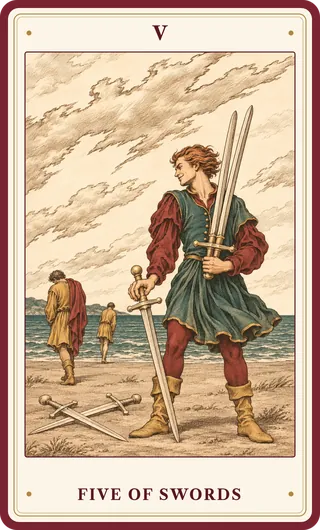
The smirking figure
He stands in front, pleased with himself, holding the swords he has gathered. Reversed, he is the part of you that is starting to feel the cost of that win.
Three swords in hand
These are the spoils taken through pressure, cleverness or a sharp tongue. Reversed, they suggest the weapons are being set down, or that you are still gripping them too tightly.
Two swords on the ground
They are what the losers left behind, the damage the fight caused. Reversed, they ask what needs to be picked up, repaired or returned.
The two retreating figures
They walk away toward the water, beaten and silent. Reversed, they can turn back for a conversation, or they carry a grudge that has not gone anywhere.
The stormy sky
Torn, fast-moving clouds show a mind in turmoil. Reversed, the sky points to the storm passing, or to pressure still building out of sight.
The shoreline
Water behind the scene is the emotional life that the fight cut off from. Reversed, it suggests feelings returning to the surface once the arguing stops.
Five of Swords reversed as advice
The advice of this card is simple to say and hard to do: put down the swords. Notice what the fight is protecting, usually a bruised ego, and ask whether the relationship, the job or your peace of mind is worth more.
In practice that can look like four steps:
- Name your own part in the conflict, even if it is small.
- Say it plainly, without adding “but” or a list of the other person’s faults.
- Ask what the other person needs in order to move on.
- Decide what you will not accept, and hold that line kindly.
The reversed card also warns against peace that is only silence. Choose the kind that comes from honesty and repair. If an apology costs you your self-respect, or the other person keeps taking the same swords from you, then walking away may be the true message.
Is the Five of Swords reversed a yes or no?
Reversed, the Five of Swords is a cautious yes for questions about ending a conflict, apologising, making peace or leaving a hopeless contest. The fight is winding down, so progress is possible.
It is a maybe for anything that needs full trust or a clear win, because the card often shows the aftermath rather than a finished repair. If your question was “Will we get back together?” or “Will this dispute end well?”, the answer depends on whether both sides actually lay down their weapons.
For quick questions you can check the Five of Swords yes or no page, which also covers the upright card.
Past, present and future positions
In the past position, the card says an old fight or a win-at-all-costs habit is still affecting you. It often appears for people who carry a grudge from years ago that they thought was forgotten.
In the present position, you are in the middle of the turn: tired of the fight, deciding whether to reach out, or deciding whether to leave. It is a card of decision, and the next step is usually yours.
In the future position, expect conflict to ease, either through a conversation or through distance. It is a better omen than the upright version, though the quality of the peace depends on how honestly the issue is addressed. A calm three card line such as past, present, future suits this card well, and you can find layouts on the 3 card tarot page.
Try this: Pull one extra card and ask “What would real peace look like here?” Place it beside the Five of Swords reversed and read the two together as a plan, not a prediction.
Card combinations worth knowing
Combinations help you decide which meaning of the reversed Five is in play. With Justice, a dispute is settled fairly, possibly through formal means such as mediation or a contract. With the Two of Swords, the conflict is frozen rather than ended, and someone is refusing to look at it.
With the Six of Swords, you are leaving a difficult situation and heading toward calmer waters. With the Seven of Swords, someone is hiding something, which suggests the peace is a cover. With the Three of Swords, the hurt is fresh and reconciliation may have to wait until it has been felt. With the Ten of Cups, the repair is warm and lasting.
If you are reading the whole suit, the Five sits in the middle of a story of mental life. The suit of swords shows how the mind moves from the clarity of the Ace through conflict and loss, and why a card like this one marks a turning point rather than an ending.
Mistakes people make with this card
The first is assuming reversed always means good news. Reconciliation is likely, but it is not automatic, and the card can describe grudges that outlast the argument by years.
The second is reading it as a message to give in. Dropping pride is different from dropping your boundaries. If someone keeps hurting you, the card can support leaving as much as it supports forgiving.
The third is treating the card as being about other people only. It is also about the tactics you use: sarcasm, keeping score, winning by wearing someone down. If it turns up repeatedly, look at how you argue.
A final point is mixing it up with similar cards. The Five of Wands reversed is about disagreement and chaos that eases, with a lot less malice involved. The Five of Swords reversed carries the weight of someone being hurt, which is why remorse and forgiveness belong to it.
Five of Swords reversed and the number five
Five is the number of disruption, friction and change in tarot, the point where the stability of four is broken. In the suit of swords, which belongs to air and the mind, that disruption becomes conflict, ego and the hard thoughts we use as weapons. Traditional astrology links this card with Venus in Aquarius, a hint that this is about relationships and detachment, and that the right distance can be as helpful as closeness.
Reversed, that energy turns inward or slows down. Either the conflict is relaxing, or it is being held in. Seeing it this way helps you avoid reading the card as a simple good or bad sign. It is a card about what we do with friction once the shouting stops.
Moving from this card toward stability often leads to calmer cards such as the Six of Swords reversed, where the move away from trouble is stalled or incomplete, or to forward movement in the cards that follow in a reading.
What to do after you draw it
First, decide which conflict the card is about. Most people know within a few seconds. Then ask what you want from it: peace, distance, an apology or an end. Different goals need different actions.
Second, take one small concrete step in the next few days. Send the message you have been drafting, set a boundary, or write the letter you will not send. The reversed Five rewards action that is calm and specific.
Finally, return to the card in a week and see what shifted. If you are keeping a tarot journal, note what the fight was really about. Over time, a pattern usually shows, and that pattern is the real lesson of the card.
Questions readers ask
What does the Five of Swords reversed mean?
It usually means a conflict is winding down: you are ready to apologise, forgive, or walk away from a fight that is not worth the price. It can also mean the argument has gone quiet without being resolved, so the resentment is still there.
Is the Five of Swords reversed a good or bad card?
It is more hopeful than the upright card, because the focus moves from winning to repairing. It still carries a warning: peace built on silence or swallowed anger tends to break later.
What does the Five of Swords reversed mean in love?
It points to making amends, ending a cold war and choosing the relationship over being right. In a harsher reading, it shows lingering resentment, grudges, or one partner who keeps score long after the argument ended.
Does the Five of Swords reversed mean my ex will come back?
It suggests the conflict between you is softening, and that a calm conversation or an apology is possible. It does not promise a romantic return, and sometimes it simply means you can finally part on decent terms.
Is the Five of Swords reversed a yes or no?
It leans toward a cautious yes when the question is about ending a dispute, apologising or moving on. For a question that needs trust, cooperation or a clean win, treat it as a maybe until the tension is truly settled.
What is the difference between the Five of Swords upright and reversed?
Upright shows the fight and the hollow win: conflict, manipulation, point-scoring. Reversed shows the aftermath: regret, reconciliation, forgiveness, or conflict that has been buried instead of solved.