
Five of Swords as a Yes or No Answer

- Arcana
- Minor Arcana, Suit of Swords
- Element
- Air
- Yes or no
- No
conflictdefeatwinning at a cost
confusionrecoveryrelease of mental strain
The Five of Swords is a no in a yes or no reading. It shows a win that comes at a high price: broken trust, hurt feelings or a fight that was not worth having. When you ask a yes or no question and draw this card, the answer is no to whatever depends on conflict, pressure or getting your own way at someone else’s expense.
The no is rarely “this can never happen.” More often it means “not like this.” The card is about the method as much as the outcome, so the most useful reading looks at what you would have to do to get a yes and whether you are willing to pay for it. For the full picture of the card, see the Five of Swords meaning. This page focuses on how to use it as an answer.
Why the Five of Swords leans toward no
Yes or no tarot readings work by tone. Cards that show growth, support, completion or open doors lean yes. Cards that show blockage, loss, delay or strain lean no. The Five of Swords sits firmly in the second group because its image is about the aftermath of a fight, with one smug winner and two people walking away beaten.
The Swords suit belongs to air, which means thought, speech and conflict. At five, the middle of any suit, things are unstable and tested. In Swords, that instability shows up as arguments, rivalry and harsh words. The card does not offer a smooth path, so it cannot give a clean yes.
There is also a practical reason it reads as no. A yes answer usually means “go ahead and things will work out.” The Five of Swords says the opposite: if you go ahead the way you are planning, something will be damaged along the way. That is a warning, and warnings are no.
What the card is really saying
Look at the picture before you decide what the answer means. The figure in front has collected three swords, and two more lie on the ground. Behind him the other two figures leave, and the sky is rough. He has won, but nobody is celebrating. The card asks whether this is the kind of winning you want.
That is why the Five of Swords is so useful for questions about conflict, competition and ego. It does not say you will lose. It says that the version of winning on offer is hollow. Many readers describe it as a Pyrrhic victory: you get the prize and lose the people or the peace that made it worth having.
When you read it as a yes or no answer, hold both layers together. The surface answer is no. The deeper message is that the question itself may be tied up with pride, rivalry or a need to be right, and that is what needs attention first.
Upright Five of Swords as yes or no
Upright, the answer is no, and it is usually a firm one. The energy around your question is tense, defensive or dishonest in some way. You may be dealing with a person who plays to win at all costs, or you may be the one doing it. Either way, pushing forward now leads to a result you will regret.
Here are the situations where an upright Five of Swords gives a clear no:
- Should I confront them and have it out? No, the argument will not give you what you want.
- Should I take this job or deal even though it means undercutting someone? No, the cost to your reputation is too high.
- Should I send that message while I am angry? No, you would win the exchange and lose the relationship.
- Should I take them to court over this? Probably not, because the fight will cost more than it returns.
In each case the card is not forbidding the goal. It is steering you away from a hostile route to it. If you ask the same question in a calmer way, such as “Should I speak to them calmly about this?”, you may get a very different card.
Read Five of Swords for your question
Upright: Usually no: the relationship is caught in a power struggle where someone needs to win, and winning will cost the closeness you want.
Reversed: A cautious yes to making peace: apologies, honest repair and letting an old argument go are possible.
Upright: They feel competitive, defensive or resentful, and are more focused on being right than on understanding you.
Reversed: They feel regret or exhaustion and are ready to soften, though pride may still slow them down.
Upright: No to the aggressive plan: office politics, rivalry or a win at a colleague's expense will leave you worse off.
Reversed: Yes to a fresh start with colleagues: tensions are easing and cooperation is back on the table.
Upright: No to money gained through a fight, a sharp deal or a legal battle that costs more than it returns.
Reversed: A tentative yes to settling a dispute, negotiating fairly or walking away from a loss you cannot recover.
Upright: Stop fighting for the sake of winning and ask what this victory would actually cost you.
Reversed: Make amends, drop the grudge and choose a calmer way to get what you need.
Upright: No to pushing through stress: conflict and tension are draining you, and rest or a boundary comes first.
Reversed: Yes to recovery: stress is easing, and letting go of resentment helps your body settle.
Reversed Five of Swords as yes or no
Reversed, the Five of Swords softens. It tends to read as a maybe or a conditional yes, because the energy has moved from fighting to ending the fight. The reversal can mean reconciliation, apology, surrender with dignity or the slow cooling of an old feud. You can read more detail on the reversed Five of Swords and on how to read reversed cards in general.
It does not flip to an automatic yes. A reversed Five of Swords can also mean the conflict is still alive underneath, with resentment simmering or a truce that has not been properly settled. So the answer depends on your question. Asking “Can we make peace?” favours yes. Asking “Will I get what I want from this person?” is less certain, because pride may still be in the way.
A good rule is that a reversed Five of Swords says yes to endings and repair, and maybe to everything else. If you are not sure how your deck treats reversals, decide that before you shuffle, and stay consistent.
Try this: Ask the same question twice, once framed as “Should I fight for this?” and once as “Should I let this go?” Draw one card for each. If the Five of Swords turns up for the first and a gentler card for the second, you have your answer.
When the Five of Swords can mean yes
The card says stop fighting for the sake of winning. That means some questions turn the answer around. If your question is “Should I walk away from this argument?” or “Should I end this draining rivalry?”, the Five of Swords supports a yes. It is telling you the battle is not worth it.
The same is true of questions about leaving a hostile situation. If you are asking whether to quit a toxic workplace, step back from a friendship built on competition or stop trading insults with a family member, the card may lean yes to leaving. The no is attached to continuing the fight, so the yes goes to stopping it.
This is the part many quick answers miss. A card does not give “yes” or “no” in a vacuum. It answers the exact thing you asked. Before you read the result, check whether your question was phrased as “go on with this” or “get out of this,” and flip your reading accordingly.
Five of Swords yes or no in love
In love, the upright Five of Swords is usually a no. It often shows a relationship where power struggles, point scoring and the silent treatment have replaced care. Questions such as “Will we get back together?”, “Is this person right for me?” or “Will they apologise?” tend to get a no while the tension remains. Someone is more interested in being right than in being close.
If you are asking about leaving, the answer shifts. When a relationship has become a constant contest, the card can say yes to walking away, because staying would mean more of the same fight. It does not mean love is impossible, only that this dynamic is not serving either person.
Reversed, the card opens a door. It can say yes to reconciliation, to an honest apology or to forgiving an old hurt, but only if both people want to put down their swords. For what a partner may be feeling when this card appears, the Seven of Swords is a useful companion to study, since both cards point to hidden agendas and one-sided play.
Five of Swords yes or no for career
At work, the Five of Swords points to office politics, rivalry, gossip and people who advance by pushing others down. As an answer to “Should I go for this promotion?” or “Should I take this deal?” the upright card says no if getting there means sharp elbows. It also warns against winning an argument with a boss or colleague that you will have to live with afterwards.
It can also describe your own behaviour. If you are tempted to take credit, undermine a rival or send a pointed email, the card is a pause button. The question to ask is not “Can I win?” but “What will I have to live with once I have?”
Reversed, a work question can get a yes when it involves mending a damaged relationship, apologising for a mistake or leaving a competitive environment. Tension is easing, and cooperation is more likely to work than combat.
Five of Swords yes or no for money
For money questions, the upright card says no to gains that rely on a fight, a sharp bargain or a lawsuit. It warns about deals where someone is being taken advantage of, including you. Questions about inheritance disputes, shared property, unpaid debts or business partnerships that have soured often draw this card.
It is a good prompt to count the full cost. Legal fees, damaged relationships and lost time can outweigh a settlement. If you ask “Should I pursue this claim?” and get the Five of Swords, it does not mean you cannot win. It means the win may not leave you better off.
Reversed, money answers soften toward settling, negotiating fairly or accepting a smaller outcome for the sake of peace. A tentative yes applies to compromise. For stable gains, you may want a card from the Pentacles suit to confirm, such as the Ace of Pentacles, which points to a clean new opportunity rather than a contested one.
Five of Swords card symbols
Choose a symbol to read what it means on the card.
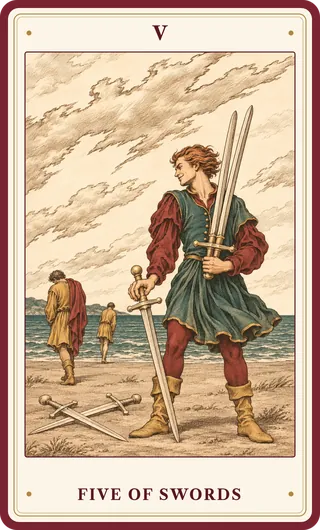
The smirking figure
A man stands in the foreground with a sly, satisfied look. He has won the fight, but his expression suggests the win was not clean or kind.
Three swords gathered
He holds three swords, one resting on his shoulder. They show what was taken by force, and the cost of taking them.
Two swords on the ground
Two blades lie at his feet, left behind by the people he beat. They stand for surrender, loss and what has been abandoned.
The retreating figures
Two people walk away toward the water with their backs turned and heads low. They show the human cost of the victory and the relationships that may not survive it.
The stormy sky
Ragged, windswept clouds fill the sky above the scene. They signal tension, bad feeling and an atmosphere that has not cleared.
The shoreline and water
The fight ends beside the sea, and the losers head toward it. It hints at emotion and distance, and at the move away from conflict that the Six of Swords later completes.
Five of Swords yes or no for health
In health readings the card reflects stress, conflict and mental strain. A no here usually means “do not push through.” Constant arguments, resentment or a competitive pace are wearing you down, and your body is paying for it. It is not a diagnosis and should never replace medical advice.
As a yes or no answer, it supports a no to anything that adds pressure and a yes to rest, boundaries and stepping out of stressful situations. Questions like “Should I keep working at this pace?” get a clear no. Questions like “Should I take a break from this conflict?” lean yes.
Reversed, it can suggest that stress is lifting, that you are recovering from a draining period or that letting go of a grudge is helping you feel lighter.
How firm is the no?
Not every no weighs the same. The Five of Swords is a firm no to the current approach, but it is not the hard stop that cards like the Tower or the Ten of Swords can be. It is closer to “not this way, not right now.”
Several things affect how strong the answer is. If the card lands upright and the surrounding cards are also heavy, the no is strong. If it comes with calmer cards or a reversal, there is room for change. A good test is to ask whether the problem is the goal or the method. If it is the method, you can often get a better answer by changing your approach and drawing again.
If you want the answer to come with a sense of timing, remember that the Five of Swords is a short, sharp card. Conflicts of this kind often flare quickly and burn out. It rarely points to something that lasts for years unless you keep feeding the fight.
Reading the Five of Swords with other cards
In a spread, neighbouring cards change the answer. A few pairings come up often:
- Five of Swords with the Four of Swords: a yes to resolution, but only after a break from the conflict.
- Five of Swords with the Seven of Swords: the conflict involves deception, not only heated feeling.
- Five of Swords with the Ten of Swords: a hard no, with the situation reaching its painful end.
- Five of Swords with the Six of Swords: a no now, then a move toward calmer waters.
If you draw more than one card, the Five of Swords usually shapes the tone of its neighbours. A positive card beside it suggests that the goal is fine but the method is not. A heavy card beside it confirms the warning. For a method that gives you more context, try a three card spread with the Five of Swords as the middle card, so you can see what leads to it and what follows.
Try this: Draw three cards for one question: what is driving the conflict, what the fight would cost, and what a peaceful path looks like. Read the Five of Swords in the middle as the cost.
How to ask a question that gets a useful answer
The best yes or no questions are specific, personal and about your own choice. “Should I send this email today?” works. “Will my boss ever stop being difficult?” does not, because it depends on someone else’s free will and has no clear yes or no.
When you pull the Five of Swords, ask whether the question is built on rivalry. Phrases like “beat,” “prove,” “win” and “get back at” often attract this card. Try rewriting the question to focus on what you want rather than whom you want to defeat, then draw again. You can find more ideas in this list of questions for a tarot reading.
Also remember that a single card is a snapshot. Use a yes or no tarot reading as a quick check, and treat it as a starting point for thought, not a verdict. If the same question keeps drawing the Five of Swords, the message is the same each time, and repeating the draw will not change it.
What to do after drawing the Five of Swords
The most practical move is to pause. Write down what you want from the situation, then write down what it would cost to get it. If the cost is a relationship, your reputation or your peace of mind, the card has done its job.
Then look for a lower-conflict route. This might mean having a calm conversation instead of a confrontation, asking for mediation or simply letting someone else have the last word. Letting go is not losing. In many cases it is the only way to avoid a win that feels like a loss.
Finally, check your own part. The Five of Swords can describe the other person, but it often points back at you. If you notice an urge to prove a point, score a hit or stay silent to punish someone, the card is asking you to be honest about that.
Common mistakes when reading this card
The first mistake is treating the no as a prediction of failure. The card describes what a fight will cost, not whether you can win it. Plenty of people draw it and do succeed, but at a price they did not expect.
The second is ignoring the question’s wording. A question about leaving a conflict flips the answer, as covered above. The third is blaming the other person. Because the card is about competition, it is easy to see the villain in someone else when the pattern is partly your own.
The last is overreading a single draw. If you are drawing the Five of Swords because you are already upset, the cards may be reflecting your mood. Wait until you are calmer, then ask again with a clearer question. When you want the card’s complete meaning, with its imagery, advice and positions, the Five of Swords card page covers it in full.
Questions readers ask
Is the Five of Swords a yes or no card?
It is a no card. It points to conflict, a hollow victory or a plan that costs more than it gives. The goal may still be reachable, but the way you are going about it is not working.
Is the Five of Swords a yes or no in love?
Upright, it usually means no, because the relationship is stuck in arguments and ego. If you are asking whether you should leave a toxic dynamic, it can lean yes. Reversed, it is a careful yes to reconciliation.
What does the reversed Five of Swords mean as a yes or no answer?
Reversed, it softens into a maybe or a conditional yes. It favours questions about making peace, apologising or dropping a fight. It does not guarantee the other person will meet you halfway.
Can the Five of Swords ever mean yes?
Yes, when the question is about leaving a fight, ending a draining conflict or walking away from something unhealthy. The card says stop battling, so a question that asks whether to stop gets a yes.
Does the Five of Swords mean I will lose?
Not necessarily. You may win, but the card warns that the win will feel empty or damage something you value. Treat it as a prompt to count the cost before you push on.
How firm is the no from the Five of Swords?
It is a firm no to the current approach, not always a permanent no to the goal. If you change your method, soften your stance or wait for tempers to cool, the answer can change on a new draw.