
Seven of Cups Reversed (Meaning in Love, Work & Life)

- Arcana
- Minor Arcana, Suit of Cups
- Element
- Water
- Yes or no
- Maybe
choicesfantasyillusion
emotional blockswithdrawalimbalance
The Seven of Cups reversed usually means the fog is lifting. The daydreams, mixed options and wishful thinking of the upright card start to give way to a clearer view, and you are able to see which choices are real and which were only glowing in the clouds. It is generally a helpful reversal, and it often arrives right after a period of confusion or overwhelm.
It has more than one face, though. The same reversal can describe sharp disillusionment, when a fantasy falls apart, and it can also describe the opposite problem, where someone is so tired of choosing that they refuse to decide at all. This guide explains all three, how to tell them apart in your own reading, and what the card says in love, feelings, work, money, health and yes or no questions.
What the Seven of Cups reversed means
In the Rider-Waite-Smith image, the upright Seven of Cups shows a dark figure staring at seven cups floating in the clouds, each holding a different vision. It is the card of imagination, temptation and too many possibilities. Reversed, the picture is turned over, and so is the effect: the clouds clear, the cups settle, and the figure has to decide what to do next. You can read about the card in its normal position on the upright Seven of Cups page.
The core meaning of the reversal is a return to reality. Options become fewer and more concrete. Illusions lose their shine. You may find that one path has always been more solid than the others, or that you can finally name what you were chasing and why. Keywords for the card include clarity, focus, decision, reality check, disillusionment and, in the shadow version, avoidance.
Reversed cards in general do not simply mean “the opposite”, and that is especially true here. If you want a quick refresher on how reversals work before you go on, the guide to reading reversed tarot cards covers the basics.
The three ways this reversal shows up
The most common version is clarity arriving. You have been overwhelmed and now you are not. A choice that felt impossible starts to look obvious, and you feel the relief of being able to commit. This is the reading most people hope for when they pull the card.
The second version is disillusionment. Here the clarity is not pleasant. You see that the offer, the person or the plan was never what you thought, and a fantasy you were holding on to has collapsed. This hurts, but it is usually the kind of hurt that stops you wasting more time.
The third version is avoidance. The card can describe someone who reacted to overwhelm by refusing to consider anything, which is not the same as choosing. You may have narrowed your options so hard that you are no longer looking at real opportunities, or you may be using “I’m still thinking about it” as a way to stay safe. The honest reading often sits between the extremes: fewer options, properly examined.
How to tell which version you have
Look first at your question. If you asked “what should I do about X?” and you already feel relief or a pull in one direction, the clarity reading is probably right. If you asked about something you have been hoping for and the card feels like a cold splash of water, think about disillusionment. If you have been circling the same decision for weeks, the avoidance reading deserves a hard look.
The cards around it help a lot. Supportive cards like the Ace of Cups, the Star or the Sun point to clarity that feels good. Heavier cards such as the Five of Cups or the Three of Swords suggest the disillusionment version, where something has to be mourned. Cards of stagnation, like the Four of Cups or the Two of Swords, point to avoidance.
You can also tell by how your body reacts to the word “decide”. Relief means the fog is lifting. A flash of dread means you are close to a truth you are not ready for. Flat boredom, or a sudden urge to change the subject, usually means avoidance.
Try this: Write your question at the top of a page. Underneath, list every option you have been considering, then draw a line through any that you could not describe in three concrete facts. Whatever is left is what the reversal is asking you to look at.
Read Seven of Cups for your question
Upright: Upright, you are caught in romantic daydreams or torn between several people, and you may be loving an idea more than a person.
Reversed: Reversed, the fantasy fades and you see your partner or your options as they really are, which can bring relief or a hard truth.
Upright: Upright, someone's feelings are a pleasant haze of wishful thinking and mixed attraction.
Reversed: Reversed, their feelings are becoming clearer, though that clarity can mean they commit, or that they realise the daydream was never real.
Upright: Upright, you have too many ideas and possible paths, and none of them is getting finished.
Reversed: Reversed, you stop scattering your energy and choose one realistic direction, or you stay stuck because you will not choose.
Upright: Upright, you are tempted by get-rich plans and shiny purchases that are not grounded in numbers.
Reversed: Reversed, you check the details, drop the unrealistic scheme and start working with an honest budget.
Upright: Upright, slow down and ask which of these wishes you are truly willing to build.
Reversed: Reversed, pick one option, test it against facts, and let the rest go without guilt.
Upright: Upright, escapism and daydreaming may be a way of avoiding how you actually feel.
Reversed: Reversed, you face habits like overindulgence or avoidance and start making steadier, more honest choices.
Seven of Cups reversed in love
In love, the reversal means you are losing the rose-coloured filter. If you are in a relationship, you may be seeing where it really stands after a stretch of avoiding the question. You might notice that you have been imagining a future that the two of you have never discussed, or tolerating vagueness because it felt safer than asking. The card says it is time for a plain conversation about what is real.
This is not a doom card for couples. It points to areas that need honest attention, and it can lead to a stronger relationship if both people are willing to stop drifting. Good questions are: what has actually happened between us, and what have I only hoped for?
If you are single, the reversal often means you are done chasing an idealised partner who exists only in your head. You stop swiping for a feeling and begin asking who actually fits the life you want. It can also show that you have been so rigid about your list that you have overlooked someone good because they do not match the fantasy. The balance is to keep your standards and drop your script.
Seven of Cups reversed with an ex or a new connection
With an ex, the card asks you to look at the past with clear eyes. Remember what really happened, not the highlight reel, and ask whether the old problems have been solved. With someone new, it asks for realistic expectations: pay attention to what they do, not to the story you are building about them.
Seven of Cups reversed as feelings
When this card describes what another person feels, it shows someone who has been confused, distracted or daydreaming and is now sorting it out. They may have been attracted to several people or ideas, or enjoying the fantasy of you without much contact with the reality. Reversed, that haze is ending.
What follows depends on the rest of the reading. It can mean they are ready to commit and be direct. It can also mean they realise the fantasy was stronger than the connection, and they step back. Either way, you can expect fewer mixed signals and more of a definite position, even if it is not the one you were hoping for.
If the card describes your own feelings, take it as a sign that your emotions are settling and that you are able to name what you want. Trust the part of you that has stopped negotiating with the daydream.
Seven of Cups reversed in career
At work, the upright card shows too many ideas and not enough follow-through. Reversed, you finally narrow things down. You stop starting projects you will not finish and commit to a direction that is realistic. The glamour of certain career dreams loses its hold, and you may go back to a path you ignored because it seemed too ordinary.
The reversal can also describe the shadow side: feeling stuck, with the sense that advancement is limited, or being so overwhelmed by choices that you freeze and let opportunities pass. If you are considering a career change, the card advises research and realistic planning, not a leap based on a mood. Talk to people who do the job, look at the day-to-day work, and test the idea in a small way first.
In a job search, be wary of positions that sound too good. The reversed card tells you to read the contract, ask direct questions and check what you are agreeing to.
Try this: Choose one project that has been floating around your head. Write the next physical action that would move it forward and put it in your calendar for this week. If you cannot name an action, the project is still a cloud.
Seven of Cups reversed in money
With money, the reversal ends impulsive decisions and unrealistic gains. If you have been chasing a get-rich plan, buying things to chase a mood, or imagining a windfall, the card tells you to come back to numbers. It is a good sign for people who are ready to budget, compare options and invest instead of spending on impulse.
It also carries a direct warning about offers. When something promises a lot for little effort, the reversed Seven of Cups says to check the details, since checking costs almost nothing and protects a lot. This applies to investments, loans, schemes and anything involving an upfront fee.
If you want to see how the other money cards sit with this one, the Four of Pentacles shows the other side of the question, which is holding on too tightly, and the Two of Pentacles shows how to juggle real commitments.
Seven of Cups reversed in health
For health, the card points to lifestyle and honesty. Reversed, it can show poor habits having a real effect: overindulgence, escapism through food, alcohol or screens, or simply not looking at a problem. The advice is to take back control gently and in practical steps.
It can also describe a mind that has been floating, with scattered attention and little rest. Grounding routines such as regular meals, sleep, movement and time away from your phone suit this card well. If you feel that you are using fantasy or substances to avoid painful feelings, speak to a doctor or a counsellor. A tarot card is not a diagnosis and should never replace medical care.
Spiritual life and manifestation
Spiritually, the reversal marks the end of escapism. You may have been collecting teachings, rituals and ideas without practising any of them, or using the idea of a bigger destiny to avoid your ordinary life. Reversed, the card asks for depth over variety: pick one practice and keep it going long enough to see what it does.
For manifestation, the card is useful. Wishing is the upright card’s work, and the reversal moves you into building. Choose the one wish you are actually willing to act on, and let the others be nice ideas. If you want a card that shows illusion from another angle, The Moon reversed is about fears and confusion lifting in a similar way.
Seven of Cups card symbols
Choose a symbol to read what it means on the card.
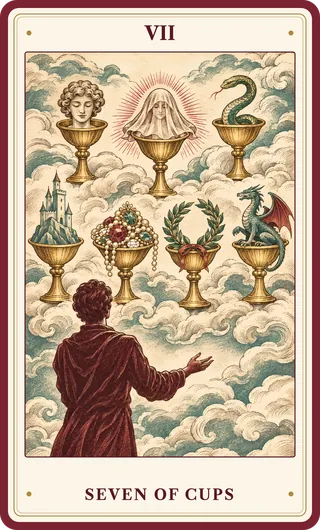
Silhouetted figure
The figure is shown from behind as a dark outline, so we see the dream as the dreamer does, without a clear view of what is real. Reversed, this is the moment the figure turns around and starts to look properly.
Seven floating cups
The cups hang in the air with nothing holding them up, which is why they stand for wishes, not facts. Reversed, they begin to sink, settle or thin out, and you can tell which ones could rest on solid ground.
Clouds
The clouds carry the vision and blur the edges of everything. Reversed, the cloud cover breaks and what was glowing and vague becomes plain and measurable.
Covered figure
One cup holds a shrouded, veiled shape, a mystery you cannot read from where you stand. Reversed, it asks whether you are brave enough to lift the cover or whether you are avoiding what is under it.
Jewels and laurel wreath
The pile of jewels and the wreath of victory promise wealth and success without effort. Reversed, they warn you to check the price tag and the fine print before you reach out.
Snake and dragon
These cups hold the dangerous options, the temptations that look appealing and carry a sting. Reversed, they show the hidden cost of an easy path becoming visible, or a risk you have been ignoring.
Castle
The castle in a cup is the grand plan, a lifetime goal that looks wonderful from a distance. Reversed, you ask whether you actually want to live in it, or whether you only like how it looks.
When the reversal warns about temptation
The Seven of Cups has always carried a note of temptation, and the reversal keeps it. Some of the cups in the picture hold dangerous things, and the reversed card can show you the moment the danger becomes visible. A generous offer, a charming person or a thrilling opportunity may not be what it seems.
This is the part of the card that is easiest to miss. If your question involves a deal, a new contact or something that feels almost too good, treat the reversal as a prompt to slow down. Ask for details in writing, give it time, and notice whether the story gets vaguer when you ask for specifics. A real opportunity usually survives questions.
The Seven of Swords is the card to compare here. Where the Seven of Cups is about fooling yourself, the Seven of Swords is about deception and sneaking around, and the two can show up together.
Symbols in the reversed image
The imagery explains why the card works as it does. A silhouetted figure faces a cloud of cups holding a castle, jewels, a laurel wreath, a snake, a dragon, a face and a veiled shape. All of them promise something, and none of them is supported. Turning the card over is a reminder that the figure’s task is to look at each one properly.
The jewels and the wreath are the easy wins, which is why they are the ones to test first. The snake and dragon are the risks that you may have been ignoring. The covered cup is the unknown, and it is the one that usually matters most, because it is the choice you have not looked at yet.
Seven of Cups reversed as a yes or no
As a yes or no answer, the card depends on the question. If you ask whether you should commit to a clear, realistic plan, it leans towards yes, because the reversal supports choosing and acting. If you ask about a fantasy, a too-good offer or a plan with no details, it leans towards no.
The card rarely says yes to “maybe later” or “I’ll see what happens”, since the whole point is that it is time to decide. For a fuller breakdown of how this card answers direct questions, see Seven of Cups as a yes or no answer.
What to do when you draw it
The advice from this card is simple and practical. Narrow your options, check them against facts and pick one. The aim is not to have the perfect option, since there rarely is one. The aim is a good, real one that you are willing to work on, and a promise to adjust as you learn.
Here is a short routine that fits the card:
- List every option you are considering, however small.
- For each one, write down what you know for certain and what you are only hoping.
- Remove anything that is entirely hope.
- Pick one of the remaining options and name the first step.
- Set a date to review how it is going.
If you find yourself resisting step four, notice that. The resistance is the avoidance version of the card, and it is worth asking what you are afraid will happen if you commit.
Try this: Pull one more card and ask “What am I avoiding looking at?” Place it next to the Seven of Cups reversed and write one sentence on how the two connect. You can use the random tarot card generator if you do not have your deck with you.
Seven of Cups reversed in a spread
Position matters. As the past, the card shows that you have come out of a period of confusion or fantasy. In the present, it says you are in the middle of seeing clearly, or in the middle of resisting it. In the future, it shows that clarity or disillusionment is on its way, and that choosing is coming.
In a simple three-card line, it works well as the middle card: what has been hazy, what is clearing, and what you do about it. A 3 card tarot reading is an easy place to try this. As an outcome, it suggests the matter will become much clearer, but not that it will be resolved without your input.
Cards that pair well with it
Next to the Eight of Cups, the reversal suggests that once the illusions fall away, you may decide to leave something that no longer feels true. With the Lovers or the Two of Cups, it points to clear, grounded romantic choices. With the Hermit, it suggests a quiet period of sorting through your thoughts.
With the Magician, it is a good sign for focus and skilled action. With the Devil or the Moon, it can show that you are still partly caught up in a pull or a fear, and that the fog has not fully gone. When it falls with the Tower, expect a sudden break in a fantasy, and be kind to yourself while it settles.
Upright and reversed compared
Upright, the Seven of Cups is the pleasure and the problem of having many options. You daydream, imagine and wish, and nothing quite lands. Reversed, you find out what the cups are made of.
The upright card says “so many possibilities” and the reversed card says “so which one?” If both appear in a reading, perhaps in a past and present position, you are likely watching the shift from imagination to decision. That is almost always a good sign, even when it asks you to give something up.
Questions readers ask
What does the Seven of Cups reversed mean?
It most often means the fog of confusion and wishful thinking is clearing and you are ready to choose. It can also point to disillusionment, when a fantasy collapses, or to avoidance, when you refuse to choose at all.
Is the Seven of Cups reversed a good card?
Usually yes, because it brings clarity, realism and the ability to commit. It can feel uncomfortable if the clarity shows you that something you hoped for was never real, but that is useful information.
What does the Seven of Cups reversed mean in love?
It means you are seeing a partner or a potential match without the rosy filter, and you are less willing to drift. Singles stop chasing an idealised person, and couples start talking about what is actually happening.
Is the Seven of Cups reversed a yes or no?
It leans towards yes if you act on the clarity and pick a direction, and towards no if the question is about a fantasy or an offer that sounds too good. It rarely supports a vague, unexamined plan.
How is the Seven of Cups reversed different from upright?
Upright is the cloud of too many options and daydreams. Reversed is what happens when that cloud breaks, either into focus and commitment, hard disillusionment, or a stubborn refusal to decide.
What does the Seven of Cups reversed mean as someone's feelings?
The person is getting clearer about what they feel, so their mixed signals and daydreaming are ending. What they decide depends on the cards around it, but you can expect more honesty and less haze.