
Three of Swords Reversed (Meaning in Love, Work & Life)

- Arcana
- Minor Arcana, Suit of Swords
- Element
- Air
- Yes or no
- No
heartbreakgriefpainful truth
confusionrecoveryrelease of mental strain
The Three of Swords reversed most often means that heartbreak is beginning to ease. The sharpest pain has passed, and forgiveness, recovery and release are now possible. It can also point the other way: a hurt that has been buried, replayed or left unfelt, so it keeps coming back in quieter forms.
Upright, this card is the wound itself: a pierced heart under a rainy sky. Reversed, the swords are being pulled out, or you are pretending they were never there. Which of those you are looking at depends on your question, the cards around it and how honest you are about where you really are. This guide covers both readings, then goes through love, feelings, reconciliation, work, money, health, advice and yes or no answers.
The core meaning of the Three of Swords reversed
The central idea is the aftermath of emotional pain. In the Rider-Waite-Smith image, a red heart is pierced by three swords against a background of rain and storm clouds. Turned upside down, the heart is no longer taking the blow. The question becomes what you do with the hurt now that it has landed.
Common keywords for the reversed card are healing, forgiveness, release, recovery, optimism and letting go. Its shadow keywords are suppressed grief, self-criticism, holding a grudge, numbness and reopening old wounds. Both sets are valid, and the art of reading this card is knowing which one applies.
If you want the full picture of the pain it grows out of, the upright Three of Swords covers heartbreak, grief and painful truths in detail. The reversed card picks up where that one leaves off.
Two readings: healing or avoided grief
The first reading is recovery. The storm has done its worst, and you are in the stretch where you can breathe again. You may notice you went a whole day without thinking about the person or the event, or that you can talk about it without your voice shaking. This is the version most people hope for, and it is common when the card sits in a future position or beside cards like the Star or Ten of Cups.
The second reading is a hurt that has not been processed. Here the reversal acts like a lid on the heart. You may say you are fine, stay busy and keep things light, while the grief waits underneath. It often shows up as irritability, numbness, snapping at people who did nothing wrong, or a strange flatness around things you used to enjoy.
A third, smaller variation is rumination. Swords are the suit of the mind, so the reversed card can describe someone who keeps replaying the story, rewording what they should have said and sharpening the pain through repetition. The wound is old, but the thinking keeps it fresh.
How to tell which meaning you are getting
Reversed cards are rarely one fixed meaning, and this one swings widely. A few quick checks will usually settle it. These apply whether you are reading for yourself or for someone else.
- Check the timing in your question. If the hurt happened months ago and you ask how things stand now, healing is more likely. If it happened last week, avoidance or numbness is more likely.
- Look at the neighbouring cards. Soft, hopeful cards point toward recovery, while heavy Swords like the Nine or Ten point toward pain that is still active.
- Notice your own reaction. Relief when you see the card suggests healing, while a flash of irritation or a wish to skip past it often means you are avoiding something.
- Ask what you are still doing about it. Are you talking, writing, resting and letting time work, or keeping busy so you never sit with it?
For a wider guide to how reversals behave across the whole deck, see how to read reversed tarot cards.
Try this: Draw the Three of Swords reversed and write down the hurt it brings to mind in three sentences. Then circle any sentence you would not say aloud to a friend. That is usually the part still waiting to be felt.
Read Three of Swords for your question
Upright: The worst of a breakup or betrayal has passed, and trust and tenderness slowly return, with reconciliation possible but not promised.
Reversed: You may be replaying an old hurt, holding a grudge, or skipping the grief that would let you actually move on.
Upright: They feel regret, relief or a quiet wish to repair things and let the hurt go.
Reversed: They are numb, guarded or avoiding what they feel, so the emotion comes out as distance or irritability.
Upright: You are recovering from a layoff, a harsh review or a workplace betrayal and ready to work with clearer expectations.
Reversed: Disappointment is still driving your choices, or you are pushing down frustration instead of dealing with it.
Upright: A financial setback is easing and you can look at your numbers without panic.
Reversed: Shame or fear about a past loss keeps you from facing your accounts or making a plan.
Upright: Forgive where it helps you, keep the lesson, and let yourself move forward.
Reversed: Stop rehearsing the story, stop numbing it, and let yourself feel it properly so it can finish.
Upright: Stress and low mood are lifting, and rest, support and routine are working.
Reversed: Suppressed grief shows up as tension, poor sleep or exhaustion, and it deserves real attention and support.
Three of Swords reversed in love
In love, this card usually appears after the damage is done: after a breakup, an argument, a betrayal or a hard truth. The relationship may be over, or it may have survived and is now in repair. Either way, the emotional tone is about recovering rather than reeling.
For single people, it often describes healing from a past relationship and a slow return of trust. You may be ready to date again but still carry some caution, and that is fine. The card suggests going at the speed your heart can manage, rather than forcing yourself to be fine for someone new.
For people in a relationship, it can mean working through a rough patch with real forgiveness, or it can warn that an old argument keeps being reopened. If the same wound comes up in every fight, the card is asking whether you have truly let it go or only agreed to stop discussing it. Forgiving does not mean forgetting, and the card supports keeping the lesson while dropping the resentment.
Three of Swords reversed as feelings
When the card describes what someone feels toward you, it usually points to regret, sorrow or a wish to put things right. The person may know they hurt you, or they may be carrying hurt from the way things ended. They are often trying to move past it, and that does not always mean they are moving toward you.
It can also describe someone who is shut down. They may avoid the topic, deflect with humour or seem cold, when the truth is that the situation is painful enough that they cannot look at it. Silence here is not always indifference.
If you are reading for your own feelings, the card often says you are more hurt than you are admitting, or more healed than you gave yourself credit for. Check which one feels true, because both are common.
Does it mean getting back together?
This is the question most people bring to this card, and the honest answer is: it opens the door but does not walk through it. The reversed Three of Swords shows that bitterness is softening and that forgiveness has become possible. That is a necessary condition for reconciliation, but not a promise of it.
Reconciliation is more likely when other cards back it up, such as the Two of Cups, the Six of Swords or the Ten of Cups. It is less likely when the surrounding cards show the same betrayal repeating, or one person still stuck in denial. A reunion built only on relief that the pain stopped tends to fall apart when the original problem comes back.
It can also mean that closure is the real outcome. You may not get the relationship back, but you get peace about it, and for many readers that is the more valuable result. If you are weighing a second chance, ask what has changed, not only whether the feelings remain.
Three of Swords reversed in career
At work, the upright card is a layoff, a betrayal by a colleague or a harsh blow to your confidence. Reversed, it describes recovering from that blow. You may be rebuilding after a job loss, forgiving a manager who treated you badly or starting again with more realistic expectations of workplaces.
It can also show disappointment that has gone underground. If you were passed over or criticised and told yourself it did not matter, the card suggests it does matter, and that it is shaping your motivation or your reactions in meetings. Naming the frustration, even privately, tends to release more energy than ignoring it.
In team settings, the reversed card can ask you to stop holding onto a conflict. If a past argument with a coworker still colours every interaction, it may be time to clear the air or at least decide to treat them neutrally. For more on how this suit behaves in practical matters, the Suit of Swords overview is a good companion.
Three of Swords reversed in money
Financially, the card is about recovery from a setback such as a lost job, a failed venture, a debt or a costly mistake. Reversed, it suggests the shock has worn off and you can look at the situation with a clearer head. That is often the point where real planning becomes possible.
The shadow side is shame or avoidance. If you have stopped opening bank statements or you avoid talking about money because of an old loss, the card is pointing to the emotional weight under the numbers. Money problems are often grief problems in disguise, and handling the feeling first can make the practical steps much easier.
It is not a prediction of sudden gain or loss. Think of it as a sign that your relationship to a financial wound is changing, and that the next sensible step is a small, concrete one, like a budget, a call to a creditor or a conversation with someone you trust.
Three of Swords reversed in health
Because this card is about the heart and mind, its health meaning concerns emotional wellbeing. Reversed, it can show low mood lifting, grief becoming bearable and sleep or energy returning. Supportive habits such as time outdoors, regular meals and talking to friends are likely helping.
It can also warn that suppressed sadness is showing up physically, as tension, headaches, poor sleep, chest tightness or a constant feeling of being worn out. Tarot cannot diagnose anything, and persistent physical symptoms deserve a doctor’s attention.
If grief or low mood has lasted a long time or feels too heavy to carry alone, speaking to a therapist or a doctor is a strong and sensible choice. The card encourages feeling and processing, and a trained professional can help with that in ways a reading cannot.
Three of Swords card symbols
Choose a symbol to read what it means on the card.
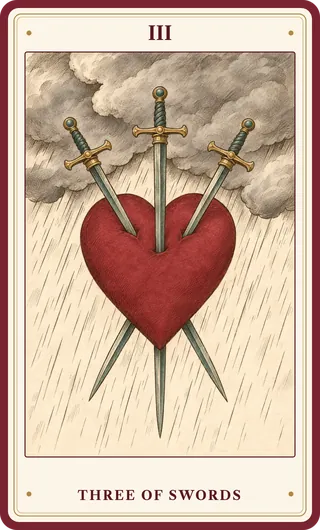
The red heart
The heart stands for love, the self and everything you feel deeply. Reversed, the question is whether the wound is closing or whether you are covering it up.
Three swords
The swords are painful truths, words or events that cut through the heart. Reversed, they are being drawn out slowly, or they are still lodged and being ignored.
Grey storm clouds
The clouds show a mood of sorrow that surrounds the whole scene. Reversed, they suggest a storm that is thinning, though the sky is not yet clear.
Falling rain
Rain is grief that is allowed to fall and wash through you. Reversed, it points to tears that have been held back or are finally easing.
Bare background
There is no figure, no shelter and no distraction around the heart. Reversed, it reminds you that you cannot hide from the feeling, but you also are not trapped in it.
Air element
Swords belong to air, the suit of thought, speech and truth. Reversed, the thoughts you repeat about the pain matter as much as the pain itself.
What the reversed image shows
The card has no people in it, only a heart, three swords and weather. That stark design is part of its message: pain is not a story about who did what, but a direct experience of the heart. When you see it reversed, look at what is missing. There is no shelter, and also no villain.
The three swords are often read as three sources of hurt: a truth, a loss and a betrayal, or past, present and future worries all striking at once. Reversed, they can be seen leaving the heart. The rain and clouds suggest the storm is moving on, though the ground is still wet.
Swords are the suit of air, which governs thinking and speaking. That is why the reversed card so often involves the story you tell yourself. The same event can heal or fester depending on the words you repeat about it.
Three of Swords reversed as advice
As advice, the card says: stop pressing on the bruise. That can mean letting go of a grudge, ending a loop of rereading old messages, or setting down a version of events that keeps you angry. It can equally mean the opposite: stop pushing the pain away and let it be felt in a safe place.
Some practical forms of that advice include speaking kindly to yourself, writing an unsent letter, taking a break from social media posts about the person, and being patient with how long healing takes. Forgiveness here is a decision about your own peace, not a statement that what happened was fine.
Be the peacemaker where it is safe to do so, and protect yourself where it is not. The card does not ask you to return to someone who keeps hurting you.
Try this: Write an unsent letter to the person or situation that hurt you. Say everything, then add one line beginning “What I am keeping is…” and one beginning “What I am releasing is…”. Keep or destroy the letter as you like.
Is the Three of Swords reversed a yes or no?
It leans toward a slow yes. For questions about whether you will heal, forgive, move on or find peace, it supports a yes, with the note that time is involved. For questions that need a quick or clean result, it is closer to a maybe.
If your question is about someone returning, treat it as cautious. The card says feelings are softening, not that action is coming. Draw a clarifying card, or try the Three of Swords yes or no page for the full upright and reversed answers.
In a spread: past, present or future
In the past position, the reversed Three of Swords says you have already been through the worst, or that an old hurt has been left unprocessed and still affects you now. In the present position, it describes where you stand today: either midway through recovery or tempted to avoid the feeling.
In the future position, it is one of the more hopeful signs in a hard reading. It suggests the pain will loosen, and that forgiveness, closure or a calmer outlook is ahead. As an outcome card, it says the situation ends with healing rather than further injury.
It works well in a simple 3 card tarot spread using past, present and future, because you can see whether the pain is moving toward release or stuck in place. Reading it between two other cards makes its direction clear.
Three of Swords reversed vs upright
The difference is timing. Upright, the heart is being struck: news arrives, a relationship ends, a truth lands. Reversed, the strike is behind you, and what matters is how you respond. The card moves from event to aftermath.
Upright cards also tend to be unmistakable, while the reversed card needs more interpretation. Upright asks you to allow grief, reversed asks you to complete it. If you saw the upright card in a recent reading and the reversed one now, it is a good sign of movement.
Cards that often appear alongside it
Pairings tilt the meaning clearly. These are a few that come up often.
- Six of Swords: moving away from trouble toward calmer water, and a sign that healing is underway. See also the Six of Swords reversed if progress feels stalled.
- Ten of Swords reversed: the painful ending is over and recovery is beginning, so read this pair as relief. The Ten of Swords reversed shows what that recovery looks like.
- The Star: hope returning, gentle renewal and trust in the future.
- Eight of Cups: a deliberate walk away from something that no longer serves you.
- Nine of Swords: anxiety and sleepless worry, suggesting the hurt is still very active.
Common mistakes when reading this card
The most common mistake is assuming the reversal cancels the pain. It does not. The card describes pain changing form, and it can still be raw. Treat it as a stage, not a verdict.
The second is reading it as a promise of reconciliation. Forgiveness and reunion are different things, and one can happen without the other. The third is rushing: if you are told you are healing, you may feel pressure to be over it, when the card is really permission to take the time it takes.
Try this: For one week, pull a single card each morning and note whether you feel more or less hurt than the day before. Patterns show quickly, and you can use a random tarot card generator if you do not have a deck with you.
Questions readers ask
What does the Three of Swords reversed mean?
It usually means heartbreak is easing and you are moving toward forgiveness, recovery and release. It can also mean the pain is being avoided or replayed instead of felt, so the surrounding cards decide which reading fits.
Is the Three of Swords reversed a good card?
It is one of the gentler reversals in the Swords suit, because it often marks the end of the sharpest pain. It is not automatically positive, since it can also show grief that has been pushed down and still needs attention.
Does the Three of Swords reversed mean getting back together?
Not by itself. It shows that the hurt is softening and that forgiveness is possible, but whether the relationship resumes depends on the other cards and on whether both people have changed what caused the pain.
What does the Three of Swords reversed mean as feelings?
Someone with this card often feels regret, sadness or a wish to put things right. It can also describe a person who is shutting their feelings down so they do not have to face the hurt.
Is the Three of Swords reversed a yes or no?
It leans toward a slow yes for questions about healing, forgiving and moving on. For questions about a quick fix or a guaranteed outcome, it is closer to a maybe.
What is the difference between the Three of Swords upright and reversed?
Upright is the moment of heartbreak, when the pain is sharp and fresh. Reversed is the aftermath, when you either recover and release it or avoid and prolong it.