
Ten of Swords as a Yes or No Answer

- Arcana
- Minor Arcana, Suit of Swords
- Element
- Air
- Yes or no
- No
painful endingrock bottomrelease
confusionrecoveryrelease of mental strain
The Ten of Swords is a no in a yes or no reading. Upright, it says the situation you asked about has reached its end, and carrying on in the same form will not work. Reversed, the answer softens into a slow, conditional yes: recovery is possible, but only once the ending has been accepted.
That no is specific. It answers the question you asked, not your whole future, and it often comes with relief attached. The card shows the lowest point of the Swords suit, and the sky behind the fallen figure is already turning gold. Read the full card on its own page at Ten of Swords meaning, and use this page when you need a clear verdict.
Why the Ten of Swords answers no
Yes or no readings depend on whether a card moves energy forward or closes it down. The Ten of Swords closes it down. It is the final card of the suit of the mind, and the number ten marks completion, so the story of conflict, worry and betrayal that runs through the Swords has nowhere left to go.
The image says the same thing. A figure lies face down with ten swords in the back. Nobody needs a ten-sword pile to prove the point, and that excess is the message: this is not a setback or a delay, it is over. When you ask “will this work?” and get an image of something already finished, the answer is no.
The card also carries no waiting energy. A Four of Swords, for instance, means rest and pause, which can sit between a yes and a no. The Ten has no pause in it. That is why it gets a firmer no than many other difficult cards.
What the image tells you about the answer
Look at the details before you accept the verdict, because they shape how you deliver it. The swords are all in the back, which points to hurt that came from behind: betrayal, surprise, something you did not see coming or did not want to see. The figure is not fighting. That tells you the struggle has stopped, and the question is no longer about winning.
Then look at the rest of the card. The water is calm, there are distant hills, and a thin band of light sits on the horizon. The scene is bleak but not hopeless. Tarot readers often describe it as the card where you cannot fall any lower, and that is where its second message comes from. The no is real, but it is also the end of a painful stretch.
Upright Ten of Swords: a no, and the reason
Upright, the answer is no because something has already finished. The relationship, plan, job or hope you are asking about has run its course, or will do very soon. Asking whether it will recover, continue or succeed misses the point of the card.
It helps to translate the no into plain language. Depending on the question, the Ten of Swords upright can mean “no, they will not come back”, “no, this plan will not succeed as it stands”, or “no, this will not get better by trying harder”. It does not mean “no, never to anything”. It means no to continuing in the same form.
Here is a quick way to read the verdict:
- Will it continue or improve? No.
- Will it end or change? Yes, and often already has.
- Is there hope of reversing it? Not in the same form.
- Will I be all right afterwards? Usually yes, in time.
Read Ten of Swords for your question
Upright: A relationship, hope or pattern has ended for good, so the answer to reconciling or holding on is no.
Reversed: Healing is underway and a calmer chapter is possible, but only after you stop reopening the old wound.
Upright: Someone feels finished, betrayed or worn out, and the emotional door is closed for now.
Reversed: Someone is recovering and slowly letting go of pain, though trust is still fragile.
Upright: A job, project or plan has collapsed or is about to, and pushing on in the same form will not work.
Reversed: You are recovering from a setback or redundancy and can start rebuilding on new terms.
Upright: A financial plan or venture has failed, so the answer to more investment or risk is no.
Reversed: The worst of the loss has passed, and a careful, modest recovery is possible.
Upright: Stop fighting what is already over, accept it and ask for support.
Reversed: Do not rush back to the old situation, and let recovery take the time it takes.
Upright: Exhaustion, burnout or a low point is signalling that you need real rest and proper support.
Reversed: Energy is returning and recovery is under way, so pace yourself rather than testing your limits.
Ten of Swords reversed as yes or no
Reversed, the card shifts from the blow to the aftermath. The most useful reading is a conditional yes: yes to recovery, yes to rebuilding, but not yes to a return to the old arrangement. The full range of reversed meanings is on the Ten of Swords reversed page.
Different sources give different labels here, from yes to maybe to conditional. The reason is that reversed cards bend the energy rather than flipping it, and a reversed Ten can mean two very different things. It can show a person recovering, which leans yes, or a person refusing to accept an ending, which leans no. Your question decides which one applies.
If you ask “will I recover from this?”, reversed Ten is a yes. If you ask “will this come back?”, it is a no or at best a not yet, because the card is about moving on, not going back. If you are unsure how reversals work in your own practice, how to read reversed tarot cards covers the options, including reading yes or no without reversals at all.
Try this: Pull the card, then ask yourself whether your question was about continuing or about recovering. Write both versions of the question on a page and see which one the card actually answers.
When the Ten of Swords means yes
The card is a no to continuing, so it is a yes to ending. If your question is “should I leave this job?”, “should I stop chasing this?” or “is it time to close this chapter?”, the Ten of Swords is one of the clearest yeses in the deck. It says there is nothing left to save, and holding on will only prolong the pain.
This is also why careful wording matters. The same card gives opposite answers to “should I stay?” and “should I go?”, and neither answer contradicts the other. Both say the old situation has finished.
It can also be a yes to relief. Someone who has been bracing for bad news may draw this card and find that the worst has already happened. A yes to “will the pain stop?” is reasonable, especially with the dawn imagery in the background.
Ten of Swords yes or no in love
In love, the Ten of Swords is a no to anything that depends on a relationship surviving. That covers getting back with an ex, repairing a broken trust, waiting for someone to change, or hoping a person returns. The card shows an ending that is complete, and it does not leave room for a second chance in the same shape.
Reconciliation and exes
For “will my ex come back?”, the answer is no. For “should I keep waiting?”, the answer is also no. The card is blunt here because it is kind: it asks you to stop spending energy on a door that has closed. If you are also seeing the Three of Swords in the same spread, the heartbreak and the ending are the same event, now complete.
New relationships and commitment
For a new relationship, marriage or a big commitment, the Ten of Swords is a no as well. It does not suit beginnings. Reversed, it may suggest you are still healing from a past relationship and not ready, which is a not yet rather than a never.
Ending a relationship
If you are asking whether to leave, the card says yes. It can also describe the end of a pattern, such as a cycle of arguments or a one-sided effort, even where the relationship itself continues in a changed form.
Ten of Swords yes or no for career
At work, upright Ten is a no to the current plan. It can mean a job is ending, a project has collapsed, a business is failing, or burnout has finally broken something. It is a no to “will this promotion come through?” and a no to “will this role last?” if you have asked about holding on.
It is a yes to leaving, resigning, closing a failing project or accepting a redundancy as the end of an era. If the question is “should I quit?”, the card agrees that the old version of your working life has finished, though it does not tell you what to do next.
Reversed, it points to recovery after a professional blow. A reversed Ten is a reasonable yes to “can I rebuild after this?” and to starting again on modest terms. It is not a yes to a fast comeback.
Try this: Ask a second question after the Ten of Swords: “What is the next small step after this ending?” Draw one card and treat that as your yes or no for the step, not the ending.
Ten of Swords yes or no for money
For money, upright Ten is a no to more investment, borrowing or risk in whatever you asked about. It is the card of a plan that has already failed, so putting more into it is likely to deepen the loss. It is a yes to cutting your losses, closing the account, or selling what no longer works.
It does not predict poverty. It says the particular scheme, partnership or approach has ended. If the question is whether a debt, loss or financial crisis will end, the answer leans yes, because the Ten shows the lowest point rather than a long decline.
Reversed, it suggests recovery and careful rebuilding. It supports small, cautious steps. If you want a steadier picture of rebuilding, a Money Tarot Spread gives more detail than a single card can.
Ten of Swords card symbols
Choose a symbol to read what it means on the card.
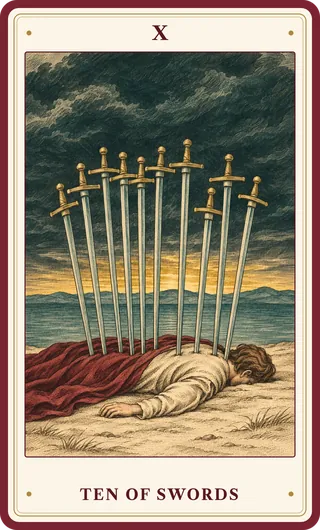
Ten swords in the back
The full count of swords shows an ending that is complete, with nothing left to attack. It is the suit of the mind taken to its limit, which is why the card reads as a final no.
Figure lying face down
The body is still and has stopped struggling. It shows surrender and exhaustion, the moment when resistance is over.
Black sky
The darkness stands for the lowest point and the end of hope in the old form. It also means there is no further to fall.
Golden dawn on the horizon
A band of light breaks the dark at the edge of the scene. It promises that something new can begin once this ending is accepted.
Calm water and distant hills
The sea is flat and quiet, so the storm is over. Peace follows the crisis, though it arrives slowly.
Red cloak
The red cloth is the one splash of life and passion in a cold scene. It hints that vitality has not been lost, only knocked down.
Raised fingers
The figure's hand is held up in a small gesture of blessing or acceptance. It shows that surrender can be an act of peace rather than defeat.
Ten of Swords yes or no for health
Take this section with care: tarot cannot diagnose or predict medical outcomes, and a card is never a substitute for a doctor. Read the Ten of Swords as a comment on strain, not on prognosis.
Upright, it often points to exhaustion, burnout or a low point where the body and mind have had enough. For “will I feel better soon?” the answer is not yet, and for “do I need to rest?” it is a firm yes. The card tells you to stop pushing and ask for help.
Reversed, it suggests that energy is returning and recovery is under way. Pace yourself, because a reversed Ten still carries the memory of the collapse. If you are in real distress or feel unsafe, contact a doctor, a counsellor or an emergency service rather than a deck.
How long until the yes?
Timing questions work differently from yes or no, but people ask them alongside. The Ten of Swords suggests the ending is immediate or already past, while the recovery is slower. A good rule is that the no arrives quickly and the yes arrives gradually.
In a reading, a reversed Ten often marks the point where the worst is behind you but healing is not finished. You should not expect a date from the card. A better use is to take the dawn on the horizon seriously: it tells you the direction of travel, not the hour. For a fuller approach, see tarot timing.
Ten of Swords with other cards in a yes or no spread
In a multi-card yes or no spread, the Ten of Swords sets the tone, but its neighbours shape the answer. A few pairings come up often:
- With the Tower: a hardened no, a sudden and complete collapse.
- With Death: a yes to renewal, but only after the ending finishes.
- With the Sun: the worst is over and recovery is strong.
- With the Ace of Swords: a clear new start after the ending.
A three-card line works well here: the situation, the ending, the outcome. If the Ten falls in the first position, it describes where you are. If it falls in the last, the no applies to where the question is heading. The 3 card tarot page explains how to read positions.
How to ask a question the Ten of Swords can answer
The card is only as clear as your question. Questions that mix two things, such as “should I leave and will he miss me?”, will give a muddy answer. Ask one thing at a time, in a way that has a real yes or no.
Here are questions that work well with a card this final:
- Is this relationship over?
- Should I let go of this plan?
- Will I recover from this setback?
- Is it time to walk away?
Questions that work poorly include “will they change?” and “will this get easier if I keep trying?”, because the card will give a no that you may not want. If you want help framing questions, questions for tarot reading has examples, and the yes or no tarot reading tool lets you ask a single question and draw a card.
What to do after you draw it
A no from the Ten of Swords can feel heavy, but it is useful. It tells you where to stop spending energy. The most practical reaction is to accept the ending first and plan second, because trying to plan around a situation you refuse to see as finished usually fails.
Some readers draw a second card for what comes next, and that is a good habit. Others let the day pass before asking again. Asking the same question over and over until you get a yes is the one thing to avoid, since it tends to bury the real message.
Try this: Write down what has ended, in one sentence, with no hope or blame in it. Then write one thing that is still yours: a skill, a friend, a habit, a place. Keep both lines together for a week.
Is the Ten of Swords the worst card in the deck?
It looks like it, but it is not a card of fresh disaster. The damage is done in the picture, and the figure is not being attacked any more. Many readers find it one of the most honest cards, since it describes a low point without offering false comfort.
It is also not a death card in the literal sense. Death is about transformation, while the Ten of Swords is about the end of a painful struggle. If the sky and the sea in the picture feel hopeful to you, you are reading it right. For a related card that is lighter and about leaving a hard situation behind, see the Six of Swords yes or no.
Quick reference
If you only need the summary: upright is a no, reversed is a conditional yes, and the card is a yes to endings and relief. It is a no to continuing, reconciling, investing more or waiting longer. When you want the full symbolism and every meaning in love, work and life, return to the main Ten of Swords page, and use the random tarot card generator if you want to draw again for a new question.
Questions readers ask
Is the Ten of Swords a yes or a no?
Upright, the Ten of Swords is a no. It says the situation has reached its end and will not continue in its current form. Reversed, it becomes a conditional yes that points to recovery rather than a return to how things were.
Can the Ten of Swords ever mean yes?
Yes, when the question is about ending something. If you ask whether you should leave, close a chapter or stop fighting, the card answers yes, it is time. It also leans yes when reversed and the question is about healing.
What does the Ten of Swords mean for a yes or no question about love?
It is a firm no to reconciliation, rekindling or holding on to a relationship that has already ended. It is a yes to letting go and to the pain finally being over. Reversed, it suggests healing is possible but not quick.
Does the Ten of Swords mean something terrible will happen?
No. The card shows an ending that has already happened or is unavoidable, not a prediction of fresh disaster. The dawn in the image tells you the worst point is also the turning point.
Is reversed Ten of Swords a yes or no?
Reversed, it is a qualified yes or a maybe, depending on the question. It supports recovery and new starts, but it warns against rushing or clinging to the old situation. If you ask about quick results, expect a not yet.
What should I do after pulling the Ten of Swords for a yes or no question?
Accept the no for the question as you asked it, then ask a new question about what comes next. A good follow-up is what you need to let go of or what the next step toward recovery is.