
Four of Pentacles Yes or No: What the Card Answers

- Arcana
- Minor Arcana, Suit of Pentacles
- Element
- Earth
- Yes or no
- Maybe
savingsecuritycontrol
setbackspoor planningfinancial worry
The Four of Pentacles is a cautious, conditional answer. Upright, it is a yes when your question is about saving, protecting or holding steady, and a no (or “not yet”) when your question is about taking a risk, spending freely or making a sudden change. Reversed, it leans yes to letting go, giving and moving, with a warning against overspending or clinging.
If you need one word from an upright draw, say “not yet.” That is not a rejection. It is the card of someone who sits on solid ground and refuses to move until they feel safe, and the answer follows from that image. The rest of this page shows how to read that lean for love, work, money and everyday decisions. For the full card meaning, see the Four of Pentacles card page.
Four of Pentacles upright as yes or no
Upright, the card reads as a yes to anything that keeps you secure. If you ask “Should I keep my current job while I look around?” or “Should I hold on to my savings this month?”, the Four of Pentacles supports that choice. It is the card of the budget, the locked drawer and the steady routine.
It becomes a no for questions that need openness and movement. “Should I lend this money?” “Should I quit with no plan?” “Will they open up to me this week?” In each case the card shows someone with both hands full and both feet planted, and that figure does not say yes to change easily.
That is why the one-word summary is “not yet.” The card is not forbidding the outcome. It is telling you the conditions for it are not in place, and that a tight grip, yours or someone else’s, is the obstacle.
Four of Pentacles reversed as yes or no
Reversed, the grip loosens, so the card turns toward yes for questions about release. “Should I finally spend on this?” “Should I let this go?” “Will they let me in?” are all questions where the reversed card leans yes. Money gets moving, walls come down and a stuck situation begins to shift.
The reversal has a darker side, though. It can describe overspending, greed or a control problem that has spilled over into possessiveness. If your question is “Is my money safe?” or “Is this person being honest about what they have?”, the reversed card is a warning, and a no. There is more on that spread of meanings on the reversed Four of Pentacles page.
To decide which way a reversal leans, ask what is being released. If something good is being freed, such as generosity, a decision or a stuck project, read yes. If something you need to keep safe is slipping away, read no.
Why the Four of Pentacles gives a split answer
The Rider-Waite-Smith image explains the mixed answer. A crowned figure sits on a stone block, with one coin on the head, one held to the chest and one under each foot. Nothing is leaving this person, and nothing is coming in either. The card is about security, and security is a good thing until it becomes the only thing.
Four is also the number of structure, foundations and stability. In the tarot’s numbering, it follows the fresh start of the ace, the choice of the two and the early growth of the three, then stops to consolidate. Consolidating is useful, and it is also a pause. The card lands in that gap between “I have something” and “I am afraid to lose it.”
Because the card holds both strength and fear, different readers give different yes or no answers. Some read it as a plain yes (security supports your goal), some as a no (fear blocks it) and some as a maybe. The most useful reading depends on what your question actually asks. That is the method used on this page.
Read Four of Pentacles for your question
Upright: A guarded no or a slow not yet: someone is protecting their heart, and the relationship needs more trust before it can move.
Reversed: A yes to opening up: walls come down, possessiveness eases and affection is finally shared, though it can also mean clinging in a messier way.
Upright: They care but feel the need to stay in control, so affection arrives in small, carefully measured amounts.
Reversed: The guard is dropping, and real feelings are starting to show, or the person has swung into jealous, grasping behavior.
Upright: A yes to staying put and protecting your position, a no to risky moves, big spending or a sudden leap.
Reversed: A yes to taking the leap or sharing resources, with a warning against reckless spending or holding back out of fear.
Upright: A yes to saving, budgeting and keeping what you have, and a no to lending, splurging or speculative bets.
Reversed: A yes to spending or investing with purpose, and a no to hoarding, overspending or financial secrecy.
Upright: Protect what matters, but check that your grip is not turning security into a cage.
Reversed: Loosen your hold on purpose, and give or spend where it will do some good.
Upright: Rest and routine help, though tension held in the jaw, shoulders or gut needs release.
Reversed: Stiffness is easing and you are ready to change habits, but watch for overcorrecting or neglecting limits.
How to ask a question the Four of Pentacles can answer
Yes or no tarot works best when the question has a clear outcome and a time frame. “Will I get the promotion?” is vague about what “getting” means. “Should I accept the offer to move teams in the next month?” is a question the card can speak to. Closed questions like these give you a lean you can act on.
Also decide before you draw what each answer means. If the Four of Pentacles comes up, are you asking about holding or changing? Write one sentence: “A yes means I keep things as they are, and a no means I make the change.” Without that, any card can be bent to fit what you hoped to hear.
If you are stuck for wording, the questions for tarot reading page has plenty of examples, and the yes or no tarot tool lets you draw a card for a question straight away.
Try this: Before you draw, write your question and finish this sentence: “If the answer is yes, I will ___.” If you cannot finish it, the question is not ready yet.
Four of Pentacles yes or no in love
In love, the upright card is usually a guarded or slow answer. It shows someone who protects their heart, their time and their independence. If your question is “Will they commit?” or “Will we get back together?”, expect a not yet. The card suggests the person is still counting the cost, and pressure will make the grip tighter.
It can be a yes for stability questions. “Is this relationship steady?” “Are we building something solid?” The Four of Pentacles in a long relationship often describes loyalty, shared finances and a settled home. The risk is possessiveness, and the card quietly asks whether protection has become control.
Reversed, it leans yes to opening up. Someone who has held back may start to share, make space or say what they feel. It can also show a partner who has swung into jealousy or clinginess, so look at the surrounding cards and the behavior in front of you, not only the lean. If you want more on one person’s feelings, the Eight of Cups as a yes or no answer is a useful contrast: that card walks away where the Four of Pentacles stays.
Four of Pentacles yes or no for career
At work, the upright card says yes to stability. Keep the job, protect your position, build savings before a change, document your work. It is a good draw if you are asking whether to stay in a secure role during an uncertain time.
It leans no for leaps. If you ask “Should I start my own business now?” or “Should I take the risky offer?”, the card suggests you are not ready, or the plan has too little cushion. It can also describe a boss or workplace that is guarded with information, promotions or credit, so a request for more may meet a closed door.
Reversed, the card gives you permission to move. It can show a stuck situation finally freeing up, an offer to share responsibility or the confidence to leave a role where you have been hanging on out of fear. Pair the card with the steady effort of the Eight of Pentacles if you want to see what building skill, not just holding on, looks like.
Four of Pentacles yes or no for money
Money is where this card is most at home. For saving, budgeting and holding a reserve, it is a clear yes. For a question like “Should I pay off debt before investing?” or “Should I keep an emergency fund?”, the card backs a careful approach.
It is a no for spending that is driven by hope rather than a plan. Lending to a friend, a large purchase or a speculative investment all run against the card’s grain. The upright figure would sooner hold three coins than risk the fourth.
Reversed, the card can mean either of two things, so read it by context. It can be a yes to spending after a long period of scrimping, or a warning about money slipping through your fingers. If your question was about a purchase you have been putting off, it often says go ahead. If it was about whether your funds are safe, treat it as a caution. A money tarot spread can give you more detail than a single card.
Four of Pentacles in health and boundary questions
For health, the card describes tension, routine and holding on. It is a modest yes for rest, structure and protecting your energy, and a prompt to notice where you clench. Jaw, shoulders and stomach are the usual places. Tarot is not medical advice, so use the card to notice patterns and see a professional for anything physical.
Boundaries are the healthier face of this card. If you ask “Should I say no to this request?” or “Should I protect my time this week?”, the Four of Pentacles often says yes. The figure on the stone block is not apologizing for what they have, and that can be a good model when you are being drained.
Reversed, it can suggest that your boundaries are too rigid or too loose. Ask which one fits. Someone who has been closed off may need to let people in, while someone who gives too much may need to close the gate.
Four of Pentacles card symbols
Choose a symbol to read what it means on the card.
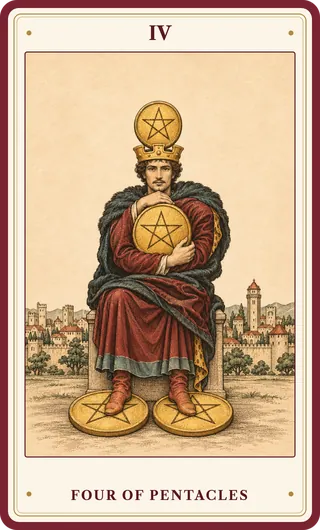
The crown with a pentacle
A coin sits on the figure's head like a crown. It shows that wealth and security occupy the mind first, and may block clear thinking.
The pentacle held to the chest
The figure clutches one coin against the heart. It points to protectiveness and emotional guarding as much as money.
The two pentacles under the feet
A coin is pinned beneath each foot. This is stability in the literal sense, but also a figure who cannot move without letting go.
The stone seat
The figure sits on a solid block rather than standing or walking. It signals stillness, permanence and a decision to stay put.
The city behind
A town sits in the background, turned away from. It hints at community, trade and opportunity that the figure is not engaging with.
The cloak and crown
The figure is dressed as someone of status and standing. It suggests a person who has built something and fears losing it.
How surrounding cards change the answer
A single card gives a lean, and its neighbors give the context. In a yes or no spread the cards on either side can turn a not yet into a yes or confirm a no. Pair the Four of Pentacles with a card of opening or growth and the grip softens. Pair it with a card of loss or blockage and the grip tightens.
Some pairings to know:
- With the Ace of Pentacles: a yes to a new financial start, held carefully. See the Ace of Pentacles yes or no page.
- With the Ten of Pentacles: a yes to lasting security and family wealth, though it may take time to build.
- With the Eight of Cups: a no to staying, because one card holds on while the other leaves.
- With the Two of Pentacles: a not yet, because money is tight and juggling continues.
When the neighbors disagree, trust the card closest to your question’s key word. If you asked about money, let the pentacles lead. If you asked about someone’s feelings, give weight to the cups.
Timing: how fast does the answer come?
The Four of Pentacles is a slow card. It rarely signals a sudden result. If your question is “When?”, expect weeks or months rather than days, and expect the timeline to depend on how quickly someone is willing to let go of their caution.
In its Golden Dawn attribution the card is linked to the Sun in Capricorn, an earth sign associated with patience and long-term effort. That fits the image: results come through persistence, not speed. If your question has a deadline, the card suggests you may miss it unless you take steps to loosen things up. The tarot timing page shows how to ask time questions more precisely.
When the card is reversed, timing speeds up. A reversed Four of Pentacles can indicate that something stuck is about to move, so the wait may be shorter than you feared.
Using the card in a three-card yes or no reading
One card gives a lean, and three give a story. A simple 3 card tarot layout works well: the first card shows what is holding you back, the second shows what you need to protect, and the third shows what happens if you hold or release.
If the Four of Pentacles lands in the first position, fear or control is the obstacle. In the middle, it tells you the thing you are protecting is worth keeping. In the third, it suggests the outcome is stability, though perhaps at the cost of growth. Where it falls changes its meaning, so write down the position before you decide the answer.
Try this: Draw three cards for one yes or no question. Before you read them, say aloud whether the question is about holding on or letting go. Then see which card disagrees with you.
When the answer feels wrong
Sometimes you draw the Four of Pentacles and feel a flash of resistance, particularly if you wanted a plain yes. Notice that. Often the feeling is the card working. It asks where you are guarding something, and a defensive reaction suggests it found the spot.
Resist the urge to draw again until you get the answer you want. A second draw for the same question usually muddies the reading. If you are unsure, change the question instead: ask what you need to understand about the situation, not whether it will work out.
Also check the question itself. If the card does not seem to fit, the question may be too broad or may contain two questions at once. “Should I move and take the new job?” is two decisions. Split it and draw again.
Example questions and likely answers
Here is how the card tends to read for common questions:
- “Should I keep saving instead of spending?” Yes, upright.
- “Should I lend money to a family member?” No, or not yet, upright.
- “Will my partner open up about their feelings?” Not yet upright, yes reversed.
- “Should I stay in my current job this year?” Yes, upright.
- “Should I finally make this big purchase?” Reversed leans yes, upright leans no.
These are leans, not verdicts. The same card can mean something different depending on your real circumstances, so test the reading against what you know.
Common mistakes when reading this card as yes or no
The most common mistake is treating the card as a plain yes because it looks like money and stability. The figure looks successful, but the image is about what they cannot do. Another is treating it as a plain no because the figure appears stingy. Protecting what you have is often wise.
Other mistakes to avoid:
- Ignoring the question: the same card means different things for “Should I save?” and “Should I give?”
- Skipping the reversal: a reversed card changes the lean, so note orientation before you read. The reversed tarot cards guide covers how.
- Reading it as a prediction: it describes the energy around a choice, not a fixed result.
- Forgetting the neighbors: a lone card has less context than a spread.
What to do after drawing the Four of Pentacles
Treat the card as a prompt to check your grip. Ask what you are protecting, and whether the protection is still needed. Often the card is not saying “do not act.” It is saying “act from a place of security, not fear.”
If the answer is yes to staying put, make the holding deliberate. Set a budget, build the reserve, write down the boundary. If the answer is not yet, set a date to revisit and name one small step that would loosen things. If it is reversed, pick one thing to release, such as a payment you have delayed, a conversation you have avoided or a coin you have clutched.
For a sense of where this card ends up when security finally pays off, read the Ten of Pentacles as a yes or no answer. It is the Four of Pentacles with the fear gone and the wealth shared.
Try this: Write down one thing you are holding tightly right now, such as money, a plan or a feeling. Decide whether to keep holding it, and put the reason in one sentence.
Questions readers ask
Is the Four of Pentacles a yes or no card?
It is a conditional answer. Upright, it is a cautious yes for questions about saving, protecting and staying put, and a no or not yet for questions about risk, spending or sudden change. Reversed, it leans yes to release and movement.
Is the Four of Pentacles a yes in love?
Usually a slow or guarded yes at best. The card shows someone protecting their heart, so the answer is more likely not yet than a warm, immediate yes. Reversed, it leans yes as walls come down.
Does the reversed Four of Pentacles mean yes or no?
It leans yes when the question is about letting go, giving, spending or moving on. It leans no when your question is about holding something safe, because the reversal warns that control or money is slipping.
Is the Four of Pentacles a yes for money questions?
Yes if you are asking whether to save, budget or hold on to what you have. No if you are asking about lending, large purchases or speculative investments.
Can I trust one card for a yes or no answer?
Treat it as a prompt rather than a prediction. A single card gives you a lean, and the quality of your question, the cards around it and your own circumstances matter just as much.
What should I do if I draw the Four of Pentacles for a big decision?
Slow down and check your facts before you commit. Ask what you are afraid to lose, and whether protecting it is wise or just habit.