
Page of Wands as a Yes or No Answer

- Arcana
- Minor Arcana, Suit of Wands
- Element
- Fire
- Yes or no
- Yes
enthusiasmexplorationideas
delayslost motivationscattered energy
The Page of Wands is a yes. Upright, it answers a question with a warm, energetic “go ahead,” especially when the question is about starting something, trying something or reaching out. Reversed, it softens to “not yet” or “maybe,” because the excitement is there but the focus and follow-through are missing.
This is a card of beginnings and first attempts, so its yes comes with a condition: it favors the start, not the finish. That is the part most quick answers skip, and it is the part that helps you decide what to do. Below you will find how the card answers questions about love, work and money, how reversal changes things, and how to tell a strong yes from a polite one.
The short answer: a yes with a small catch
If you want a quick verdict, here it is. Upright means yes. Reversed means not yet. If you want the full picture of the card first, our Page of Wands meaning page covers every suit of life it touches.
The catch is that the Page is a beginner. He is the first rung of the Wands court, the one who has just been handed a spark and wants to run with it. His yes is real, but it belongs to curiosity, experiments and first steps. If your question is whether something will last, succeed or pay off in full, the card cannot promise that. It can only tell you the start is worth making.
Think of it as the answer a friend gives when you say “should I try this?” and they light up. They are not guaranteeing the outcome. They are telling you it is worth finding out.
Why the Page of Wands leans yes
Wands is the suit of fire: drive, passion, creativity and action. Fire cards tend to read as yes in a yes or no spread because they move forward. The Page sits at the start of that energy, which makes him one of the most forward-leaning cards in the suit.
The Page is also a messenger. In many readings the card points to an invitation, a piece of good news or an idea that arrives suddenly. A messenger arriving is a “yes, something is coming” kind of image, which supports a positive reading. If you are sitting with a decision, the card’s tone is: stop analysing and start.
There is a simple test for why this works. Ask whether the question is about movement or about holding still. The Page answers movement questions with yes. It has nothing to say about patience, endurance or waiting out a storm, which are jobs for cards like the Nine of Wands.
Page of Wands reversed: yes or no
Turned upside down, the Page of Wands stops being a clear yes. The most reliable reading is “not yet.” The spark exists, but it is scattered, rushed or not backed by a plan. You may be excited and also stalling, or starting several things and finishing none.
A reversed Page is rarely a flat no. It more often says the answer depends on you doing one thing first: narrowing your focus, finishing a small task, or waiting until your enthusiasm has survived a few ordinary days. If you ask “should I quit my job to start this?” and the Page comes up reversed, the card is asking whether the idea has been tested yet.
For a deeper reading of every situation the reversal covers, see Page of Wands reversed. If you are new to how reversals work in general, reversed tarot cards explains the approaches readers use, including the choice to read without them at all.
Try this: Ask your question, draw the Page of Wands reversed, and write down the single smallest action that would test your idea this week. If you complete it, ask the question again and see what the card says.
Read Page of Wands for your question
Upright: A yes to flirtation, a first date or a message sent out of pure excitement, though it speaks to the spark more than to long-term commitment.
Reversed: Not yet: mixed signals, a crush that fizzles, or someone who loves the chase but will not follow through.
Upright: They are curious, excited and eager to know you better, and they are probably not hiding it well.
Reversed: Their interest is scattered or immature, so the feeling is real but it does not yet have steady direction.
Upright: Yes to applying, pitching, studying or trying a new role as a learner, with enthusiasm counting for a lot.
Reversed: Hold off: the idea is unfocused, you are procrastinating, or the offer is not as exciting as it sounds.
Upright: A small, curious step with money is favored, such as a first sale, a side project or a low-cost experiment.
Reversed: Do not gamble on a half-formed plan: spending outpaces planning and the numbers are not ready.
Upright: Say yes, start small, and let curiosity lead while you learn as you go.
Reversed: Pause, pick one idea, finish one small thing, and then decide whether the interest is real.
Upright: Restless energy wants an outlet, so a new activity, class or routine is a good yes.
Reversed: Burning out, starting and quitting routines, or ignoring tiredness because you are chasing the next thing.
How strong is the yes?
Not every yes is equal. A useful way to read the Page of Wands is as a “yes with strength” that shifts with context. Here is a simple guide:
- Upright, with supportive neighbors: a clear, confident yes.
- Upright, on a question about commitment or long-term results: a cautious yes.
- Reversed, on a question about starting something: not yet, with a task attached.
- Reversed, with blocking or heavy cards beside it: lean no for now.
This scale matters because a single word, “yes,” hides the nuance that makes the answer useful. The Page of Wands says yes loudly to enthusiasm and quietly to certainty, so listen for which one your question is really asking about.
Page of Wands yes or no in love
In love, the Page of Wands is a yes to the beginning of things: a new crush, a flirtatious exchange, a first date, a message you send because you could not wait. If you ask “does this person like me?” or “should I ask them out?”, the upright card says go for it.
The yes weakens when the question is about depth. “Will we be together long-term?” or “Are they ready to commit?” asks the Page to speak for a stage of life he has not reached. He is playful and sincere in the moment, but he is still learning what he wants. For a relationship question like that, look to cards of maturity such as the King of Wands or the Ten of Cups.
Reversed, the Page can point to a lack of follow-through: someone who texts in bursts, loses interest quickly, or acts younger than their age. That is a “not yet” for a serious partnership, and a good sign to ask whether you are looking for the same pace.
Page of Wands yes or no for career
For work, the Page of Wands is a strong yes to learning, applying and pitching. Think of a course, an entry-level role, a trial project, a creative experiment or a first client. Enthusiasm counts as a real asset when you are starting out, and the card knows it.
If your question is “should I take this new job?” and the role lets you grow into it, the answer is yes. If the job requires you to prove deep expertise immediately, the answer is a cautious yes: you may be underprepared, so ask what support you will have.
Reversed, the card warns of procrastination, a half-formed plan, or a role that sounds more exciting than it is. A useful follow-up is to draw a clarifier from the Wands suit, such as the Knight of Wands, which tells you whether the momentum will arrive or stall.
Page of Wands yes or no for money
Money questions are where the Page needs the most care. The card favors small, curious steps: a first sale, a side project, a low-cost experiment or a skill that could earn later. In those cases the answer is yes.
It is a poor guide for big financial bets. A large investment, a major purchase or a risky loan needs the steadiness of earth cards, and the Page is a fire card in its first week of life. If your question is “should I put my savings into this?” and the Page appears upright, read it as “start with a test, not the whole amount.”
Reversed, spending tends to outrun planning. The numbers are not ready, and excitement is standing in for research. Treat it as a gentle brake, and consider drawing again with a money tarot spread to look at the situation more fully.
Page of Wands as a yes or no for decisions and advice
When the Page of Wands answers a “should I?” question, the advice is to try it. This is the card that says the weird idea is worth a test run. It rewards curiosity over perfection, and it suggests you will learn more from doing than from thinking.
Upright, the guidance is: start small, share the idea, ask questions and accept being a beginner. The Page does not mind looking new, and neither should you. If you have been waiting for confidence before you begin, the card tells you confidence comes after the first attempt.
Reversed, the advice flips to focus. Pick one idea. Finish one small thing. Notice whether you still want it after the thrill fades. That is often the clearest way to turn a reversed Page into a yes.
Try this: Before you ask, write your question as a decision about a first step, not an outcome. “Should I send the application?” works better than “Will I get the job?” Then draw and read the Page in that light.
Page of Wands card symbols
Choose a symbol to read what it means on the card.
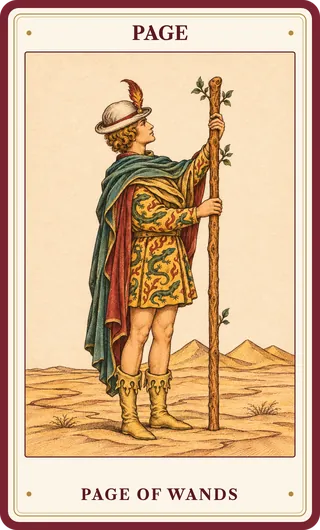
The leafing wand
The Page holds a staff with green leaves sprouting from the top. It shows a living idea that is just starting to grow, which is why the card leans yes to new beginnings.
Salamander tunic
His yellow tunic is patterned with salamanders, a classic fire creature. It ties him to passion and transformation, and shows he wears his enthusiasm openly.
Feathered hat
A red feather rises from his cap, a sign of lightness, messages and youthful confidence. It supports the card's reading as news or an invitation arriving.
Desert pyramids
Three small pyramids sit in the distance behind him. They suggest long-term goals he has not reached yet, and a reminder that the yes is about starting, not arriving.
Dry, open landscape
The ground is sandy and bare under a warm sky. There is room to move and nothing built yet, so the answer is open ground and not a finished result.
Gaze fixed on the wand
The Page looks at the top of the staff, not at the horizon. He is absorbed in what he has just found, which explains both his excitement and his tendency to lose focus.
Questions where the Page of Wands is a weak yes
The Page is positive, but some questions ask for qualities he does not have. In these cases, expect a softer answer or consider reframing the question:
- “Will this relationship last?” (the card speaks to sparks, not staying power)
- “Will I definitely succeed?” (the Page cannot promise results)
- “Is this investment safe?” (fire favors experiments, not security)
- “Is this person emotionally mature?” (the Page is young by nature)
None of this makes the card unhelpful. It simply tells you that the honest answer to those questions is “it is too early to say.” You can then ask a better question, such as “what is the best first step?”
How neighboring cards change the answer
In a multi-card reading, the Page of Wands does not stand alone. The cards beside it can strengthen or temper the yes. Next to the Ace of Wands, the answer becomes a bright green light, because both cards speak of a spark that is ready to be used.
Next to heavy or restrictive cards, such as the Ten of Wands or Eight of Swords, the yes narrows. The idea is good, but burden or fear may get in the way. Next to the Page of Swords, the energy turns toward talk and planning: a yes if you are willing to think it through, and a warning if you are only talking.
When two pages appear together, read it as two beginners learning together. That is a yes for shared projects, though they will need a steady hand nearby. Court cards can also tell you whether the Page is a person or a message, which leads to the next point.
Reading the Page of Wands as a person or a message
Sometimes the Page represents a real person: a young, enthusiastic, creative individual, or an adult with a youthful, playful spirit. If your question is about “who” or “will I hear from them,” the card often answers yes, with news arriving in a bright, sudden way.
Other times the Page is the message itself. It may be a text, an invitation or an idea. In a yes or no context, this makes the answer a quick yes: something is coming, and it is likely to be light and promising.
For help telling these cases apart, see our guide to court cards in tarot, which explains how to decide between a person, a role and an energy.
What the imagery tells you about the answer
The Rider-Waite-Smith picture is a quiet argument for the yes. A young figure stands in a dry, open landscape, studying a wand that has begun to sprout green leaves. His tunic is covered in salamanders, a fire symbol, and a feather sits in his cap.
Notice where he is looking: at the wand, not at the distance. That is the card’s whole message in one pose. He is absorbed in a new idea, and the yes belongs to that absorption. Behind him, small pyramids stand far away, a reminder that the big goals are a long walk from here.
When the image feels exciting and light, the answer is yes. When you notice the empty ground and the distant pyramids more, the card is reminding you that a lot of work lies between the spark and the result.
How to ask the question so the card can answer
Yes or no readings work best when the question is clear and about action. The Page of Wands responds well to questions with the word “start,” “try” or “send.” Vague or fatalistic questions tend to give vague answers.
A simple method:
- Write one question that can be answered with a yes or a no.
- Keep it about a decision you control.
- Shuffle, draw one card and note whether it is upright or reversed.
- If it is the Page of Wands, read the strength using the guide above.
- Write down the first step the card suggests.
If you would like to practice with a tool, try the yes or no tarot reading page, which lets you draw a card for any question and see how its answer compares with what you expected.
Using the Page of Wands in a three-card yes or no spread
A single card can feel thin, so many readers add context. A 3 card tarot layout works well for this: the first card is your situation, the second is the answer, and the third is advice or the likely result.
If the Page of Wands lands in the answer position, read it as a yes to beginning. If it appears as the situation card, it describes where you are: excited, curious and at the start. If it appears in the final position, it suggests the outcome is a new beginning, which may be more of a fresh chapter than a settled result.
Try this: Draw three cards for your question and place the Page of Wands, if it appears, in the sentence “The answer is yes to starting, as long as I ___.” Fill in the blank with whatever the other two cards suggest.
When to draw again
If the Page of Wands comes up and you still feel unsure, do not redraw the same question over and over. Instead, ask a follow-up about the specific doubt. For example, if the card says yes to a new job, ask “what should I watch out for?” and read the new card as a response to that.
Redrawing for the same yes or no tends to produce confusion, not clarity. One honest draw, a clarifier and a written next step is usually enough. If the answer is a reversed Page, give yourself a few days, finish the small task the card suggests, and return with a new question.
The Page of Wands is a card that rewards action over analysis. Whatever the answer, it is most useful when it leads to a small, real step you can take today.
Questions readers ask
Is the Page of Wands a yes or no card?
Upright, the Page of Wands is a yes, especially to starting something new, learning or reaching out. Reversed, it becomes a not yet or a maybe, because the energy is there but the focus is not.
Is the Page of Wands a yes for love?
It is a yes to attraction, flirting and early dating. It is a weaker yes to commitment, because the Page is young and still learning what he wants.
What does the Page of Wands mean as a yes or no for a job?
Yes to applying, interviewing and taking a role where you can learn. If the job demands proven expertise right away, the answer softens to a qualified yes.
Is the reversed Page of Wands a no?
Usually it is a not yet, not a hard no. The reversed card points to delays, scattered effort or an idea that needs more thought before you commit.
Can the Page of Wands mean no?
It can lean no when the question needs maturity, stability or proven results, such as a guarantee of commitment or a large financial bet. The card favors beginnings, not certainty.
How do I know how strong the yes is?
Look at the question type, the card's orientation and the cards beside it. A Page of Wands next to supportive cards like the Ace of Wands is a clear yes, while next to heavy or blocking cards it becomes a cautious one.