
Knight of Swords Tarot Card Meaning (Upright & Reversed)

- Arcana
- Minor Arcana, Suit of Swords
- Element
- Air
- Yes or no
- Yes
ambitionhastedirect action
confusionrecoveryrelease of mental strain
The Knight of Swords means fast, decisive, mentally driven action. He is the card of the person or the moment that charges toward a goal with total focus, sharp words and very little patience. Upright, it supports courage, honesty and quick progress. It also warns that speed without a plan can leave damage behind.
In a reading, this card often arrives when something needs to move now: a conversation you have put off, a decision that cannot wait, or a person who comes on strong. Below you will find what the card shows, how it reads in love, feelings, work, money and health, how it works as a person and a yes or no answer, and how it behaves next to other cards.
Knight of Swords at a glance
If you only need the quick version, these are the core ideas most readers attach to the card.
- Upright keywords: action, speed, ambition, courage, directness, focus, momentum, a mind on a mission.
- Reversed keywords: recklessness, impatience, aggression, scattered energy, burnout, empty talk.
- Element: Air, the suit of thoughts, words and decisions.
- Core question: are you moving fast because it is right, or because slowing down feels uncomfortable?
Think of the card as a thought turned into motion. Where the Page of Swords is curious and gathering information, the Knight has already decided and is riding.
What the card shows
In the Rider-Waite-Smith deck, a knight in full armour gallops across an open landscape on a white horse. His sword is raised, his body leans forward and the horse is stretched out at speed. Behind and around him, trees bend in a strong wind and clouds gather in a stormy sky.
Nothing in the image slows him down. He rides straight into the wind rather than around it, which is the whole personality of the card in one picture. The sky is not calm and the ground ahead is unmarked, so he is going fast without any visible road. That detail matters: the energy is real, but the plan may not be.
Smaller details add nuance. Butterflies on his tunic and birds on the horse’s harness are both air symbols and suggest a mind that moves quickly from one thing to another. You can see every symbol in more detail in the symbols section of this page.
Try this: Look at the card for one full minute and ask what the knight can actually see ahead of him. Then write down one situation in your life where you are moving at his speed, and what you can or cannot see ahead of you there.
Knight of Swords upright meaning
Upright, the Knight of Swords is a call to act. Your thinking is clear, you know what you want to say or do, and hesitation is costing you more than a mistake would. The card supports speaking up, setting a boundary, starting the project or defending a principle with energy and conviction.
It also describes a certain kind of intelligence: quick, verbal and decisive. This is the mind that cuts through waffle and gives a straight answer. When you need to push through resistance or finish a stalled task, the Knight shows the mental drive that gets it done.
The caution built into the card is that this energy is not patient. The Knight sees the target and goes, which can mean trampling over details, other people’s feelings or his own limits. Treat an upright Knight as permission to move fast, and as a reminder to check your facts and your tone as you go.
Read Knight of Swords for your question
Upright: Direct, fast and intense: a partner or a phase that moves quickly, says exactly what it thinks and wants an answer now.
Reversed: Mixed signals, cutting words or a sudden retreat: someone who rushes in, then bolts, or an argument that escalates too fast.
Upright: They feel strongly and want to act on it, but the feeling lives in the head first and may come out blunt rather than tender.
Reversed: They feel agitated, defensive or unsure, and may be reacting to pressure instead of telling you what is really going on.
Upright: A green light for bold moves, a fast pitch or a hard push toward a deadline, as long as the groundwork is done.
Reversed: Burnout, careless mistakes, office conflict or a scattered push that burns energy without finishing anything.
Upright: Quick decisions and decisive action with money, which can pay off if backed by research.
Reversed: Impulse spending, risky bets or a hasty investment you may regret.
Upright: Act now, speak plainly and commit to the plan, but check your facts before you charge.
Reversed: Stop, slow down and think again before you send the message, quit the job or make the leap.
Upright: High mental energy and a fast pace: good for motivation, but watch for overdoing it and running on adrenaline.
Reversed: Nervous tension, racing thoughts, poor sleep and accident-prone haste call for rest and a slower rhythm.
Knight of Swords reversed meaning
Reversed, the Knight’s energy loses direction. Speed turns into recklessness, confidence into arrogance and directness into harshness. You may be arguing to win rather than to solve something, rushing a decision you have not thought through, or talking about big plans while doing very little.
It can also show the opposite problem: the charge stalls. You have the urge to act but are blocked, frustrated and restless, so the energy turns inward as tension, irritability or racing thoughts. Some readers also see a reversed Knight as someone who promises a lot and does not deliver.
The practical advice is usually to pause, cool down and re-plan. For a full breakdown across love, work and life, see Knight of Swords reversed. If reversals are new to you, how to read reversed tarot cards explains the different ways to approach them.
Knight of Swords in love
In a love reading, the upright Knight of Swords brings directness and pace. A relationship may move quickly, or a partner may say exactly what they think, confess feelings without delay or push for a clear answer about where things stand. The attraction is often intellectual: banter, debate, shared ideas and a mind you cannot stop thinking about.
For singles, the card can mean someone arrives suddenly and with force, or that you are the one who should stop waiting and make the first move. For couples, it can mean a frank conversation that clears the air, or a period of intensity and passion expressed through words more than softness.
The risks are bluntness, impatience and emotional distance. A Knight who is quick to talk may be slow to feel, and a fast start does not guarantee a long road. If the card shows up in a relationship question, ask whether the pace feels exciting to both people or only to one. Compare it with the more romantic Knight of Cups, who rides in with feeling rather than argument.
Knight of Swords as feelings
When the card describes what someone feels for you, it points to strong interest that lives mostly in the mind. They think about you a lot, they have formed opinions and they want to act. That can look like fast texts, bold invitations or sudden declarations.
It can also describe feelings that are real but not yet settled. This Knight reacts quickly and may change course just as fast, so the intensity does not always mean depth. Watch whether the actions stay steady over weeks, not just days.
Reversed as feelings, the Knight can show frustration, defensiveness or agitation. The person may feel cornered, may lash out with words they do not mean, or may pull away abruptly. In that position, the card often says they are overwhelmed, not indifferent, but it does not excuse hurtful behaviour.
Knight of Swords in career and work
At work, the Knight of Swords is a strong card for ambition and momentum. It supports pitching an idea, applying for the role, taking on a tough project or pushing a deadline through with focus. People with this energy are often seen as sharp, competitive and fast learners who get things moving.
It is also a card for communication: negotiating, debating, writing, presenting or standing up for your position. If you have been hesitating on a career move, the Knight says the window favours action, provided you have done your homework.
The shadow side shows up as impatience with colleagues, careless errors from rushing, overwork and conflict with slower-moving people. If you are the Knight, build in a check step before you send, sign or submit. If a boss or coworker is the Knight, expect speed and bluntness, and keep your own details tight.
Knight of Swords in money
With money, the card favours quick, decisive choices. It can show a fast opportunity, a bold negotiation or a decision to stop deliberating and act on a plan. Speed can work well here if the thinking has already been done.
It becomes a warning when the impulse outruns the research. Reversed, or when surrounding cards look shaky, it can point to hasty purchases, risky investments, or reacting to a headline instead of a strategy. A good rule is to let the Knight set the pace of your action and let a steadier card, such as the Four of Pentacles, set the limits of your risk.
Knight of Swords in health
In health readings, the Knight of Swords describes a very active mind and body. It can show strong motivation to start a training plan, fix a habit or tackle a health problem head on. The energy is there, so use it with structure.
It also warns of strain. A body running on adrenaline and constant thought can end up with tension, poor sleep, anxiety or injuries from rushing. Reversed, these signs become more pronounced. Tarot cannot diagnose anything, so treat the card as a reflection of pace and stress, and speak to a qualified professional about any health concern.
Try this: For one day, pause for ten seconds before every email, message or decision you feel an urge to rush. Note how many of them would have gone differently with a short pause.
Knight of Swords as a person
As a person, the Knight of Swords is quick, articulate and driven. He is the friend who says what everyone else is thinking, the colleague who volunteers for the hardest task and the partner who wants to settle an issue today. Appearance-wise, readers often link the card with sharp, restless, energetic types, but the personality matters more than looks.
At their best, these people are brave, honest and great at getting a project moving. At their worst, they are arrogant, impatient, argumentative or prone to leaving a mess when they move on. They respect competence and have little tolerance for dithering.
The card can also describe you in a specific moment, not your whole character. If it shows up as a description of yourself, ask where you are charging ahead in a way that serves you and where you are simply running from a pause.
Knight of Swords card symbols
Choose a symbol to read what it means on the card.
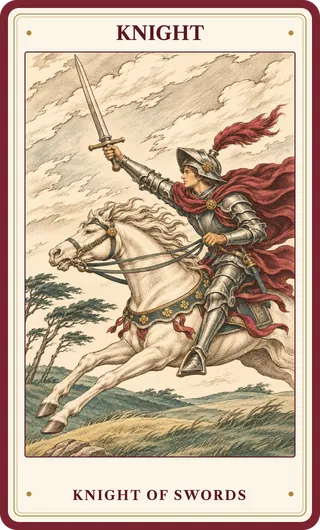
Galloping white horse
The horse is in full charge, showing speed and momentum. Its white colour points to a mind driven by ideas and conviction rather than raw instinct.
Raised sword
The sword is held high and ready, the classic Swords symbol of intellect, truth and words. Here it signals a mind committed to a cause and willing to cut straight through.
Armour
The knight is fully armoured, which shows readiness for conflict and a protective, defended stance. It also hints at someone who may be guarded about feelings.
Bent trees and wind
The trees lean hard in the wind and the knight rides straight into it. This is the Air element in action: forceful, restless change that he meets head on.
Stormy sky
Heavy clouds gather above the ride, suggesting tension, urgency and a situation that is moving fast. It warns that the pace can create turbulence.
Birds and butterflies
Birds decorate the horse's harness and butterflies mark the knight's tunic, both linked with air and the mind. They add a lighter, changeable quality to an otherwise fierce image.
Barren landscape
The ground is rough and open, with no obvious path or destination. It shows how fast the knight is going compared with how little planning may sit behind it.
Knight of Swords as a yes or no answer
For yes or no questions, the Knight of Swords leans yes. It is a card of forward motion, so it supports acting, speaking up and going ahead. The qualifier is speed: the answer is often yes, but quickly and with attention to the details you might skip.
Reversed, it leans toward no or not yet, particularly if the question is about whether to rush into something. If you want a fuller answer with context, the dedicated page on the Knight of Swords as a yes or no answer goes through the different question types.
Advice when the Knight of Swords appears
The card’s central advice is to commit and communicate. If you have been circling a decision, choose and move. If you have something to say, say it clearly and without cruelty. The Knight rewards courage and clarity, and punishes avoidance.
Balance it with a few simple checks:
- Is my information accurate, or am I reacting to a half-picture?
- Who else is affected by how fast I move?
- What is my next step, and the one after it?
- Would I still say this if I waited a day?
These questions keep the Knight’s momentum while taking out the recklessness. If the answers are uncomfortable, that is a sign to slow down before you strike.
Element, astrology and numerology
The Knight of Swords belongs to the Swords suit, which is tied to the Air element: thought, speech, logic and conflict. Knights in the court cards usually carry an active, moving quality, so many readers describe this card as fire moving through air: passion expressed through the mind. Gemini and Aquarius are common astrological links in modern decks, though different traditions assign signs differently, so use them as optional flavour.
In the court card structure, Knights represent action and the stage where an idea is pushed into the world. If court cards confuse you, court cards in tarot explains how pages, knights, queens and kings relate to each other.
Knight of Swords compared with other court cards
The Knight of Swords is easiest to understand next to its neighbours. The Page of Swords is curious and still learning, the Knight acts on what he knows, the Queen of Swords has experience and clear boundaries, and the King of Swords uses authority and judgement. As you move up the suit, the mind gets calmer and more disciplined.
The Knight of Wands is the closest cousin in energy. Both charge ahead, but the Wands Knight is driven by passion and adventure, while the Swords Knight is driven by an idea, a point to make or a problem to solve. The Wands Knight asks “what if it’s fun?” and the Swords Knight asks “what’s the fastest way to do this?”
Knight of Swords card combinations
Cards next to the Knight can show where the speed is going and whether it will help or hurt. Here are some common pairings.
- With the Ace of Swords: a clear new idea and the drive to act on it right away.
- With the Hermit: a fast mind pulled toward reflection, urging you to think before you charge.
- With the Five of Swords: conflict that escalates, or a win that costs more than it gains.
- With the Eight of Wands: very rapid movement and news, with little time to react.
- With the Nine of Swords: anxious thoughts that spur impulsive action.
For more on reading cards in pairs, try the tarot card combination calculator or the guide to powerful tarot card combinations.
Timing and speed in a reading
The Knight of Swords is one of the fastest cards in the deck, and readers often treat it as a sign that something will happen in days or a few weeks, not months. It describes sudden developments, fast messages and decisions that need to be made without a long wait.
That speed can also be a warning in itself. If the card appears in a spread about a situation that has felt stuck, it can mean things are about to shift quickly. If it appears for a slow-moving matter such as a long-term plan, it may be telling you that you are pushing too hard.
Try this: Draw the Knight of Swords and one other card, using the random tarot card generator if you like. Ask the second card where the Knight’s energy is best spent today.
Questions to ask yourself when you pull it
Because the Knight is about action, journaling questions work well with it. Try asking where you are acting from clarity and where you are acting from irritation, what you have been avoiding saying, and what you would do if you trusted your first decision.
You can also use the card as a daily prompt. If it shows up first thing in the morning, it often points to something that needs a decisive step before the day ends, such as sending the difficult message or finally starting the thing you keep postponing.
Questions readers ask
What does the Knight of Swords mean in tarot?
The Knight of Swords means fast, decisive, mentally driven action. It shows someone or something charging toward a goal with sharp focus, bold words and little patience for delay. The risk is rushing without a plan.
Is the Knight of Swords a good or bad card?
It is neither: it is a card of intensity. Upright, it supports courage, speed and honest communication. It turns difficult when the speed becomes recklessness, bluntness or aggression.
What does the Knight of Swords mean in love?
In love it describes a direct, fast-moving connection or a partner who speaks plainly and acts on impulse. It can bring excitement and clarity, but also a lack of emotional depth or staying power if the pace is too quick.
What does the Knight of Swords reversed mean?
Reversed, the Knight of Swords points to recklessness, scattered energy, aggression or a sudden stall. It can also describe someone who talks a big game but does not follow through. The message is usually to slow down and think again.
Is the Knight of Swords a yes or no card?
Usually yes, with a warning about speed. The card favours action, so it supports moving forward, but it asks you to check the details first. Reversed, it leans toward no or not yet.
Which zodiac sign is the Knight of Swords?
The Knight of Swords belongs to the Air element, and many modern systems link it with Gemini or Aquarius. Associations differ between traditions, so treat the sign as a flavour rather than a fixed rule.