
Knight of Swords Reversed: Meaning in Love, Work & Life

- Arcana
- Minor Arcana, Suit of Swords
- Element
- Air
- Yes or no
- Yes
ambitionhastedirect action
confusionrecoveryrelease of mental strain
The Knight of Swords reversed means that the card’s fast, decisive energy has lost its aim. Upright, this knight charges toward a goal with a clear mind and a raised sword. Reversed, the same charge becomes reckless haste, harsh words and arguments, or it stalls into scattered thinking, frustration and blocked ambition. The message is nearly always some form of slow down, check your facts and think about how you are coming across.
Which version applies depends on the question and the cards around it. Sometimes you are the one rushing. Sometimes the card describes another person, or a situation moving faster than anyone can manage. This guide covers each reading in love, work, money and health, how to tell whether the card is about you or someone else, and what to do about it. If you want the full picture of the card the right way up first, start with the Knight of Swords meaning.
What the Knight of Swords reversed means
The Knight of Swords belongs to the suit of Swords, which rules thought, speech, truth and conflict. As a knight, he is the part of the suit that acts. He has an idea and he goes after it at once. That is what makes him brave and efficient upright, and it is also what makes him dangerous when something tips out of balance.
Reversed, the core theme is energy without direction. Speed replaces judgment. Opinions replace information. Honesty turns into bluntness that wounds, and confidence turns into certainty that cannot be questioned. The keywords most readers use are impulsiveness, aggression, impatience, arrogance, recklessness, scattered focus and burnout.
There is a second side that many short descriptions miss. A reversed Knight of Swords can also be a knight who is held back: the charge stops, the sword is not raised, and all that drive has nowhere to go. That is the frustrated person, the stalled project, the restlessness that has no outlet. Both versions come from the same root, which is a mind moving faster than its ability to steer.
Two ways the energy goes wrong
The first is the overheated knight. Here the charge continues, but nothing is being checked. You send the message before you cool down. You sign before you read. You win the argument and lose the person. This version is loud and obvious, and it is usually what people mean when they say the card is about recklessness or aggression.
The second is the stalled knight. This is energy that cannot go forward, so it turns sideways or inward. It looks like procrastination dressed up as planning, a head full of ideas and no follow-through, or self-criticism so relentless that nothing gets started. The sword has not vanished. It is being aimed at the rider.
How do you tell which one you are looking at? Ask whether the situation has too much force or too little traction. If everything is moving too fast and people are getting hurt or confused, it is the overheated knight. If you feel agitated but stuck, or if plans keep collapsing before they begin, it is the stalled one. Many readings contain both: a burst of rushing, then a crash.
What the reversed image shows
In the Rider-Waite-Smith card, the knight gallops on a white horse across open ground, sword raised, under a sky full of moving cloud. The trees lean with the wind. Turn the card over and the whole picture reads as a charge that has lost its footing: a rider whose horse is getting away from him, momentum that cannot be controlled, a mind running ahead of the body.
The horse is worth noticing. It is the body and the sheer physical force behind the knight’s intentions. When the card is upside down, the rider is no longer in control of the animal, and that is a useful way to think about stress and haste in your own life. You may be pushing so hard that your body, your sleep or your patience is taking the damage.
The empty landscape matters too. There is no visible destination in the picture. The knight is certain, but certainty is not the same as direction. Reversed, the card asks the question the picture never answers: where exactly are you going, and have you checked that it is the right place?
Try this: Before you act on whatever this card is about, write one sentence naming the exact outcome you want. If you cannot finish the sentence in under a minute, you are charging without a target.
Read Knight of Swords for your question
Upright: Upright, it shows a fast, direct, passionate approach to romance, with honest words and a clear pursuit.
Reversed: Reversed, it warns of someone who rushes in, argues to win, runs hot and cold, or disappears once the chase is over.
Upright: Upright, strong feelings are spoken openly and acted on with energy.
Reversed: Reversed, feelings are real but come out as sharpness, defensiveness, impatience or sudden withdrawal.
Upright: Upright, it is ambition, speed and confident action that gets things moving.
Reversed: Reversed, it points to rash decisions, blunt emails, clashes with colleagues, or a push that has stalled and scattered.
Upright: Upright, it favors decisive moves and quick action on a financial opportunity.
Reversed: Reversed, it warns against impulse buying, hasty investments and money lost by acting before checking the facts.
Upright: Upright, it says act now, speak plainly and trust your drive.
Reversed: Reversed, it says slow down, read the situation, soften your tone and aim before you charge.
Upright: Upright, it suggests high energy, a fast mind and a body that can keep up with your pace.
Reversed: Reversed, it points to stress, racing thoughts, poor sleep, tension and burnout from pushing too hard for too long.
Knight of Swords reversed in love
In a love reading, the reversed Knight of Swords often points to a relationship that is moving too fast, too hot or too sharply. It can describe a whirlwind beginning with big declarations and little foundation, and the fall that follows when the intensity has nothing underneath it. For someone who is single, it can warn of a person who comes on strong, makes quick promises and then goes cold or vanishes.
In an existing relationship, the card commonly describes arguments. Words are used to win rather than to understand, or one partner steamrolls the other’s views. Someone may be critical, sarcastic or dismissive without seeing how it lands. The topic of the fight is rarely the real issue: the real issue is that nobody is listening.
It can also be a quieter picture. The reversed knight sometimes shows a partner who is emotionally unavailable because their mind is always elsewhere, on work, on plans or on a rolling worry. Or it may be you: feeling restless, wanting to bolt, or ending things in a rush because the discomfort of staying put feels unbearable. If the connection feels more like a debate than a partnership, this card is naming that pattern. For a gentler counterpart in the same suit, compare the Page of Swords reversed, where the talk is gossip and nerves rather than a full charge.
Knight of Swords reversed as feelings
When someone’s feelings toward you come up as the reversed Knight of Swords, the usual reading is that the interest or emotion is real but poorly expressed. The person may be defensive, impatient, quick to criticize or unwilling to be vulnerable. They might say something cutting, then retreat. They might hide caring behind jokes and debate.
It can also mean the feelings are unsettled. This is someone who cannot decide, who swings between enthusiasm and withdrawal, and who is more comfortable thinking about the relationship than being in it. Read the card as inconsistency rather than indifference. The energy is there, but it is not steady enough to rely on.
As how someone sees you, it can suggest they find you intense, argumentative or hard to pin down. That is not a fixed judgment. It is often a mirror, so ask honestly whether your recent tone has been sharper than you intended. Context from the cards beside it will tell you whether this is about their guardedness or about a rough patch you both share.
Knight of Swords reversed in career
At work, the reversed Knight of Swords is the rushed decision, the badly timed email, the meeting where someone talked over everyone and left the room with a plan nobody agreed to. It points to ambition that has turned into aggression, or to a colleague who treats speed as proof of competence. Conflicts that begin with blunt words tend to cost more than the time they save.
It can also describe the stalled version: a project that was launched with huge energy and has gone nowhere, a career plan that changes every few weeks, or a person who is busy all the time but cannot point to results. Lots of motion, little progress. Burnout belongs here too, especially when you have kept up an intense pace for a long time.
If you are job hunting, be careful about quitting in a burst of frustration or firing off applications without tailoring them. If you are in a leadership role, the card asks how your pace and tone affect the people around you. The more measured authority of the King of Swords reversed tells a related story about what happens when sharp thinking loses its fairness, though it is cooler and more calculated than the knight.
Knight of Swords reversed in money
Financially, this card is a warning against acting before you have the full picture. It points to impulse purchases, hasty investments, signing contracts without reading them and chasing a fast return on a half-formed idea. Money lost to haste is its classic pattern.
It can also describe a stalled financial plan: lots of research and strong opinions, but no actual action, or constant switching between strategies. A person who is certain they have found a shortcut may be the person who needs to check the numbers one more time.
Some versions of this card are described as someone who will do anything to earn money fast. In a reading, that usually means ask who is offering you the quick deal, and whether their urgency is a pressure tactic. Genuine opportunities survive a night of sleep. If you want to build a more careful picture, a money tarot spread can slow the question down and break it into parts.
Knight of Swords reversed for health and stress
For health, the reversed Knight of Swords is mostly about stress and the nervous system. Racing thoughts, poor sleep, tension in the shoulders and jaw, irritability and a feeling of being permanently wound up are all in its territory. The body is trying to keep up with a mind that never stops.
Burnout is the other major theme. This card appears when someone has been pushing through exhaustion on the assumption that stopping is failure. The rider is so focused on the goal that he does not notice the horse is spent. It is worth treating that as a real signal and not just a metaphor.
This is a symbolic reading, not medical advice. If you are dealing with persistent anxiety, insomnia, panic or exhaustion, speak to a doctor or a qualified professional. The card can point to the pattern, but it cannot diagnose it.
When the card describes another person
As a person, the reversed Knight of Swords is quick, clever and combative. They have strong opinions and little patience for anyone who disagrees. They may talk a big game and then lose interest before following through. Their humor can have an edge, and their advice often arrives before you finish your sentence.
Not every reversed knight is cruel. Some are simply young, anxious or overstimulated, and haven’t yet learned that speed and honesty need manners. Others are bullies who use intellect to dominate. The surrounding cards and your own experience of the person should decide which.
Be especially careful when this card appears about a new acquaintance, a salesperson or a fast-moving romantic interest. Someone who pushes you to decide immediately, or who becomes sharp when questioned, is worth slowing down for. Compare this energy with its fiery cousin, the Knight of Wands reversed, who also rushes and leaves, but through restless charm rather than verbal attack.
Knight of Swords card symbols
Choose a symbol to read what it means on the card.
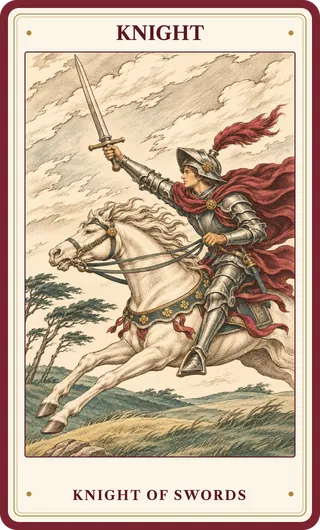
Raised sword
The sword is held high as the knight charges, showing a mind that has chosen a target. Reversed, it points to words and ideas used as weapons, or a blade swung without checking what it will cut.
White horse at full gallop
The horse is raw speed and physical energy, with the knight steering from behind. Reversed, the horse is out of control or exhausted, and the body pays for the mind's urgency.
Wind-bent trees
The trees lean in the direction of travel, showing the force of the knight's momentum. Reversed, they suggest the damage that fast, forceful action leaves in its path.
Stormy sky
Clouds swirl overhead, matching the mental weather of Swords: quick thoughts, agitation and conflict. Reversed, the storm is inside, as anxiety, anger or racing thoughts.
Butterflies and birds
These appear on the knight's tunic and the horse's harness and belong to the element of air. They show lightness and ideas, which become scattered and unfocused when the card is reversed.
Armor and red plume
Full armor shows readiness for conflict and a belief in being right. Reversed, it can mean defensiveness, a closed mind, or aggression used as protection.
Bare, rough ground
The landscape is open, empty and uneven, with no clear destination in sight. Reversed, it raises the question of where all this speed is actually heading.
Signs the card is about you
Sometimes a reversed Knight of Swords is a mirror. These are common signs that it is pointing at your own behavior:
- You reply immediately, often while angry, and regret the tone later.
- You are certain you are right and stop listening partway through a conversation.
- You start many things and finish few, or you keep changing direction.
- You are exhausted but cannot slow down, and rest feels like laziness.
- Your thoughts race at night and your body feels tense by afternoon.
If several of those fit, treat the card as a prompt, not a criticism. Everyone has a Knight of Swords energy, and most people get it wrong at some point under pressure. Noticing the pattern is already the first step in changing it.
It is also worth asking whether you have been on the receiving end. A reversed knight can describe a household, workplace or friendship where someone else’s haste and sharpness set the pace. If you feel braced all the time, the card may be validating that rather than blaming you.
Try this: For the next 24 hours, wait ten minutes before sending any message that you feel urgently needs sending. Notice how many you rewrite or delete.
Upright and reversed compared
Upright, the Knight of Swords is courage in motion. He is a clear mind, a quick decision, an honest word and the willingness to go after what you want. His weakness is that he can overshoot. Even in the upright position, he is not famous for patience.
Reversed, that weakness takes over or the strength switches off. Direct becomes blunt. Confident becomes arrogant. Fast becomes careless. Focused becomes obsessive. Where the upright card says go, the reversed card says check first.
The reversed card is not always the upright card’s opposite. It is often a distorted version of the same quality, which is why simply flipping the meaning can mislead you. If your question is about a decision you are already pushing hard on, this card asks what you may be ignoring. If your question is about a stuck plan, it asks what is stopping the charge and what would help it find a direction. For more on how reversals work in general, see our guide to reading reversed tarot cards.
Is the Knight of Swords reversed a yes or no?
For most yes or no questions, it leans toward no, or at least not yet. The card says the plan is rushed, the facts are incomplete or you are not in the right frame of mind to judge. That is different from a flat refusal. In many cases the answer becomes yes after a pause, a second look and a calmer approach.
If the question is about whether to act immediately, such as sending a message, confronting someone or making a financial move, the answer is clearer: wait. If it is about whether a fast-moving situation will work out well, the card suggests it will cause more trouble than it solves.
For a full breakdown of both positions, see the Knight of Swords yes or no page. If you want to put a question to the cards directly, the same rule applies: a reversed knight is an invitation to ask a better, slower question.
Combinations that change the meaning
A single card is rarely the whole story, so read it in context. With the Five of Swords, the theme of conflict grows: someone wins at the cost of the relationship, and the fight does lasting harm. With the Ten of Wands, you are looking at burnout from carrying too much, and the knight is the pace that got you there. Next to the Eight of Cups, it can mean walking away in a hurry rather than a deliberate decision.
Combined with calmer, grounded cards, the reversed knight loses most of its sting. With the Four of Swords it becomes a clear instruction to rest, and with Temperance it shows the energy being tempered and brought into balance. Cards like the Hermit suggest the answer is withdrawal and reflection before action.
Court cards help identify who is involved. If the reversed knight sits next to a Queen or King, you may be looking at a dynamic between two people with very different styles. Our court cards guide explains how pages, knights, queens and kings usually behave in a spread.
If you don’t read reversals
Many readers prefer to read every card upright, and that works well here. The Knight of Swords already carries its own shadow: even upright, he can be hasty, blunt and one-sided. If you draw him upright and sense that something is off, read the card’s warning side without flipping it.
You can also use the reversed meanings as a checklist when the upright card does not fit. Ask whether the person or situation is too fast, too sharp, too sure of itself or too scattered. If the answer is yes, the card is speaking its shadow language whichever way up it landed.
On the other hand, if you do use reversals, treat them as a shade of meaning rather than a dramatic switch. A reversed Knight of Swords is rarely a catastrophe. More often it is a small adjustment of pace and tone that makes the difference between a plan that works and one that falls apart.
What to do when you draw it
The advice of the reversed Knight of Swords is practical. Pause before you act. Check the facts. Give yourself a night with any decision that cannot be undone. Choose your words with the same care you would choose your actions, because they are actions.
Then ask what you actually want. Not what you want to prove, or what you want to escape, but what you want to build. Speed is useful only when it serves a direction. Once you know the direction, you can often move faster than before, because you are no longer wasting energy on false starts.
If the stalled version fits better, the advice is different but just as simple: pick one thing and do the first step. Scattered energy settles when it has a single place to go. Shrink the task until it is small enough to start today.
Try this: Pull one more card as a cooling card (a random tarot card works well) and ask: “What would help this charge find its aim?” Journal the answer for five minutes.
Questions to ask yourself
A reversed knight is better answered with questions than with conclusions. These work well for journaling or a follow-up reading:
- What am I trying to prove, and to whom?
- What have I assumed without checking?
- Who has been hurt or confused by how fast I have moved?
- Where am I busy but not making progress?
- What would I do differently if I had one more day to decide?
You can also take these into a spread. A simple 3 card tarot layout of what is driving the rush, what it is costing you and what would help works neatly with this card.
The reversed Knight of Swords is not telling you to be less brave. It is asking you to be brave and aimed. That is a much stronger version of the same knight.
Questions readers ask
What does the Knight of Swords reversed mean?
It means the card's fast, direct energy has gone wrong. That shows up as recklessness, harsh words, impatience and arrogance, or as the opposite: stalled momentum, scattered focus and blocked ambition.
Is the Knight of Swords reversed a bad card?
It is a warning, not a verdict. It asks you to slow down, check your facts and soften your delivery before the consequences arrive, and most of the time that adjustment is enough to change the outcome.
What does the Knight of Swords reversed mean in love?
It often describes someone who comes on strong and then cools off, or a relationship that moves too fast or turns into constant argument. It can also point to a partner who uses sharp words, or to you reacting before listening.
Does the Knight of Swords reversed mean someone is angry with me?
It can. Reversed, this card often shows feelings that come out as defensiveness, sarcasm or irritation. It can equally mean the person is overwhelmed or restless and handling it badly, so look at the other cards before assuming anger.
Is the Knight of Swords reversed a yes or no?
Usually a no, or at least a not yet. It says the plan is rushed, the facts are incomplete or the timing is off, and that a pause would serve you better than pushing ahead.
What does the Knight of Swords reversed mean for a person?
It describes someone sharp, impatient and quick to argue, who may talk big and not follow through. They can be clever and well meaning, but they struggle to listen and often leave a mess behind them.