
King of Swords as a Yes or No Answer

- Arcana
- Minor Arcana, Suit of Swords
- Element
- Air
- Yes or no
- Yes
authorityintellecttruth
confusionrecoveryrelease of mental strain
The King of Swords is a yes card when it appears upright, but it is a conditional yes. It says go ahead if your choice is logical, fair and honest, and it says stop and think if you are acting out of pride, anger or wishful thinking. Reversed, the King of Swords leans toward no, or at least not yet, because the clear judgment that makes him powerful has turned cold, controlling or confused.
That makes this card different from a simple green light. The King does not hand out easy yeses. He asks you to test your question first, and then he backs you if it passes. This page explains how to read that answer in love, work, money and health, when an upright King still means no, and how to ask a question so the card can answer it clearly. For the full picture of the card, see the King of Swords meaning.
Why the King of Swords reads as a yes
The King of Swords is the mature end of the suit of Swords, which rules thought, truth and communication. By the time you reach the King, the mental struggles shown in the lower Swords cards have been worked through. He sits upright on his throne, holds his sword straight up and looks directly ahead. Nothing in the image is confused or hesitant, and that steadiness is why the card reads as a yes.
In a yes or no reading you are really asking whether conditions favour your question. Upright, the King says they do, because clear thinking and good judgment are on your side. The card describes someone who has the facts, knows his position and can act on it. When you draw it, the situation usually has what it needs to move forward.
The yes is not warm or dreamy. It is the yes of a judge, a senior manager or a trusted adviser: “this holds up, so proceed.” That tone matters when you decide how much emotional reassurance to read into the answer.
What the King is saying yes to
The King says yes to decisions that can be explained. If you can state your reasons in a few plain sentences, and those reasons stay solid when someone challenges them, he approves. This is why the card shows up for contracts, negotiations, exams, legal matters, serious conversations and decisions you have already thought through.
A useful way to apply this is to treat the card as a short test. Before you accept the yes, check four things:
- Can you state your reason without exaggerating?
- Is the decision fair to everyone it affects, including you?
- Do you have the facts, or are you guessing?
- Would you still stand behind this choice if it became public?
If you can answer yes to all four, the King’s yes is strong. If one fails, the card is still a yes in principle, but it is telling you which part to fix first.
Try this: Write your question as one clear sentence, then write the three facts that support the answer you want. If you cannot find three, the King’s yes is asking you to gather more information before you commit.
When the upright King of Swords means no
An upright King of Swords can still point to no when your question is driven by emotion alone. If you ask “Will they miss me?” or “Do I feel better soon?”, the King has little to offer. He deals in facts and decisions, not in hopes, and he may answer by showing you that the question cannot be decided on feeling.
It can also mean no when the question itself fails the fairness test. Asking whether you can win an argument by being harsh, get ahead by bending the rules or keep a secret from someone who deserves to know goes against everything the King stands for. In these cases the card reads as a refusal, even though it is upright.
The surrounding cards usually make this clear. If the King appears next to cards of deceit or anxiety, treat the yes as weakened. A very emotional question deserves a card from the suit of Cups, so if the King keeps appearing for questions about feelings, he may be telling you to look at the facts and stop circling.
Read King of Swords for your question
Upright: Yes, if both people are willing to speak plainly, keep their word and treat each other fairly.
Reversed: No for now: coldness, control or harsh words are getting in the way, and the relationship needs honesty before it needs commitment.
Upright: They think before they feel: they are steady, serious and sure of their position, even if they do not show warmth easily.
Reversed: They are guarded or critical, and may be using logic to avoid saying what they actually feel.
Upright: A strong yes: take the role, make the case, sign the agreement, and lead with clear standards.
Reversed: No, or not yet: a power struggle, an unfair boss or your own rigidity is blocking progress.
Upright: Yes to a decision built on facts, contracts and a clear budget; no to anything run on hope.
Reversed: No to deals with unclear terms, and a warning against letting pride or stubbornness drive a financial choice.
Upright: Decide with your head, say it clearly, and be ready to defend the choice.
Reversed: Step back from being right at all costs, and check whether your thinking is fair or just cold.
Upright: Yes to a plan based on solid medical information, a second opinion and a clear routine.
Reversed: No to ignoring advice or overthinking symptoms: stress and mental strain need attention.
King of Swords reversed as yes or no
Reversed, the King of Swords generally leans no. The qualities that make him trustworthy, such as objectivity, authority and discipline, have gone wrong. He can become a tyrant, a cold critic, a person who uses logic as a weapon, or someone whose judgment is clouded by bias or stress. The answer to your question is often no because the thinking behind it is not reliable yet.
This is not always a final no. A reversed King often means “not like this.” The goal is still sound, but the way you are approaching it needs to change: less control, more listening, clearer facts, fairer terms. Once those are addressed, the answer can shift toward yes. If you want to read more about this side of the card, see the King of Swords reversed meaning.
Some readers treat a reversed court card as a person rather than a verdict, so it is worth asking whether the card describes someone in your life who is abusing authority. If it does, the no may be about that person’s decisions rather than yours. For a wider guide to the method, see how to read reversed tarot cards.
King of Swords yes or no in love
In love questions the upright King leans yes when the relationship is built on honesty, respect and clear communication. He suits people who say what they mean and keep their word. A yes from him often means a relationship that will be stable and fair, though perhaps more reserved than romantic.
He is a weaker yes when the question is about passion, chemistry or a quick spark. He does not rush, and he does not make grand gestures. If you ask “Is this person worth my commitment?” he will tell you to look at their actions and their honesty, and if both hold up, he agrees.
Reversed in love, the answer leans no. The relationship may be cold, controlling or dominated by criticism, or someone may be holding back out of fear of being vulnerable. A reversed King can also describe a partner who is always right and never wrong. The answer improves only if both people are willing to speak openly and soften their stance.
King of Swords yes or no in career
Career is where this card is strongest. Upright, the King of Swords is a clear yes to promotions, leadership roles, negotiations, interviews, professional exams and decisions that need authority. He suits careers in law, medicine, teaching, consulting, finance and management, and he favours the person who prepares thoroughly and communicates plainly.
If you are asking whether to take a job or make a bold move at work, the King says yes when your reasons are solid. He also supports setting boundaries, asking for written agreements and holding yourself to high standards. If you are asking about a boss or senior figure, the card often describes someone fair and direct.
Reversed, the answer is no or not yet. The card can describe an unfair boss, a workplace power struggle, or your own inflexibility getting in the way. If you are the one who has been too rigid, the card is asking you to listen before you decide.
King of Swords yes or no for money
For money questions the King of Swords says yes to choices based on numbers, contracts and sound advice. A budget you can defend, a purchase you have researched or an investment with clear terms all earn his approval. He is not a gambler, so any decision based on a hunch or a rush to act will fail his test.
He is particularly useful for questions about legal or financial paperwork. If you ask whether to sign an agreement, the King says yes if you have read the terms, understood the risks and found the arrangement fair. If you have not, the card is a polite reminder to do that first.
Reversed, he leans no. Watch for unclear terms, pressure to decide quickly, or a person offering advice who benefits from your choice. It can also warn against letting pride, anger or stubbornness shape a financial decision.
Try this: Before asking a money question, write down the worst outcome in plain numbers. Then draw the King of Swords as your answer card and ask whether you could still defend the decision if that outcome happened.
King of Swords yes or no for health
In health readings, the upright King leans yes to plans grounded in good information: a diagnosis from a qualified professional, a clear treatment plan, a second opinion or a structured routine. He represents informed, sensible decisions and the calm that comes from understanding your situation.
The King is not a medical authority, and tarot cannot replace a doctor. Use the card as a prompt to think clearly and seek proper advice, not as a replacement for either.
Reversed, he points to stress, overthinking or ignoring good advice. It can also describe a mind running too hard, which can affect sleep and wellbeing. If you draw this card in that position, treat the no as a signal to slow down and speak to someone qualified.
King of Swords card symbols
Choose a symbol to read what it means on the card.
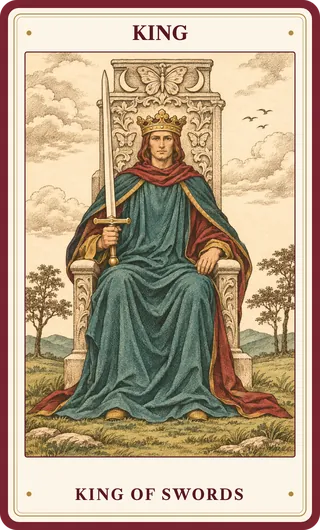
Upright double-edged sword
The sword points to the sky, showing a mind that is sharp and under control. Its two edges mean truth cuts both ways, so every decision the King makes carries responsibility.
Throne with butterflies
Butterflies carved on the throne stand for change and the way ideas transform. They soften an otherwise stern figure and hint that his judgments can grow.
Winged cherub and crescent
A small winged head on the throne links intellect with a higher, more ethical kind of thought. The crescent moon adds intuition behind the logic.
Blue robe
Blue is the colour of clear thinking and calm speech. It shows authority that comes from reason rather than force.
Red cloak
The red cloak adds human warmth and willpower to an otherwise cool figure. It reminds you that his judgments still affect real people.
Clouded sky and bare trees
The pale sky and stripped trees point to air, the element of thought, and to a mind that has cleared away clutter. Nothing is hidden in this landscape.
“Should I” and decision questions
Decision questions suit the King of Swords well, because he is the card of judgment. When you ask “Should I take this step?”, he says yes if you can weigh the evidence and stand behind the result. He is especially helpful when you have been going back and forth, since he asks you to choose and commit rather than keep analysing.
If you are choosing between two options, pull one card for each and compare them. The King beside an option points to the choice you can justify more clearly. If he appears reversed beside one of them, that option may be driven by pressure, ego or bias.
A simple rule works well here: the King favours the answer you could explain calmly to a fair-minded stranger. If your preferred answer only works when you leave out part of the story, the card does not support it.
Questions about other people
Yes or no questions about other people’s feelings are tricky with the King of Swords. He rarely shows romantic warmth, so a question like “Does he love me?” will not get a clear answer from him. More often he shows how a person thinks and acts: reserved, principled, serious and slow to reveal emotion.
If you ask whether a particular person will do the right thing, the upright King leans yes if that person has shown integrity before. He is not a prediction of a sudden change of heart. He reflects character.
Reversed, he describes someone who is guarded, critical or controlling. If your question is whether someone will be reasonable or fair, a reversed King suggests not at the moment. This does not necessarily mean they are cruel, only that they are not ready to listen.
When will the answer arrive
Tarot timing is soft, and no card gives a calendar date. Still, the King of Swords connects with air and with decisions that come after careful thought, so the answer tends to arrive once a firm choice or agreement is made. You are usually not waiting on fate. You are waiting for a clear decision to be taken, often by you or by someone in authority.
If you want a rough guide, think in terms of days and weeks rather than months for conversations, contracts and exams, and longer for matters that depend on formal processes. If you are asking about timing in more detail, see tarot timing for ways to approach it.
The reversed King suggests delay. Something has to be corrected, clarified or renegotiated first, and that can take a while.
How neighbouring cards change the answer
A yes or no reading is most reliable when you draw one card and take it as it comes. If you pull more than one, the King’s answer can shift depending on what appears beside him. Some pairings strengthen the yes and others add a warning:
- With an Ace, Six or Ten from a positive suit, the yes is stronger and more likely to be smooth.
- With the Three of Swords or other painful Swords cards, the answer is yes but carries emotional cost.
- With cards of deception, such as the Seven of Swords, check whether someone is withholding information.
- With very emotional Cups cards, the answer depends more on feeling than logic, so weigh the King less.
When the neighbouring cards do not agree, trust the card that most closely matches the nature of your question. A practical, factual question belongs to the King. An emotional one belongs elsewhere.
How to ask the King a good question
The King of Swords answers best when your question is specific, fair and answerable. “Should I accept this offer by Friday?” works. “What will happen in my life?” does not. Because he values clear language, he gives clearer answers when you give him clear questions.
Aim for a question you can answer with yes or no, avoid asking two things at once, and decide before you draw how you will treat the answer. Avoid repeating the question until you get the answer you want, which is the opposite of what the King stands for. For more ideas on wording, see questions for tarot reading.
Try this: Draw one card for your question and note whether you feel relief or resistance when you see the King. Then ask yourself what you were hoping to hear, and whether the King’s conditions are met.
King of Swords compared with other yes or no cards
Within the court cards, the King of Swords is more decisive and less personal than the other Kings. The King of Cups answers with emotional maturity and care, the King of Pentacles with practical security, and the King of Wands with bold vision. The Swords King answers with facts and fairness. You can see how each court card works in the court cards guide.
His closest relative is the Queen. The Queen of Swords as a yes or no answer leans yes too, but she judges from experience and honest perception rather than formal authority, and she is more likely to say no when she senses a lie. Next to her, the King is the one who makes the final call.
Compared with the Knight of Swords, who is fast and impulsive, the King is slower and steadier. A Knight says yes to action now. The King says yes once you have thought it through.
Using the answer
Treat the King of Swords as a yes you have to earn. If you draw him upright, review your reasons, check that your decision is fair, then act on it with confidence. His message is that a clear mind and honest words are enough to move forward.
If you draw him reversed, do not take it as a door closing for good. Look at what in the situation is cold, rigid or unclear, and decide what you would change. You can then ask the question again later with new information, which is fair, because the situation has changed.
If you want a broader tool, try the yes or no tarot reading page, where you can draw a card for any question and compare the answer with what you have learned here.
Questions readers ask
Is the King of Swords a yes or no card?
Upright, it is a yes, with conditions. The answer is yes when your decision is logical, fair and honest, and the card asks you to check that before you act.
Is the reversed King of Swords a no?
Usually it leans no, or at least not yet. It points to cold, controlling or muddled thinking, so the answer becomes yes only after you correct that.
Does the King of Swords mean yes in love?
Often yes, if the relationship rests on honesty, respect and clear commitments. It is less warm than a Cups card, so it favours plain agreements over romantic promises.
Is the King of Swords a yes for a job or career question?
Yes, and it is one of the strongest areas for this card. It supports taking a leadership role, negotiating fairly and making decisions based on facts.
How soon will the King of Swords answer come true?
Tarot timing is never exact, but the King suggests an outcome that arrives once a clear decision is made. Expect movement after a firm choice, an agreement or a direct conversation.
What if I draw the King of Swords and I do not like the answer?
Look at what the King is asking: a fair test, honest information, a clear head. If your question fails that test, the card is telling you to rethink it before you act.