
The Hierophant in Love & as Feelings

- Arcana
- Major Arcana, card 5
- Element
- Earth, Taurus
- Yes or no
- Maybe
traditionguidanceinstitutionsshared values
rebellionunconventional pathsquestioning rules
The Hierophant as feelings means someone feels serious, respectful and committed toward you. Their affection is steady rather than fiery, and it leans toward long-term bonds: exclusivity, shared values, families meeting, and eventually a formal step such as engagement or marriage. Reversed, the feelings are real but complicated, often tangled up with resistance to rules, labels or expectations.
This is one of the more reassuring cards to see in a feelings position, and also one of the easiest to over-read. It can describe a person who has chosen you, or a person who has chosen the proper next step and you happen to fit it. Below you will find how to tell the difference, how the card changes for new connections, partners and exes, and what to ask next. For the card’s wider meaning, see the full Hierophant tarot card meaning.
What The Hierophant means in a feelings position
The Hierophant is card number five of the Major Arcana, and it represents tradition, teaching, shared belief and institutions. In a feelings position, the question shifts from what the card stands for to what a person feels when they live by those things. The answer is a love that values commitment as something to honour, not something to test.
Someone showing up as The Hierophant is not usually swept away. They are thoughtful about love. They ask whether your values line up, whether you want the same kind of life, and whether the relationship has somewhere to go. That makes their feelings slower to arrive and harder to shake once they do.
The card also carries the energy of Taurus in many tarot systems, which fits. Taurus is an earth sign, patient and loyal, and it prefers what lasts. If you want a one-line summary: their feelings are built to hold weight.
Upright: committed, values-based love
Upright, the Hierophant says they feel safe with you and take you seriously. They are not playing games or keeping you as a backup. If they have said little, it is more likely because they want to do things properly than because they are hiding something.
You can expect a mix of respect, admiration and quiet devotion. They often feel you are someone they could learn from, or someone they could guide, and many people feel a pull toward teaching and growing together. Their love is less about the thrill of attraction and more about recognition: a sense that you fit into the life they already want.
Because this love is deliberate, it can feel unromantic at first. There may be fewer grand gestures and more reliability. If you want to see how a similar steadiness looks in a happy long-term partnership, the Ten of Cups shows what that foundation can grow into.
Do they love you, or the next step?
The most useful question to ask of this card is whether the feeling is aimed at you or at the structure. Some people drawn to The Hierophant truly want you specifically. Others want what a relationship represents: marriage, family approval, a proper place in the community. You may simply be the person standing in the right spot.
Both versions feel similar at the start, because both involve commitment talk and serious intent. The difference shows over time. A person who loves you will want to know your inner life, your fears, your humour and your quirks. A person who loves the step will talk mostly about timelines, expectations and what a partner “should” be.
Neither is wrong, and the second is not always cold. But it matters whether you are being chosen or slotted in. Ask yourself whether they can describe you, not only the role you would fill.
Try this: Write down three things this person has said or done in the past month that were only about you, such as a detail they remembered or a comment about your character. If you cannot find three, the feelings may be more about the structure than the person.
Read The Hierophant for your question
Upright: Committed, traditional love that wants to become official through exclusivity, engagement, marriage or a shared family life.
Reversed: Love that resists labels or rules, or a relationship where one person's expectations no longer fit the other's.
Upright: They feel respect, loyalty and a calm certainty that you could be a long-term partner.
Reversed: Their feelings are real but tangled up with doubt, pressure from others or a wish to break from convention.
Upright: Mentors, institutions and proven routes are on your side, and following the established process works in your favour.
Reversed: The standard path feels wrong for you, and you may be ready to question rules or a mentor.
Upright: Conservative choices such as savings accounts, pensions and trusted advisers serve you better than risky bets.
Reversed: Be wary of outdated advice or a financial product that is only popular because everyone else uses it.
Upright: Learn from someone with experience, honour your commitments and let shared values guide your decision.
Reversed: Think for yourself, stop following a script that no longer fits and set your own terms.
Upright: Steady routines, regular check-ups and trusted professionals support your wellbeing.
Reversed: A rigid routine or one-size-fits-all advice is not working, so look for an approach that suits your body.
How Hierophant feelings show up in real life
This love tends to be expressed through consistency. You will usually know where you stand, because they say what they mean and then follow through. Surprise is not their language.
Common signs include:
- They talk about the future in practical terms: holidays next year, meeting family, moving in.
- They want to define the relationship and do not like being vague about status.
- They respect your boundaries and move at an agreed pace.
- They ask about your values, faith, beliefs and how you were raised.
- They show up on time, keep promises and are uncomfortable with mixed signals.
These behaviours can seem old-fashioned, but they are the card in action. If someone does the opposite, such as avoiding labels and keeping plans loose, the Hierophant is probably describing you or the situation rather than them.
The Hierophant reversed as feelings
Reversed, the Hierophant shows feelings caught between convention and freedom. The person may care a great deal but dislike the rules attached: the labels, the timeline, the pressure from family or culture. They may be questioning whether the kind of relationship they were taught to want is the one they really want.
This can look like hot and cold behaviour. They want closeness but resist being pinned down, or they commit on paper and feel trapped inside. It can also describe someone whose family disapproves of the relationship, so that outside expectations are pulling their feelings in two directions.
It does not automatically mean they do not love you. It means the love is complicated by something structural. For more on this, read The Hierophant reversed, and if you are new to the idea, our guide to reading reversed tarot cards explains how reversals shift a card without simply flipping it.
Early dating and new connections
With someone you have only just met, the Hierophant suggests they are looking for something real. They are unlikely to be after a casual fling, and the attraction often builds slowly, more like recognition than lightning. They may ask direct questions about what you want, which can feel intense on a second or third date.
If you are single and this card appears as a future partner’s feelings, expect a connection through shared circles: a community, a class, a faith group, a family introduction or a long friendship. The Hierophant does not usually promise a chance meeting across a crowded room.
The caution is pace. Because this energy wants clarity, it can move to commitment faster than you are ready for. If you feel rushed, say so early. A person who truly fits the card will respect that you need time.
In an established relationship
When the Hierophant describes a partner’s feelings in a long relationship, it points to companionate love that has settled in. The first excitement may have passed, but they feel sure of you and want to deepen the bond. This often shows up as a wish to formalise things: engagement, marriage, a shared home, joint plans.
It can also signal renewal of vows in a wider sense, such as recommitting after a hard period or agreeing on shared values again. The card is a good sign for couples who want stability and a bad sign only if one person is craving novelty.
If the relationship has become more routine than rewarding, the card is a prompt to add meaning to the structure. Shared rituals, traditions and goals are where this energy thrives.
The Hierophant as an ex’s feelings
When the card describes an ex, it usually shows respect for what the two of you had. They may think of the relationship with fondness, even reverence, and see it as something with real value. They are not likely to be reckless about contacting you.
Whether they want to return depends on what they want from a bond. The Hierophant wants proper commitment, so reconciliation would need to be serious, honest and clearly defined. A casual rekindling does not fit this card. If the breakup came from different values or life plans, the card can also mean those differences still matter to them.
Sometimes it points to something gentler: the lessons they took away and a sense that the relationship taught them something. That can be warm, but it is not always a sign of longing.
The Hierophant card symbols
Choose a symbol to read what it means on the card.
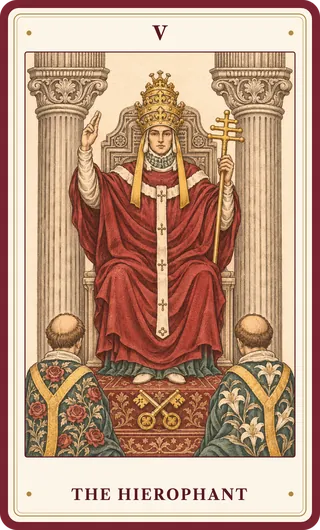
The triple crown
The three tiers of the Hierophant's crown stand for authority over body, mind and spirit. In love, they point to a bond that is meant to be whole and serious, not only physical or only emotional.
The triple-cross staff
The staff marks spiritual office and the passing down of teaching. As feelings, it shows someone who sees love as something received from tradition and handed on again.
The raised right hand
Two fingers rise in blessing, a gesture that makes a promise formal. It suggests feelings that want a public, witnessed commitment.
The two kneeling acolytes
Two figures kneel in front of the Hierophant, receiving instruction. They represent a pair learning the rules of a shared life together.
The crossed keys
One gold key and one silver key lie at the Hierophant's feet. They stand for the conscious and the subconscious mind, and for the idea that a lasting bond needs both reason and instinct.
The two grey pillars
The pillars frame the scene like the walls of a temple. They show love inside a structure, with boundaries that hold the relationship steady.
The red and white robes
Red robes carry warmth and devotion, while the white and patterned details speak of learned wisdom. Together they say that this love has heart but expresses it with discipline.
When it means respect, not romance
Some readers see the Hierophant in a feelings position as admiration that does not turn romantic. That is a real possibility. The card is a teacher, mentor or guide, and a person can deeply value a mentor, friend or family-like figure without feeling desire.
You are more likely to be looking at this version if the connection began in a teaching or advising role, if they treat you as a trusted confidant, or if they describe you in terms of character rather than attraction. Warmth, loyalty and affection are all present, but the spark may not be.
The way to tell is to look at the rest of the spread and at behaviour. Romantic cards nearby, such as the Two of Cups or the Lovers, tip it toward love. A calm surrounding spread suggests deep fondness without passion.
The Hierophant vs The Emperor vs The Lovers
These three cards are often confused in love readings. The Lovers is about attraction and a meaningful choice: passion, chemistry and the decision to be together. Our guide to The Lovers as feelings goes deeper on that. The Hierophant is about what comes after the choice, the vow and the shared values that keep it going.
The Emperor is closer than it looks. The Emperor protects through personal strength and control: I will build walls and keep you safe. The Hierophant protects through shared belief: we follow the same path and it holds us. If you want the contrast in full, read The Emperor as feelings.
A simple way to remember it: the Lovers feels a spark, the Emperor takes charge, and the Hierophant makes a promise.
Card combinations that sharpen the answer
The Hierophant rarely lands alone, and its neighbours tell you which kind of feeling you are dealing with. Here are a few useful pairings:
- With the Two of Cups: mutual, committed affection and a real chance of a formal bond.
- With the Ten of Pentacles: feelings aimed at family, home and the long term.
- With the Four of Pentacles: control, possessiveness or fear of losing you.
- With the Fool: rigid expectations meeting a wish for spontaneity.
- With the Moon: confused or hidden feelings, and an unclear picture of what they want.
If you pull the Hierophant in a spread about someone’s behaviour, look at the cards in the positions for obstacles and outcomes before deciding what the Hierophant means.
Try this: Pull one extra card to clarify the Hierophant. Ask: “Is this feeling about me, or about what a relationship should look like?” Then read the new card with that single question in mind.
What the imagery says about feelings
The Rider-Waite-Smith Hierophant sits between two grey pillars in red robes, wearing a three-tiered crown and holding a triple-cross staff. His right hand is raised in blessing, and two kneeling figures wait at his feet, with two crossed keys between them. Every part of the image has a relationship reading.
The pillars say love sits inside a structure. The kneeling pair say there is something to be learned together, and the raised hand says a promise is being witnessed. The crossed keys, one gold and one silver, point to head and heart working together.
What the picture does not show is spontaneity. Nothing here is casual, and nothing is hidden. That is the real message about the person: they want love that can be seen, named and held up in the open.
When the feelings are your own
If the Hierophant describes how you feel, it suggests you want substance. You may be tired of ambiguity and ready for someone who shares your values and is willing to commit. That is a healthy instinct, and it deserves to be taken seriously.
It is also worth asking whether you want this person or the security that the relationship would bring. Looking for a partner who ticks the right boxes is not the same as being drawn to them. Reversed, the card can mean you are questioning whether the expected life is the one you want.
Try this: Complete the sentence “I want a partner who …” ten times, quickly. Circle the answers that come from your own heart rather than from family, culture or habit. Those are the values to look for.
How to get a clearer answer
One card about feelings gives you a direction, not a full picture. To go further, use a spread that separates what they feel from what they want and what the relationship needs. Our relationship tarot spread does this clearly and works well when the Hierophant is already in the mix.
A few steps help:
- Ask a specific question, such as “What does this person feel toward me right now?”
- Read the Hierophant as upright or reversed before reading the story around it.
- Look at the neighbouring cards for warmth, doubt or control.
- Compare the card with what the person does, not only what they say.
If you want a quick yes-or-no angle, see The Hierophant as a yes or no answer. In short, the Hierophant is a tarot card about commitment, and it tends to say yes to love that is serious and no to love that is casual. The best use of the card is to ask yourself whether that kind of love is what you want, and then to watch for how the other person shows up over time.
Questions readers ask
What does The Hierophant mean as someone's feelings for you?
Upright, it means they feel serious, respectful and committed. They see you as someone to build a stable future with, not a passing fling.
Does The Hierophant as feelings mean they love me?
It usually points to real care, but the love is calm and values-based rather than passionate. Check whether they are choosing you or simply the next conventional step, such as marriage or moving in.
Does The Hierophant mean marriage?
It is the card most linked to marriage and formal commitment, but it does not promise a proposal. It shows the direction their feelings lean, so look at the surrounding cards and the timeline of your relationship.
What does The Hierophant reversed mean as feelings?
Reversed, the feelings are mixed. They may care but resist labels, feel pressured by family or tradition, or hold back because commitment feels like a cage.
What does The Hierophant mean as an ex's feelings?
It often shows respect and fond memory of what you shared, with a sense that the relationship had real value. It can mean they would return only if the relationship were rebuilt on firmer, more committed terms.
Is The Hierophant a good card to get for feelings?
It is good if you want a steady, serious bond. It is less encouraging if you hoped for passion and spontaneity, because this card offers loyalty and structure instead.