
The Emperor Yes or No: What the Card Answers

- Arcana
- Major Arcana, card 4
- Element
- Fire, Aries
- Yes or no
- Yes
structureauthoritystabilityleadership
rigiditycontrolstubbornness
The Emperor is a yes card. Drawn upright, he answers yes to a question about a plan, a commitment or a decision you are ready to take responsibility for. Reversed, he leans no, and more often means not yet: the idea may be sound, but the discipline, leadership or structure to support it is missing.
What makes this card different from a simple green light is that his yes comes with conditions. He rewards preparation, clear terms and follow-through, so the answer is only as good as the plan behind your question. This page covers how to read him in love, work, money and health, how to handle exes, timing and neighboring cards, and when his yes should make you pause.
Why The Emperor Is a Yes Card
Yes or no tarot readings sort cards by energy. Cards that build, begin, protect or complete tend to say yes. Cards that dissolve, delay, deceive or end tend to say no. The Emperor is the fourth card of the Major Arcana, and four is the number of foundations: four walls, four corners, a table with four legs. He is the card of things that stand up.
His element is fire and his sign is Aries, ruled by Mars. That gives him a forward, decisive quality. Compare him with The Empress, whose yes is about growth and nurture and arrives at its own pace. The Emperor’s yes is about structure and direction, and it arrives when you set it in motion.
You can read the full symbolism, history and meaning of the card on the Emperor tarot card meaning page. For a yes or no question, only one idea matters: he approves of what is organized, and he questions what is not.
The Emperor Upright: A Yes With Conditions
Upright, The Emperor says yes, and the yes has three parts. First, you have a plan, or can make one. Second, you will take ownership of the result. Third, you are willing to set limits and keep them. If those are in place, the answer is a confident yes. If they are missing, the card is asking you to supply them before you ask again.
Think of it as the yes of a signed contract rather than the yes of a happy impulse. It is reliable and sober. Nothing in the card is vague, and he is not offering a lucky break. He is telling you that if you do the sensible, disciplined thing, it will hold.
This is also why the same card can mean different things to different askers. Someone with a clear budget asking about a mortgage gets a firm yes. Someone asking “will it all just work out?” without a plan gets a more pointed answer: it will work out if you make it.
Try this: Before you draw, write your question and one sentence beginning “My plan is…”. Draw a card. If The Emperor appears, read your sentence aloud. If it sounds solid, take it as a yes. If it sounds vague, treat the card as an instruction to firm up the plan first.
The Emperor Reversed: No, or Not Yet
Reversed, The Emperor leans no. The reason is usually one of two opposites. Either there is too little structure (disorganization, weak leadership, broken promises) or too much control (rigid rules, domineering behavior, a refusal to adapt). Both make a yes unstable, so the card withholds it.
In practice, the reversed answer often reads as “not yet.” The foundation is cracked, but it can be repaired. A reversed Emperor on a business question might mean the idea is fine but the finances are loose. On a relationship question, it might mean the love is real but one person is dominating the other.
Reading reversals varies by reader, and some prefer to ignore them entirely. If you do use them, our guide to reversed tarot cards explains the main approaches, and the full Emperor reversed page goes deeper on this card. A useful rule for yes or no work is to treat a reversed Emperor as a no today and a possible yes after a specific fix.
Read The Emperor for your question
Upright: A yes to commitment, loyalty and a relationship with clear terms, though the answer is steady rather than romantic.
Reversed: A no for now: control, coldness or unequal power need fixing before the relationship can move forward.
Upright: They feel responsible and protective toward you and want to build something dependable.
Reversed: They feel pressure or a need to be in charge, and may be hiding behind rules, pride or distance.
Upright: A clear yes to the promotion, the leadership role, the business plan or the formal offer.
Reversed: A no until the structure is fixed: weak leadership, a power struggle or a plan with holes in it.
Upright: A yes to budgets, long-term plans and disciplined decisions, and a no to impulsive risks.
Reversed: A no to loose spending or rigid financial control; rebuild the system first.
Upright: Make the plan, set the terms and take responsibility for the outcome.
Reversed: Loosen your grip, or build the missing discipline, before you commit.
Upright: A yes to routine, structure and consistent habits; your body responds to steady discipline.
Reversed: A no to extremes: overly strict regimens or ignored routines both need adjusting.
The Emperor Yes or No in Love
In love, The Emperor is a yes to commitment, loyalty and security. Ask “Will we get serious?” or “Is this person reliable?” and he leans yes. He points to a partner who shows up, keeps their word and takes the relationship seriously, and to a relationship that has clear footing.
The yes is not a romantic flourish. If your question is about passion, tenderness or emotional closeness, the card answers more cautiously, because this is a card of protection and order, not of feeling. A relationship with The Emperor in it can be loving and still lack softness, so the answer to “Is it emotionally fulfilling?” may be a conditional yes at best.
The reversed card in love often points to control: a partner who dictates, a power imbalance, jealousy dressed up as protectiveness, or someone who refuses commitment while demanding loyalty. The answer is no to the relationship as it currently runs. For what a specific person feels, read The Emperor as feelings, which treats his emotional side in more detail.
The Emperor Yes or No for Getting Back With an Ex
For reconciliation, upright, The Emperor is a cautious yes. He supports a return when both people are ready to set clear terms: honest conversations, agreed boundaries and real accountability. A relationship rebuilt on structure has a better chance than one that simply drifts back together.
The caution matters because The Emperor is also the card of old patterns. If the breakup came from control, stubbornness or one person always having the final word, a return without change will repeat the same cycle. In that case the card is less a promise and more a test: can you do this differently?
Reversed, the answer is a firm no for now. It suggests that pride, power struggles or an unwillingness to take responsibility still stand in the way. If your ex is the one you are asking about, the reversed card usually means they are not ready to be accountable yet.
The Emperor Yes or No for Career and Work
Work is where The Emperor is strongest. Ask about a promotion, a leadership role, a formal offer, a contract or starting a company, and the answer is yes. He represents recognized authority, which is exactly what a title, a managerial seat or a signed agreement gives you.
He also favors the person who prepares. If you have done the groundwork, he confirms it. If you are applying for a senior role without the experience, he asks whether you have earned the standing the position needs. He is not flattering.
Reversed, the answer is no until the structure is repaired. That might mean a boss who abuses authority, a team with no clear leader, or your own habit of avoiding responsibility. Ask yourself where the order is breaking down, then fix that one place.
The Emperor Yes or No for Money
For money questions, The Emperor says yes to stability, saving and disciplined decisions. A budget, a long-term investment plan, a fixed-rate loan you can afford, or setting up a business with proper accounts all earn his approval. He is not the card of windfalls or gambles.
That makes his answer to speculative questions less friendly. Ask “Will I win this?” or “Should I put everything on this risky bet?” and the reasonable reading is no, or at least not on those terms. His yes belongs to the slow, well-managed route.
Reversed, he warns of financial chaos or its opposite: control so tight that you cannot invest, spend or enjoy anything. If you are asking about money and he appears reversed, check your system. A leaking budget and an obsessive one are both reversed-Emperor problems. For a deeper look at financial readings, a money tarot spread gives you more than a single card can.
The Emperor Yes or No for Health
In health questions, The Emperor says yes to routine and discipline. A consistent sleep schedule, a structured exercise plan, regular check-ups and steady habits all fit his energy. If you are asking whether a new regimen will work, the card says yes as long as you stick to it.
He is not a diagnostic card, and no tarot reading replaces medical advice. Use his answer for behavior and habits, not for predicting illness or recovery. For any real health concern, a professional’s opinion comes first.
Reversed, the card leans no to extremes. That might be a plan that is too harsh to sustain, or one you keep abandoning. Both are the same lesson: build a routine you can actually keep.
Reading The Emperor When the Question Is About Someone Else
The Emperor often stands for a person: a father figure, boss, authority, or a stable and protective partner. If you ask “Will my manager approve this?” and he appears, the answer leans yes, because the card is the person with the power to say it. Upright, that person is fair, capable and reliable. Reversed, they may be controlling, absent or unreliable.
When the question is about what a person feels, the yes or no format is limited. “Do they love me?” does not fit this card well, because he is about duty and stability rather than emotion. A better question is “Will they commit?” or “Can I rely on them?”, which suits him much more naturally.
The same applies to yourself. When you draw him and the question is about your own choice, ask whether you are the Emperor in this situation. Are you the one with the authority to decide? If so, the card is telling you to decide, and to own it.
How the Cards Around The Emperor Change the Answer
A single card gives a leaning, not a verdict. The cards beside him can strengthen, soften or flip the answer. In a three-card line, read them together before you decide.
- With Ace cards (such as the Ace of Pentacles): a very strong yes, especially for new ventures that need both opportunity and structure.
- With The Tower: the yes is shaken. A foundation is about to be tested, so expect disruption before stability.
- With the Eight of Pentacles: yes, but only after real, patient work.
- With the Five of Swords or Seven of Swords: a yes that involves conflict or hidden motives. Check who benefits.
- With The Hanged Man: pause. The answer is yes in principle but not now.
If you want to compare combinations quickly, the tarot card combination calculator can help you see how two cards interact. Always read the cards as a whole story, not as separate votes.
The Emperor card symbols
Choose a symbol to read what it means on the card.
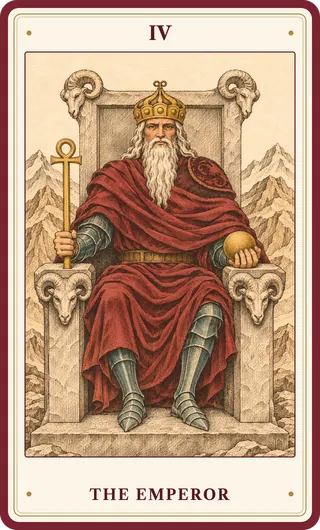
Stone throne with ram heads
The throne is solid and carved with rams, the animal of Aries and Mars. It shows authority that is built to last and willing to act.
Orb in his left hand
The orb stands for the world he governs and the responsibility that comes with it. In a yes or no reading it asks whether you can carry what you are asking for.
Ankh scepter
The ankh in his right hand is an ancient symbol of life and of power used to sustain. It points to a yes that protects and provides rather than dominates.
Armor under the red robe
He is ready for conflict even while sitting still. The yes he gives is one you may need to defend.
Red robe
Red connects him to Mars, will and drive. It says the energy behind this answer is active and decisive.
Bare mountains
The barren peaks behind him show a hard, unsoftened landscape. Results come from effort and structure here, not from luck.
Long white beard
His age signals experience and earned authority. The answer rests on proven methods, not guesswork.
Timing: When Does the Yes Arrive?
The Emperor is not an instant card. His number is four, and his energy is slow and deliberate, so the yes tends to arrive through steps rather than in a flash. Think of weeks to months, and of a process with a clear order: application, review, decision, signature.
Aries is a fire sign and ruled by Mars, so once the decision is made, action can be quick. The wait is typically before the decision, not after it. If you are asking about timing, read the surrounding cards for pace: Wands accelerate, Pentacles slow things steadily, and Swords bring conversations and paperwork.
A reversed Emperor points to delay. Something needs to be completed, signed, corrected or negotiated first. The delay usually has a visible cause, and finding it is the way to move things forward.
How Strong Is the Yes?
Not all yeses are equal, and The Emperor’s strength depends on your question. A rough guide:
- Very strong yes: career, leadership, formal commitments, business structure.
- Strong yes: money management, long-term plans, legal or administrative matters.
- Qualified yes: love and commitment, reconciliation, health routines.
- Weak yes or no: spontaneous, emotional, creative or purely luck-based questions.
This is a rule of thumb, not a law. Your deck, your style and the cards around him all affect the answer. If the result feels unclear, draw a second card as a clarifier or rephrase the question rather than pulling more and more cards until you find the answer you wanted.
Try this: Ask the same question twice, once about a result you want (will I get it?) and once about the action you control (should I commit to the plan?). Compare The Emperor’s answer to each. He usually answers the second more clearly.
When The Emperor’s Yes Deserves a Second Look
A yes from The Emperor is not always a gift. The card can also mean that a decision will take control, rigidity or heavy responsibility into your life. A job with a title but no freedom, a relationship with security but little warmth, or a plan that works only because it is controlled tightly can all return an upright Emperor. The yes is accurate, but it may not give you what you hoped for.
Before you accept the answer, ask what the yes costs. Does the structure serve you, or do you serve the structure? He is a good protector and a poor companion for anyone who needs flexibility. If your question includes needs the card does not cover (play, rest, intimacy, change), note the gap.
Also notice if you are using The Emperor to avoid choice. A yes that tells you to “just follow the rules” can be a way of not listening to your own judgment. The card asks for authority, and the authority you most need to claim is your own.
Framing a Question The Emperor Can Answer
The better the question, the clearer the answer. The Emperor responds best to questions about plans, commitments, roles and decisions that you control. A few tips help:
- Ask a closed question with a clear action: “Should I accept this offer?” works better than “What will happen with work?”
- Keep it to one topic at a time, so the answer does not blur across love, money and career.
- Decide in advance what upright and reversed mean for you, and do not change the rules after the draw.
If you use a digital draw, the yes or no tarot reading tool gives you a quick answer, and the page on questions for tarot reading has examples of how to phrase them. Then, if the result is The Emperor, return here to read the nuances.
Why the Picture Says Yes
The Rider-Waite-Smith image supports the yes. The Emperor sits on a stone throne carved with ram heads, holding an ankh scepter in one hand and an orb in the other. He wears armor under a red robe, and bare mountains rise behind him. Nothing in the picture is soft or uncertain.
Look at the details as answers to a yes or no question. The throne says the foundation is solid. The orb and scepter say he holds responsibility and the power to sustain life. The armor says he will defend what he builds. The barren mountains say the result is earned through effort, not luck. Together they describe a yes that is stable, defended and hard won.
This is also why the card carries a warning. The landscape behind him has little color or comfort. It is a yes for building, not for relaxing, and he expects you to bring the work.
The Emperor in Other Decks and Larger Spreads
Most modern decks follow the Rider-Waite-Smith pattern and number The Emperor as IV, and the yes or no reading above applies. In the Marseille and Thoth traditions the imagery differs, with the Marseille Emperor in profile and the Thoth Emperor linked to Aries and the Star in a different arrangement, but the core meaning of authority and structure is the same. If your deck has unusual imagery, let the number and the keyword guide you.
In a larger reading, a yes or no answer from The Emperor is one piece of the story. In a spread such as the Celtic Cross, he may describe the situation, the advice or the outcome, and his yes or no changes with his position. In the outcome position, an upright Emperor suggests a stable result. In the challenge position, he may point to control as the obstacle.
For a first-time reader, start with one-card pulls to learn the card’s voice, then move to the spreads in our tarot card spreads guide.
Quick Reference: The Emperor Yes or No
Use this summary when you want a fast answer, then read the full explanation above if the situation is more complicated.
- General question: upright yes, reversed no or not yet.
- Love: yes to commitment and reliability, qualified for emotional closeness.
- Ex and reconciliation: cautious yes upright, no for now reversed.
- Career: strong yes upright, no until the structure is repaired reversed.
- Money: yes to discipline and planning, no to impulsive risk.
- Health: yes to routine, no to extremes.
Whatever the result, The Emperor asks the same thing of you: decide clearly, plan sensibly and take responsibility for what follows. When you can do that, the answer is yes.
Questions readers ask
Is The Emperor a yes or no card?
The Emperor is a yes card when it appears upright. It says yes to plans that are organized, realistic and backed by real commitment. It becomes a no or a not yet when the plan is vague or someone is abusing control.
Is The Emperor reversed a yes or no?
Reversed, The Emperor leans no. Often it means not yet: the idea is sound but the structure, discipline or fair leadership is missing. Fix the weak point and the answer can turn to yes.
Does The Emperor mean yes in love?
Usually yes if you want commitment, stability and a reliable partner. It is a weaker yes if you are asking about passion, tenderness or emotional openness, because this card is more about security than romance.
Is The Emperor a yes for getting back with an ex?
It is a cautious yes. The relationship can return if both people accept clear rules and responsibility this time. If the old problem was control or ego, treat the card as a warning, not a promise.
Is The Emperor a yes for a job or promotion?
Yes. This is where The Emperor is strongest, because it represents authority, leadership and formal recognition. It favors a role with real responsibility and a clear structure.
Can The Emperor mean no even when upright?
Yes, if your question asks for something spontaneous, emotional or unplanned. An upright Emperor can answer no to a plan that has no structure. A neighboring card such as The Tower or Five of Swords can also override the yes.