
The Emperor Reversed (Meaning in Love, Work & Life)

- Arcana
- Major Arcana, card 4
- Element
- Fire, Aries
- Yes or no
- Yes
structureauthoritystabilityleadership
rigiditycontrolstubbornness
The Emperor reversed means that authority, order and discipline have slipped out of balance. It points to control that has become domineering and rigid, or to the opposite problem: no structure, no leadership and nobody willing to take charge. The cause may be a boss, a partner, a parent, or your own habits.
The upright Emperor is the steady builder of the major arcana. Turned upside down, his strengths go wrong in one of two directions, and the work of reading him is to find out which. Below you will find what he means in love, work, money and health, how he reads as a person or as someone’s feelings, and what to do when he turns up in your spread.
What the Emperor reversed means
At its simplest, the reversed Emperor asks: how are you using power, and how is power being used on you? The upright card is about healthy authority: clear rules, firm boundaries, calm leadership, protection and a plan that lasts. Reversed, that same energy is blocked, twisted or taken too far.
Common keywords for the reversed card include domination, rigidity, inflexibility, lack of discipline, immaturity, abuse of power and loss of control. None of these means the same thing at once, which is why this card confuses people. A rigid tyrant and a chaotic procrastinator look like opposites, yet both are failing at the same task: holding authority well.
The card can speak about you, someone around you, or a system you live inside, such as a company, a family or a set of rules you grew up with. Pay attention to the question you asked and to the cards beside it. They usually show which of these the Emperor is describing.
The two faces of the reversed Emperor
The first face is the tyrant. This Emperor holds on too tightly. He insists on his way, dislikes being questioned, treats rules as more important than people, and confuses obedience with respect. He can be a controlling manager, a partner who monitors and dictates, or the voice in your own head that demands perfection and never lets up.
The second face is the abdicator. This Emperor has the throne but does not sit on it. He avoids decisions, lets things slide, skips the boring work of structure and then wonders why nothing holds together. He can be a leader who will not lead, a partner who will not commit, or you, if you keep promising yourself a routine you never start.
Often both faces appear in the same situation. A tyrannical boss creates a chaotic team. A parent who was too strict leaves a child who struggles to set their own rules. If the card feels like it fits in two ways at once, that is normal, and worth noticing.
The upright Emperor, briefly
To read the reversal well, remember what has been flipped. The Emperor is card number four, the number of foundations, and he is linked with Aries and the planet Mars. He sits on a stone throne carved with rams, holding an ankh and an orb, dressed in red over armour. He is the builder, the protector and the one who sets the rules so others can feel safe. You can read the full upright picture on the Emperor tarot card meaning page.
The four in his number is not a coincidence. If you like numbers as a way into cards, the page on tarot numerology shows how four reads across the deck: stability, structure, and the risk of getting stuck inside it.
Seen against the upright card, the reversal is easy to understand. The throne becomes a cage, the armour becomes a wall, and the rule-maker either forgets why the rules exist or stops making them.
Read The Emperor for your question
Upright: A stable, protective, committed partner who builds a secure life with you and keeps their word.
Reversed: A power imbalance, with one person controlling, withholding or refusing to compromise, or a partner who will not take responsibility.
Upright: They feel responsible for you and show love through providing, planning and steady presence.
Reversed: Their feelings come out as control, jealousy or emotional distance, or they feel insecure and out of their depth.
Upright: Strong leadership, clear structure, promotion and respected authority.
Reversed: A rigid or tyrannical boss, red tape, or your own poor planning and reluctance to step into leadership.
Upright: Disciplined budgeting, long-term planning and financial security built on solid foundations.
Reversed: Rigid financial control, status-driven spending, or a lack of budget and plan that keeps money unstable.
Upright: Take charge, set clear rules and lead with steady confidence.
Reversed: Loosen your grip or build the structure you have been avoiding, and decide which one you actually need.
Upright: Strong routines, good discipline and a sturdy body and mind.
Reversed: Stress from over-control or a chaotic routine, with tension, burnout and trouble sticking to healthy habits.
The Emperor reversed in love
In a relationship reading, the reversed Emperor usually points to an unequal partnership. One person makes most of the decisions, holds most of the power, or expects the other to fit into a fixed picture of how life should be. It can show up as jealousy, checking up, criticism, or a partner who goes cold and shuts down when challenged. If it feels like you are shrinking to keep the peace, the card is naming that.
It can also describe the other face: a partner who refuses to take responsibility. They may avoid commitment, leave the planning and the hard conversations to you, or act like a teenager with adult privileges. In that case the card is asking whether you are tired of being the only grown-up in the room.
For singles, the Emperor reversed can mean you keep attracting people who want control, or that you are not yet settled enough to build something stable. It can also point to unresolved feelings about fathers or male authority that colour how you pick partners. If you are also drawing love cards, the relationship tarot spread is a good way to look at the balance between two people.
Try this: Write down who makes the decisions in your relationship for one week: where to eat, how to spend money, who gives way after an argument. If the pattern is lopsided, that is what the card is pointing at.
The Emperor reversed as feelings
When you ask what someone feels about you, the upright Emperor says they feel protective, responsible and serious. Reversed, those feelings are tangled. They may care, but express it as control, possessiveness or a need to be right. Or they may be emotionally distant, hiding behind competence, work or a calm front because they do not know how to be vulnerable.
It can also mean the person feels insecure or out of control themselves. A man who bosses everyone around is sometimes a man who is afraid of being exposed. This does not excuse the behaviour. It just helps explain why someone may seem strong and yet impossible to get close to.
Reversed does not automatically mean they do not care. It means their feelings are not coming across in a healthy, reliable way. For more on how this card reads in a feelings position, see the Emperor in love and as feelings.
The Emperor reversed in career
At work, this card most often describes poor leadership. A boss may micromanage, play favourites, enforce pointless rules, or run the office like a small kingdom where hierarchy matters more than results. It can also describe a company culture that is stuck in old ways and punishes new ideas, or red tape that stops everything from moving.
Look at yourself too. The reversed Emperor can show up when you are being too rigid with a team, refusing to delegate, or leading by fear. It can also show up when you lack discipline: missed deadlines, no plan, a sense that you are reacting to your work rather than directing it. Sometimes the card says others see you as a leader while you keep stepping back from the role.
If you are job hunting, it can mean the structure you want is not on offer yet. If you are thinking of starting your own business, it asks whether you have the planning and self-discipline to hold it together without anyone to answer to. When you are ready to see where the energy shifts, look at the King of Wands reversed, which shows a different kind of leader struggling with ego and control.
The Emperor reversed in money
In financial readings, the reversed Emperor warns against two extremes. One is financial control: hoarding, refusing to share information about money, using money as leverage over a partner, or making decisions to protect status rather than security. The other is a lack of plan: no budget, no savings structure, no clear picture of what comes in and goes out.
It can also point to someone else’s authority affecting your finances, such as a stubborn lender, a strict contract, or a family member who controls the purse strings. If the card appears about an investment, it advises caution about anything that depends on rules, regulation or one powerful person’s decision.
The fix is rarely dramatic. Write the budget down, agree on shared rules with anyone whose money is tied to yours, and review it regularly. The Emperor is the card of systems, so a simple system is the best remedy.
The Emperor reversed as a person
As a person, the reversed Emperor is someone whose relationship with authority is unhealthy. This may be a domineering father, a manipulative boss, a partner who must have the last word, or a man with a hard shell who never lets anyone see him struggle. In astrological terms, he carries the harsh side of Aries and Mars: aggression, impatience and the need to win.
He can also be the opposite: a person with a title but no real authority, who avoids conflict, never sets limits and lets others run over him. You may sense that this person is capable on paper but does not follow through.
Not every Emperor figure is male. Anyone can be the Emperor, including a mother, a sister or a female manager who rules through control. If you have a court card pulled alongside him, such as the King of Swords reversed, you may be looking at someone who is cold and calculating as well as controlling.
Health and wellbeing
For health, the reversed Emperor often shows up as stress that comes from trying to control everything, or from the fallout of having no routine. Tension in the shoulders, jaw and back, headaches, high blood pressure and burnout are the sort of symptoms people link with this card, though a tarot card is never a diagnosis and any real symptom deserves a doctor.
Emotionally, the card can point to feelings of insecurity or powerlessness, or to emotions you have locked away because you were taught that strength means never showing weakness. Habits matter here: sleep, meals, exercise and time off. The reversed Emperor asks whether your routines support you or merely punish you.
Try this: Choose one daily habit you keep breaking (sleep time, a walk, a meal) and set a small, realistic rule for it. Keep it for seven days without adding anything else. That is the Emperor’s discipline in its gentlest form.
The Emperor card symbols
Choose a symbol to read what it means on the card.
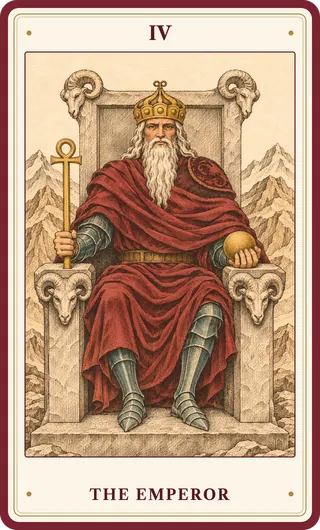
The stone throne with ram heads
The throne is carved from solid stone and topped with rams, the animal of Aries and Mars. Reversed, it shows power that has turned hard and unmovable, or a seat that nobody is willing to fill.
The ankh scepter
In his right hand the Emperor holds an ankh, an ancient symbol of life and authority. Reversed, it points to power used to dominate life rather than protect it.
The golden orb
The orb in his left hand stands for the world he governs and his responsibility for it. Reversed, it warns of someone gripping the world too tightly or dropping it.
The red robe
Red is the colour of Mars, will and action. Reversed, it can show anger, aggression and a temper that rules the room.
The armour beneath the robe
He wears armour under his robes, a sign that he is ready to defend what he has built. Reversed, it becomes emotional shutdown, a man who cannot be reached.
The barren mountains
Behind the throne the land is dry and rocky, with a small stream of water. Reversed, it suggests rigidity that leaves no room for growth, warmth or feeling.
The white beard and crown
His long white beard shows age, experience and earned authority. Reversed, it can mean outdated thinking, rules that no longer fit, or authority that has not been earned.
Family, fathers and the inner authority
Because the Emperor is the main father archetype of the tarot, the reversed card often brings up father issues. It may reflect a father who was harsh, absent, unpredictable or impossible to please, and how that shaped your sense of authority. It can show how you still react to rules, bosses or any man who sounds sure of himself.
It also points inward. We each carry an inner authority: the part that sets limits, makes decisions and follows through. If your inner Emperor is a bully, you may be harsh and perfectionistic with yourself. If he is absent, you may struggle to organise your life or say no. Neither is a character flaw. Both are patterns that can be changed once you spot them.
In spiritual terms, the reversed card asks you to look at the beliefs and rules you inherited and test whether you actually hold them. Some deserve to stay. Others were just handed to you.
Is the Emperor reversed a yes or no?
Usually the answer is no, or not yet. The upright Emperor says yes to anything that needs structure, planning and steady effort. Reversed, it suggests that the discipline, authority or support you need is not in place, or that someone’s control is blocking the way. A plan that depends on rigid rules or a strict authority may stall.
There are exceptions. If your question is whether you can get free of someone controlling, or break out of a rigid system, the reversed Emperor can be a quiet yes: the structure is weakening. Context decides. For a full read on the card as a quick answer, see the Emperor as a yes or no answer.
Is the reversed Emperor always negative?
No. Reversed cards are not simply bad versions of upright cards. Sometimes the reversed Emperor means a situation is easing: a rigid authority is losing its grip, or you are finally questioning rules that have held you back. It can mean a healthy move away from over-control.
It can also mean the energy is blocked or internal rather than hostile. You may have the strength to lead but are holding it back. You may have a plan that has not yet taken form. If you want a general approach to reversals, the guide to reversed tarot cards explains the main ways to read them, and the same logic applies here: blocked, excessive, or turned inward.
The sister card on the feminine side is worth comparing. The Empress reversed deals with nurturing gone wrong in a similar way, smothering or neglecting, as the Emperor does with authority.
What to do when the Emperor is reversed
The first step is to decide which way you have tipped. Ask yourself two questions: where am I being too controlling or too rigid, and where am I avoiding structure or responsibility? The answer often arrives quickly, and it is usually in one specific area of life, not everything.
Then act in proportion. If you are the tyrant, try to share decisions, listen before you answer and let others do things their own way. If you are the abdicator, make a plan, set a boundary, and finish one task you have been putting off. If someone else is the tyrant, name the behaviour calmly, set clear limits and keep records where work is involved.
Some situations call for more than adjustment. If someone’s control feels frightening, includes threats, isolation or checking on where you go, that is not a tarot lesson but a safety matter, and talking to someone you trust or a support service is the right step.
Emperor reversed with other cards
Pairings sharpen the message. With the Devil, control may have turned into something heavy and hard to leave. With the Tower, a rigid structure is about to come down. With the Magician, watch for charm used to manipulate. With Justice, the question becomes fairness: are the rules being applied evenly?
With cards of the Empress or Queens, the balance between firm structure and warmth is in play. With the Ace of Wands or Knight of Wands, you may have energy and ideas but no plan to carry them. With Pentacles cards, the issue is likely practical: money, work or home.
You can test combinations with the tarot card combination calculator, but the best guide is always the question you asked and how the cards sit next to each other.
Reading the Emperor reversed by position
In a past position, the reversed Emperor can point to a controlling parent, a rigid upbringing or a time when you gave away your power. In the present, it describes the current struggle with authority or discipline. In the future, it warns that a power conflict or a loss of structure is coming unless you act.
As an outcome, it suggests the situation may end in a standoff or a collapse of order if nobody shifts. As advice, it tells you to examine how you lead and how you follow. In a Celtic Cross, notice whether it sits in the position of challenge, the hopes, or the external influences, because that tells you whether the issue is yours or someone else’s. The Celtic Cross guide explains each position.
Try this: Pull the Emperor reversed on its own and write two lists: places where you hold on too tightly, and places where you avoid taking charge. Circle one item from each list and take one small action on both this week.
Final thoughts on the Emperor reversed
The reversed Emperor is not a prophecy of tyranny. It is an honest look at power: who has it, who is avoiding it, and whether it is being used to build or to control. The best response is rarely to rebel for the sake of it or to clamp down harder. It is to find the middle, where there is enough structure to feel safe and enough room to breathe.
If the card surprised you, sit with it for a day before deciding which face it showed. Then act on the smallest piece you can control. For more ideas on how to read a whole spread, see how to read tarot.
Questions readers ask
What does the Emperor reversed mean in tarot?
The Emperor reversed means authority and structure have gone out of balance. It points either to someone who controls too much (a tyrant) or to a lack of discipline and leadership (an abdicator), in you or around you.
Is the Emperor reversed a bad card?
It is a warning more than a verdict. It shows where control, rules or discipline have stopped working, and it usually comes with a clear fix: loosen up, build structure, or stand up to someone.
What does the Emperor reversed mean in love?
In love it usually describes a power imbalance. One partner may be too controlling or emotionally closed, or someone may be avoiding commitment and responsibility. In a new romance it can mean the foundations are not yet solid.
Does the Emperor reversed mean a man or a father figure?
Often it points to a male authority figure such as a father, boss or partner, but it does not have to. The Emperor is an energy of authority and structure that anyone can express, including you.
Is the Emperor reversed a yes or no?
Usually no, or not yet. Plans that depend on strict control, solid structure or official approval are likely to hit obstacles until the discipline or the flexibility needed is in place.
How do I fix the energy of the Emperor reversed?
First work out which direction you have tipped: too much control or too little. Then act on it, either by easing demands and sharing decisions, or by setting a clear schedule, boundaries and a plan you actually follow.